Daily insights for city builders, delivered every morning at 6 AM ET. I’m Brandon Donnelly — a Toronto-based real estate developer and founder of Globizen. I’ve been writing here since 2013.

Tag: spain

  • Standard elements in non-standard ways

    A few people have now sent me this TED talk by architect Débora Mesa Molina. But I watched it for the first time today. I guess my personal brand is pretty closely associated with architecture and design.

    In it, she talks about her firm’s approach to using overlooked and/or standard building materials in unconventional ways. For example, here, she used stacked precast beams to assemble a house in Madrid (c.2008). The entire structure came together in only 7 days.

    My first reaction is that I like the idea and approach — which is really quite interesting — more than the final designs. I am also curious if there were any cost savings as a result of using “standard” materials. What are your thoughts?

  • Personalizing outdoor spaces on multi-family buildings

    I am still making my way through (and editing) my photos from Lisbon and Malaga. Here is one that I took from the Playa de La Malagueta. I also posted it to Twitter and Instagram and asked: Should we encourage the personalization and customization of outdoor spaces on multi-family buildings?

    This building overlooks the beach and the Alboran Sea. If you look closely, you’ll see that a number of the balconies have been modified to include different kinds of awnings and shade structures. And some look to have been converted to interior space.

    A few of you seem to support this level of customization, provided that the overall design integrity of the building is maintained. And I would agree that in this particular instance, it seems to work, which is actually why I took the photo. It gives the facade life.

    I recall seeing instances of this in Toronto, but generally speaking it’s not encouraged or allowed. In condominiums, outdoor spaces attached to units are typically defined as “exclusive-use common elements.”

    The challenge, here, lies in the subjectivity of “maintaining the overall design intent of the building.” I’m not sure how you codify that, unless you pre-design the options. Perhaps that’s one way of doing it.

  • The Information Age: Tech & the S&P 500

    The below chart from this morning’s Wall Street Journal is perhaps a good example of our ongoing transformation from an industrial economy to an information economy. Just four stocks — namely Microsoft, Apple, Amazon, and Facebook — have accounted for 19% of the S&P 500’s total return this year. All of them are “tech.”

    And this is not new to 2019. Similar contributions were made by tech last year and in 2018. I have been used to hearing about the 4 horsemen of tech. But apparently there’s even now something called the “FAANG stocks,” which refers to Facebook, Amazon, Apple, Netflix, and Google (Alphabet).

    This shift is, of course, one of the reasons why every city is trying to establish a strong tech ecosystem. I saw that first-hand in Lisbon this past week. And frankly I think the city has many of the same characteristics that made Berlin a great place for tech. It’s affordable. It’s filled with young and smart people. And it’s a fun place to be.

    There’s a reason that Lisbon now hosts the annual Web Summit, which is generally considered to be the largest tech conference in the world. (The North American offshoot, called Collision, relocated to Toronto this year in order to be in a more global city.)

    Portugal only has a population of about 10 million people. There are some 3 million people in the metropolitan area of Lisbon. But that doesn’t really matter because most startups today are immediately targeting a global customer base.

    I learned more about Portugal and Spain’s colonial pasts on this trip and I found it fascinating. In many ways, it was the start of globalization. But that was the Age of Discovery. Those centuries are over and done with. Our century is the Information Age. The above chart is part of that story.

  • Sunset in Malaga

    Here are a few photos from last night’s sunset here in Malaga. (All unedited and straight from my iPhone.) It was one of the most beautiful sunsets that I have ever seen and seemed to go on for hours. But of course, the photos don’t come close to doing it justice.

  • Out of office: Malaga

    The above photo was taken on a walk up to the Castillo de Gibralfaro in Malaga, Spain. It was built by the Moors during their occupation of the Iberian Peninsula in the Middle Ages.

    It is located on Mount Gibralfaro (~130m up) in the center of the city, overlooking the historic core, the waterfront, and its lower elevation sibling — the Alcazaba (or citadel).

    In the Middle Ages, this is what it meant for a city to be defensible. High ground. Formidable double walls. And places to shoot from.

    Thankfully, today, I think one could easily argue that “urban defensibility” tends to instead rely on things like knowledge, innovation, and diversity.

    Here are a couple of photos from inside the fortress. It is always amazing to see what labor was able to build without the technologies that we have today.

    Portions of it were built using a very elegant and elongated brick. Above is the bar area at the top. Presumably this was a later addition, though, supposedly the Moors did make and sell wine from the Andalucia region.

    If you ever find yourself in Malaga, this complex is a must visit.

  • The challenges of the metropolis beyond Habitat III

    This morning I woke up to an email from the Urban Ecology Agency of Barcelona. They are a public consortium dedicated to urban sustainability and made up of the City Council of Barcelona, the Municipal Council and Metropolitan Area of Barcelona, and the Barcelona Provincial Council. The email was about this upcoming “urban congress” taking place in Barcelona from May 22-24:

    Sadly, I have no plans to be in Barcelona next month. But if any of you are based or traveling there, the conference is all about the future challenges that cities will face and about contributing to the new urban agenda. The main topics are: sustainability, city planning, social cohesion, and competitiveness. 

    Habitat III – which is in the title of the conference – was a United Nations conference on housing and sustainable urbanization. It took place in Quito, Ecuador in October 2016. However, it forms part of a much larger framework around sustainable global development. More info here.

    Barcelona is also one of my favorite cities, so I am happy to share this one with all of you. If you’d like to register for Post-Habitat III, head over here.

  • One lease for the world

    image

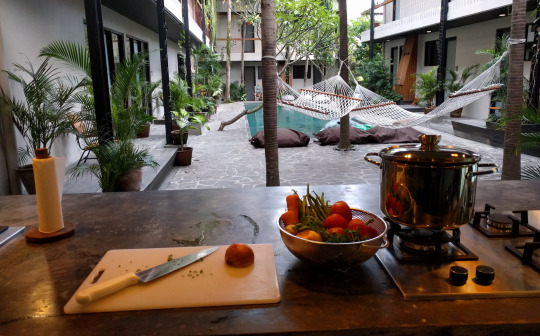
    If you’re looking for more evidence that the way we live and work is changing, then check out a new startup called Roam. They describe themselves as an international network of communal spaces. So far, they have locations in Ubud (Bali), Miami, and Madrid. Buenos Aires and London are coming soon.

    The way it works is that you start by signing a lease for either a week or a month. You get a private room and bathroom, but everything else, from the co-working spaces to the kitchens, are shared amongst the community. Like other co-working and co-living environments, the community they build is critical.

    However, what really differentiates Roam is that you can sign one lease and then live all over the world, freely traveling across their properties. All of the locations are offered up at the same price and you can stay for as long as you’d like.

    In my line of work, I don’t have the flexibility of living like a global nomad. But today, there are many people who can. And I also know that there are many people who would prefer to live like this. It’s liberating in so many ways.

    My friend and I actually had a similar idea to this back in University and we spent some time working on it. At the time, and this was over a decade ago, we felt that there was a segment of people who increasingly wanted to live like global citizens. I still believe that to be true and, clearly, so do others.

    To date, Roam has raised $3.4 million in funding.

    Image: Ubud kitchen via Roam

  • Barcelona’s new superblocks

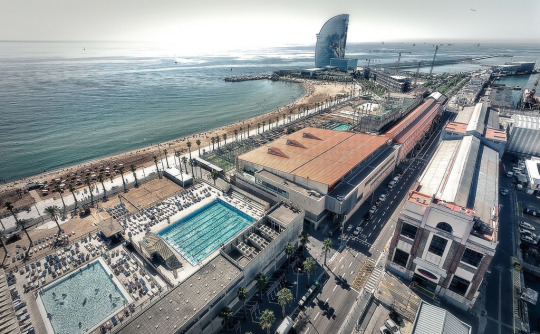
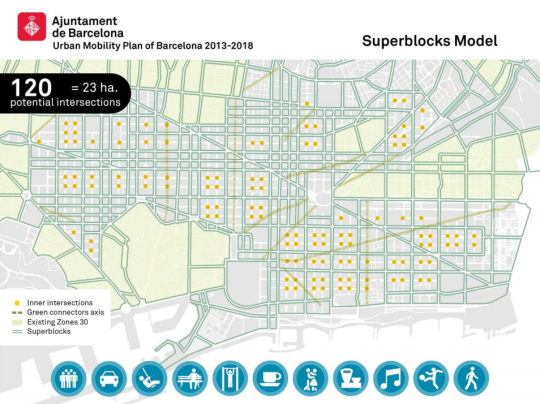
    Barcelona is in the midst of dramatically rethinking its urban fabric to address issues around urban mobility and climate change. Initially laid out in this 2014 Urban Mobility Plan for Barcelona, the city is now implementing something it calls superilles (or superblocks in English).

    Here’s what it looks like:

    The idea is to concentrate transit and vehicular traffic onto the edge of these new superblocks and then convert the interiors into livable spaces for pedestrians and cyclists. Here’s a description from the Agència d’Ecologia Urbana de Barcelona:

    “Superblocks are made up of a grid of basic roads forming a polygon, some 400 by 400 meters, with both interior and exterior components. The interior (intervía) is closed to motorized vehicles and above ground parking, and gives preference to pedestrian traffic in the public space. Though the inner streets are generally reserved for pedestrians, they can be used by residential traffic, services, emergency vehicles, and loading/unloading vehicles under special circumstances. The perimeter, or exterior, of Superblocks is where motorized traffic circulates, and makes up the basic roads.”

    The result is going to be an absolutely radical shift in the amount of public space given to drivers, pedestrians, and cyclists. When their 2014 report was issued, it was estimated that 73% of public space was allocated to cars (versus pedestrians). This plan will completely flip that ratio. With the superblock model, it is estimated that 77% of public space will now be allocated to pedestrians.

    Here’s what that is expected to look like…

    Before:

    After:

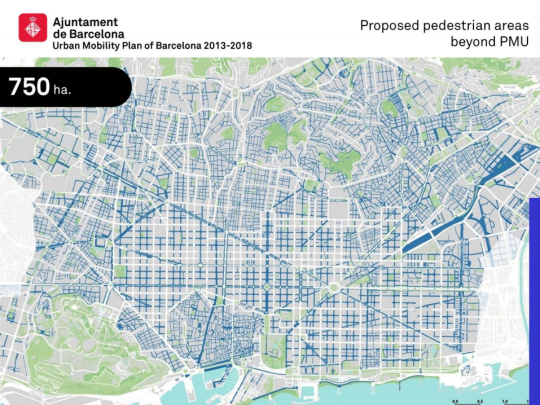
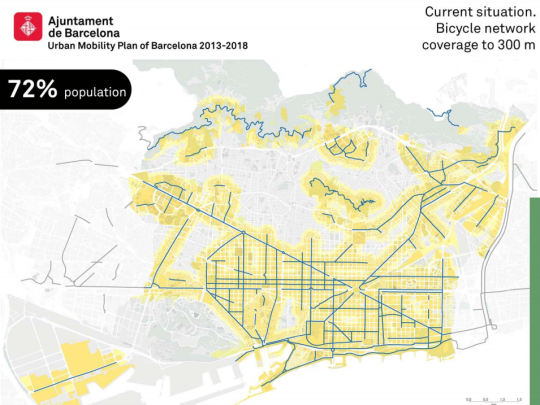
    There are also plans to expand the bicycle network to roughly 95% of the city’s population.

    Before:

    After:

    If any of you are from Barcelona, I would love to hear a local perspective on this mobility plan. Were and are there cries of a war on the car?

    Images: Top image from Tom Walk (Flickr); Maps from Urban Mobility Plan of Barcelona 2013-2018

  • A Spanish social media town

    I am a big fan of Twitter.

    I use it more than any other social network and any other app on my phone (according to my battery usage). In fact, I’m such a fan that I recently started buying shares. I don’t own a lot and the Canadian-US exchange is awful right now, but I do plan to continue buying (I like dollar cost averaging).

    Twitter isn’t the darling of Wall Street like Facebook is. And I think the biggest weakness of Twitter is that it’s difficult for new users to really “get it.” Facebook solved this problem early on by recognizing that new users had to connect with X number of friends right away so that they received value immediately and the next time they visited.

    But I digress. That’s not the focus of this post.

    This morning a friend shared a Medium article with me that was written by the Laboratory for Social Machines at MIT. The article is about a small town in Spain called Jun (pronounced “hoon”) that has transitioned to using Twitter as the dominant platform for communication between government and citizens.

    The initiative first launched in 2011 and since then the mayor, José Antonio Rodríguez Salas, has been trying to get every resident onto Twitter. All 3,500 residents are even encouraged to go into the town hall to have their Twitter accounts verified. This way government employees know for sure that they’re dealing with an actual resident of the town.

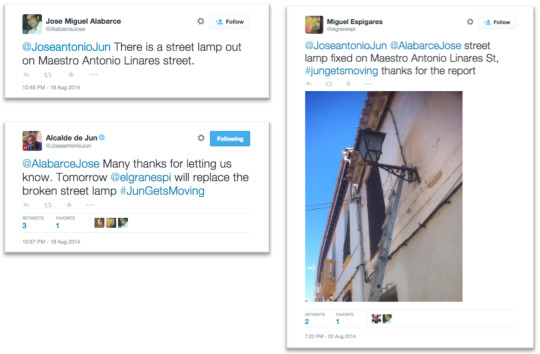
    Here’s a simple example of what this means for government-citizen relations (the folks at MIT translated everything to English):
    image

    In the above example, a citizen tweeted the mayor informing him that a street lamp was out. The mayor then responded, tagged an electrician, and said it would be fixed the following day. Sure enough the electrician went and fixed it the following day, and then tweeted out a photo of the lamp.

    This is great. And Twitter was made for these kinds of interactions. Facebook was not.

    Here in Toronto we have @311Toronto, which I have tweeted many times before with problems and they do respond quickly (far quicker than if you try and call them). But I still think there’s room for us to improve transparency and engagement across the board.

    All of this is a perfect example of how technology and cities are colliding in a big way. In today’s world I really think you need to be able to think across disciplines.

  • #LoveWins in the United States

    https://500px.com/embed.js

    By now, I am sure that all of you know that the U.S. Supreme Court made a landmark ruling yesterday (Friday, June 25, 2015). In a 5-to-4 vote, it was decided that the U.S. Constitution guarantees the right to same-sex marriage.

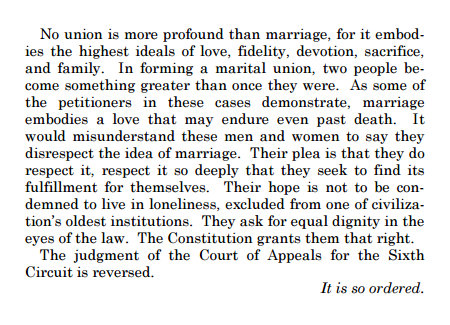
    Here is Justice Anthony Kennedy’s closing paragraph. What a great read.

    image

    With this decision, the United States joins the Netherlands, Belgium, Spain, Canada, Norway, Sweden, and many other countries who already allow same-sex marriages nationwide. And I am delighted to see that happen with Canada’s neighbor.

    I am also proud to say that it has already been a decade (2005) since Canada became the 4th country in the world – and the 1st country outside of Europe – to allow same-sex marriages. Not because it had a direct impact on my life, but because it is the right thing to do.

    It is the right thing to do because it creates “equal dignity” among all men and women (as Justice Kennedy states above) and because it’s the right thing to do for our economies.

    I believe that the strongest economies are the ones that can remain open and tolerant to new ideas and all kinds of people. 

    Cities like Toronto and New York (as I’ve argued before) became successful precisely because they opened themselves up to new ideas and new people (immigrants).

    But many studies show that as people age, “openness” declines. We become less intellectually curious and our preference for variety wanes. Perhaps this is where the expression “set in your ways” comes from and why political orientation often correlates with age.

    Thankfully the U.S. wasn’t so set in its ways that it couldn’t provide equal dignity to its citizens.