Daily insights for city builders, delivered every morning at 6 AM ET. I’m Brandon Donnelly — a Toronto-based real estate developer and founder of Globizen. I’ve been writing here since 2013.

Tag: snapchat

  • My predictions for 2022

    As promised, below is a list of some of my predictions for this coming year. I have tried to be both punchier and more precise in my prognostications; because, well, obvious predictions are boring and precision will allow me to better evaluate my thinking at the end of the year. So here goes.

    1. 2022 will be the year that COVID-19 becomes endemic and finally fizzles out to a point where it no longer factors into our decision making in the same way that it has for most people over the last two years or so. I think this will happen by as early as the summer.
    2. As a result, I think the majority of people will be back in their offices by this September at the very latest, with many coming back much earlier. The whole hybrid/flexible work thing won’t completely disappear, but the majority of people who used to work in offices will be back.
    3. Recreational/fringe residential real estate will soften in 2022 as a result of 1) its tremendous run-up during this pandemic and 2) the renewed pull of urban/office life. Conversely, urban apartment rents will continue to rise and eventually surpass their pre-COVID levels. The SF Bay Area could be one exception.
    4. The explosion of travel that I thought was going to happen in 2021, will truly happen this year. The summer will mark its official return, with European travel volumes (to give just one example) returning to their pre-COVID levels.
    5. We will see meaningful efforts to further breakdown the hegemony of single-family zoning throughout many North American cities. This has been building for a number of years and I think we will see some tipping point-like moments in 2022. Specifically, expanded permissions for multi-unit housing and greater densities.
    6. I wish I could say that autonomous vehicles are destined to do something truly remarkable this year, but I think we are still a few years out (2024-2025?) before a large chunk of us are ride-hailing AVs. But on a related note, I do think that Uber will come into its own this year and finally become profitable (and not just with adjusted profits).
    7. Public transit ridership will, unfortunately, remain depressed and below its pre-COVID levels for this entire year. The beneficiaries of this will continue to be cars (not good), bikes, and micro-mobility solutions like e-scooters.
    8. 2021 was a huge year for NFTs and other fun stuff like digital fashion. Given these trends, I believe there will be growing demand from people to better integrate their digital and physical lives through technologies like augmented reality. Snap has been at the forefront of this space for many years and 2022 will be an important year for its Spectacles (AR glasses). But Apple and others will also make major announcements.
    9. Miami’s ascent as an important tech hub will get interrupted by questions surrounding the climate crisis and its own resilience. At the time of writing this post, the price of carbon on the EU’s Emissions Trading System (EU ETS) is about €80 per tonne. I think we will see it break €125 per tonne this year, and possibly go even higher.
    10. Ethereum, Bitcoin, and Solana (in this order) will be the top three cryptocurrencies according to market cap by the end of the year. At the time of writing this post, their market caps are $446 billion, $895 billion, and $55 billion, respectively. I am also expecting some breakout web3 consumer applications that will push, maybe, 40% of Canadians and Americans into the crypto space.


    Photo by Dave Xu on Unsplash

  • Offline and online

    I was out for dinner this week with a group of real estate developers. And as you might expect, we spent the majority of the time talking about real estate and complaining about how long things take. But a good chunk of time was also spent pontificating about the world of crypto. That’s what happens these days. In fact, one of my friends joked that my/this blog used to be a real estate and cities blog, but now it’s a crypto blog. It’s a joke, but I guess it’s becoming partially true.

    For as long as I can remember, I have always been interested in what’s new and what’s next. And I think this is next. So I’m reading, playing, thinking, and writing about it. And the more I do these things, the more my conviction grows. But what really did it for me was the hands-on playing around part. I’m not interested in owning a crypto ETF (the US is about to get its first bitcoin ETF based on futures contracts). I want to own the cryptocurrencies directly so I can see what they can do and how everything works. (Though I will say that this space is still not very user friendly.)

    One of the things that comes to mind as I continue to play is the future interrelationship between our offline and online worlds. Because already we are living in a world where people now buy and collect rent on virtual real estate in places like Decentraland (REITs are even starting to emerge). Where parties happen online instead of offline (but still attract big name DJs). Where people buy digital fashion instead of physical fashion, and pay just as much for it and sometimes even more. And where augmented reality is changing how we experience our cities in real life. A few weeks ago, I came across a park in Paris that had partnered with Snapchat to deliver an AR experience, to give just one example.

    These are meaningful shifts that are gaining traction (and this post is by no means an exhaustive list). And while I remain steadfast in my belief that cities are profoundly resilient and real-world experiences are irreplaceable, I do believe that our emerging digital worlds are going to have an impact on how we design and build our cities going forward. From art murals of NFTs to entire new virtual worlds, this is an exciting time for cities and technology.

    Enjoy the weekend.

  • First ever virtual shoe try-on activation

    Earlier this month Snapchat announced the acquisition of Vertebrae, which is a 50-person company that allows brands to create and manage 3D versions of their products. Why does this potentially matter? Because Snapchat is already doing stuff like this:

    (If you can’t see the embedded video, click here.)

    This was a recent partnership with Gucci that Snapchat is calling the first ever “virtual shoe try-on activation.” The way it worked for the nearly 19 million people that it reached was pretty simple. Point the Snapchat camera at your feet. Try on a bunch of new Gucci shoes. Buy by tapping “shop now.”

    As we all consider what it will mean to go shopping in the future — and what kind of real estate will be most valuable — this kind of innovation strikes me as being a very big deal.

  • Our ambient computing future

    I noticed this week that Google has started to overlay augmented reality-type place markers onto Street View. The markers are designed to help surface the kind of local business information that you might otherwise find in search — phone number, hours of operation, and so on. Apparently not everyone is seeing them, but the feature is starting to roll out in certain cities. Above is a photo of Dundas Street West in the Junction.

    This transforms Street View into even more of a wayfinding tool, but it also offers up a glimpse of how the world might look with augmented reality. But to make this ultimately happen, you really do need to figure out how to get people to start wearing smart glasses. Lots of companies, including Google and Snap, have been trying. None of their products have really stuck — though Snap’s Spectacles are easily the best looking ones.

    However, last month Google did announce that it had acquired Canadian smart glasses company, North. I was invited to try out a pair of North Focals 1.0 glasses, which I wrote about over here. They were exceedingly cool, but definitely not ready for mainstream and daily usage. The sides were thick and you had to wear a ring joystick in order to navigate through its menus. Too much work. Too nerdy.

    But that’s okay because Google didn’t buy North for the Focals product. They bought them for talent, patents, and for probably a bunch of other things. They bought them to help Google invest in its “hardware efforts and ambient computing future.” The little markers you might now be seeing on Google Street View are likely part of that.

  • Shoppable AR

    I don’t think Snapchat is on a lot of people’s radars these days. (Though it did recently become worth more than Twitter.) But every time I hear about what they’re building I can’t help but think, “Wow, that’s really cleaver and creative. I see a longer-term vision at work here. And if it all works out, this could be something very special.”

    This past week it was announced that the company is going long on something they call shoppable AR (augmented reality). Already, more than 170 million of its users engage with its AR features on a daily basis. Shoppable AR is an extension of that and will allow people to do things like try on clothes, similar to the way people currently apply selfie filters. Obviously this could be a boon to online shopping.

    They’re also continuing to develop something called “Scan,” which allows people to scan a logo or barcode and trigger a specific AR experience related to a product they may be thinking about buying. It doesn’t take much to think about how some of this functionality could be applied to specific industries, such as real estate.

    But will all of this fuel growth for the company? Or will Facebook simply steal the idea if or when it catches on?

  • My Focals by North fitting

    Over the weekend I went by the new North store on Ossington for the fitting of my new Focals by North glasses. According to Retail Insider, this is the first retail space in Canada that is entirely dedicated to wearable tech (shout-out to Hullmark and CBRE). Full disclosure: I am not being paid by North, but I was asked if I would accept a pair of Focals and provide my thoughts. So I will be doing that over the coming months on the blog.

    Previously known as Thalmic Labs, North is a Waterloo-based company that first attracted attention with the launch of a gesture-control armband known as Myo. What that product did was make digital interactions completely hands-free. It had strong use cases across medicine, music, and business. However, this past October the company announced that it would be moving on from Myo. Enter Focals by North. 

    Focals are custom-built eyewear with an integrated display that only the wearer can see. It is similar to, for example, BMW’s heads up display, and the idea is that it is a way for you to quickly get the information you want, without pulling out your phone and disengaging from the world. The ambition is human-centric technology that integrates seamlessly.

    Here is an example of what that display looks like (it is much better and cooler in person):

    image

    To control the display you use both your voice (the glasses have a microphone) and a 4-directional joystick called a Loop, which sits on your index finger like a ring and that you thumb. You can receive and send texts (voice to text), you can get turn-by-turn directions, you can view your appointments and the weather, and you can ask Alexa things.

    The first step in the ordering process is a fitting. And that’s what I did over the weekend. The glasses are all custom made and so they start by doing a full 3D scan of your head in a room that feels like the future. Once that’s done, you pick what frame you want, the color, and your sun clips (an essential accessory for day drinking in Trinity Bellwoods). Total cost: CAD 1,299.

    While exceptionally cool, it is premature for me to really comment on the tech at this point. I’m expecting my Focals in 8-10 weeks. But is it interesting to opine on the current state of eyewear tech.

    Most people believe that the problem with Google Glass was the fact that you had to be a Silicon Valley nerd in order to want to wear them out in public. They looked and continue to look ridiculous, which is why Snap went fashion first with their Spectacles. I have always found this product really intriguing. I want to use it. But I’ve stopped using Snapchat entirely and I don’t really have a strong use case for them.

    Snap’s Spectacles are about capture and content creation, whereas Focals are about discreetly feeding you information that you would otherwise have to pull out your phone (or watch) to view. There’s no camera on Focals. That’s not what they are about. But they are obviously fashion first.

    The question for me is whether the experience will truly be seamless and integrated, or if I’ll still be disengaged – gazing off into my glasses (space) while I ask Alexa to UberEats me a chicken shawarma wrap. I’ll let you know in about 8-10 weeks. If you’re looking for more on Focals by North, check out their website and this CNBC piece. Go Canadian tech.

  • Would it be insider trading if Kylie Jenner traded on her tweets?

    Lately I have really gotten into Matt Levine’s daily newsletter about “Wall Street, finance, companies and other stuff.” Maybe that’s how I should describe this blog: Cities, real estate, design, and other stuff.

    If you aren’t familiar with Matt’s writing, here is an article that he wrote about Kylie Jenner’s recent tweet concerning Snapchat. You know, the one that wiped out $1.3 billion of market value because she revealed – using only 88 characters, I might add – that she was no longer using the app.

    https://platform.twitter.com/widgets.js

    The article was spurred on by this question:

    “Would it be insider trading for Kylie Jenner to buy short term out of money put options on Snap and tweet out that she’s no longer using Snap?”

    And this is the start of his answer:

    Insider trading, as I am constantly saying around here, is not about fairness; it is about theft. It is not illegal to trade on your own nonpublic knowledge of your own intentions. Warren Buffett can buy stocks before he announces that he’s bought them, even though that announcement will predictably make the stocks go up. 

    If I did describe this daily blog like Matt describes his daily newsletter, this post would clearly fall into the “other stuff” camp. But maybe you too will find it interesting. If you do, you can subscribe here

  • Google and Facebook show

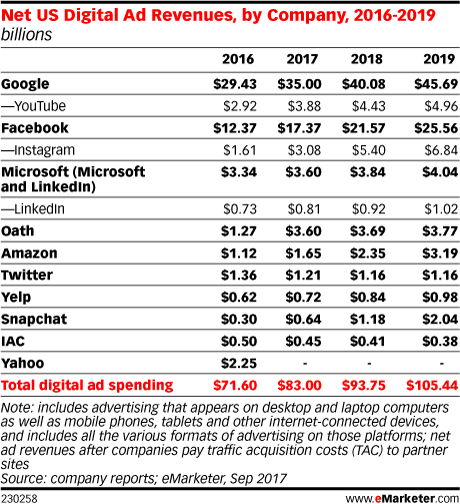
    This morning Fred Wilson posted this chart on his blog:

    image

    What is clear is that when it comes to US digital ad revenue, it’s the Google and Facebook show, followed by everyone else. Microsoft/LinkedIn is a distant third. Fred calls it “the digital advertising duopoly.” And his view is that the tech industry needs to figure out new approaches to monetization that still allow free content to be consumed. 

    I’ve said this before, but Facebook buying Instagram for $1 billion seems like a bargain when you look at a chart like this and you see what they were able to do with the platform. Instagram’s 2018 revenues are projected to be bigger than every other company on the list minus Google but including YouTube.

    Also notable are the flatlining of Twitter and the projected growth of Snapchat. 2017 was a rough year for $SNAP. But it appears that somebody believes they’ll be able to turn things around with their app redesign and reconstituted ad platform. Be that as it may, it’s still the Google and Facebook show – at least for the time being.

  • People you may know

    If you’ve ever wondered how Facebook figures out all of the people you may know, here is some reading material. 

    The short answer is that Facebook doesn’t just know the things you’ve told it about yourself, it also knows what other people have told it about you. 

    One of the ways in which this is done is through its so called “shadow profiles". These are profiles that get created when other people share information about you with Facebook. 

    For example, you may not want to share your work email address with Facebook, but if it’s sitting in someone’s phone and that person decides to share his/her address book with Facebook, then it could show up in your shadow profile.

    And if there’s a common data point, such a phone number, then Facebook can fairly easily link that work email address back to you and start suggesting people from your work that you may know.

    The scary part, of course, is that Facebook is getting your information without you explicitly sharing it with them. It could be coming from that person you gave your business card to at the bar.

    It goes to show you just how fierce the competition is for our attention. It may be an assault on our privacy, but more Facebook connections means a higher likelihood that we’ll stay engaged on the platform.

    Over the past year I have been growing increasingly intolerant of this demand for my time. Slowly but surely I have been turning off all nonessential notifications on my phone. 

    Very few now remain, which is why if you’ve been trying to reach me on Facebook, WhatsApp, LinkedIn or some other platform, and I’m not responding, it’s because there’s a good chance I’m not seeing the notifications.

    And let me tell, it feels liberating.

  • Crowd Surf

    When Snap Inc. announced its Q2 financial results earlier this month, it reported 173 million daily active users – an increase of 21% year-over-year. But this fell short of what was expected. Analysts were expecting 175.2 million DAUs

    (Snap defines a DAU as anyone who opens the Snapchat app during a defined 24 hour period.)

    Regardless of your position on this stock, one thing is clear about the company: they are very creative and they continue to innovate.

    The company is currently testing a new feature called “Crowd Surf.” What it does is automatically stitch together related Snapchat Stories from the same location to form seamless videos. 

    It made its debut at a concert in San Francisco. The real magic is how Crowd Surf was able to assemble a continuous audio track using an assortment of 10-second Snapchat Stories, all taken from different locations at the concert and all from different users.

    Click here and scroll down for a preview video.

    To accomplish all of this, Snap takes a “sound print” of the audio playing in a particular location from people’s Stories. It then filters each of the clips so they sound more alike and autogenerates a stitched together video.

    You obviously need a critical mass of users and content for this to work, which is why the feature was introduced at a concert. But it’s certainly a remarkable way of creating valuable content from decentralized user inputs.

    I guess the only question is: How long until Instagram copies this?

    Photo by Yvette de Wit on Unsplash