
Toronto started allowing sixplexes as-of-right across 9 wards last summer. Since then (and according to the Toronto Star), the city received 60 permit applications, more than half of which also included a garden or laneway suite (so 7 homes total). Our project at 571 Oakwood Avenue should be on the below map, but I don’t have access to the paywalled article to take a closer look:
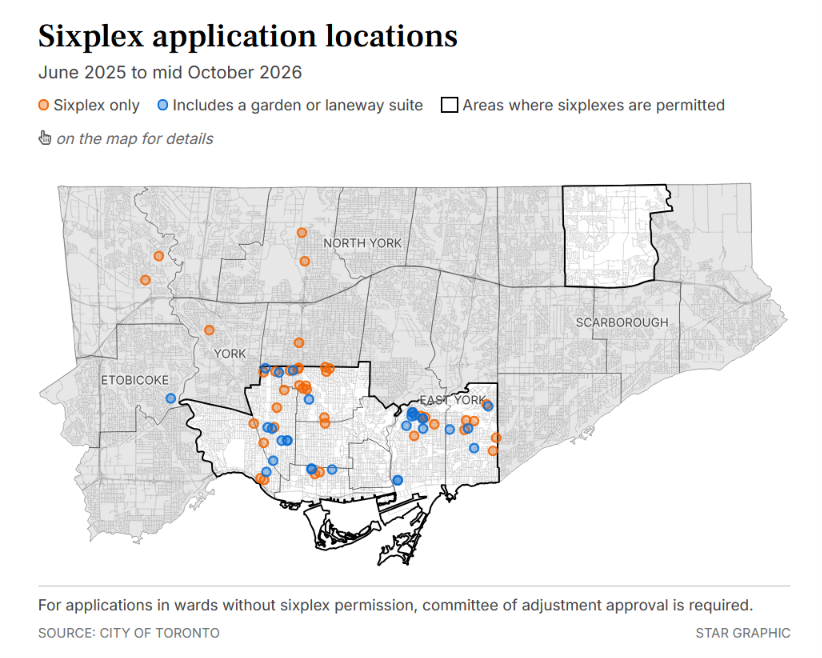
If we assume that 30 of the applications included 7 homes and the remaining 30 only had 6 homes, that’s a total of 390 homes, most of which were permitted as-of-right for the 16-month period between June 2025 and October 2026. Annualized, let’s call this 300 homes in the first year.
What is obvious is that, for a city of 3 million people, this isn’t nearly enough. But we also know that it takes time for the market to respond to new policy changes and that we will certainly see an increase next year.
In my view, if we saw a few thousand new homes delivered this way each year, it would be a policy success. So let’s say that we need to 10x the number of homes, which would mean bringing the annual project count from ~45 to 450.
This feels doable, though it does remain to be seen how well this model will work in the inner suburbs. It’s worth noting that the one ward in Scarborough that currently permits sixplexes has yet to see an application according to this dataset.
The big barrier is likely parking. Most of these infill projects are being built with none of it, and that means they’re only really feasible from a market perspective in areas that are walkable and have acceptable levels of transit.
Even still, it’s not inconceivable to think that we could increase the annual application count to a few hundred. And this would be meaningful because it’s the most cost-effective way to deliver new infill housing. Single-family homes are obviously more expensive to build, and so too are higher-density concrete buildings.
Add in six-storey buildings along the city’s major streets, and suddenly you’ve got missing-middle housing making a real contribution to Toronto’s housing needs.
