Daily insights for city builders, delivered every morning at 6 AM ET. I’m Brandon Donnelly — a Toronto-based real estate developer and founder of Globizen. I’ve been writing here since 2013.
The City of Victoria, BC did a good thing last week: It passed its “Missing Middle Housing Initiative“, which means that up 6 dwelling units (their language not mine) will soon be permissible on every single-family lot in the city, and up to 12 dwelling units will be permissible in “corner townhouses”. These land uses changes come into effect on Sunday, March 12, 2023 (45 days after adoption).
Here on the blog, we’ve been talking about this shift toward intensifying our single-family neighborhoods for many years. And momentum clearly continues to grow. At face value, this appears to be one of the more enlightened moves by a city: 6 homes and 12 homes. Though these headline numbers may have something to do with the average lot sizes in Victoria. Either way, the devil is in the details. And here are some of those details:
What is positive to see is that a number of other zoning requirements have been updated. Because it’s not enough to just say, “Hey, we’re going to allow more homes on each lot. There, we’ve done something. Developers, go and do that.” Here, the allowable height has been increased, setbacks have been decreased, and the floor space ratio (site density) has been increased from 0.5 to 1.1 (assuming you do at least one amenity contribution).
I don’t know if this is exactly right and if it’s everything that developers will need in order to start building a lot more missing middle housing in Victoria. (If you’re a local developer, please let me know in the comment section below.) But I think it’s certainly a step in the right direction.
Between 2016 and 2021, and according to this recent report from Statistics Canada, the population of the Toronto CMA (Census Metropolitan Area) grew by over 274k people:
The population of the Montréal CMA grew by nearly 188k people:
And the population of the Vancouver CMA grew by over 179k people:
These are the three largest CMAs in the country and they, not surprisingly, also have the three largest “downtowns.” As of the spring of 2021, the most populated downtowns were as follows: Toronto (275,931 people), Vancouver (121,932 people), Montréal (109,509), Ottawa (67,169 people), and Edmonton (55,387).
In this exercise, Statistics Canada breaks down each CMA into 5 categories, which are generally based on two things: (1) your typical monocentric city model (downtown in the middle with a declining gradient of surrounding sprawl) and (2) how long it takes to commute — by car during non-rush hours — from downtown to the surrounding areas.
The good news in all of this is that Canada’s downtowns seem to be doing just fine. Broadly speaking, they are growing at a faster rate than their respective CMAs and growing at 2x the rate of the previous census cycle. Halifax’s downtown grew at 26.1% from 2016 to 2021 and Calgary grew at 21%, to give two more examples. So I think you can safely ignore what you may have heard about a pandemic exodus. Those people are now returning from the country after realizing that there aren’t any pretentious coffee shops and expensive butcher shops.
But something else is also going on in Canada’s largest urban centers. The concurrent trend is continued urban sprawl. The biggest downtowns are growing quickly, but so are the distant suburbs (30 minutes or more from downtown). And they are growing at a faster rate than everything in between. This is not entirely surprising, but it is obviously concerning from a climate change perspective and because it suggests that people are being forced to do the old “drive until you qualify” thing.
These two phenomena are the most pronounced in the Toronto CMA. If you scroll back up to the top of this post, you’ll see that downtown absorbed a decent chunk of the population growth (about 14%), particularly considering its small footprint. But then if you look at the distant suburbs (the mustard color), you’ll see that it’s where 72% of new entrants went!
The question I like to ask with all of this is, “are people choosing to move to the distant suburbs because that’s the housing and location that they truly want, or are people choosing it because it’s all they can afford?” There is an argument out there that sprawl is a natural market outcome and that we shouldn’t be forcing people to live in higher-density housing. And I am certainly sympathetic to giving people as much choice as possible.
But how much choice are we really giving people in our biggest cities? We have figured out how to intensify our downtowns through mid- and high-rise development. And evidenced by the growth rates, many people are enjoying this form of housing and the kind of urban lifestyle that comes along with it. But if it happens to not work for you, our current solution is, “either be rich so you can remain close to downtown or go for a drive.”
What is clear from this latest census data is that we haven’t yet figured out the in-between. The missing middle is still missing. And that’s because we have clear mechanisms in place to more or less ensure this is the case: (1) We restrict meaningful growth from taking place in our single-family neighbourhoods and (2) we have made a habit out of shifting some of the incumbent tax burden to new entrants through things like development charges.
Overall, it’s a devilishly clever system where two things happen: “Sorry, you can’t build that kind of housing here. Build it somewhere else. By the way, I’d like to keep my property taxes as low as possible, so not only do I not what you close to me, but I’d also like you to help pay for some things. Cool?” This is the arrangement that we are seeing playing out in these charts. It can be easy to ignore, but it’s there.
The headline, here, is that “the US is running short of land for housing.” But if you read the article, you’ll see that the headline should probably read, “the US has land-use restrictions in place that make it unnecessarily difficult to build enough new housing.” Here’s an excerpt:
Asking prices for homes in these new communities [the exurbs of Tampa] go as high as $900,000, in part because the land underneath is so valuable. That has a lot to do with land-use regulations.
Tampa’s zoning rules prevent developers from building anything larger than a single-family home in much of the city. When officials for Hillsborough County, which includes Tampa, adopted zoning regulations in 1950, they said the measures were necessary to prevent overcrowding and traffic jams and would preserve the neighborhood character, all “with a view to conserving the value of buildings,” according to the regulations.
If all you can build are single-family homes, then you’re going to need a lot more land compared to if you were allowed to build a bit higher and/or a bit denser. But it is a good way to ensure that supply remains somewhat scarce and that one is faithfully “conserving the value of buildings.”
It is, however, worth mentioning that we have invented ways to use land more efficiently. The population density of Hillsborough County is somewhere around 1,200 people per square mile. The population density of Paris, on the other hand, is over 50,000 people per square mile.
This might seem like a fairly benign tweet by Clive Doucet, a former Ottawa City Councillor. I mean, Paris is wonderful. It is livable, walkable, and my favorite city in the world after Toronto. But as I have argued many times before on the blog, there is a tendency to look at Paris’ uniform mid-rise buildings and then incorrectly try and translate it over to a North American (or other) context with opinions that we should simply cap building heights. Because if only we were to do that, then we would be left with our own version of beautiful Paris.
This is false. And you should immediately call bullshit on anyone who suggests this might be the case. It ignores most of what Napoleon III and Haussmann did to Paris in the 19th century, and instead just cherry picks height so that it can be exported back home to oppose tall buildings. If we really and truly want Paris, then it is important to be reminded that, among many other things, the Paris we all love today is the result of:
The annexation of eleven surrounding communities (in order to form the city’s current boundaries)
Mass urban renewal, involving the displacement of some 350,000 people (according to some estimates at the time)
Nearly two decades of large-scale disruptive construction
The demolition of hundreds of old dilapidated buildings (some of which may have even been in a Heritage Conservation District — bad planning joke)
The cutting through of nearly 80 kilometers of new avenues all across the city
The building of high-density courtyard buildings and blocks
As you might suspect, Parisians at the time were upset with this kind of large-scale change. The now famous Impressionist painters lamented the new monotony of Paris’ regular mid-rise blocks. Where had the unique and quirky Paris of past gone? It was, of course, being systematically erased in the name of modernization and urban renewal, which by the way, included a new and important water and sanitation network. What Napoleon III and Haussmann did was transform Paris from a crumbling medieval city into a modern metropolis.
I am not suggesting that any of this is bad and shouldn’t have happened. Today, Paris is deeply loved the world over. But what I am suggesting is that if we truly want to create our own version of Paris, then we are going to need to be realistic with ourselves on what it is going to take to get there. It will require nothing short of massive change.
If we want Paris and Paris-like densities (despite what Clive posits in his tweet, Paris is not the densest city in the world), we are going to need to be fully prepared to rip up and rethink our entire approach to zoning. Taller buildings are partially (largely?) a result of our cultural obsession with single-family houses. We restrict supply, codify low-densities, and then wonder why the remaining areas need to be so tall. We then grasp at out-of-context examples in order to justify our own selfish interests.
If Paris is really what we want, then we must be prepared for everything that comes along with its pretty mid-rise buildings. Are you ready?
The headline sounds pretty promising: San Francisco is on the verge of abolishing single-family zoning, and will soon allow 4-plexes across the city and up to 6 units on corner lots. It is also clear recognition that, “hey, we have a housing problem and should probably figure out a way to increase overall supply.”
Unfortunately, when you look at the policy details, you’ll see that this is likely to be more symbolic than effective. What is being proposed is to take the 40% of San Francisco’s land area that is zoned exclusively for single-family houses and upzone it to allow for duplexes on an as-of-right basis.
And then, if you happen to have owned the property for at least 5 years — or inherited it from a family member that did — you can apply for a special “density exception” from the city. This would allow you to build 6 units on corner lots and 4 units on all remaining mid-block lots.
But here’s the other thing: if you are granted this density exception, the additional units (beyond your as-of-right two) will be subject to rent control. So the important question here is about whether or not anyone will end up building more than luxury duplexes and, if they do, will there be enough scale to produce a meaningful impact.
I’m not familiar with development cost structures in San Francisco and I’m not sure if there will be any incentives/subsidies for delivering these additional rent controlled units, but the above feels like far too many barriers if the goal is more housing.
But it remains a step in the right direction. Symbolism certainly has its merits.
This is a chart from Abundant Housing LA (a YIMBY group), via City Observatory, showing the relationship between median household income and single-family zoning across the 88 cities that make up L.A. County. On average, about 80% of the land in the County is zoned for single-family housing. This is also true for Los Angeles, which is not surprisingly its biggest city. What is pretty clear from this chart is that the richest areas tend to have a higher percentage of single-family homes. If you read Anthony Dedousis’ post, you’ll also see that the housing tends to be more expensive (makes sense) and that the homeownership rates are higher in these single-family areas. One obvious takeaway is that it shows you how clearly we are dividing our cities. Zoning is regulation. And here we are seeing some of the socioeconomic implications. But I’m curious if this relationship would be as strong in other cities around the world and at different scales (i.e. neighborhood levels). When it’s made available (not all cities have this much space), how universal is this pull toward single-family housing?
There is something happening in many North American cities right now. We are starting to question the supremacy of zoning for only single-family homes.
This past summer, the state of Oregon passed policy requiring cities of 25,000 people or more to allow duplexes, triplexes, and fourplexes within their single-family home neighborhoods. Minneapolis is poised to do something similar with its Minneapolis 2040 plan (though it has been contentious). And, of course, here in Toronto we recently rolled out laneway suites all across the city. Small scale multi-family dwellings are also already permissible in some areas (though few are being built).
Some are calling this a YIMBY movement. But however you want to define it, it’s an acknowledgement that, if the goal is to built up instead of out, perhaps it’s time we look at the parts of our cities with the lowest population densities. I would also add that following my recent post on Paris vs. Vancouver, many seemed to gravitate (in the comments) toward the Parisian model — even if it did result in over 50,000 people per square kilometer. Density, it would appear, is okay.
While positive, it remains to be seen whether these policy changes will result in a meaningful increase in housing supply. And a lot of that will come down to the details. As I have said before on the blog, the math can be challenging on these sorts of smaller projects, which is why you have smart people proposing things like an “inverse density” rule to help encourage more smaller scale development.
But as the saying goes, sometimes you need to crawl before you can walk. And, if nothing else, there’s certainly symbolic value to what seems to be taking hold across North America right now.
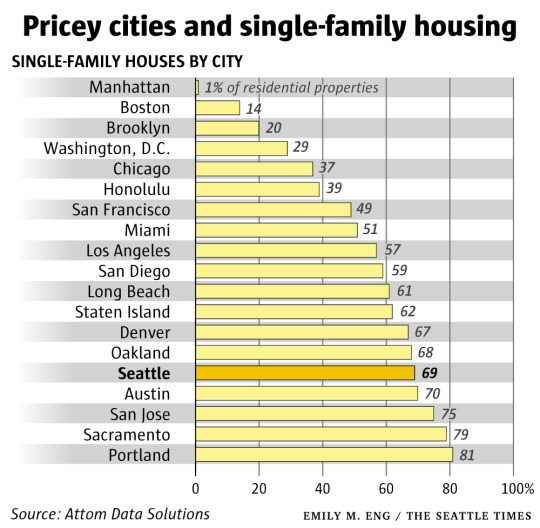
The Seattle Times has an article up about “widespread single-family zoning” that will feel familiar to many here in Toronto who, I know, are having similar conversations about the amount of land dedicated to low-density housing.
The article, by Mike Rosenberg, estimates that 49% of all developable land in Seattle is dedicated to single-family housing; that 8% is dedicated to multi-family housing; and that another 8% is dedicated to commercial and mixed-use buildings. The rest of the land is institutional, open space, vacant, and so on.
Of all the residential lots in the city, the estimate is that 69% of them are occupied by single-family houses. This is compared to 1% in Manhattan.
I tried to reverse engineer the 69% based on the land use areas in the article, but the math didn’t quite add up. In any event, the argument here is, of course, that single-family homes are too expensive in Seattle and that the city needs more land available for multi-family housing.
Housing supply is no doubt important, but looking at the above chart, having a low, or lower, percentage of residential land dedicated to single-family housing doesn’t seem to necessarily guarantee affordable housing.
Hirt’s major claim is that what really sets American zoning apart is its orientation, explicit or implicit, to putting the single-family residential zone at the top of the hierarchy of urban land uses. Not only are single-family zones listed first in many zoning codes, but they make up significant pluralities, or even majorities, of total land area in most American cities. Interestingly, Hirt points out that this wasn’t necessarily true when zoning was first introduced: New York’s famous first zoning law didn’t even have a single-family zone at all.
As Hirt points out, Americans appear to be unique in believing that there is something so special about single-family homes that they must be protected from all other kinds of buildings and uses—even other homes, if those homes happen to share a wall. The recent revolt in Seattle over a proposal to soften that city’s single-family districts, in other words, would not be possible anywhere else in the world, not least because very few people live in single-family districts to begin with.
I don’t know if Canada is covered in the book, but we clearly share many similarities with that of the US.
I would say more, but at this point in the day I should probably rest my eyes and stop looking at a computer screen. Hopefully we can continue this discussion in the comment section below.