Daily insights for city builders, delivered every morning at 6 AM ET. I’m Brandon Donnelly — a Toronto-based real estate developer and founder of Globizen. I’ve been writing here since 2013.

Tag: single family housing

  • The third Los Angeles

    I just stumbled upon an interview with Christopher Hawthorne (architecture critic for the Los Angeles Times) talking about a “third Los Angeles.” 

    His argument is that the first Los Angeles ran from about 1880 to World War II, and was characterized by a form of urbanism that most of, today, do not associate with LA. It was a city of streetcars, innovative multi-family housing, and local landscapes.

    The second Los Angeles was the second half of the 20th century. And it is the LA that probably comes to mind for most people when they think of LA. It is the city of freeways, single-family homes, and sprawl.

    The third Los Angeles is the city’s most recent iteration and started sometime around 2000. Like many things in life, it is in some ways a return to the past: namely the first LA. It is about urban intensification, transit, and more drought resistant landscapes. It is a city that senses its geographic limits.

    I like how he talks about some of the challenges associated with intensification and this third LA:

    “People in very good conscience who live in Santa Monica or San Francisco think of a moratorium on development as a progressive thing to support rather than reactionary or conservative or just in their own political self-interest. I don’t have a problem with somebody who bought a house at a certain point saying, “I bought into a certain place, you know, I want it to stay this way, and I’m going to use whatever resources I can to keep it that way.” They have every right to say that, even if I disagree. I have a problem with people saying that’s consistent with a progressive agenda about cities or a forward-looking attitude about the environment or about resources. It’s not.”
  • The yellowbelt

    We talk a lot about the greenbelt here in Toronto. Some argue that it’s squeezing the housing market and driving up prices.

    But what about the yellowbelt? (Credit to Gil Meslin for the term.)

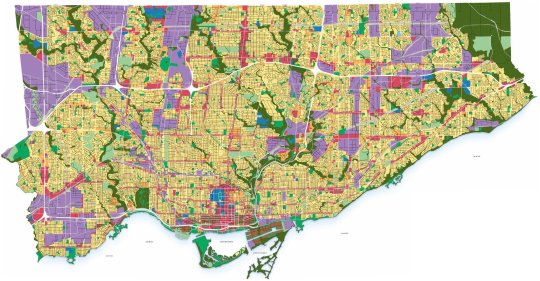
    Here is a land use map of Toronto:

    The yellow areas are “neighborhoods.” They, along with parks, ravines, watercourses, and valleys, make up ¾ of the city’s land area. The Official Plan describes these areas as being “stable” – meaning they will see little physical change. Supply cannot adjust to demand.

    I get why this is the way it is and I understand how difficult it would be change something like this. But let’s not ignore the impact that this land use constraint has and will continue to have on the housing market. 

    It’s the yellowbelt. Thank you Gil for letting me to steal the name.

  • The impact of Chinese buyers on Vancouver’s single family home market

    I have a new favorite blog that I think you might all enjoy as well. It’s called BT | A | Works and it is the “architectural and urban research and development division” of Bing Thom Architects in Vancouver. 

    I think it’s it’s important to have people in a firm who are researching and experimenting with ideas beyond the day-to-day tasks of a job. So I was excited to discover their work this morning.

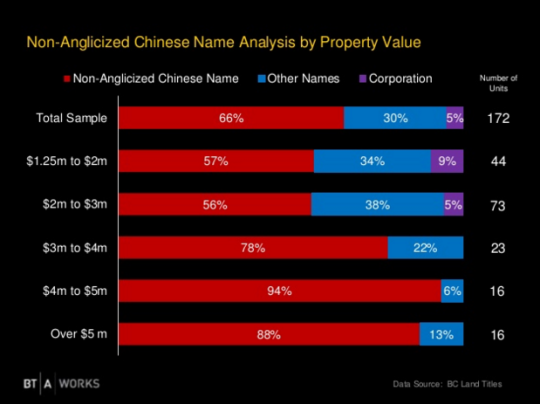
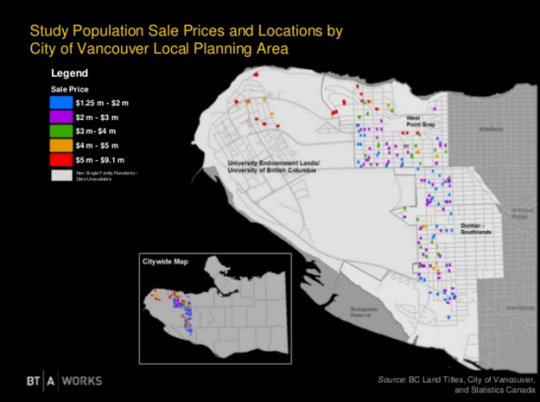
    Their most recent post is a look at ownership patterns of single family homes sold in 3 west end neighborhoods in Vancouver from September 2014 to February 2015 (a 6 month period). These are some of the most expensive areas in the city and, collectively, they found 172 properties sold with an aggregate value of around $520 million.

    Given the presence of foreign buyers in Vancouver’s real estate market, one of the things they then did was identify “non-anglicized Chinese names” on the title records. This means names like “Li Xian”, but not names like “Andrew Shui-Him Yan”, because the anglicized first name suggests that they are probably not a new immigrant or probably not living abroad.

    Here’s what they found:

    In total, 66% of the properties in the sample (172 properties) were associated with a non-anglicized Chinese name. And for properties over $5 million, the percentage jumps to 88%. The other interesting thing worth noting is that 23% of the registered owners declared their occupation as “homemaker/housewife.”

    I thought this would serve as an interesting follow-up to the post I wrote about a month ago called, Is Hongcouver better off than Vancouver? If you’d like to see the full BT | A | Works presentation, click here.

  • The impact of laneway housing in Vancouver

    In 2009, Vancouver created policy and legalized laneway homes. (If you’re not up on laneway housing, click here. I’ve written too much about this topic.)

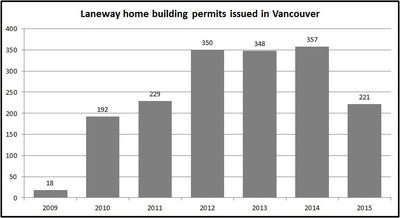
    Since then, the number of laneway homes built in Vancouver has steadily increased to the point where roughly 350 new homes are built every year. 

    Here’s a chart I found showing the number of laneway home building permits issued in Vancouver since 2009 (the year to date number for 2015 is up to and including June):

    image

    This is pretty interesting in its own right.

    But as soon as I saw this chart I started wondering how these numbers fit into the overall new home construction landscape. So I decided to dig up the City of Vancouver’s Statement of Building Permits Issued for June 2015.

    As the chart above shows, the number of laneway dwelling units built (well, permits issued) was 221 as of June 2015. But what’s really fascinating is that this numbers exceeds the number of building permits issued for single family dwellings, which was only 192!

    Also super interesting is the significant spread in building permit value. 

    For single family dwellings, the total value was $156,086,861 (or $812,952 per dwelling unit). On the other hand, for laneway dwellings the total value was $36,478,785 (or $165,062 per unit).

    Now to be fair, if you add single family dwellings with a secondary suite into the mix, you get a total count of 608 new dwelling units (as of June 2015). But at 221 new units, laneway dwellings still make up a meaningful portion of the new construction market.

    So while laneway houses might seem fringe for Toronto and other cities right now, they’re really not that fringe. In fact the numbers above start to show that they can be a viable source of new and relatively affordable single family housing.

    Eventually other cities will realize this too.

  • Multifamily vs. single family

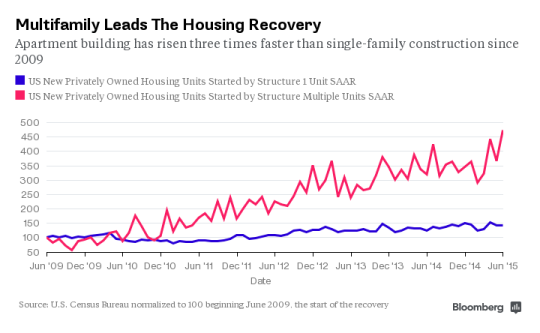
    Since 2009 when the U.S. economy started to recover, housing starts (i.e. new residential construction) have favored multifamily buildings over single family housing. Apartment/condominium construction has grown 3 times faster according to the U.S. Census Bureau (via Bloomberg).

    image

    A lot of this multifamily construction is assumed to be rental apartments, but this category also includes for sale condominiums. The classification has to do with building typology rather than housing tenure. (I would love to see how the above graph breaks down in terms of the latter.)

    The typical explanations for this trend often relate back to Millennials being poor and saddled with student debt. That’s why they’re delaying buying single family homes. But eventually the expectation is that they will resume doing

    (largely) what previous generations have done.

    Money and the economy, I’m sure, have something to do with the above trend. But I’m not convinced that it’s the whole story. 

    There are also shifts happening with respect to consumer preferences and with respect to how we plan and build our cities. That’s why I’m very interested in monitoring family formations and housing choices. 

    At the same time, I’m also a Millennial. And whenever I catch myself thinking a certain way, I assume that there are probably other Millennials out there who feel similarly.

  • A look at homeownership rates

    The Old Urbanist (Charlie Gardner) recently published an interesting post talking about the origins of American zoning using the work of Professor Sonia Hirt and her new book, Zoned in the USA: The Origins and Implications of American Land-Use Regulation.

    One of the central themes in his post is the American (and Canadian) fixation on single-family homes:

    …the United States is the only developed country of those surveyed, apart from Canada, to widely employ single-family detached residential zones that bar all commercial and multifamily uses.

    And the reason for this is largely because of two longstanding beliefs in American (and again Canadian) culture: Your goal should be to become a homeowner, and that home should ideally be a single-family detached home.

    But there’s lots of evidence to suggest that these legal protections (and many of the other things being done to encourage/subsidize homeownership) aren’t actually that effective at driving up homeownership.

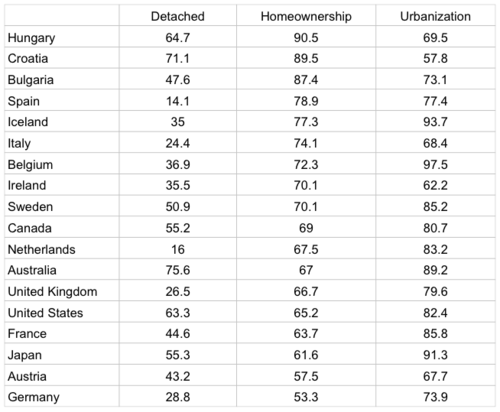
    In his post, Charlie includes a chart showing the percentage of detached homes and the homeownership rates for various countries (data is from 2013/2014). I sorted it based on homeownership and added urbanization rates to see if there was any correlation (doesn’t appear to be).

    Source: Charlie Gardner & Wikipedia

    The US and Canada are quite good at putting lots of people in detached housing (though not as good as Australia!), but the homeownership rates are nowhere near the top. In fact, the US falls in the lower half.

    Did you think the homeownership rate would be higher in the US?