Daily insights for city builders, delivered every morning at 6 AM ET. I’m Brandon Donnelly — a Toronto-based real estate developer and founder of Globizen. I’ve been writing here since 2013.

Tag: sidewalk toronto

  • A global hub for urban innovation

    Dan Doctoroff, the CEO of Sidewalk Labs (and the former deputy mayor of New York City), was recently interviewed by BNN Bloomberg about the company’s plans and ambitions for Quayside here in Toronto. 

    He talks about the project; their interest in timber construction; how the company, Sidewalk Labs, might ultimately make money; and how their mission is to create a global hub for urban innovation.

    This last point is, of course, the most exciting opportunity – both for Sidewalk Labs/Alphabet and for Toronto. And it’s why many people believe that Quayside will end up a far greater (economic development) coup compared to HQ2.

    The interview is only 10 minutes. If you can’t see it embedded below, click here.

    https://webapps.9c9media.com/vidi-player/1.5.1/share/iframe.html?currentId=1461888&config=bnn/share.json&kruxId=InSaVlLc&cid=%5B%7B%22contentId%22%3A1461888%2C%22ad%22%3A%7B%22adsite%22%3A%22ctv.bnn%22%2C%22adzone%22%3A%22ctv.bnn%22%7D%7D%5D

  • Letter from Toronto on Google’s city of the future

    Politico Magazine recently published this article about Sidewalk Toronto. It’s called: Google Is Building a City of the Future in Toronto. Would Anyone Want to Live There? 

    If you’re familiar with what Sidewalk Toronto is up to, the first bit will likely cover things you already know. But later on it gets into an interesting discussion around data privacy, among other things.

    One argument is that if you strip any personal identifiers from the data you collect, then you’ve effectively eliminated the issue of privacy. 

    But what about “collective privacy?” 

    What if you could, for example, identity signs of concentrated drug usage within certain districts, communities, or even buildings? Does that start to get a little too personal?

    This is the great debate surrounding Quayside, the area that Sidewalk is focused on. The article also touches on what Quayside could mean for the future of Toronto.

    Just about all players involved believe that if Sidewalk can be successful at Quayside, it has a shot at the adjoining 800-acre Port Lands, a swath of problem space big enough to become home to a dozen new neighborhoods in a growing metropolis. Townsend, the consultant, says of the Port Lands: “That’s a city they’re going to build there. This is just the warmup, this little piece.”

    Full article, here. There’s also an audio version in case that’s your preferred consumption method. It’s about 40 minutes long if you do it that way (and don’t speed it up).

  • City building reading list (and an event)

    Today’s post is going to be about a handful of things that have caught my attention.

    – Gary Hack, who is the former dean of the University of Pennsylvania School of Design, recently published a book called Site Planning: International Practice. It is a textbookish guide to planning processes, new technologies, and sustainability, with an emphasis on rapidly urbanizing countries. Thank you to my friend Michael Geller for bringing this to my attention.

    – Sidewalk Labs Toronto is opening a new experimental workspace here in Toronto at 307 Lake Shore Boulevard East (Queens Quay & Parliament) on Saturday, June 16th from 12 – 6pm. It’s an old fish processing plant that they have turned into their office. The team will work there during the week and on the weekends they will open to the public to showcase what they’re up to. Register for the June 16th event, here. I just did.

    – Alexandra Lange has a recent piece in the New Yorker called, The Hidden Women of Architecture and Design. It’s about the important role that women have played in the “design of childhood”, which is the title of a book by Lange. There’s also a short but interesting story about Detroit’s Lafayette Park (Mies van der Rohe) at the beginning of the article.

    – Finally, here is a blog post by Witold Rybczynski where he talks about the shortcomings of architectural education. Obscure theories. Technical or made-up jargon. And no concern for budgets and schedules. I have always shared a similar view and have long felt that there needs to be more business school in architecture school.

    Hopefully there’s something in here that is of interest to you.

  • Meet Replica

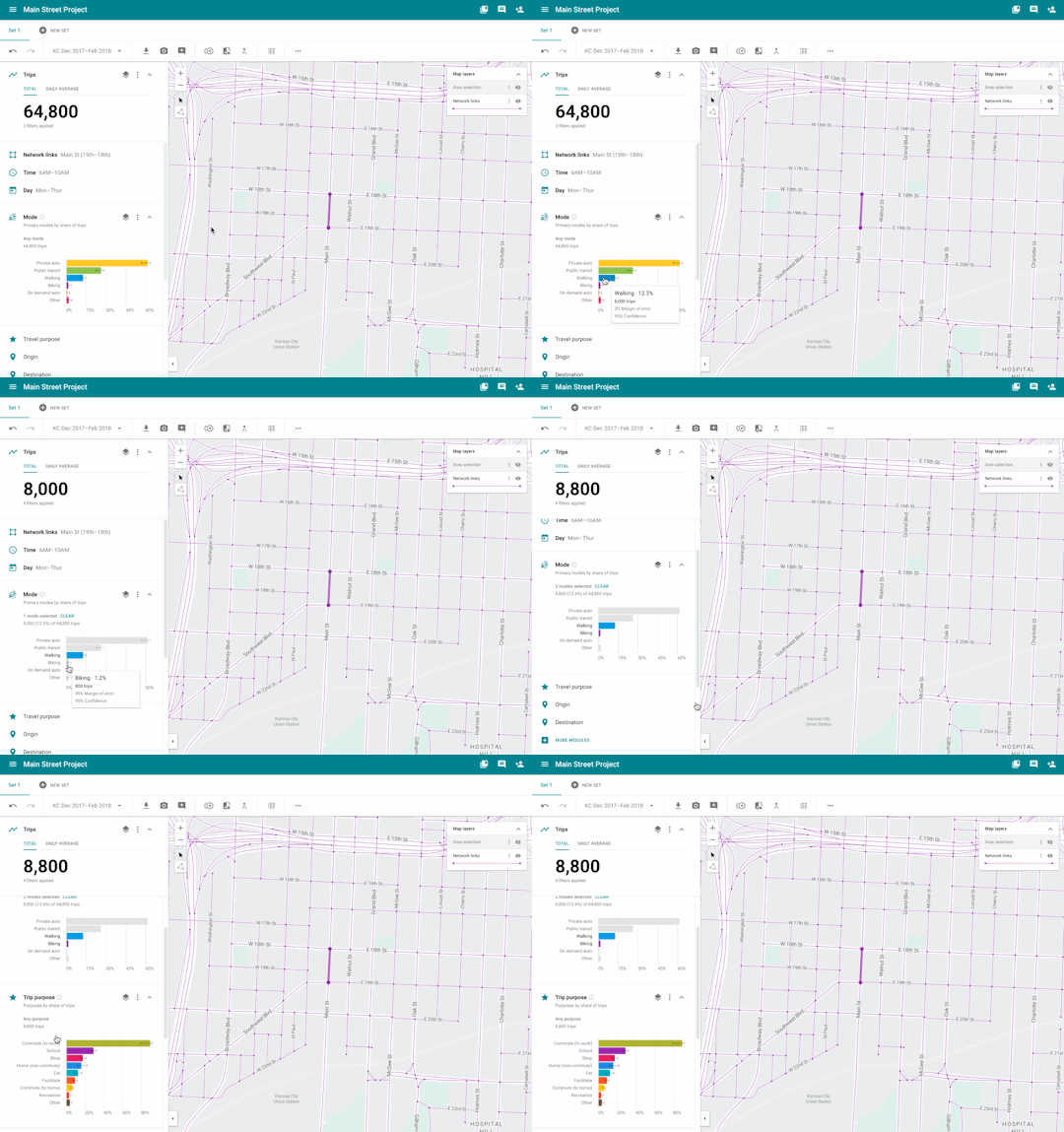
    Sidewalk Labs is currently building out a platform called Replica that will support them in their development plans here in Toronto. Replica is

    “a user-friendly modeling tool that uses anonymized mobile location data to give planning agencies a comprehensive portrait of how, when, and why people travel in urban areas.”

    Here is a preview of the Replica dashboard showing a section of Main Street in Kansas City. I hope the animated GIF shows up for you.

    The platform uses a combination of mobile location data (~5% of the population) and on-the-ground checks, typical stuff like manual traffic counts and transit boardings.

    The goal is to understand in real-time who is using a street, as well as how (driving? cycling?) and why (going to work?).

    Their introductory blog post obviously stresses the importance of personal privacy, but I am curious how they determine where people are going.

    I suppose if they pair journeys with destinations (and the durations at those destinations) they can make reasonable assumptions around the why.

    I think the benefits to all of this are clear. But does any or all of this worry you from a privacy standpoint?

  • Are we entering a new era of tech-driven city building?

    Emily Badger of the New York Times published an interesting piece yesterday talking about the tech industry’s current obsession with trying to fix cities. And there are certainly many problems to fix.

    Staying true to tech and engineering parlance, there’s lots of talk of optimization. How do you technologically optimize a city, for things such as affordable housing?

    There’s no doubt that many of you will sympathize with this statement: 

    To planners and architects, all of this sounds like the naïveté of newcomers who are mistaking political problems for engineering puzzles.”

    But naïveté is not always a bad thing and with all of the money sloshing around in this industry, there’s also no doubt that this is likely a new era of city building.

    The article ends by quoting JD Ross, the 27-year old co-founder of Opendoor – a startup that we have discussed many times before on this blog and is now valued at over $1 billion.

    It is him saying that he wants to figure out how to put $100 million into this space as soon as he can figure out the right target to optimize for. “It’s better than buying a Bugatti.”

    Of course Sidewalk Toronto – which is mentioned a few times throughout the article – is already a perfect example of tech infiltration.

    But I think Dan Doctoroff gets it right when he posits that the real naïveté will come from disrespecting urbanist traditions.

    Photo by David Alacaraz on Unsplash

  • Become a Sidewalk Toronto Fellow

    Sidewalk Toronto is currently looking for “12 smart, creative, and caring people who are interested in the future of Toronto’s waterfront and how we [Sidewalk Toronto] can responsibly incorporate technology to improve urban life.”

    Each Fellow will complete a 2-day orientation session in Toronto; 6 days in Amsterdam and Copenhagen; 5 days in New York City and Boston; 3 days in Vancouver; and then do a final 2-day working session back in Toronto before presenting their takeaways.

    This feels like a response to the criticism that Sidewalk Toronto wasn’t doing enough to listen to the community and that it simply wanted to build a tech-infused neighborhood that could serve us more ads – but it’s cool nonetheless. 

    If you’re between 19-24 years old and you live in Toronto, you can apply here. It sounds like a fun opportunity for young city builders. I know that I certainly would have been all over it when I was in that age bracket.

  • The neighborhood of the future (part 2)

    I have been traveling since the weekend and so I am behind on my reading. One of the benefits of writing this blog every day is that I am forced to read as much as I can. I have to be a sponge.

    Right now, I am still reeling in excitement over the Sidewalk Toronto announcement and getting caught up on that reading. 

    This week Sidewalk Labs published the entire vision section of their RFP response to Waterfront Toronto. This is the response that won them the Quayside partnership. It’s 196 pages and can be downloaded here.

    I’m still making my way through the package, which I am obviously going to do, but I thought this was a great diagram:

    image

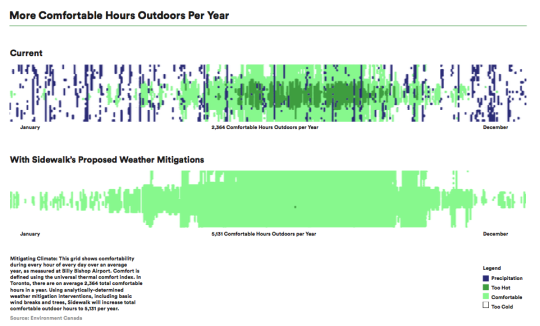
    As is stated in their RFP response, inclement weather affects pedestrians and cyclists more than drivers. Toronto’s most notable response has been our PATH system, which pulls both people and retail below grade, away from the elements.

    But Sidewalk’s research suggests that with the right wind, sun, and precipitation strategies, they may be able to 2x the number of comfortable outside hours per year here in Toronto. That’s what the above diagram shows.

    Of course, there is so much more in their RFP response. But I need more time to digest it all. I’ll be sure to report back to all of you once I have done that. If you don’t feel like going through all 196 pages yourself, you can watch this 4 minute YouTube video instead.