Daily insights for city builders, delivered every morning at 6 AM ET. I’m Brandon Donnelly — a Toronto-based real estate developer and founder of Globizen. I’ve been writing here since 2013.

Tag: shopify

  • The Well is a very impressive masterplan

    I am so impressed by The Well. I walked through it this afternoon after a meeting at BDP Quadrangle’s office, and I think that once it’s fully open and stabilized, it’s going to become an instant icon and destination in the city of Toronto. So much so that when people visit Toronto, they’re going to come to The Well to take a photo under its glass canopy. Just watch.

    Right now, only a portion of it is accessible to the public and it’s because there’s a BMO bank branch on the lower level that is open and operating. It’s all by itself right now, though, so if you bank with BMO, maybe pop by and say hello.

    Now, if you’re a naysayer, I would imagine you’re probably thinking at least two things. You’re thinking of the office space that Shopify left behind. And you’re thinking that open-air malls maybe aren’t well suited towards the Toronto climate. When our group walked through it today, Matt Young (of Republic Developments) immediately said that it felt like something from California.

    I don’t really get this climate argument though. Mainly for two reasons: (1) because winter clothes exist and (2) because we have lots of other open-air malls throughout the city that are doing just fine. Except we don’t call them open-air malls, we just call them streets. And the way they work is that people walk outside, and then go into various retail establishments.

    On the office piece, well, you all know how I feel about office.

    Congratulations to everyone involved in The Well. It is an accomplishment that you should all be very proud of, and our city is better for it. I look forward to seeing it continue to take shape.


  • Amazon’s supply chain moat is turning out to be useful

    Today, Amazon ships approximately 72% of its own packages. This is up from about 47% in 2019. Ben Thompson of Stratechery recently published an excellent article talking about why this is important and how the company’s investments in logistics are, yet again, paying dividends.

    The foundation of Amazon’s “moat”, Ben argues, is aggregating customer demand. When most people buy something on Amazon from a third party merchant, they think and feel as if they’re buying directly from Amazon. Some people probably don’t even appreciate the difference and in most cases it probably doesn’t matter. It comes in a box with Amazon’s logo on it and that’s that.

    But it’s an important distinction because if you’re a third party merchant, Amazon pretty much “owns” your customers. They are the ones aggregating demand. They have the brand equity and loyalty. And if you left the platform, your customers would be unlikely to follow you.

    This is kind of the opposite of how Shopify’s ecommerce platform works. When you operate a Shopify store you are using their platform, but you are bringing your own brand, web domain, and other assets to it, such that you can now establish a more direct relationship with your customers. This doesn’t mean that Shopify doesn’t have a moat, it’s just something different.

    All things being equal, most businesses would rather “own” their customers than not. The problem right now is that shipping and supply chains are no joke, and so there are real advantages to being on Amazon and having them handle your fulfillment. It could mean the difference between getting your products out for Christmas, or not.

    So all things are not equal.

  • Shopify’s mission is to be an entrepreneurship company

    Howard Lindzon has a podcast called Panic with Friends. It was started last March (hence the name) and he uses it to interview entrepreneurs, investors, venture capitalists, and other business people about what they’re up to. In today’s episode he speaks with Harley Finkelstein, President of Shopify, about the future of ecommerce and about how they’re positioning the company. What was interesting but not surprising to hear was that in the early years people didn’t believe that Shopify had a large enough total addressable market. Supposedly, there weren’t enough people out there who might be interested in starting their own online store. That, of course, has proven to be false and there are new and successful ideas emerging all the time. We’re also now talking about how ecommerce is reshaping the landscape of our cities. Given all of this, the company has grown to think of itself as an entrepreneurship company. If you’re at all ambitious, then you’re an entrepreneur in their eyes and Shopify wants to be the platform for you. As a Canadian, it’s great to see them doing so well. If you can’t see the embedded Spotify player above, click here.

  • Is Toronto’s tech ecosystem too US-centric?

    The Wall Street Journal’s recent piece about “Silicon Valley invading Toronto” is, in my view, describing a generally positive outcome.

    We are one of the largest cities in North America (the exact ranking depends on where you draw the urban boundaries).

    We have more enlightened views around foreign and high-skilled workers (I was given a short window in which to leave the US after I finished my first graduate degree there).

    And we have a large and highly educated pool of tech talent (the salary differential discussed in the article looks to be, at least partially, a result of the weaker Canadian dollar).

    US companies are gobbling up office space in Toronto. And presumably, this is one of the reasons why 139 new flights were added between Toronto and Francisco over the last two years. (Source: WSJ)

    However, I do agree with the remarks from people like Jim Balsillie (Blackberry) and Harley Finkelstein (Shopify) that a better outcome would be the creation of more massively successful Canadian tech companies.

    As Finkelstein points out, there’s a big difference between 100,000 square feet of space for the HQ of a new and growing Canadian tech company and 100,000 square feet for a new branch or satellite office.

    The stats we read in the papers about the number of tech jobs being created in Toronto generally don’t speak to composition. Where in the value chain do these people sit? Where is the value accruing?

    The intellectual capital is here. And we should be doing everything we can to foster and finance new homegrown ideas and businesses.

    Image: WSJ

  • Value of distribution and reach for consumer facing products

    image

    Forbes recently pegged social media influencer Kylie Jenner’s net worth at somewhere around $900 million. That makes her the youngest (she’s 20) person on Forbes’ annual ranking of “America’s Richest Self-Made Women.” 

    And if the trend line continues, she’ll be the youngest self-made billionaire, ever. Mark Zuckerberg apparently holds that title right now. But he was a classic underachiever and only became a billionaire at age 23.

    Most of Kylie’s net worth is derived from Kylie Cosmetics, which launched less than 3 years ago, but did an estimated $330 million in revenue last year. Forbes values the company at almost $800 million. And Kylie owns every bit of it. 

    The reason I am mentioning this today is because I was fascinated by the above Forbes article. It’s such a powerful example of social media leverage. Forbes put it differently: “Social media has weaponized fame.” 

    Kylie has 111 million followers on Instagram (plus many more on her other social channels) and that’s really the most important part of this equation. She has the distribution and reach to acquire boat loads of customers. It doesn’t matter what you’re selling if nobody knows you’re selling it.

    The rest of her business is pretty much outsourced. Seed Beauty (out of Oxnard, California and Nanjing, China) handles the manufacturing, packaging, and shipping fulfillment. Shopify (headquartered in Ottawa) is her e-commerce platform.

    We could of course have a debate about whether a celebrity-fueled business is really all that sustainable. And perhaps there’s risk in relying so heavily on social for customer acquisition. But youngest billionaire is youngest billionaire.

    Image: Forbes

  • Tech salaries and brain drain

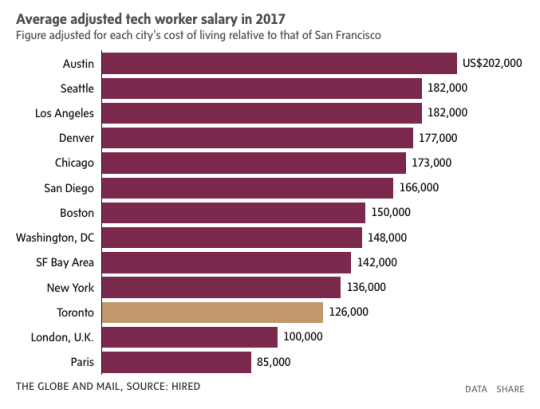
    The Globe and Mail recently ran an article arguing that tech salaries in Toronto are significantly less than those in the US and that it is leading to “alarmingly high rates” of brain drain. The claim is that the average tech salary in 2017 was US$73,000 in Toronto, compared to US$140,000 in the Bay Area or US$129,000 in New York City. 

    However, if you adjust these salaries for each city’s cost of living, the numbers look like this (chart taken from the same article):

    Now all of a sudden Toronto is lumped together with the Bay Area and New York City. It was adjacent to London even when you didn’t adjust the salaries. As Tobi Lütke – CEO of Shopify – points out in his Twitter rebuttal of the article, housing is the determining factor in this adjustment: “Toronto is a very expensive city, and Austin isn’t.”

    Lütke also points out, in case you’re in the market, that Canadian-based Shopify pays its tech employees well above market, provides stock compensation, and is currently “hiring like crazy”. But perhaps more importantly, he stresses the importance of Canadians building the economy of the country in which they are from. I feel exactly the same way.

  • Urbanism Online: #capital

    image

    For those
    of you from Ottawa, I’m going to be in town this Thursday evening talking
    at an event put on by the National Capital Commission called Urbanism
    Online
    . It’s all about how blogging, social media, and online discussions can
    and are contributing to the betterment of cities.

    The other
    bloggers include:

    – Marc-André Carignan, Montreal, Kollectif.net

    – Jillian Glover, Vancouver, This City Life

    – Robert Smythe, Ottawa, UrbSite

    The event is
    now full, but email them or tweet me if you’d really like to come
    and I’ll certainly ask about space availability. I’m sure it’s going to be a great discussion.

    I have a bit of a soft spot for Ottawa. I used to spend a lot of time there when I was working on an office building at 150 Elgin Street. (Key tenants include The Canada Council for the Arts, KPMG, and Shopify.)

    I haven’t been back since the building was completed, so I’m excited to see how it turned out.

    Update: The event will also be streamed on Periscope, here.

  • NXT City Night 2015

    I just got
    my tickets for NXT City Night,
    happening Thursday, September 24, 2015 at 6:30pm here in downtown Toronto.

    If you’re
    not familiar with NXT City Prize, it’s an annual urban design competition where
    young Canadians (35 years of age or younger) submit ideas to improve the built
    environment. The top submissions win a total of $9,000 in prize money and the winning idea
    gets paired up with the City of Toronto work on actually implementing it. That’s
    the best part.

    The 2015
    finalists have already been announced, here, but the top submissions
    will be announced at NXT City Night. The Chief Planner of Toronto, Jennifer
    Keesmaat
    , will be there, along with the
    competition’s very impressive jury
    .

    I think it’s
    important to keep in mind that a lot of what makes cities great often happens
    through citizen-led grassroots movements.

    The
    High Line in New York
    – which today attracts over 5 million visitors a year
    and is believed to be responsible for over $2.2 billion in new economic
    activity – was really the work of 2 friends who thought that preserving and
    repurposing the High Line was a cool idea. Which is why in 1999 they founded a
    non-profit called Friends of the High line. Amazing things happen when people and
    passion get involved.

    So I would
    encourage you to grab a ticket and join me at NXT City Night next week. Tickets are
    $25, but if you use the coupon code ATHISCITY,
    you’ll get $5 off your ticket 🙂

    The event is
    also taking place in a spectacular old warehouse building at 56 Maud Street
    (formerly St. Andrew’s Market Hall). That alone is reason enough to come. I’ve been inside before. Get your Instagram ready. But
    if that’s not enough, there’s also:

    • Open bar including Steam Whistle beer and Pillitteri Estate wine
    • Catering from Oyster Boy, Kanpai Snack Bar, Thoroughbred and many more
    • Art installations by Wayward Collective
    • Beats by Jesse Futerman and A Digital Needle
    • Local wares from GetFresh, Shopify, Spacing Store and Swipe

    I hope to see
    you there. Make sure to tweet at me
    if you’ll be there so we can connect in person.

  • 21 largest venture capital investments in Canada

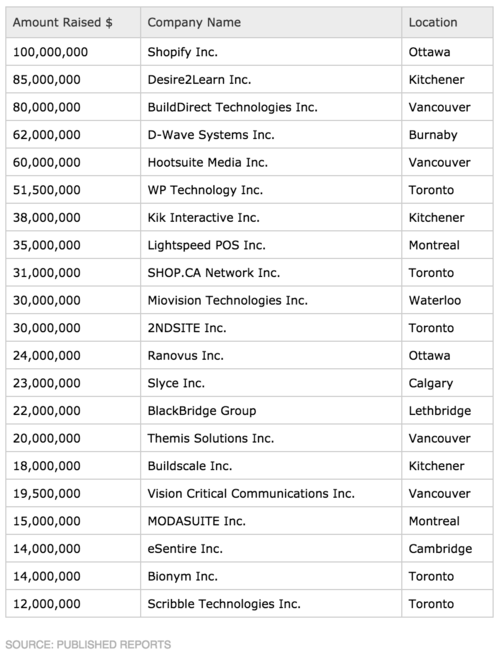
    The Globe and Mail published an interesting article this evening looking at the 21 largest venture capital investments in Canadian tech over the last 18 months. It’s called: Who needs Silicon Valley? Canadian startups scoring bigger deals.

    To put things into perspective, total venture dollars invested in Canada last year (2014) was around $1.9 billion. In the US, that number is estimated to be somewhere around $48 billion. So there’s a big spread here. But the Globe is arguing that there’s a shift towards medium-sized Canadian tech companies raising larger and larger rounds.

    Here are the top 21 largest venture capital investments made in Canada over the last 18 months:

    image

    At the same time, there’s also an attitude change that seems to be taking place. Confidence is growing. Here’s a quote from Mike McDerment of Freshbooks from the same article:

    “Our goal is to be an anchor tenant in Toronto. At Freshbooks, we want to build a global company that really contributes in some meaningful way to the city,” Mr. McDerment said. He touts the local schools and talent pool and downplays the Valley’s head start.

    “The money is shameless – it’ll just go wherever. It wants the opportunities,” Mr. McDerment said. “I don’t see why Toronto can’t beat Silicon Valley.”

    All of this is important because the medium-sized companies of today will hopefully become the large-sized companies of tomorrow. And that’s what you need to build a thriving startup hub. You need big successes. You need those companies going public and generating wealth for their employees and communities.

    Thankfully, that seems to be where we’re headed. The first company on the list above – Shopify – is already preparing for a dual US-Canada IPO.