
Daily insights for city builders, delivered every morning at 6 AM ET. I’m Brandon Donnelly — a Toronto-based real estate developer and founder of Globizen. I’ve been writing here since 2013.

Tag: senseable city lab

  • The super-linear relationship between human interactions and city size

    image

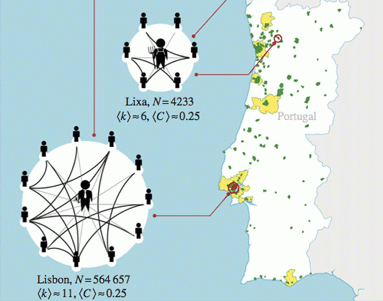
    The MIT Senseable City Lab recently teamed up with a few other research groups to investigate the relationship between human interactions and city size. If you happen to be a member of the Journal of the Royal Society Interface, you can download the full report here. But in true ATC fashion, I’m going to give you the Coles Notes version here.

    What the study did was look at billions of anonymized mobile phone data in both Portugal and the UK in order to determine how our real life social networks change with city size. And what they found is a pretty consistent relationship:

    [T]his study reveals a fundamental pattern: our social connections scale with city size. The larger the town you live in, the more people you call and the more calls you make. The scaling of this relation is “super-linear,” which means that on average, if you double the size of a town, the sum of phone contacts in the city will more than double – in a mathematically predictable way.

    What’s interesting about this finding is that it starts to explain how cities–and the clustering of people–can act as fertile ground for the exchange of ideas and knowledge. The bigger the city the more people you probably know.

    But what I’m curious about (I don’t have the report) is if there’s some kind of upper limit. Presumably this “super-linear” relationship tapers off after a certain city size, because there has got to be limits to the number of people we can maintain productive relationships with.

    According to British anthropologist Robin Dunbar, that number was 150 people.

  • 80% of New York’s 150 million taxi trips could be shared

    I’ve been a big fan of MIT’s Senseable City Lab since I was a grad student at Penn. Their work sits at the intersection of cities and technology, and so I’ve always found it incredibly fascinating.

    Recently, the lab examined data from all of New York’s 13,586 registered cabs and looked for ways that technology and mobile tech could potentially optimize the way the system works today. In particular, they were interested in examining instances where people were heading to the same place at the same time, and were within no more than a 3 minute walk of each at the start of the trip.

    What they found was that, of the 150 million taxi rides taken in New York City during 2011, almost 80% of them could have been shared.

    That is, 80% of the time, there was an overlap in both time and route. That’s an hugely interesting stat because it starts to show just how much waste and inefficiency there currently is in the system. Think about all the trips and carbon emissions that could be potentially eliminated through optimization.

    Here’s a video they produced on the project. Click here if you can’t see it below.

    [youtube https://www.youtube.com/watch?v=Gyq_Zr96uzs?rel=0]

    It’s a great example of how technology is and will continue to creep into every segment of the economy. It’s exactly what I was talking about in my post, “Disrupting everything.”