Daily insights for city builders, delivered every morning at 6 AM ET. I’m Brandon Donnelly — a Toronto-based real estate developer and founder of Globizen. I’ve been writing here since 2013.

Tag: scale

  • A small site solution: Inverse Density

    My recent post about minimum project sizes triggered some great follow-up discussions over email. Today, I learned about a Master Plan that was recently completed for Little Havana, Miami by the urban design and planning firm Plusurbia.

    In it, they try to address some of the problems that I described in my post through something they call “Inverse Density.” Given the tendencies toward larger projects, they are proposing to incentivize the development of smaller and underused lots with more density.

    The idea being that if you can encourage more smaller scale development, you can actually help to protect the character of a place. In 2017, the National Trust for Historic Preservation declared the neighborhood a national treasure.

    Here’s a screenshot from the plan:

    What you are seeing here is existing vs. proposed policies. The proposed scenarios both result in higher densities, even though the lots are smaller. Alongside this, they are proposing to get rid of parking minimums for lots less than 7,500 sf.

    It’s an intriguing idea and I’m glad they shared it with me. If you’d like to download a copy of the full Little Havana Master Plan, click here.

  • A taxonomy of moats

    Jerry Neumann’s recent blog post on the “taxonomy of moats” is a great summary of the ways in which companies — and perhaps even cities — can protect themselves against competition.

    Here’s an excerpt from his introduction:

    Value is created through innovation, but how much of that value accrues to the innovator depends partly on how quickly their competitors imitate the innovation. Innovators must deter competition to get some of the value they created. These ways of deterring competition are called, in various contexts, barriers to entry, sustainable competitive advantages, or, colloquially, moats. There are many different moats but they have at their root only a few different principles. This post is an attempt at categorizing the best-known moats by those principles in order to evaluate them systematically in the context of starting a company.

    And here is his taxonomy of moats. He identifies four main sources:

    As a sidebar, consider how this might also apply to cities.

    Scale, for example, matters a great deal. We know that as cities get bigger, people tend to walk faster, have broader social connections (the relationship is super-linear), and be far more productive and innovative.

    If you’d like to read Jerry’s full post, click here. And if you’re interested in this space, I recommend you also check out Fred Wilson’s recent post on, “The Great Public Market Reckoning.”

  • 10x the scale

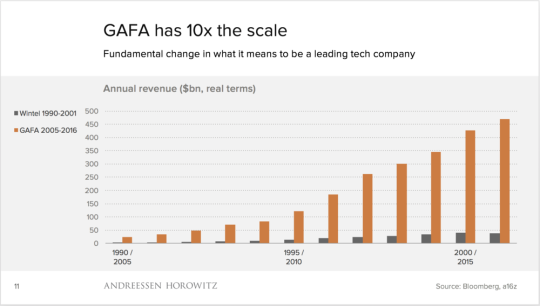
    Below is a chart from Benedict Evans comparing annual revenue from the Wintel era (Microsoft + Intel) to the current GAFA era (Google, Apple, Facebook, and Amazon). 

    His argument is that, today, “the scale of tech winners” is about 10x what it was during the previous cycle.

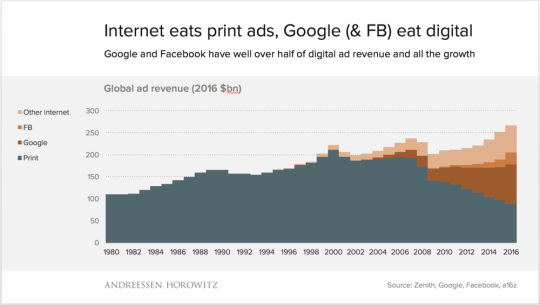
    And here is a chart, from that same post, showing how the internet ate print ads when it comes to global revenue:

    A lot of this has to do with the unprecedented growth of smartphones and the sheer number of people who came and are coming online. Mobile is 10x the PC market.

    But the other interesting narrative from the post is the argument that these companies (GAFA) have learned from previous generations just how aggressive you need to be to survive.

    The shift to mobile posed a structural threat to Facebook. At the time of its IPO, there were serious doubts as to whether the company would be able to pull off this transition.

    Which is why the founder went out and spent 10% of the company to acquire companies that would help with this transition and ensure its survival. That seems to have worked.

    In the words of Andrew Grove: “Only the paranoid survive.“ And in today’s tech world, the rewards for surviving are that much bigger.

  • What use could driverless cars serve beyond just transport?

    image

    Here’s further evidence that technology is starting to infiltrate into many other industries, including architecture. London-based architect and designer Pernilla Ohrstedt is currently working on an exhibition for Dezeen and MINI Frontiers that will architecturally visualize the 3D data that driverless cars collect in order to navigate around.

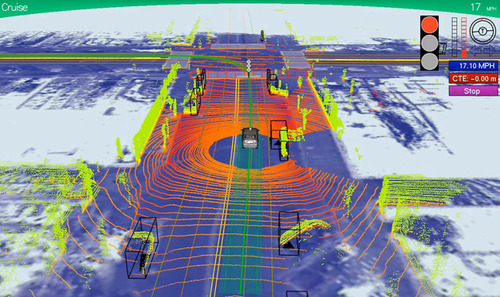
    I had never thought of this before, but as a byproduct of driverless cars, we’re about to start collecting detailed replicas of all of our cities – well beyond the static images we currently have with Google Streetview. In order to navigate by themselves, driverless cars are constantly scanning their surroundings to create a “point cloud” replica of the built environment. This point cloud basically tells the car where they are, where they should drive, and what obstacles might be around.

    It could look something like this:

    image

    Already there are firms like ScanLAB emerging to provide 3D scanning, publishing, and visualization services. But this is obviously just the tip of the iceberg. I can only imagine what innovation will emerge from the passive collection of all this data once driverless cars become commonplace in our cities.

    As one example, it could be a way for us to systematically measure the correlation between the qualities of a street and the vibrancy of its street life. Is there a perfect width? An ideal traffic volume? A right scale? All of this data could make city building more of a science (and perhaps less political).

    My hope though is that this data would be open and accessible to all, so that clever entrepreneurs could build on top of it.

    What are some of your ideas?

    Images: Dezeen

  • Earth’s biggest ____store.

    Imagine this sequence of events (and don’t peak by clicking on any of the links).

    The year is 1994.

    You notice that the internet is starting to become a big deal and that more and more products are being sold online. As a result of this trend, you decide to start an online business.

    You write up the business plan and begin operations out of your garage. You then get lucky (or you’re just smart and talented). Within 2 months, sales reach $20,000/week. That’s over a million dollars a year.

    Business continues to grow and within 3 years you’re able to take your company public, raising $54 million at a $438 million valuation. Over the subsequent two years, you’re then able to raise an additional $2.2 billion in debt to fund your continued growth. 

    The year is now 2000.

    You were just named Time magazine Man of the Year. And traditional brick-and-mortar retailers are really taking notice (i.e. suing you). That’s pretty impressive after only 6 years of operation. 

    This company is called Amazon. And that “you” is Jeff Bezos.

    I was reading up about how much of an asshole Jeff Bezos is, and then became interested in the Amazon story. I thought I would share a bit of it with you all here.