
Daily insights for city builders, delivered every morning at 6 AM ET. I’m Brandon Donnelly — a Toronto-based real estate developer and founder of Globizen. I’ve been writing here since 2013.

Tag: saudi arabia

  • Building new cities

    On this blog, we often talk about city building in the context of doing things to help improve a city — whether that be a development project, a new public art mural, or an interesting local business. These interventions help to build a city. But even more specifically, the term has, for many, come to mean building up a city in a positive way.

    But there is another way to think about city building. You can think of it in terms of building actual new cities. We’ve spoken about some of these before, namely this one in California and this odd one in Saudi Arabia. But apparently it is becoming more common. According to The Economist, the world is now building more new cities than it has in the last 80 or so years:

    Egypt’s “New Administrative Capital” is part of a rush of city-building. Firms and governments are planning more settlements than at any time in the post-war period, with many already under construction. Ninety-one cities have been announced in the past decade, with 15 in the past year alone. In addition to its new capital in the north, Egypt is building five other cities, with plans for dozens more. India is considering eight urban hubs. Outside Baghdad, Iraq, workers have just broken ground on the first of five settlements.

    In some cases, it is being done as a solution to urban congestion. If this city is too expensive and unaffordable, just create a new one. This appears to be part of the idea with the above city outside of San Francisco. Of course, new cities can also be created for ideological reasons, or for political purposes, which was the case with Brazil’s capital city, Brasilia.

    Here, the idea was to move the federal capital away from the country’s populated southeast region to a more geographically neutral location in the middle of the country. It also turns out that seeding a new city with government institutions is a good way to get one of these started. Existing cities do, after all, benefit from network effects.

    History points to characteristics shared by successful projects. State institutions can help anchor cities, as Brasília (in Brazil) and Chandigarh (in India) showed in the 20th century. Although both have had problems, people in Brazil and India are voting with their feet. Brasília’s population is growing at 1.2% a year, more than double the national average. Chandigarh, a state capital, is now India’s fourth-richest region on a per-person basis.

    But putting money, ego, and ideology aside, when does it actually make sense to start a new city in lieu of just expanding (or addressing the problems in) the one(s) you’ve already got? Population size can’t be the only factor in determining whether a city is “full”, because Tokyo seems to do just fine as the largest metropolitan area in the world.

    If it hasn’t already been done, I think this would make for an interesting research project. Until then, there’s this (paywalled) Economist article.

  • Build whatever you want

    As a gross generalization, there are probably two ways in which one can approach the building of a new building. The first is based on demand. You believe that there is demand for new housing or new office space or some other use, and so you decide to build new space in order to satisfy that exact demand.

    Sometimes developers get it wrong and build too much space or the wrong kind of space, but the reason for building remains the same: you believe that there is a market waiting for you.

    The second way to build is to completely disregard the market and just build whatever you feel like building because it is going to serve some other alleged purpose. And that is arguably what is happening in Saudi Arabia with The Line and what happened in places like North Korea with its “Hotel of Doom.”

    I suppose that there is a chance that somebody in North Korea believed (or pretended to believe) that there was demand for a skyscraper that was 1,000 feet tall and housed 3,000 hotel rooms, but in reality, the real reason was that leadership thought it looked cool and that it would make for good propaganda.

    To be fair, there was probably also some hope that it would spur demand and attract foreign investment. But it’s still a case of just building whatever you want.

  • The global average fertility rate is decreasing

    According to this recent Bloomberg article, the world is expected to add more than 3 billion people by 2100. At the same time, the global average fertility rate is dropping. In 1960, it was five live births per woman. As of 2017, it had dropped to 2.43.

    About half of all countries are now below the rate of replacement, which means they’re relying on immigration (places like Canada) and/or they’re relying on labor productivity gains to keep their economy growing (places like China).

    The article is also fascinating in that it begins to consider the economic and cultural forces that shape the above fertility rates. Women in Saudi Arabia, for example, have one of the lowest labor force participation rates in the world. Only about 25% are in the workforce.

    If you’d like to read the full article, you can do that here.

    Image: Bloomberg

  • And the award for the tallest building of the year goes to…

    The Guardian recently published an article on vanity height in skyscrapers. What this is referring to is the unoccupied portions of tall buildings which are built purely for vanity reasons – that is, to increase the face height of the building and claim some superlative title.

    Example: 

    The tallest building in the world is currently the Burj Khalifa in Dubai. It’s 828m tall. To put that into perspective, the CN Tower in Toronto is 553m. But according to the Council on Tall Buildings and Urban Habitat, 29% of the Burj Khalifa’s height is actually unoccupied or “vanity space.” In other buildings, such as the Burj al Arab (also in Dubai), the amount of unusable space is as high as 39%. 

    For the purists out there, this of course raises the question of what should should be counted when assessing building height. Should it only be spaces where humans typically inhabit? The CN Tower has a lot of unoccupied space, which is why it is frequently excluded from these sorts of ego rankings. 

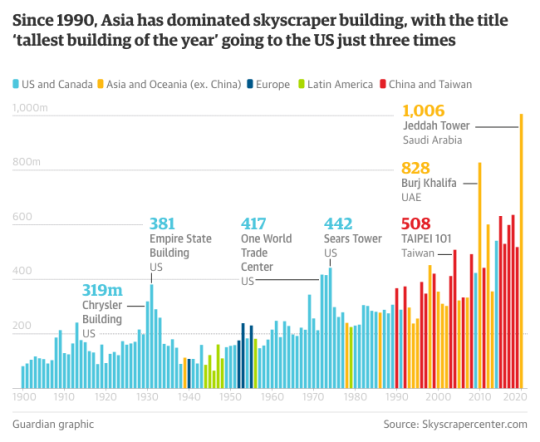
    But semantics aside, this is obviously not a new phenomenon and it’s interesting to think about this race to the sky as a proxy for what’s going on in the world. Below is a chart showing which regions have been able to lay claim to the “tallest building of the year” since 1900. 

    Since 1990, it has been all about Asia and Oceania and China and Taiwan…