Daily insights for city builders, delivered every morning at 6 AM ET. I’m Brandon Donnelly — a Toronto-based real estate developer and founder of Globizen. I’ve been writing here since 2013.

Tag: san francisco

  • How should cities manage their own awesomeness?

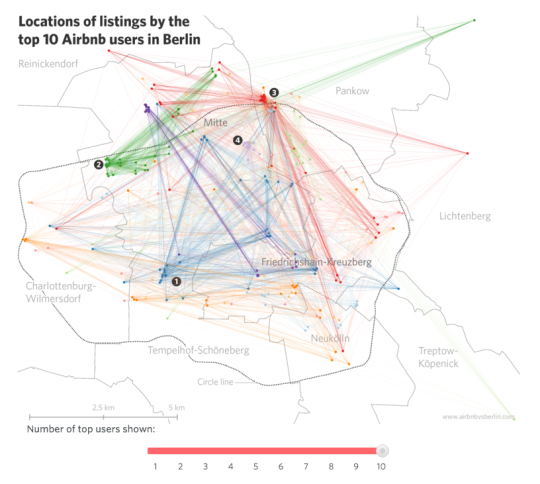
    Conor Maguire introduced me to an interesting site today called Airbnb vs. Berlin. The site does a deep dive into Berlin’s Airbnb market with the hope of answering the question: Is Airbnb contributing to a shortage in affordable housing?

    The site is very well done. It’s filled with lots of great market stats and diagrams such as this one here: 

    Of course, the impetus for a site like this is that cities all around the world, from San Francisco to Berlin, are grappling with rising home prices. If you happen to live in a successful, growing city, that’s probably what is happening.

    But when this happens, we seem to want to look for something or someone to blame. In San Francisco it’s the tech workers. They’re the ones driving up homes prices. In Vancouver, it’s the foreign Chinese buyers. And in Berlin, it’s those Airbnb users who are just out to make a profit. In all of these cases, we like to tell ourselves that if we could just get rid of “X”, everything would be much better. 

    But I think sometimes we forget that this is also the result of doing many things right.

    If Berlin wasn’t a brilliantly cool place to visit, then tourists wouldn’t come. And if tourists didn’t come, then Berlin wouldn’t have, by far, the largest Airbnb market in Germany. If Vancouver wasn’t one of the most enjoyable places in the world to live, you wouldn’t have the same attention from overseas buyers looking to snatch up properties. 

    So in a way, we should be asking ourselves: How do we, as a city, manage our own awesomeness?

    The other thing that Airbnb vs. Berlin reminded me of is the viewpoint that profits are some dirty little secret. I hear it all the time in the real estate development business. People will say: “That developer is just out to make money.” Of course she/he is! They operate a business. And like all for-profit businesses, one of the objectives – it may not be the only one – is to make money.

    I say all this not as a direct response to the website. They remained fairly neutral in their analysis. Instead, I raise it as an alternate viewpoint in the seemingly universal battle against “X.”

    In case you’re wondering about Berlin’s Airbnb market, the site estimates that there are roughly 11,701 Airbnb listings in the city out of a total of about 1.9 million flats. Of these listings, it is estimated that somewhere around 30% are by “professional users” who are only out to make a profit and are not participating in the “sharing economy” in its purest sense. That equates to about 0.18% of all Berlin flats.

    Based on this number, I’d say that Berlin’s cool factor probably has a lot more to do with the city’s rising rents than do the profit seeking Airbnb users.

  • Urban infill case study: 1234 Howard Street in San Francisco

    Urban infill developments can be tough. The sites are often small and/or narrow and that creates a lot of design challenges. Access to light is a common problem.

    But constraints can also be beautiful, because they have a way of forcing creativity. 

    When I was in architecture school, I used to find it easier to work when I was given constraints and challenges. It gave me something to latch onto, as opposed to just starting with a blank canvas. A big part of design, at least for me, is about solving problems. So give me a problem to solve!

    One of the ways that architects and designers often deal with the access to light problem is by carving out lightwells or courtyards to bring light down into the building. This can be used when you have a deep site or when you’re building right up against the property line and you can’t have any windows.

    One project that I’ve always liked for this reason – as well as the fact that it’s beautifully designed – is 1234 Howard Street in San Francisco. It looks like this from above:

    image

    The site is 50′ x 165′ and it spans an entire block. 

    In order to get lots of light into all of the units, the architects (Stanley Saitowitz | Natoma Architects) split the site up into 3 “bars”, each of which would be somewhere around 16′ x 165′. The middle “bar” was then dedicated to a courtyard that cuts through the entire building.

    image

    The two flanking bars were then further subdivided into 2 units per bar, which translates into 4 units per floor x 4 floors. The ground floor is just common areas and parking.

    The advantage of this design strategy is that the apartments now have windows running the length of the courtyard, where as typically on narrow deep lots you would end up with “bowling alley” units and windows just on one end.

    The disadvantage of this design strategy is that you’re now just over 16′ away from seeing what your neighbor is eating for dinner, among other things. 

    But with the right window coverings, I’m sure we’d all survive in these apartments with their Bulthaup kitchens and Miele appliances.

    image

    I love seeing creative solutions to tight urban sites. And one of the things that I worry about, with things like the Mid-Rise Performance Standards here in Toronto, is that we’re reducing or even eliminating the possibility for these kinds of creative solutions.

    I recognize that 1234 Howard is not the same as an avenue mid-rise site in Toronto with low-rise residential behind it. But the thought still crossed my mind as I was writing this piece.

    All photos via Stanley Saitowitz | Natoma Architects Inc.

  • This U.S. housing boom is different

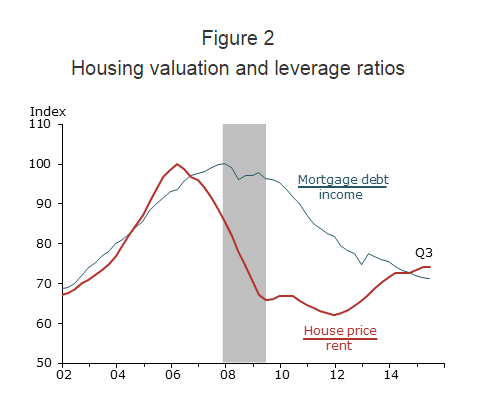
    Just a few days ago, The Federal Reserve Bank of San Francisco published an interesting research study where they argue that this U.S. housing boom is different than that of the early 2000s.

    During the last boom, U.S. home prices peaked in 2006 and then dropped about 30% in the wake of The Great Recession. Since then prices have rebounded – almost to their pre-recession levels. This has some people asking whether this story is headed towards the same ending.

    But the FRBSF is saying no:

    “We find that the increase in U.S. house prices since 2011 differs in significant ways from the mid-2000s housing boom. The prior episode can be described as a credit-fueled bubble in which housing valuation—as measured by the house price-to-rent ratio—and household leverage—as measured by the mortgage debt-to-income ratio—rose together in a self-reinforcing feedback loop. In contrast, the more recent episode exhibits a less-pronounced increase in housing valuation together with an outright decline in household leverage—a pattern that is not suggestive of a credit-fueled bubble.”

    And here’s the chart:

    Source: Flow of funds, Bureau of Economic Analysis (BEA), CoreLogic, and BLS. Data are seasonally adjusted and indexed to 100 at pre-recession peak.

  • Why can’t cities reach equilibrium?

    The October issue of The New Yorker has an interesting piece called: Naked Cities – The death and life of urban America.

    I find the article ends up rambling a bit, but I like the idea presented right at the beginning. The idea that cities can never really find equilibrium. They’re either dying, or victims of their own success.

    Here’s that paragraph:

    Cities can’t win. When they do well, people resent them as citadels of inequality; when they do badly, they are cesspools of hopelessness. In the seventies and eighties, the seemingly permanent urban crisis became the verdict that American civilization had passed on itself. Forty years later, cities mostly thrive, crime has been in vertiginous decline, the young cluster together in old neighborhoods, drinking more espresso per capita in Seattle than in Naples, while in San Francisco the demand for inner-city housing is so keen that one-bedroom apartments become scenes of civic conflict—and so big cities turn into hateful centers of self-absorbed privilege. We oscillate between “Taxi Driver” and “The Bonfire of the Vanities” without arriving at a stable picture of something in between.

    I like this because there’s truth to it. But at the end of day, this is just one of the many challenges facing great city building. 

    To solve the problem of affordable housing you could just be a city in decline. But that’s not much fun. So the better option, however difficult it may be, is to figure out how to manage the negative externalities associated with winning.

  • Is Hongcouver better off than Vancouver?

    The Twilight Zone | Vancouver by Apar Sidhu on 500px.com

    https://500px.com/embed.js

    It’s raining this morning in Toronto. The sun really hasn’t come up and out yet. And I’m spending the morning drinking coffee and reading a City Journal article from this past summer called “Hongcouver.”

    The article talks about how the Chinese – first from Hong Kong and then from mainland China (PRC) – have dramatically reshaped the economic and cultural landscape of Vancouver.

    I, unfortunately (it’s a great city), don’t spend a lot of time in Vancouver and so I don’t have an accurate sense of the local sentiment towards all of this change. But there’s no question the city has changed. 

    Here’s a snippet from the above City Journal article:

    As for the notion that Chinese money tended to be ill-gotten, Yu pointed out that the property boom was propelled by the structural disparity between prosperous Hong Kong, a dynamic economy, and the comparative backwater of Vancouver, still “living on the fumes of empire.” For the price of a Hong Kong flat, a Chinese immigrant—even, say, an accountant—could buy a splendid home on Vancouver’s West Side. “The Hong Kong Chinese who came could buy their way into any neighborhood. [They] knew that money was a tool,” Yu told me. “They weren’t going to accept a second-class citizenship in Vancouver. They could say, ‘I don’t care about your British Imperial manners, I am going to buy your house.’ ” The irony was that the Hong Kong arrivals—“more sophisticated than the people they were displacing,” with “better schooling, better English accents,” Yu said—were themselves the products of a system of law and finance instituted by the British with the establishment of their Hong Kong colony in the 1840s, after Britain thrashed China in the First Opium War.

    A lot of this was fuelled by the now defunct Immigrant Investor Program. The intent of the program was to allow “experienced business people” into the country in order to contribute to economic growth. If you had business experience, a net worth of at least C$1.6 million (that was gained legally, of course), and were able to invest C$800,000, then you could get permanent residency.

    Between the mid-1980s and the end of the 1990s, approximately 30,000 Chinese came to Vancouver via this investor-class visa. And between 1987 and 1997, it is estimated that this group of Chinese possessed about $35 to 40 billion in disposable income. No wonder they bought real estate.

    But the interesting question is whether or not Vancouver is better off now than it was in the 1970s before all of this migration really took hold. 

    There many who would argue that it is not. Vancouver now has the most expensive real estate in Canada and prices have completely detached themselves from local income levels – as they have in many international cities.

    But there’s also a strong argument to be made that this influx of money has made the Vancouver economy more dynamic. Unemployment in the city was cut almost in half between the early 1980s and 1991 during the first wave of migration. It went from 13.6% to 7.7%.

    In a way, it’s not all that different than what’s currently happening in San Francisco with tech and housing. I’m not saying there aren’t problems to be solved. But I think many of us can agree that the answer is not to eradicate the tech sector.

    That’s throwing the baby out with the bathwater.

  • Is venture-based real estate development coming to the Bay Area?

    Golden Gate Bridge by Mariusz Blach on 500px.com

    https://500px.com/embed.js

    Chamath
    Palihapitiya
    is a Sri Lanka born, Canada educated, venture capitalist in
    Silicon Valley, who made a boatload of money as one of the early employees of
    Facebook. He now runs a VC firm called Social +
    Capital
     and owns part of the Golden State Warriors.

    The other
    night he was interviewed at a StrictlyVC event in San Francisco and I think
    that many of his comments would also be of real interest to the Architect This City
    community. He’s super passionate in interviews and always fun to listen to.

    Below is what
    he had to say about the San Francisco startup scene. It really speaks volumes
    about what people will put up with in order to live in an awesome place/city that they love. All of his responses below are from this
    TechCrunch article
    .

    “The city has to be doing more, around
    transportation, around housing… You have to get rid of the nimbyism and you
    need to quadruple, if not quintuple, the amount of housing. You need to tell
    that engineer from the University of Michigan that he can live here on a salary
    of $80,000.

    [In the meantime], we look at our startups, and
    the minute that they start to spend more than 15 percent of their burn – good
    money that we give them – on rent, a huge red flag goes up. When they, on a
    per-head-count basis, are spending so much, we start looking at the
    productivity of the technical team. And if it’s good but not great and they’re
    spending this insane amount of money [versus] a different team in Redwood City,
    we start to ask ourselves: “Are you so convinced that success is going to
    happen in this city at 1.5x the cost?”

    Because for every dollar that someone in
    Mountain View or Redwood City is raising, you [in San Francisco] have to raise
    one-and-a-half to two times that just to get to the same point. So you’re cutting
    your half life in half. To prove that you can take an Uber from some fuckin’
    shitty bar to another shitty bar? Like, I don’t understand.”

    And here he
    talks about the possibility of his venture firm also getting into the real
    estate development business. I couldn’t resist blogging about this.

    “We made a big
    decision with our last fund to build an organization that looks really
    different than a venture firm, and that organization is going to be this
    hybrid, bastard stepchild of Berkshire Hathaway and Blackstone and BlackRock.

    What I mean by this is
    that we want to have a large permanent capital base and we want to make really
    long, discontinuous bets on companies and sectors and trends.

    And one of the things
    we talked about was having a real estate fund …[because] we owe it to our
    companies to alleviate some of these problems when no one else is going to. If
    we went and built one million square feet somewhere of mixed use, where you
    work and live, and we rethink what it means to have a modular living environment
    for a millennial cohort that wants to work at companies and doesn’t necessarily
    have kids, we can do that in a way and give that back to our CEOs as a benefit
    of working with us.

    And you can probably
    make the economics work. Because we only really care about the equity of the
    company anyways. And the equity in the real estate will take care of itself if
    you take the 30-year view. So we’re at the point now where we’re like, wow, we
    should raise a few billion dollars and get into the real estate business and
    solve this problem systematically for our companies. And maybe in that, it
    becomes a blueprint for how others should do it. We’re just basically going to
    act as our own city-state and decide how to do it ourselves.”

    It’s
    interesting to think about what the economics might look like if your primary goal is
    simply to provide space to your portfolio companies (entrepreneurs) so that
    they get more (financial) runway and, therefore, have a greater chance of success. I’d love to see that pro forma.

  • Uber, commuting, car ownership, and the future of urban mobility

    Earlier this week I wrote a “Tech Tuesday” post talking about Uber’s new Smart Routes functionality, which it is currently testing out in San Francisco. At the end of the post I ended by saying that it’s not just the taxi industry that should be thinking about Uber, it’s also public transit authorities. 

    And that’s because many people in cities rely on multi-modal forms of transportation (I know I do) and in my mind it is clear that Uber is trending away from just “Everyone’s Private Driver” to a service that is starting to look and feel a lot like urban mass transit.

    Then today my good friend Evgeny sent me a post called, “Public Transit Should Be Uber’s New Best Friend.” And it’s one of the best pieces I’ve read on Uber and its impact on urban mobility. I highly recommend you give it a read, particularly if you’re in the city building arena.

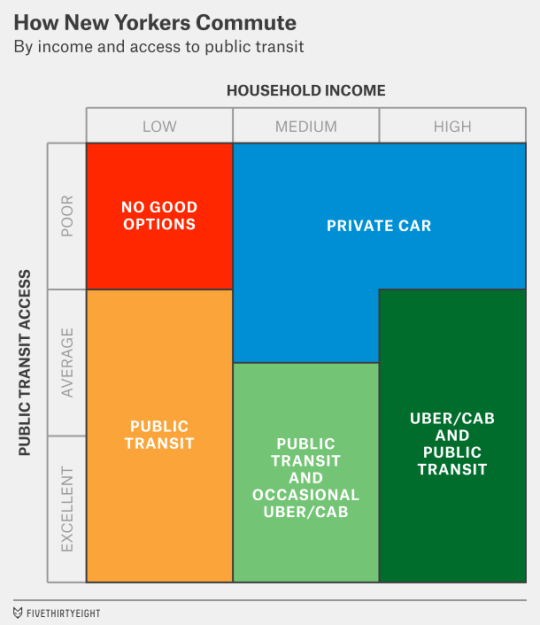
    The article does a deep dive into how New Yorkers commute. Here’s how they broke it down.

    image

    It then talks about what it will take for a company like Uber to make a meaningful dent in car ownership (which is one of the company’s goals) and how the truly big opportunity for Uber is to go more mass market and tap into the public transit market – either by interfacing with or by building its own version of it.

    Here’s their concluding paragraph:

    But there’s a much wider potential audience if Uber can also reach middle-class customers who want to save money. Perhaps in the distant (or even the not-so-distant) future, Uber can build its own version of “public” transit, making rides so cheap that they cost less than the $4 or $5 that Americans now pay, on average, to make a trip in their personal cars. In the meantime, it might have more success among “car-cutting” customers who can use Uber along with public transit. That might mean Uber’s growth is concentrated more in cities like New York, San Francisco and Chicago — and in Europe and Asia — that already have reasonably strong public transit networks.

    It’s definitely worth a full read. Thanks again for sending this over Evgeny.

  • Cities with the most single men and women

    There are thousands of people who read this blog via email or by following on Tumblr. The rest of the readership just stops by on the web and visits periodically.

    But of the thousands of regular readers, I know that many do not click through to the comment section. And that’s a shame. Because oftentimes I find the comments more interesting than my actual post.

    Take for example yesterday’s post on The Millennial Dream

    The initial post was about Millennial housing choices (and some stats on marriage and fertility rates). The comments provided some additional color on the trends, but they also got into mobile dating apps and whether or not it’s easier or harder to meet people in cities, today. It was a fun discussion.

    This got me thinking and reminded me that people come to cities not only because of labor markets, but because of dating markets. 

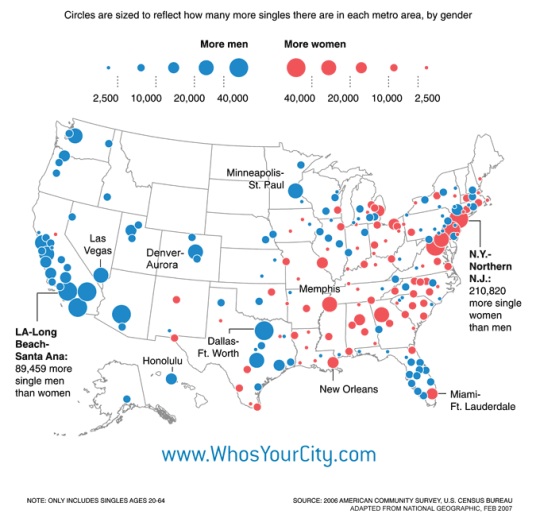
    So for today’s piece, I thought I would post the following diagram from Richard Florida’s book, Who’s Your City? It shows how many more singles (aged 20-64) there are – according to gender – in the largest US metro areas.

    I couldn’t find an equally detailed map for Canada, but based on this, it looks like Toronto is slanted towards single women and Calgary is slanted towards single men.

    Does the above look right to you?

  • Tech Tuesday: Uber testing out “Smart Routes” in San Francisco

    Uber is currently testing out something called “Smart Routes” in San Francisco.

    Basically it works similar to UberPOOL (where you carpool with strangers to bring the cost down), except that your pickup location (and trip?) is confined to a specific route. 

    This means less detours and more rides for drivers, as well as even cheaper fares for passengers. But just like public transit, you’ll likely have to walk a few minutes to get to the closest route. 

    Here’s a screenshot of what that looks like (via TechCrunch):

    The green line is the “Smart Route.” So all you have to do is select a pickup location somewhere along that green line, and you’ll save a bit a money. Currently it’s “$1 or more” off your fare, but who knows what it might be when this feature actually rolls out.

    This is fascinating to me because it’s starting to look and feel a lot like a conventional bus route. But in this case, the routes can change and new routes can be easily created as demand changes. 

    So it’s not just taxis that need to be thinking about Uber. It’s public transit authorities as well.

  • Are there enough nerds in Miami?

    image

    I was browsing through my online reading list this morning (as I do every morning), and I stumbled upon this Dezeen article talking about a big new 6.5 million square foot development being proposed in Miami’s Park West neighborhood. 

    The goal of the project is to transform Miami into “Florida’s Silicon Valley.”

    This sort of thing is happening all around the world. From Buffalo to Lisbon, cities everywhere are betting on tech, startups, and entrepreneurship to grow their economy in the 21st century. And I personally think that’s really exciting.

    But as I was reading the article, I couldn’t help but think of an old essay that Paul Graham wrote back in 2006 called, How to be Silicon Valley. (Paul Graham is a famous Silicon Valley entrepreneur/investor).

    In his essay Graham argues that to be or to replicate the model of Silicon Valley in your city, you basically need two types of people: rich people and nerds. The idea, of course, being that the nerds work on the cool new ideas and the rich people then fund them.

    Using this logic, he specifically calls out Miami as a city where few startups happen and as a city not likely to become another Silicon Valley. Though there’s lots of money and rich people in Miami, there simply aren’t enough nerds. In Graham’s words: “It’s not the kind of place nerds like.”

    But that was back in 2006. 

    The iPhone didn’t even exist yet. Things have since changed. Now there are successful tech companies like Snapchat (valuation north of $15 billion) that are based out of cities like Los Angeles. And I think you could argue that Los Angeles and Miami do share some similarities.

    So while it may have seemed far fetched in 2006 for Miami to become a startup hub, is that really the case today?

    Image: Dezeen