Daily insights for city builders, delivered every morning at 6 AM ET. I’m Brandon Donnelly — a Toronto-based real estate developer and founder of Globizen. I’ve been writing here since 2013.

Tag: rotman

  • Unlearning our biases

    I had coffee this morning with an engineer who is going back to business school in order to segue into real estate development. This is a fairly typical journey. Lots of people come into development from a related discipline. In my case, it was architecture (even though I never practiced architecture). It was also the case when I went to Rotman that something like a third of the class had a background in some sort of science or engineering field.

    However, one thing I did mention this morning was that he will likely find that he will need to unlearn certain things as he moves forward. Every discipline tends to indoctrinate us with a certain way of thinking about the world. Lawyers tend to be a certain way. Engineers tend to be a certain way. And architects tend to be a certain way.

    In my case, I found that architecture school taught me to be, among other things, an intense perfectionist. The modus operandi in design studios is that your project is never ever complete. The more you work on it, the better it will become. And as a result, you should feel a deep onus to work on it as much as humanly possible. But in business, this isn’t practical. In the vast majority of cases, speed over perfection will serve you better.

    I believe wholeheartedly in multi-disciplinary backgrounds, and maybe this is one of the reasons why. It shows you what you should unlearn. What would you say your biases are?

  • Need vs. want and what that means for pricing

    Seth Godin recently posted this four quadrant chart on his blog. It is for plotting different products based on price and based on want vs. need. In his post, he asks his audience to think about what they’re offering and which quadrant it fits within. It can only be in one.

    I am fascinated by questions of pricing. At at some point on this blog, I wrote about a pricing class that I took at Rotman while I was doing my MBA about a decade ago. It stands out to me as one of my favorite university classes.

    So let’s consider these four quadrants.

    In the top left, you have inexpensive products that are wants and not needs. This quadrant is where you’d place those novelty sunglasses you picked up for your friend’s theme party. Fun for that moment, but if they break or you lose them, that’s probably okay.

    In the top right are expensive wants. Seth uses the example of a Hermès purse. The need is a place to put your belongings, but that’s not how these sorts of items are priced. The real value, arguably, comes from their “signaling” and how they make the owner feel.

    This is the luxury goods category. Demand will likely be cyclical and sporadic, and so you’ll need to make sure that you have fat margins.

    In the bottom right are expensive needs — like a pacemaker. Seth’s point is that these products need to work exceptionally well, all of the time. In the case of a pacemaker, it is truly a matter of life or death. At the same time, there’s going to be less price sensitivity.

    In the bottom left are the inexpensive wants. Low cost products that people really want and are infinitely useful. Seth’s example is Amazon Web Services.

    This quadrant of products is attractive because demand will naturally be extremely high. Cheap and invaluable will do that. However, Seth’s caution is that you still need to sustainably deliver the goods. These aren’t novelty sunglasses.

    I find it helpful to think of products as existing in only one quadrant. But most offerings aren’t going to exist all they way in one corner. It’s perhaps important to consider the “job to be done.” (To borrow from the late Clayton Christensen.)

    Take, for example, housing. On a fundamental level, it’s a need. We all need shelter. But it can also be a want, or have aspects of want. I need a place to live. But I want a place in the mountains. This subtle difference means something very different when plotted precisely.

    Image: Seth Godin

  • School of Real Estate

    I’ve been getting a lot of (email) questions lately about what to study in order to become a real estate developer. So I thought I would reblog this post that talks about exactly that. I wrote it over a year ago and I almost forgot it existed.

    At the same time, I’m reminded of something: I think these questions really speak to the fact that there’s a significant opportunity (particularly in Canada) in terms of real estate development education. 

    Oftentimes when I get these questions, I end up recommending the Master of Science in Real Estate Development (MSRED) at ColumbiaMIT, and USC. Why don’t we have something similar (and better) in Canada? We are falling behind.

    I have raised this with some Universities here in Toronto, but the response I got was that they felt the real estate courses being offered as part of their existing MBA programs were more than sufficient. I think we can do a lot better.

    One professor suggested that I line up a big donor and work with them to spearhead the creation of the (Insert Donor Name Here) School of Real Estate. I think that’s a great idea, but not something I have the capacity for right now.

    Hopefully somebody else out there is of the same mind.

    Post Update: 3 days ago the Schulich School of Business (York University) announced a one-year full time Master of Real Estate and Infrastructure (MREI) program – the first of its kind in Canada. 

    This is great news. 

    Now I would love to see the University of Toronto and Ryerson University (as well as others) step up and leverage their respective architecture schools. Schulich is already out of the gate on this one.

  • The psychological benefits of third places

    Photograph - by rinatus (rinatus) on 500px

    – by rinatus (rinatus) on 500px

    Today I’m thinking about extraversion and third places within cities.

    As many of you I’m sure know, the idea of a third place is that after your home (first place) and your work (second place), cities have what are known as third places. This could be a coffee shop, a barber shop, or a public space (to name only a few examples).

    This, of course, is not a new idea. For decades people have been arguing that third places are essential for establishing a sense of community, place, and belonging. In fact, this emphasis on third place is one of the ingredients that made Starbucks so successful.

    But with the rise of the internet and freelancing, third places are becoming even more important. That’s why coffee shops have become arguably the best example of a third place in today’s cities. They’ve even become the new second place for some (many?) people.

    But beyond just a place to meet and socialize, I’ve been thinking today (while I was at a third place) about the psychological benefits of these spaces.

    For example:

    One of the key differences between extraverts and introverts is where they draw their energy from. For introverts, they tend to draw it from within. In order to recharge, they often feel the need to retreat and be left alone. Extroverts, on the other hand, draw their energy from the outside world. They charge up by being around other people.

    When I was completing my MBA at Rotman, one of the things they had us do at the beginning and at the end of the program was complete the Myers-Brigg personality test

    In both instances, I was as extroverted as they come (I am consistently what is known as an ENTJ). And from experience, I can say that I definitely feed off the energy of other people.

    But the interesting thing about this – to tie both of these topics back together – is that there appears to be a clear correlation between extroversion and a preference for living in urban centers. And given what I just said, that probably makes sense to you.

    So if you too classify yourself as an extroverted person, then third places are more than just a busy coffee shop or a vibrant public space. They are where you derive your energy and where you feel alive. And that’s a pretty powerful thing in my view.

  • Are startups causing inequality?

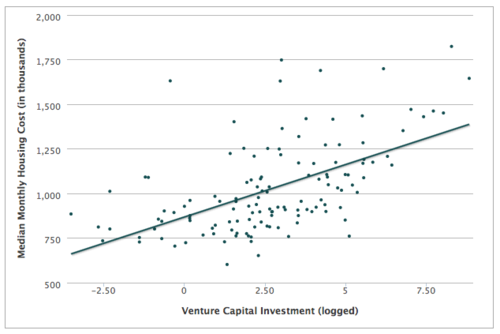
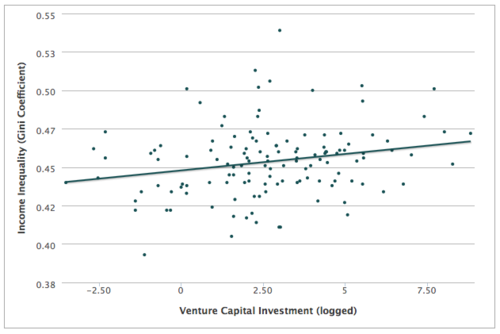
    Earlier this week Richard Florida published on article on CityLab talking about the relationship between tech innovation (in cities) and inequality. Specifically, the article deals with the correlation between venture capital investment and a variety of factors, such as monthly housing costs, wage and income inequality, and so on.

    The intent of the piece was to address the growing backlash against tech workers – in places like San Francisco – who have become the symbol for the growing gap between the rich and poor.

    The strongest correlation appears to exist between venture capital investment and housing costs. As the amount of venture capital goes up, so do housing costs – which probably shouldn’t surprise you. The rich start outbidding the poor for housing. Note: The two outlying dots at the top right, in the graph below, are Silicon Valley and San Francisco.

    image

    But when it comes to inequality, the relationship isn’t so clear. For wage inequality, there seems to be a relationship. But for the broader income inequality measure, the relationship is fairly weak. Here’s the graph:

    image

    So this is not as black and white as it might seem. Regardless, Florida ends the piece with the following statement (that I think is spot on):

    It’s time to stop pointing fingers and get on with the far more important task of harnessing the urban tech revolution to create a new urban middle class and a more inclusive urbanism—one in which many more workers and residents can participate, and one from which many more can benefit.

    The answer is not to stop innovating. That would be counterproductive. We should be be encouraging innovation, but at the same time figuring out how best to harness it for society as a whole.

    Tomorrow, I’ll touch a bit more on how we might go about doing that. I have a post planned that I think will tie in really nicely to this discussion. So stay tuned.

  • Frank’s Vault and virtual real estate

    Earlier this week a good friend of mine from Rotman, Frank Luengo, launched his own blog called Frank’s Vault.

    Given that he has used the same theme as I have here, I like to think it was inspired by ATC 🙂 But whatever the case may be, his mission is: “…to simplify the complicated, and to bring Bay Street and Main Street a little closer together.” In other words, it’s a finance blog. And I’m really enjoying it so far.

    Last summer Frank told me that he was thinking about starting this and so I’m thrilled that he finally decided to do it. I’ve talked many times before about the benefits of personal blogging, and so I won’t repeat them here. But I did want to mention one other thing. When Frank told me he launched, one of the first things I did was congratulate him on claiming frankluengo.com.

    And I did that because I’m a big proponent of owning your firstnamelastname.com. I look at internet domains as virtual real estate and I, therefore, look at firstnamelastname.com as your own piece of branded real estate on the internet. If you don’t buy it up, somebody else will. That’s obviously why I own brandondonnelly.com and why I host ATC on it.

    But since I’m such a believer in real estate – both the offline and online varietals – I actually own many others. I also own brandondonnelly.co, brandondonnelly.ca, and brandondonnelly.me. The latter one links to my tumblog, and the first 2 just redirect to this site. I don’t derive much utility from having all these URLs, but I just want them so that nobody else can get them.

    So if you haven’t yet thought about it, I would encourage you to think about claiming your own piece of real estate on the internet. I use Namecheap.com to buy my domains, but there are many others out there.

  • How technology could completely change the real estate development industry

    If you’re involved in the built environment in any way, shape, or form – as a developer, architect, policy maker, and so on – I would highly recommend you watch the video below. My friend Candice Luck, who I went to Rotman with, sent it to me this morning with a link starting at the 24 minute mark. I haven’t yet watched the whole thing, but given how interesting this short section was, I plan to.

    The video is a talk by Steve Jurvetson, who is a venture capitalist with DFJ. He was one of the founding investors in Hotmail and currently sits on the board of companies like SpaceX and Tesla Motors. At the 24 minute mark he talks about a startup called Flux.io that hasn’t yet launched their product, but is working towards “reimagining building design”. They’re a spin-off from Google X and plan to officially launch in early 2015.

    Rather than try and describe the video here, I will just say that it’s an incredible example of how technology and digitization could completely change the real estate development industry. If you can’t see the video below, click here. The video starts at the Flux.io section.

    [youtube https://www.youtube.com/watch?v=IPgyb6euISs]

  • An MBA post-mortem from a real estate guy

    image

    This post originally appeared on the Rotman Morning & Evening MBA blog

    As a recent graduate of Rotman’s Morning MBA program (and presumably because somebody over there reads Architect This City), I was asked to write a guest post for their MBA blog. More specifically, I was asked to share my thoughts on the real estate industry and on my time at Rotman. And since I haven’t really done a post like this before, I thought it would be worthwhile to do.

    But before I begin, I think it’s important to explain a bit about my background and my motivations for doing an MBA in the first place. Before going to Rotman, my first master’s degree was in architecture and real estate from the University of Pennsylvania. Basically it was a Master of Architecture combined with their MBA real estate concentration. So it included everything from real estate finance to real estate development.

    Having already done this 3-year program, there were a couple of things I wanted out of an MBA program. First of all, I wasn’t prepared to go full-time. Five years out of the workforce was simply too high of an opportunity cost for me and so part-time was all I considered. I also only applied to Rotman because I didn’t want to waste any time traveling outside of the city (or to other parts of the city). I also saw Rotman as a rising star and one of, if not the, best option in Canada.

    At the same time, I didn’t give much thought to the real estate curriculum being offered even though I fully planned to stay working in the real estate industry. I felt like I already had that sort of formal training and so, unlike some of my classmates who were looking to switch into real estate, I was after something else. I ended up majoring in Innovation & Entrepreneurship.

    What I was trying to do was really round out my skillset and fill in some of the missing holes: accounting, marketing, and so on. But even more importantly, I had drunk the kool-aid around Rotman’s focus on integrative thinking (renamed “business problem solving”) and “design thinking”. And since there will always be a part of me that thinks of itself as a designer, it seemed like the perfect program for me. 

    Because at the end of the day, it’s not that hard to learn how to create a real estate development pro forma or calculate your expected exit cap rate on some piece of real estate. That stuff is all fairly mechanical. It might seem quite mythical when you don’t know how to do it, but once you do, you quickly realize that a financial model is only as good as the assumptions you put in. As we’re told in school, garbage in = garbage out.

    The real value gets created in the assumptions. It’s created in the way you think about the market, your product, and your customers. And a lot of the time, the most value is created when you know or believe something that nobody else believes to be true. If you’re a lemming, you’re going to get lemming like returns and outcomes. So in a lot of ways, I went to Rotman to help me think better and think differently.

    In some industries, resting on your laurels can kill you in a relatively short period of time. See Blackberry. Real estate, on the other hand, is generally a bit slower moving. But that doesn’t mean that change doesn’t happen and that there isn’t room for loads of innovation.

    Just look at the Toronto of today versus the Toronto of 10-15 years ago. We’ve transformed ourselves into a city of high-rises where more and more people now want to live in the core of the city. This has brought commercial landlords back to the city center so that employers have downtown office space to attract the best human capital (see South Core) and it’s brought suburban retailers into the core to sell to these same urbanites. We’re seeing a complete reversal of the trends experienced with the last generation.

    Amidst all of this, I’ve been noticing a growing awareness and passion around cities. My blog Architect This City started as a forum for architects, planners, and developers, but it has grown into a community of thousands of people who simply love cities. They’re passionate about everything from architecture to grade-separated bike lanes (as geeky as that probably sounds).

    So I think that it’s not only the real estate market that’s changing, but also the professions involved with it. I’ve written a lot about the future of the architecture profession because I think we’re starting to see the emergence of new business models. Architects are becoming developers and developers are starting to become much more heavily involved in the shaping of the communities in which they build. Which is why in many ways, I think of my self as a city builder more than anything else.

    Finally, to make matters even more complicated, technology is starting to have a huge impact on the business. Zillow.com just bought Trulia.com for $3.5 billion to form a portal that will now serve around ¼ of the online US residential market. And Opendoor.com is getting ready to launch a product that seems entirely poised to disrupt the way homes are bought and sold in America.

    So what I’m getting at is that there’s absolutely no guarantee that the way we used to do something, is the way we’re going to continue doing it. In fact, I operate under the assumption that everything can and will be changed by somebody at some point. And if this is the way you approach things, then it should become abundantly clear to you that being able think critically is going to be one of your most important assets.

    When I was just starting at Rotman, I met for lunch with an upper year classmate who told me that one of the best things he’s taken away from the program is the ability to think about the way he thinks. That may sound silly to some, but in our uncertain world, it’s actually a great skill to have.

  • The case for electronic road pricing

    I just finished reading an HBS business case on road pricing in Hong Kong for a class I’m taking as part of my MBA. Since it’s a topic that’s integral to cities, I thought I would post my case prep here. Below are the questions I was asked to my prepare, with my answers below.

    The case is essentially about traffic congestion in Hong Kong and a decision to either build more road (a bypass route running adjacent to the harbour: The Central-Wan Chai Bypass) or implement an Electronic Road Pricing (ERP) system, similar to what was implemented in Singapore in the 70s and in London in 2003.

    If you’re a reader of this blog, you can probably guess which side I’m going to lean towards. I believe fundamentally that the only way to construct a large well functioning urban region is on the shoulders of mass transit. 

    Q: For a typical commuter, what are the costs and benefits involved in using a car over using public transportation? Why would a commuter choose to drive? Who are the most likely to drive?

    A: In my view it’s a trade off between cost, time and, to some extent convenience, although convenience and time are somewhat linked.

    From a cost standpoint, your typical driver has the fixed cost of owning a car (payments, insurance, maintenance, etc.) and the variable costs of driving (gas, parking, applicable road prices, etc.). For those who have already committed to purchasing a car, probably as a result of where they’ve decided to live, it then becomes largely a question of variable costs. In most cases, these costs are higher for driving than they are for public transportation.

    But then comes the question of time and convenience. Residents of global cities, such as Hong Kong, are becoming increasingly cash rich and time poor. There’s a real value to time. And driving often offers speed, as well as the convenience of a personalized and “comfortable” ride (personally, I find gridlock highly uncomfortable). So if the value of the time you’re going to save by driving exceeds the variable cost of driving, you’re likely going to drive. In other words, higher income individuals should choose to drive.

    Q: What are the costs of traffic and congestion for society?

    A: The costs of traffic and congestion to society are huge. You have the lost productivity as a result of people and goods sitting idle. You have the strain on family life caused by working parents struggling to find enough time outside of work. And you have the environmental impact of idling cars.

    Here’s a few stats from Natural Resources Canada:

    “In fact, if Canadian motorists avoided idling for just three minutes every day of the year, CO2 emissions could be reduced by 1.4 million tonnes annually. This would be equal to saving 630 million litres of fuel and equivalent to taking 320,000 cars off of the road for the entire year. Eliminating unnecessary idling is one easy action that Canadians can take to reduce their GHG emissions that are contributing to climate change.”

    Q: Discuss the effect of electronic road pricing (ERP) on: (a) urban re-development and town planning, as well as residential property prices; (b) fare faced by public transport.

    A:

    (a) Based on London’s experience, their property market “recorded no impact, positive or negative, in or around the charging zone.” (Case) However, intuitively, I would expect development pressures and pricing to increase within the boundary of any charging zone and for prices to fall outside, along the periphery. The reason for this is that urban real estate models, such as the Monocentric City Model, argue that as you move out from the center of a city, land prices fall, but transportation costs increase. It ties into the whole “drive to affordability” notion. In the case of ERP, transportation costs have now increased for the periphery, so it could drive down land/property prices. 

    (b) Relatively speaking, an ERP system should make pubic transportation fares appear cheaper since the marginal cost of driving has now increased. Therefore, in the longer term, it may create an opportunity to raise fares.

    Q: Why is the use of road usually free of charge?

    A: Roads are thought of as a public good. And so they’ve been typically priced as such. However, roads, and in particular highways, are also thought of as an economic development engine. They’re a heavily subsidized form of infrastructure that have been used as a tool to spur suburban and exurban growth. By driving down the cost of transportation (without factoring in the environmental costs, of course), extensive highway networks have been used to unlock the value of previously under utilized outlying land. However, I disagree with the notion that all roads should be “free.”

    Q: Why roads are often provided and managed by the government and not by profit- maximizing firms?

    A: Because typically profit-maximizing firms require paying customers. Also, since they’re viewed as a public good, governments typically want to control them.

    Q: What are the differences between ERP and a classic toll?

    A: A classic toll is typically based on a fixed price that is paid regardless of the time of day. ERP is variable. Pricing fluctuates based on the time of day and/or the traffic and congestion levels. It’s the idea that as demand for the public good in question rises, so does the price of using it.

    Q: What are the advantages of implementing ERP?

    A: There are number of advantages. The first is that you get an immediate drop in traffic/congestion. This has been clearly shown through previous case studies in Singapore, London and Scandinavia. As a result of this, the city is then able to offer an improved user experience for those who are willing to pay the increased transportation costs. At the same time, the city now has a new revenue source that it can dedicate towards other infrastructure improvements, such as public transportation. Indirectly, the city will also benefit from increased productivity levels and a smaller environmental footprint.

    Q: Why are there such few cities that have successfully adopted ERP despite the fact that the idea is praised by many economists? Singapore is one of the few successful examples, why?

    A: It’s politically unfavourable. Nobody likes any sort of new “tax”. When Livingston first proposed a congestion charge in London residents called it “Carmageddon.” Few leaders have the guts to push something like this through.

    Singapore, on the other hand, had no choice. Geographically they couldn’t afford not to discourage car use and so the political will was there. I think that Hong Kong is in a similar boat.

    Q: Imagine that you were the government official responsible for the introduction of ERP. What would be your strategy to persuade the public to support your implementation?

    A: I would focus on two main ideas: (1) the value proposition being offered and (2) the future use of the funds being collected through ERP. 

    The main value proposition is reduced congestion for a segment of the population that I suspect would be willing to pay for the convenience. Again, I return to the idea of being cash rich and time poor. 

    For those with absolutely no willingness to pay for this convenience, the value proposition becomes increased investment in public transportation (as a result of the ERP funds). This is how I believe the funds should be allocated.

    I also think it’s critical to be open and transparent to the public about how exactly the funds will be used. You don’t want the public to think of ERP as a tax. You want them to think about it as investment in infrastructure in the region.

    However, it’ll take a change in mindset. People are accustomed to roads being “free.” But to paraphrase Harvard economist Edward Glaeser, from his recent book the Triumph of the City, if you offer a hugely valuable good—such as a road or highway—and make it free, you’ll never be able to keep up with demand. It’s for this reason that building new and more roads is rarely the answer. Traffic patterns simply adjust to take advantage of the increased supply.

    If you want to control usage, you need to slap a price tag on it.

  • Richard Florida on why creativity is the new economy

    Richard Florida recently gave a talk at the Rotman School as part of Toronto’s “Big City, Big Ideas” lecture series. It was called: Why Creativity Is the New Economy. You can watch it here via Rotman. It’s about an hour long.

    If you’re familiar with the work of Richard Florida, you’ll find much of what he talks about familiar. But there is one point that I think is absolutely worth reiterating again, and again: The new economic unit of our time is the city. It used to be nations but, in today’s world, cities trump nations, provinces and states in terms economic importance.

    Florida has long stressed this point in his work and I think he’s absolutely right. The problem, however, is that our governance structures are ill-suited to deal with this shift. There are too many layers of government and our cities do not have nearly enough autonomy. 

    Toronto is also facing a profound leadership deficit at the municipal level, to say the least (See Rob Ford). This cannot continue. Strong municipal leaders are critical to our sustained global economic competitiveness. It’s every global city for themselves and I, for one, want to win.

    To give you an example of the dramatic rise of cities, take a look at this recent TechCrunch article on billion dollar startups. If you take a look at learning number 9, you’ll see an incredible interesting fact: San Francisco—not “the Valley”—is now home to the most billion dollar startups. Startups are eschewing the suburbs for the city.

    I’ve written a lot on this trend, but I still don’t think that our governments have truly woken up to the fact that, in the new economy, our cities are our most important asset.