Daily insights for city builders, delivered every morning at 6 AM ET. I’m Brandon Donnelly — a Toronto-based real estate developer and founder of Globizen. I’ve been writing here since 2013.
The data only runs up until January 2016, but here’s what he found:
“…yellow taxis provided 60,000 fewer trips per day in January 2016 compared to one year earlier, while Uber provided 70,000 more trips per day over the same time horizon.”
The Uber data only begins in 2015, but you can still see how quickly it is growing and how yellow taxis are losing market share. Five years ago, yellow taxis were reaching over 500,000 trips per day (a pretty amazing number) and in January of this year they were at about 350,000 trips per day.
It also appears that Lyft is struggling to gain traction.
What’s also great about Todd’s blog post is that he has set it up so that his chart will automatically update as new data becomes available. So if you’re interested in this topic, you should bookmark his post.
Few things are better than waking up in the mountains and seeing a notification on your phone that 9″ of fresh snow have fallen overnight, bringing the 48 hour snowfall total to 16″.
This is what people in mountain towns live for. They ski in the morning and then head to work in the afternoon. I heard a number of people on the mountain today saying that they, “want to be in the office after lunch.” It’s a lifestyle thing.
On that note, today I’d like to focus on 10 city building predictions for 2016. I’ve been assembling this list over the past few weeks and now that I have had my fill of Utah powder for the day, I’m dedicating the rest of the afternoon to writing.
These are never easy to put together. But here are my thoughts:
We will see increased migration to secondary cities – outside of the alpha global cities – which offer a higher quality of life, more affordable housing, and the ability to live a particular lifestyle. This includes cities like Austin (creative startup hub) and Denver (outdoor recreation).
As more and more cities wake up to the importance of lifestyle in attracting top talent, I think we will see a lot of cities follow the lead of Amsterdam and create “night mayors” or some other equivalent. These cities will begin to see nightlife as a competitive urban advantage.
Global cities will start experimenting with different land use and property tax reform strategies to try and deal with rising income inequality and eroding housing affordability.
We will see a barbell of residential unit sizes. We’ll see more well-designed small units as a way to try and promote housing affordability and we’ll see larger urban infill units for families and baby boomers who want to live/remain in walkable urban communities.
In line with above, I think we will see a further rethinking of urban spaces. Flexible spaces, unique program mixes, and a continued blurring of public/private spaces. One example of this is the trend towards small private spaces surrounded by generous public/communal spaces.
The Toronto and Vancouver real estate markets will continue to chug along because of low interest rates, a weak Canadian dollar, and increased foreign investment. That said, I think we will see more restraint when it comes to over-the-top luxury product.
We will finally see a disruptive technology product that starts to get people in the real estate industry thinking that change is on the way. This will not be a product that ports an offline experience online; it will a new way of thinking about the industry.
This will be the year that cities stop fighting Uber (and other similar marketplaces). Cities (and lobbyists) will finally accept that this is a new reality and then work to figure out the best way to create policy around it. Edmonton, Alberta has already become the first Canadian city to regulate Uber.
Road pricing will get the attention it deserves in North America. Things will start out slow, but we will finally get ourselves on a path which recognizes that we can’t build our way out of traffic congestion in most major cities.
I will publish a book on becoming a real estate developer.
Many city building trends and shifts seem to happen in a global way. But I think it’s worth noting that a lot of these predictions were likely written with my North American lens on, and in some cases my Toronto lens on.
It’s not easy sitting down and thinking about what will happen in the future. But it’s a worthwhile exercise. It forces you to take a stance and then, when the future does come, you can see how well you did. I saw Fred Wilson do this on his blog and I thought it was a great idea.
Now I would love to hear what you think about my predictions and what yours are for this year. Please let us know in the comment section below.
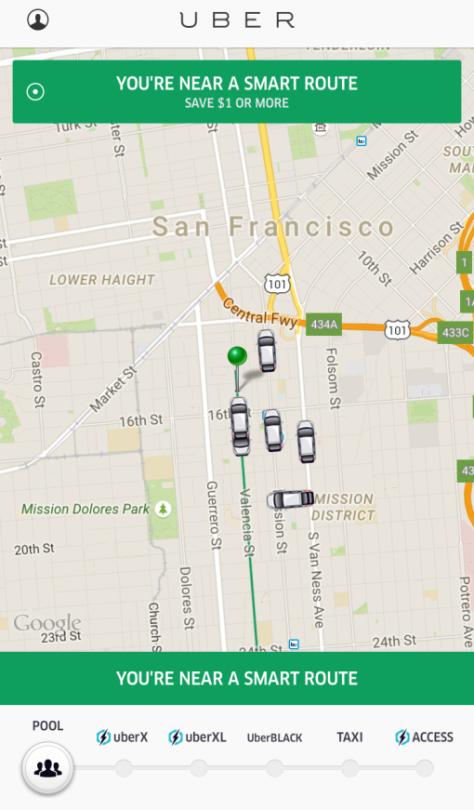
Uber is currently testing out something called “Smart Routes” in San Francisco.
Basically it works similar to UberPOOL (where you carpool with strangers to bring the cost down), except that your pickup location (and trip?) is confined to a specific route.
This means less detours and more rides for drivers, as well as even cheaper fares for passengers. But just like public transit, you’ll likely have to walk a few minutes to get to the closest route.
Here’s a screenshot of what that looks like (via TechCrunch):
The green line is the “Smart Route.” So all you have to do is select a pickup location somewhere along that green line, and you’ll save a bit a money. Currently it’s “$1 or more” off your fare, but who knows what it might be when this feature actually rolls out.
This is fascinating to me because it’s starting to look and feel a lot like a conventional bus route. But in this case, the routes can change and new routes can be easily created as demand changes.
So it’s not just taxis that need to be thinking about Uber. It’s public transit authorities as well.
One evening this past spring I was leaving a Rotman School event at Liberty Grand on the west side of Toronto. There aren’t a lot of taxis coming through this part of the city, so I figured I was going to have to wait while I hailed one from my phone. But as luck would have it, one happened to be pulling up just as I walked out of the hall.
As he drove up and rolled down the window, I told him that I was going to the St. Lawrence Market area and that I needed to pay by credit card (I was trying to be a nice guy and avoid the inevitable fight when he was dropping me off). He responded by saying, “My machine is broken. Can’t you pay with cash?” I told him, “No, unfortunately I don’t have any cash on me. I need to pay with credit card.” He then rolled up his window and drove up closer to the entrance of the hall.
Faced with this scenario, I did what most people would probably do nowadays: I pulled out my phone so that I could hail either an Uber or a Hailo cab (I’m sad that Hailo has since left the North American market). I decided on Hailo (it was cheaper until UberX came along) and ordered a car.
But within a few minutes, the same taxi with the broken credit card machine circled back around, rolled down his window, and told me that his machine was now working and he would take me to the St. Lawrence Market. Knowing exactly what had happened, I said to him, “Wooooow, that’s funny that within the span of a few minutes your machine has magically started working again.” He wasn’t happy with that response.
Now, we all know why he didn’t want to take my credit card. He didn’t want to pay the fees and he wanted the cold hard cash. And who can really blame him for wanting to maximize his profits. But for the end user, this experience sucks. When it’s 2 in the morning and all you want to do is go home to bed, you don’t care about the few dollars he’s trying to save. You just, want, to go, home.
And that’s one of the reasons why Uber (and previously Hailo) is having such a huge impact on the market. Even before UberX arrived (the cheaper alternative), lots of people were more than willing to pay the Uber premium. And they continue to pay their controversial surge prices. But that’s because the experience is so much better than what’s offered today.
We all know that Uber is under a lot of fire for what they do, but Toronto mayor Tory is 100% right in saying that ridesharing and peer-to-peer taxis are here to stay. Toronto may be seeking a court injunction to stop the service in this city, but I would agree that it’s likely going to be a big waste of money. The cat is already out of the bag.
What’s happening here is no dissimilar to what happened with Napster. A court order may have forced the company to shut down, but it didn’t maintain the status quo for the music industry. That industry went, and continues to go through, a lot of change. So a better option, would be for everyone to sit down together and figure out what the future of the taxi industry is going to look like. Because I can guarantee you that it’ll continue to change.
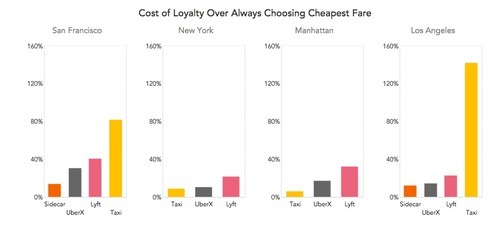
This morning I woke up to a post from venture capitalist Fred Wilson talking about the cost of loyalty when it comes to local transportation markets. More simply, it was a cost comparison between regular city taxis and ride sharing services such as a UberX, Lyft, and Sidecar in San Francisco, Los Angeles, and New York.
The way to understand this chart is to think about it as the answer to this question (from whatsthefare.com): If I were to take 1,000 rides over my lifetime with one individual service, how much more would I pay than if I compared prices and always picked the cheapest option?
What you should immediately see is that regular taxis are far more expensive in San Francisco and Los Angeles compared to all of the ride sharing services. In the words of Fred Wilson: “That is crazy. They are going to go out of business in those markets with that pricing.”
In my words: They are fucked.
I wonder where Toronto would place against these cities. My gut tells me that we would be closer to San Francisco than New York. And if that is the case, I think you can figure out what that means.
I thought this would be an interesting post given yesterday’s point about our cities being multi-modal. We urbanites have many more options at our disposal than we did only a few years ago. And if they’re cheaper and more convenient, we’re going to use them. I think that’s a good thing.
UberX officially launched in Toronto today. Which means that Toronto’s taxi and limousine industry is about to get a lot more grouchy. For those of you who may not be familiar, uberX is Uber’s low-cost car service. Just like the regular version, you hail a car using your mobile phone. But this option will cost you 40% less than a regular taxi!
Here are sample rates from the Financial District to Yonge & Eglinton (midtown):
And from the Financial District to Pearson International Airport:
This is pretty exciting. Because as much as I think it’s great to use Hailo or Uber to hail and then pay for a car, the big problem in my mind has always been that cabs in Toronto are just far too expensive. The meter starts at $4.25 and shoots up faster than you can take a selfie in the backseat.
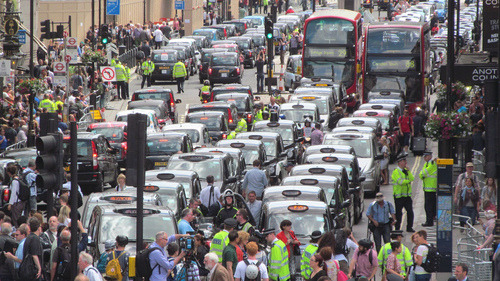
But obviously there’s an entrenched industry here that is not going to be happy about a startup eating into their fares. So I wouldn’t be surprised if we see a lot more backlash here in Toronto – as has been the case in many other cities. However I don’t think that’s a viable long term solution for the incumbents.
So instead of protesting and trying to ban it, we should be figuring out how to adjust to this changing reality. For the incumbents, this might mean lowering fares or figuring out a better way to differentiate themselves. A 40% discount is a pretty compelling value proposition. For me personally, I don’t know why I would ever pay more for a regular taxi, unless there was no other option.
On a side note, it’s worth pointing out that an uberX trip from downtown to Pearson is estimated to cost around $33 – roughly the same as what some people think the Union Pearson Express train will cost. That’s further evidence that charging a lot and targeting business travelers may not be the best strategy.
One of the things that many city planners, transportation experts, and municipalities are trying to figure out is how to successfully shift people away from driving towards alternative modes of transportation, such as biking and transit. Now, this is no easy task. There are a myriad of factors that influence a person’s decision to drive or not drive–or if they should even own a car in the first place. Though, land use and density are, in my opinion, probably the biggest.
But of all the solutions thrown around, mobile apps are typically not within the playbook. However a recent New York Times article is making the argument that it should be, because car-sharing services and apps like Uber seem to be indeed having an affect on people’s decision to own a car. And that’s because in some cities it’s actually cheaper to use Uber every day (than to own a car) and because taxi use has been shown to correlate with other (non-driving) forms of mobility.
Paradoxically, some experts say, the increased use of ride-sharing services could also spawn renewed interest in and funding for public transportation, because people generally use taxis in conjunction with many other forms of transportation.
In other words, if Uber and its ride-sharing competitors succeed, it wouldn’t be a stretch to see many small and midsize cities become transportation nirvanas on the order of Manhattan — places where forgoing car ownership isn’t just an outré lifestyle choice, but the preferred way to live.
And to be honest, I don’t think this is all that far stretched. More and more I find myself wondering why I even own a car. It’s not appreciating sitting downstairs in my garage and, given the frequency in which I use it, I would definitely be better off financially if I simply used an app like Uber or Hailo more often. About the only thing those apps aren’t great for are trips to Home Depot and snowboard trips to the mountain.
I’ve been a big fan of MIT’s Senseable City Lab since I was a grad student at Penn. Their work sits at the intersection of cities and technology, and so I’ve always found it incredibly fascinating.
Recently, the lab examined data from all of New York’s 13,586 registered cabs and looked for ways that technology and mobile tech could potentially optimize the way the system works today. In particular, they were interested in examining instances where people were heading to the same place at the same time, and were within no more than a 3 minute walk of each at the start of the trip.
That is, 80% of the time, there was an overlap in both time and route. That’s an hugely interesting stat because it starts to show just how much waste and inefficiency there currently is in the system. Think about all the trips and carbon emissions that could be potentially eliminated through optimization.
Here’s a video they produced on the project. Click here if you can’t see it below.
It’s a great example of how technology is and will continue to creep into every segment of the economy. It’s exactly what I was talking about in my post, “Disrupting everything.”