
Daily insights for city builders, delivered every morning at 6 AM ET. I’m Brandon Donnelly — a Toronto-based real estate developer and founder of Globizen. I’ve been writing here since 2013.

Tag: research paper

  • The status quo, please

    In 1988, William Samuelson (Boston University) and Richard Zeckhauser (Harvard University) published a seminal paper called, Status Quo Bias in Decision Making.

    In one of the experiments cited in the paper, two groups of people are given a hypothetical task that involves picking from a selection of different investment opportunities.

    In both cases, the groups are told that they are someone who regularly reads the “financial pages”, but that up until recently hasn’t had much money to invest.

    Both groups are then told that they have just inherited “a large sum of money” from their great-uncle. This is now where the groups diverge in terms of the information given.

    The first group is given a neutral version. They are told they can invest in any of the following portfolios: a moderate-risk company, a high-risk company, treasury bills, or municipal bonds.

    The second group is given the same selection of portfolios, but is also given a “status quo selection.” They are told that a significant portion of their great-uncle’s portfolio is currently invested in a moderate risk company. 

    (They are also told that the fees associated with an investment change are insignificant and should not be a consideration for this decision.)

    What do you think happened?

    A number of different scenarios were tested, but as soon as one of the options was presented as the status quo, it became “significantly more popular”.

    This status quo advantage also tended to increase as the number of investment options increased. Perhaps people just got overwhelmed by the options and went with the “safe bet”.

    This phenomenon has become known as the status quo bias. 

    It is one of the reasons why some political offices have term limits. The incumbent bias can make for an uneven playing field. People vote for the name they recognize on the ballot.

    And it is one of the reasons why change, in general, can be so unsettling. The countless studies suggest we have an inherent bias towards the status quo irrespective of its objective merits.

    P.S. This is what came to mind as soon as I heard people calling the King Street Transit Pilot a “disaster” before the first weekday of its run was even over.
  • Local rail-driven agglomeration economies

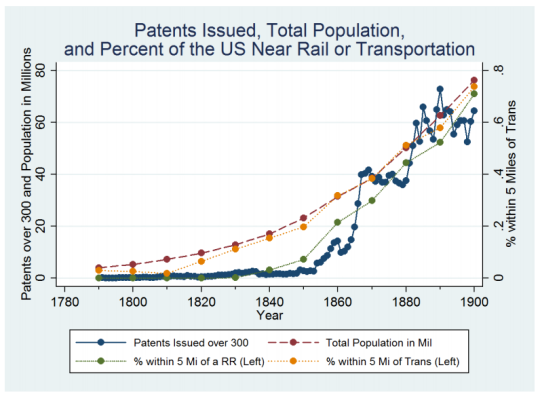
    This morning I came across the below graph in a Medium article by Eric Jaffe of Sidewalk Labs. It is taken from a research paper by Elisabeth Ruth Perlman called, Dense Enough To Be Brilliant: Patents, Urbanization, and Transportation in Nineteenth Century America.

    What this chart shows is patents issued – a proxy for innovation – in all U.S. counties between 1790 and 1900. This data is then compared against access to transport, such as rail. The discovery is a statistically significant relationship between innovation (patents issued) and rail (transport) access.

    The spike in the 1850s (shown above) is as a result of increased rail access.

    But Perlman takes it a step further and asks: what is causing this spike in innovation? Is it because inventors and creators started responding to the larger market now accessible to them because of rail connectivity? Or did transportation somehow improve productivity and the flow of information?

    To answer this question, she dug into the patents themselves (over 700,000 of them) to try and identify how ideas and key words were spreading. What she found is that rail access alone doesn’t encourage innovation. References to new technologies did not increase.

    What mattered was what happened locally. Transportation improvements promoted urbanization and density during her study period, and that’s what drove innovation. Connectivity created agglomeration economies at the local level.

    Obviously a lot has changed since the 19th century. But whether it’s rail connectivity or internet connectivity, have the rules really changed? Place still matters. What happens locally still matters. Perhaps even more. 

    This is an important lesson to consider as we build our cities and invest in transportation. Rail alone isn’t enough. What matters more is what we build around it. Are we dense enough to be brilliant?

  • A short history of redlining

    In 1933, the United States Congress created the Home Owners’ Loan Corporation (HOLC). With foreclosures rising as a result of The Great Depression, the task of the agency was to provide new low-interest mortgages to both homeowners and private mortgage lenders. Between 1993 and 1936, the agency served about one million households.

    By 1935, the parent company of the agency (the Federal Home Loan Bank Board) decided to initiate something called the “City Survey Program.” The idea was to look at local real estate trends – including the racial and ethnic composition of the country’s largest cities – in order to get a better understanding of how to manage all of these outstanding loans.

    One outcome of this program was the creation of the HOLC’s infamous “residential security maps.” (Philadelphia’s is shown at the top of this post.)

    These were maps that categorized city neighborhoods according to 4 grades. Grade A neighborhoods (green) were the best ones. They were ethnically homogenous and had room to be further developed. Grade B neighborhoods (blue) were the second-best ones. They were already completely developed, but were still considered desirable. Grade C neighborhoods (yellow) were starting to decline and showed an “infiltration of a lower grade population.” And finally, grade D neighborhoods were considered “hazardous” and colored in red. These neighborhoods had low homeownership rates, old crappy housing, and an “undesirable population”, which, at the time, largely referred to Jews and African Americans.

    Some have argued that the HOLC and their “residential security maps” are what kicked off systematic mortgage discrimination in America’s inner city neighborhoods – later referred to as “redlining.” This was the practice of denying credit to people who lived in these undesirable neighborhoods (and even to real estate developers who wanted to build in these undesirable neighborhoods).

    But University of Pennsylvania professor Amy Hillier has argued that these maps simply reflected the ethos of the time period. Using a sampling of HOLC mortgages, she found that 62% of them were issued to grade D (red) neighborhoods. The agency, itself, was not actually redlining in practice.

    Furthermore, she also looked at private mortgages issued in Philadelphia between 1937 and 1950 and found that security grade rating actually had no impact on the total number of loans issued. She did, however, discover slightly higher interest rates for properties located near and in the bottom security grades.

    All of this is to say that “redlining” is likely not the only culprit for inner city decay. There are other factors at play.

    To that end, the National Bureau of Economic Research recently published a working paper, which I discovered through CityLab, called, “Racial Sorting and the Emergence of Segregation in American Cities.” The key finding here is as follows:

    “Our preferred estimates suggest that white flight was responsible for 34 percent of the increase in segregation over the 1910s and 50 percent over the 1920s. Our analysis suggests that segregation would likely have arisen in American cities even without the presence of discriminatory institutions as a direct consequence of the widespread and decentralized relocation decisions of white urban residents.”

    In other words, it wasn’t just mortgage discrimination; it was also just general discrimination. That actually makes a lot of sense, because, if you think about it, the former couldn’t have occurred without the latter being present.

    Here’s how the research paper puts it (via CityLab):

    “Policies that reduce barriers faced by blacks in the housing market may thus not prevent or reverse segregation as long as white households have the ability and desire to avoid black neighbors.”

    (Note: Most of the information and data used in this post was sourced from the work and research of Amy Hillier.)

  • Does the world need a Global Parliament for Mayors?

    Earlier this month a team consisting of Benjamin Barber (who is author of If Mayors Ruled the World: Dysfunctional Nations, Rising Cities), Richard Florida (who is Director of the Martin Prosperity Institute here at the University of Toronto), and Don Tapscott (who is a leading authority on innovation) released a research report advocating for a global network of cities that they’re calling a “Global Parliament for Mayors.”

    Here’s a snippet from the press release:

    “Nation-states work together through multi-lateral agreements and global institutions in an effort to solve global problems. But states have limitations, and their cooperative efforts in our new era of interdependence and globalization are increasingly insufficient and even ineffective and outmoded,” say the three prominent researchers. A Global Parliament of Mayors represents a new type of governance network – one with enormous potential.

    “Our proposed parliament would operate as a global urban network with a vibrant online community that collaborates on key issues 365 days a year,” they say. “Multi-stakeholder governance has come of age and is now fully independent from control by any government, or governmental organizations like the UN.”

    And if you dive into their report, you’ll find the following 5 reasons for why they believe a Global Parliament for Mayors (GPM) makes sense:

    1. Global migration to cities. Most people live in cities, so it makes sense to concentrate problem-solving capabilities there.
    2. Urban predisposition for problem-solving. Cities are entrepreneurial, close to the people and richly connected to a wide variety of stakeholders. They have a history of cooperation and pragmatic problem-solving. 
    3. A need for experimentation with new governance models. Traditional models of state-based global governance have struggled to advance effective solutions to many global problems, so there is an urgent need to experiment with new models. The GPM is the most promising. 
    4. Digital networks. Online collaboration technology makes it possible to operate a largely virtual parliament that would not only be more cost-effective, but more transparent, inclusive and productive.
    5. Digital citizens. There is a large, educated and motivated population of digital citizens that could be tapped to improve urban governance.

    In principle, I agree with the direction. And I feel that way because of the two major shifts outlined above: More people are living in cities (a trend that all urbanists talk about ad nauseam) and digital networks are having a disruptive effect on the way we run companies and live our lives.

    I’ve talked before about how the internet is causing a decentralization of value creation (see Airbnb, YouTube, and so on) and so I think it only makes sense that our governance structures will inevitably go through a similar transformation.

    The governance models that we are living with today were put in place during a time when the world was a different place. At one point, nation-states were the de facto way to effectively organize ourselves on a global stage – probably because there wasn’t any other reasonable alternative.

    But today, we are connected and interdependent in entirely new ways. And so the opportunity in front of us is to create a governance structure that leverages the progress and innovation that’s happening in cities, everywhere.

    If cities are our most important economic unit, then mayors are arguably some of our most important leaders. So it behooves us to figure out how to give them the frameworks and forums to best do their job.