Daily insights for city builders, delivered every morning at 6 AM ET. I’m Brandon Donnelly — a Toronto-based real estate developer and founder of Globizen. I’ve been writing here since 2013.

Tag: rental apartment

  • 11th Annual Land & Development Conference

    Today I spent the day at the 11th Annual Land & Development Conference here in Toronto. I found it particularly good this year, but it’s now late, I’m tired, and I want to go watch game 6 of the NBA finals. So I think this is going to be a fairly short post.

    Here’s a summary of some of my key takeaways from the day (a lot of it is Toronto-centric):

    • Increasingly, the commercial and residential sides of the real estate development business are converging. And it’s being largely driven by the focus on urban intensification and mixed-use.
    • This is leading to an “institutionalization” of the residential side, which has historically been the domain of smaller private/local companies and rich families.
    • Merger is creating complexity around asset valuations: Is it about the income (cap rates) and/or the future development potential?
    • Low rise house prices in Toronto continue to skyrocket. Supply is highly constrained. This has been the story for a number of years now.
    • High rise condo prices in Toronto continue to be more or less flat (modest increase). The industry is going to need to figure out how to work with and compliment the current surge in rental apartment development. There is an element of competition between the two asset classes.
    • According the RealNet’s new home price index, the spread between low-rise and high-rise housing in the Greater Toronto Area widened to $326,659 as of this past April (2015).
    • Rental Apartment Case Studies: Motion on Bay by Concert Properties (Bay and Dundas) was underwrote at $2.60-2.80 psf rents back in 2009. Rents are now in the $3 range. The Heathview by Morguard (Bathurst & St Clair) had $2.80-2.90 psf rents in its pro forma. It achieved and beat these numbers.
    • There’s a flood of Asian money coming into (1) Vancouver and then into (2) Toronto looking for development projects. There appears to be a lot of impatient and/or dumb capital out there. Challenge remains finding good development sites.

    I will end by saying that I found there to be greater transparency at today’s conference. There was a lot of talk about deal specifics and I don’t remember seeing this much detail at past conferences. 

    Maybe I just wasn’t paying attention closely enough before or maybe the industry is slowly becoming more transparent. I hope it’s the latter.

    If you were there today and I missed something groundbreaking, please share it in the comments below!
  • A few thoughts on Toronto’s rental resurgence

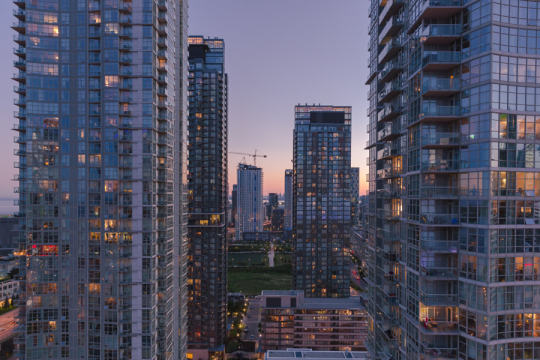
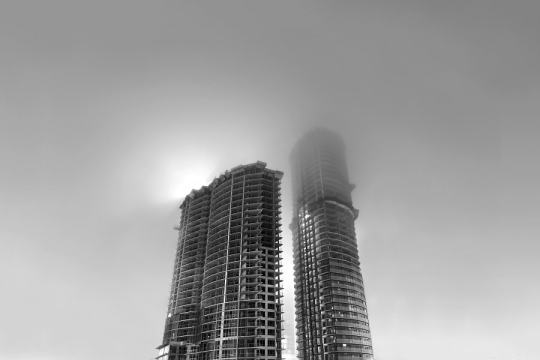
    Photograph Condos in Fog by Richard Gottardo on 500px

    Condos in Fog by Richard Gottardo on 500px

    Earlier today I attended a lunch and learn talking about the renewed interest in rental apartment development here in Toronto. Since this is a topic I’ve written about a few times here on Architect This City, I thought I would summarize some of my key takeaways from the panel discussion:

    • Market fundamentals are strong for purpose-built rental apartments. Vacancy is very low and demand will likely outstrip supply for many decades to come given the barriers to building (land availability, planning/approvals, and so on).
    • As of September 2014, CMHC reported 2,212 purpose-built rental units under construction in the Toronto region. And yet the annual demand for new rental housing is likely somewhere between 10,000 to 30,000 units (clearly some of this demand is being absorbed by condo rentals – the secondary rental market).
    • Millennials and retirees are seen as core markets for new rental apartments. Millennials want to live in urban centers and they like the flexibility that renting provides. Retirees want to know that they won’t be asked to move out because the owner wants to sell their condo unit.
    • It’s almost impossible to compete against condo developers when it comes to buying land (despite the next point). They (condo developers) will pay more. Therefore intensifying our “tower in a park” building stock is going to be a critical component of meeting rental demand in the region.
    • Part of what’s driving this interest in purpose-built rental (on the part of developers) is a softening condo market. So don’t be surprised when some developers flip back to condos when it makes financial sense to do so.

    It was interesting to hear this last point. It’s something that has been on my mind, but for whatever reason wasn’t really being talked about by the industry. That’s not to say that I think the condo market is in trouble though. It has just become more balanced. And ultimately that’s probably a good thing.

    Either way, I think that more rental and more housing options are a positive for the city and for consumers.

  • A new chapter

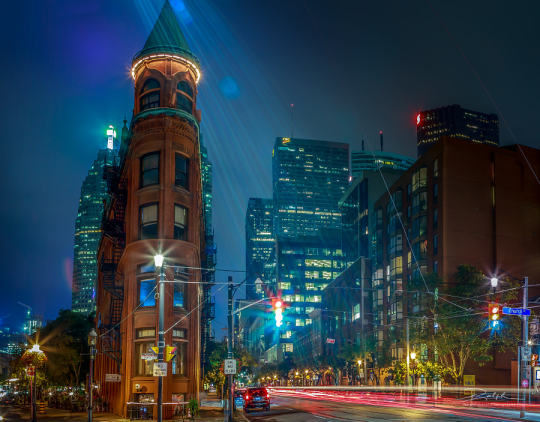
    Photograph St. Lawrence by Ralph Sobanski on 500px

    St. Lawrence by Ralph Sobanski on 500px

    I have an announcement to make on Architect This City today.

    Next week I’m joining the development team at CAPREIT (TSE: CAR.UN) here in Toronto. CAPREIT is one of Canada’s largest residential landlords. They are a growth-oriented real estate investment trust with over 41,839 residential units in major urban centers across both Canada and Ireland.

    They also happen to be headquartered in the St. Lawrence Market area, which means I now live and work in the same neighborhood. As we discussed here, location matters a lot.

    So here’s to a new chapter. I’m looking forward to diving into the multi-family business. Change is good.

  • Condo or rental apartment — does it matter?

    Photograph Community by Evgeny Tchebotarev on 500px

    Community by Evgeny Tchebotarev on 500px

    Toronto is the condo capital of North America. For a number of years now, there have been more condos under construction in this city compared to any other in North America, including New York.

    But recently the real estate community has become incredibly interested in building multi-family apartments (also known as purpose-built rental buildings). Which is why about 7 months ago I wrote a post called, Rise of rental.

    It has been decades since Toronto built rental apartment buildings at any sort of scale. That means that our existing stock is generally pretty old and that condominiums – rented out by individual investors – have been almost exclusively fulfilling the need for rental apartments in this city.

    But given that purpose-built rental apartments are on the rise, I’ve been thinking a lot lately about them and about the consumer perspective. 

    And so here’s my question to you:

    If you were looking for a place to rent, would it make a difference whether it was a condominium (rented out by an individual investor) or whether it was a professionally managed apartment building? You can assume that the suite itself is identical.

    There are obviously many differences between both forms of tenure, but I’m curious to what extent that factors into the decision making process for consumers. It hasn’t really been an option in recent years, but that seems destined to change.

    I hope we can have a discussion in the comment section below.

  • 19 Duncan Street bought for $47 million

    image

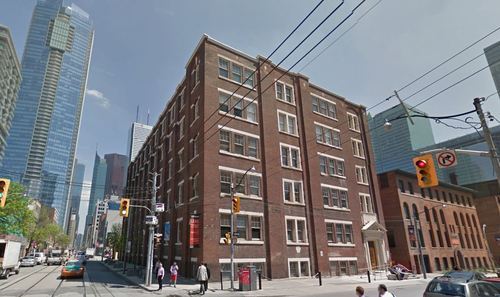
    Last week it was announced that Allied Properties and Westbank have acquired 19 Duncan Street in Toronto for $47 million.

    The property sits at the southeast corner of Adelaide Street West and Duncan Street (shown above), and includes an existing 61,911 square foot (GLA) office building, 36 surface parking spots, and a laneway (it was specifically called out in the press release).

    The plan is to restore the existing heritage building, as well as build additional retail space, office space, and rental apartments. Given the nature of this site and the team behind it, I have high hopes that it will end up a remarkable development project.

    It’s interesting to see the continuing interest in rental apartments here in Toronto – which is something I’ve written about before. Up until recently, the development community had almost zero interest in purpose built rental apartment buildings. Now they’re coming back in fashion.

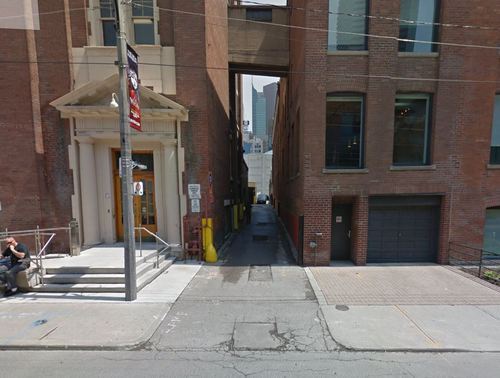
    But the other piece that’s interesting to me is the laneway. Below is a photo from Google streetview, showing what I believe is the laneway that the press release is referring to.

    image

    As many of you know, I’m involved in a non-profit here in Toronto called The Laneway Project (advisory role only). We want to transform Toronto’s underutilized laneways. And this strikes me as a perfect opportunity to do something really exciting at the corner of Adelaide and Duncan in the Entertainment District.

    So if the new owners have any interest in things that are exciting, I would encourage them to get in touch with me or one of the founders of The Laneway Project.

  • Rotterdam reinvents the urban food market

    image

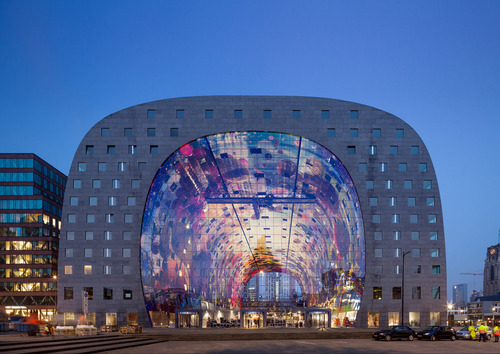
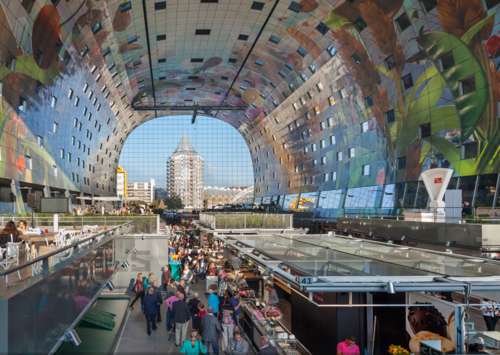
    Every now and then a piece of architecture comes along that makes you feel like your city should be more beautiful – or at least very least: bolder. In this case, it’s the new Market Hall in Rotterdam, which has been making the rounds on the internet since it opened last week. It may not be everyone’s cup of tea, but I find it really exciting.

    Designed by Dutch architecture firm MVRDV, the Market Hall is a 1.1 million square foot mixed-use building consisting of residences (102 rental apartments and 126 for sale apartments), a food market, a supermarket, a public space, and a 1,200 stall parking facility. But before I say anymore, here’s the money shot:

    image

    And here’s what it looks like from the inside of the market:

    image

    In the middle of the building is the food market. At night when it closes up, it then becomes a well-lit public space. The entire central area is enclosed, but well connected visually to the outside through a big and fancy glass facade.

    The apartments wrap the central market and were constructed using standardized modules (despite the unique form). The spaces that require natural light face outward and all the spaces that do not require natural light (by Dutch law), such as the kitchens, face inward towards the market. 

    There’s a grocery store 1 level below grade (to help supplement the market) and all parking and loading is done underground. This means that the building itself has no real backside. Most buildings typically have an ugly loading and “back of house” area – the building’s ass if you will. In this case, the entire perimeter of the building is urban and accessible.

    Finally, on the ceiling of the market is a massive mega-mural designed by Dutch artists Arno Coenen and Iris Roskam. Click here for a 360 degree panorama. It’s wild. 

    So what do you think of this building? Would you like to have it in your city? And would you consider living in one of its apartments? I would.

    Images: MVRDV

  • Exploring the Mimico waterfront

    This morning I explored Humber Bay Park, which is a waterfront park in the west end of Toronto. It’s in a neighborhood called Mimico that used to be a separate town, with its own mayor, until 1967. I honestly can’t remember the last time I was there, so it was fun to explore what felt like a new part of the city.

    Given its proximity to downtown and the fact that it’s very well connected to the water, the area is currently facing tremendous development pressures. In fact, as I was standing in line waiting to order an Americano, the conversation happening directly in front of me was all about how developers are fighting to buy up every piece of land they can find. Normally I would chime in, but today I decided to stay silent.

    Today the area is an interesting mix of old low-rise and mid-rise rental apartment buildings (many of which fell into decline a long time ago), and new high-rise condominiums that are all fighting for unobstructed views of the lake and downtown.

    There wasn’t a ton of street or public life going on, but it was certainly a beautiful place to spend a Sunday morning. As much as I’m looking forward to getting back into snowboarding, I’m not quite ready for summer to be over. So I’m happy that we’ve been having some great weather in the city.