Daily insights for city builders, delivered every morning at 6 AM ET. I’m Brandon Donnelly — a Toronto-based real estate developer and founder of Globizen. I’ve been writing here since 2013.

Tag: rental apartment

  • 1151 Queen East

    This morning I toured 1151 Queen East (here in Toronto). It is a new 47-suite apartment building that is being developed by Hullmark and that was designed by Superkül (the same architects as Junction House). It’s not quite finished yet, but it is looking terrific. The interiors feel, to me, like Berlin meets classic Miami Beach (if you can picture whatever this means). So a big congrats to the entire team. I’m sure it will be well-loved once people start moving in this year.

    At the same time, it’s hard not to see small and beautiful infill projects like this and wonder, “why do we make it so difficult to build this kind of new housing? This is a 6-storey rental building that, according to Urban Toronto, was first proposed in 2018. It then had to go through the typical rezoning process, which, in this case, seems to have taken two years. Now we’re in 2024. Uh, why?

    We should be looking at this kind of infill housing and saying, “Yes! You should go ahead and build this right now. Let us help you with that.” Instead, we erect barriers, which only force developers toward ever larger projects. If you’re going to spend two years in rezoning, no matter the scale of the development, why not build 470 homes instead of 47? And this has only been exacerbated with higher interest rates, because now time costs you that much more.

    I say all of this because this is an objectively great infill project. Our city would be a better place with a lot more of these.

  • We should waive the HST on purpose-built rentals

    We have spoken recently about the reset taking place in the development industry right now. It is difficult to underwrite new projects.

    But even before this current environment, it was challenging to make new rental housing pencil. Condominium projects almost always look more attractive (at least here in Toronto) and generally speaking, the spectrum for rental housing feasibility goes from “no, this doesn’t work” to “yeah, maybe this will work if we trend rents over a long enough time horizon.”

    The problem with this is that we know more rental housing would be a positive thing for our cities. So how do we address this? Here are some common solutions that get thrown around:

    • Make condominium projects less attractive to build. If fewer developers want to build condominiums and if fewer investors want to buy them, then maybe new purpose-built rentals will become more enticing to build. On some level, this makes sense. It should create downward pressure on land values. But this doesn’t help rental housing supply if it isn’t feasible to begin with. And why limit overall housing supply? (Related post, here.)
    • Make rental housing projects less attractive to build. I know this sounds counterintuitive when I say it this way, but we do do this. Rent controls, to give just one example, generally make it harder to build new rental housing. Yes, it can help those who are already housed, but it can disincentivize proper building maintenance, it can lead to more people being over-housed, and it absolutely hurts new supply. So there are trade-offs.
    • Make rental housing projects more attractive to build.

    I find this last one intriguing, and so here’s one specific idea that I have raised before. Though this time, I’m quoting Benjamin Tal of CIBC:

    But, by far, the most pragmatic step to take in the immediate future would be to waive or defer HST payments on purpose-built rental projects from first occupancy to the sale of the building, while keeping the same valuation methodology as the current regime.

    It’s the most realistic option since it’s relatively easy to implement, and Ottawa will have a willing partner in the Ontario government. Buried in page 84 of the recent Ontario budget was the following sentence, “we call on the federal government to come to the table on potential Goods and Services Tax/Harmonized Sales Tax (GST/HST) relief, including rebates, exemptions, zero-rating or deferrals”.

    Such a move alone would shave close to $60K from the unit cost of that 400-unit project in Toronto, resulting in a meaningful reduction in rent, while at the same time unlocking tens of thousands of rental units across the country in short order — clearly a step in the right direction.

    We should do this.

    P.S. Sam, thanks for sharing Tal’s article with me.

  • What might Toronto learn from this infill rental project in Tokyo

    This is a lovely little infill rental project in Tokyo by ETHNOS (architect) for Real Partners (developer):

    The building is 4 storeys plus a rooftop terrace. From the plans, it looks like there are 8 units, all of which are two-storey suites.

    The A and B suites are accessible from the ground floor. For the A suites, you enter at grade, and then go down into the first basement level. And for the B suites, you enter at grade and then go up to your second level. One of the entrances (suite B-3) is via an exterior walkway.

    The middle of the ground floor is the lobby entrance and there’s a single elevator that services the second and third floors (it then drops off for the fourth floor). On the second level is a co-working space, and so the upper C suites (these sound fancy) are all accessible from the third floor.

    The fourth floor and fifth floor terraces are all accessible from within the C suites, which means that the only real common area corridors in this building are on the third level. And it looks like they wanted this particular corridor to have a view to the street, because they could have easily reduced it even further to increase the building’s overall efficiency.

    What is also interesting to look at this building’s dimensions. Based on the above section, the floor-to-floor heights are 2500mm, which is low compared to the 2950/3000mm that is typically used here in Toronto for new reinforced concrete builds.

    In terms of the overall building, it is only about 10m deep and it is less than 10m tall if you exclude the stair popups on the rooftop terraces. For context here, our Junction House lot is about 30m deep and the build is about 30m tall, so actually a similar kind of box proportion.

    But let’s scan more of Toronto.

    If you move away from designated “Avenues” (which is where Junction House sits) and look at some of our other major streets (which is something the City of Toronto is in fact doing), you can sometimes/oftentimes find even deeper lots.

    Below is a random area that I quickly panned too on Dufferin Street — these single-family house lots are around 36m deep:

    Now obviously Toronto is not Tokyo and Tokyo is not Toronto. But my point with all of this was to demonstrate just how much space we actually have within our existing boundaries, should we ever feel the need to increase our overall housing supply.

    As I have argued many times before, I think one of the greatest opportunities to quickly do this sits along our majors streets.

    Architectural drawings: ETHNOS

  • Demand for short-term apartment rentals grew in 2020

    Apartment List’s quarterly Renter Migration Report (Q4 2020) offers up some interesting insights into what may be playing out in the apartment sector right now. The most striking takeaway seems to be the surge in people looking for short-term rentals (leases of six months or less). And while the data has historically shown that those looking to move to a new metro are more likely to be looking for a short-term rental compared to those searching within their current metro, that spread really widened starting in the spring of last year. See above.

    And when you drill even deeper, the most popular inbound destination — at least according to Apartment List’s search data — seems to be Honolulu. In the second half of 2020, about 26.8% of users searching in Honolulu from somewhere else in the US were looking for a short-term lease. This is compared to 14.9% during the same time period in 2019. Intuitively this makes sense to me. If you’re in lockdown and working from home, why the hell not do it from Hawaii? We’ve all have this same thought.

    Apartment List goes on to speculate that this short-term rental spike could be an indication that the inbound and outbound flows we’re seeing right now with certain cities may not be all that permanent. People are simply optimizing for the current environment. Though this data is representative of intent, rather than of leases consummated. Either way, that would be my guess. But who knows. Maybe some people will discover that surfing in the morning and working from the beach is a pretty enjoyable way to live.

  • Condo rents in Toronto are up 11.2% from last year

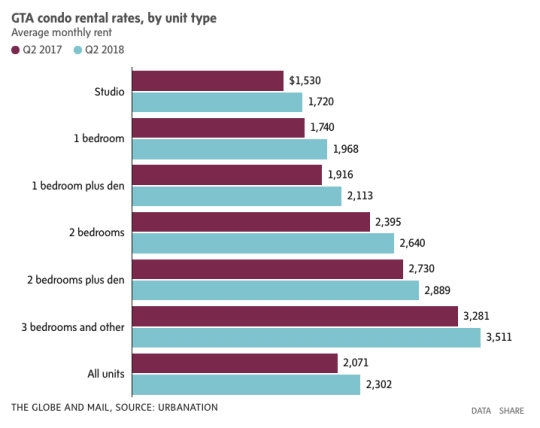
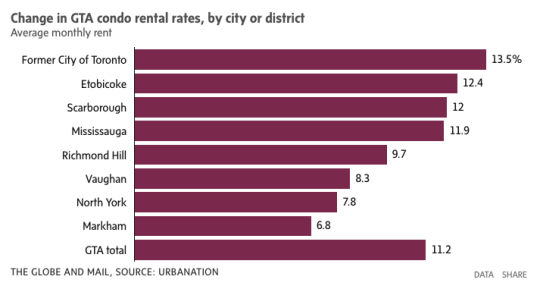
    Yesterday Urbanation released its Q2-2018 rental report for the Greater Toronto Area. It tracks both purpose-built rentals and condominium rentals, the latter being condominium units that are listed for rent on MLS. The average condo rent, for all unit types across the GTA, is up 11.2% year-over-year to a face rent of $2,302 per month.

    Here is a chart from the Globe and Mail:

    The former City of Toronto, which includes downtown, is actually up 13.5%:

    But here are the stats that I really wanted to draw your attention to today (figures from the Globe).

    According to Urbanation, there were some 384,000 condo apartments in the Greater Toronto Area in 2017 and nearly 1/3 of them were rented out. Given that the Canada Mortgage and Housing Corporation pegs the total number of rental apartments in the GTA at approximately 311,596, condo apartments represent about 40% of all our rental housing stock.

    So condo buildings are actually doing quite a bit of heavy lifting when it comes to providing rental housing in this region.

  • Studio Gang’s first project in Los Angeles

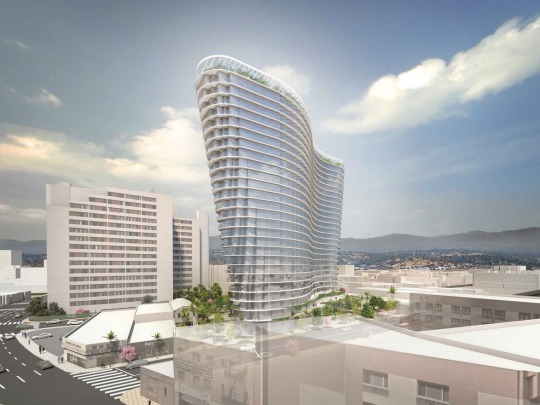
    This past week Studio Gang unveiled its first project in Los Angeles, a curvaceous apartment (300 rental units) and hotel (149 rooms) tower in Chinatown.

    The developer is Paris-based Compagnie de Phalsbourg and the hotel component is expected to be operated by the European brand, MOB Hotel.

    Above is the only rendering I could find. If you would like to read a bit more about the project, check out Curbed LA.

    Image: Studio Gang

  • VIA 57WEST in New York starts renting apartments

    image

    Bjarke Ingels’ West 57th Street project in New York (developed by The Durst Organization) has just started renting apartments (March 1). 

    Since I’m in the rental business, I thought it would be worthwhile to take a look at the rents – though I tend to obsess over all buildings and not just rental ones.

    Firstly, the project has a total of 709 apartments and 178 different unit types because of the architectural variations in the building. Of these units, 142 of them (20%) have been designated as affordable and were offered up via a lottery to people who fall within certain incomes ranges. 

    Here are the affordable rents via 6sqft.com:

    image

    I don’t know the exact numbers, but Curbed New York speculated – based on what was seen at other buildings on the west side – that the total number of applicants for these 142 units may have reached over 100,000!

    For the market-rate units, the average monthly rents are as follows (via Curbed NY):

    • Studio: $2,770
    • One-bedroom: $3,880
    • Two-bedroom: $6,500
    • Three-bedroom: $11,000
    • Four-bedroom: $16,500

    I wasn’t able to find average unit sizes (to calculate per square foot rents), but I estimate the overall average unit size to be around 1,000 square feet. 

    940,000 sf (total gross floor area)45,000 sf of retail x 0.80 efficiency (lower than average because of the shape of the building) / 709 units = approximately 1,000 sf of rentable area per unit. That’s just my rough guess based on what I could find online.

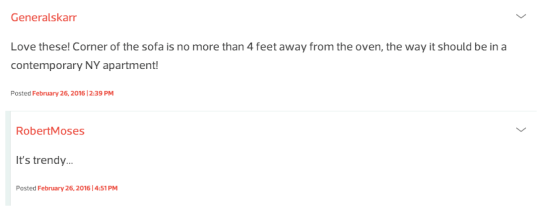
    Based on the Curbed comment section though, there are certainly some smaller units:

    image

    If anyone has any additional figures, please share them in the comments below. I think there are a few subscribers to this blog who are involved in the project.

    Image from via57west.com

  • Sam Zell’s Equity Residential sells 23,000 suburban apartment units

    Earlier this week it was announced that Sam Zell – the billionaire who initially made his money in real estate – is selling over 23,000 apartment units to Starwood Capital Group (Barry Sternlicht) for $5.4 billion. The units are all controlled by Zell’s company, Equity Residential.

    This is interesting for a number of reasons, but I’d like to point out two of them today.

    Firstly, Zell is famous for selling another one of this companies, Equity Office Properties Trust, to Blackstone for $23 billion in 2007. This was right before the market fell out and so some people are asking whether this signals the end of the apartment run. Average apartment rents in the US have increased roughly 20% over the last five years.

    But at the same time (and this is my second point), it might not be that at all. Instead, it could simply be a rebalancing of the portfolio. Here’s an excerpt from the Wall Street Journal:

    …Equity Residential has become “less aggressive as buyers of assets” in recent years, Mr. Zell said in an interview late Friday. Instead, it is getting out of suburban markets and into downtown urban centers, where young people are moving and where it is more difficult to build, he said.

    Most of the 23,300 apartment units in the deal, roughly a quarter of Equity Residential’s total, are low-rise and mid-rise units in suburban markets in and around southern Florida, Denver, Seattle, Washington, D.C., and Southern California. Analysts expect a significant amount of new supply to be concentrated in those markets in coming years.

    Of course, Sternlicht is buying these suburban properties and so he clearly has a different investment thesis. (The purchase price works out to be $230,600 per unit at a cap rate of roughly 5.5%.) But that’s what makes these deals so interesting to scrutinize. Nobody really knows what the future holds.

  • CAPREIT announces first joint venture development

    Yesterday CAPREIT announced that we have entered into our first joint venture development agreement for a mixed-use project at 1100 King Street West in Toronto’s Liberty Village neighborhood. 

    The agreement is to acquire a 1/3 undivided interest in the residential component of the project for $60.3M. The residential component will consist of 3 towers and 506 apartment suites (sitting on top of a roughly 160,000 square foot commercial/retail podium that will not be owned by CAPREIT).

    Here’s what Thomas Schwartz, President and CEO of CAPREIT had to say:

    “We expect our interest in the property, combined with the property management fees we will receive, will be accretive to our cash flow and set the stage for similar partnerships, along with our own new rental developments in the future.”

    As a member of the development team at CAPREIT, it feels great to get this one out there.

    Click here for the full public press release.

  • Pre-leasing, pre-selling, and building on spec

    When you build a new office building, the typical strategy is to pre-lease a certain portion of it. That is, you sign leases with a tenant or a few tenants so that you know for sure that X% of the building will be occupied upon completion. It’s a way to manage risk. If you don’t do this, then you are said to be building the office building “on spec.” 

    When you build a new condo building, the typical strategy is to pre-sell a certain portion of it. That is, you sell suites to purchasers based on plan drawings, certain finishes, and a model suite intended to illustrate what that future suite will more or less look like. And the reason this is typical is because most construction lenders will require you to do that.

    So when you see office buildings and condo buildings going up, there are usually already tenants and residents who plan to move in or investors who plan to rent out their suite and have generally transferred that risk away from the developer. 

    Because really the only time that a purchaser or investor wouldn’t close on a condo suite (and walk away from their deposit) is when the market corrects so badly that it actually makes financial sense to do that. That happened in the U.S. in 2008-2009 in a number of markets.

    But by contrast, when you’re building a rental apartment building you don’t have anything to pre-sell and your tenants (unlike office tenants) aren’t going to sign leases with you for some space that will be ready in 3 years. If you’re lucky, they might sign a lease with you for an apartment that will be ready in 3 months. This means that by default you are also building “on spec”.

    Now rental apartments are often considered to be the safest real estate asset class and the least correlated with the macroeconomy. But as a developer and city builder, this dynamic is still something to keep in mind.