Daily insights for city builders, delivered every morning at 6 AM ET. I’m Brandon Donnelly — a Toronto-based real estate developer and founder of Globizen. I’ve been writing here since 2013.

Tag: real estate

  • Home as machine for living

    Earlier this week I wrote a post talking about how maybe developers need to position their homes as more of a “product”. After that post, somebody asked me about my thoughts on home automation and how I thought technology was going to creep into the home.

    Then today, I came across this networked washing machine prototype from the folks over at Berg. If you can’t see the video below, click here.

    Just like Nest, this is the start of taking really unsexy home devices—thermostats, smoke alarms and washing machines—and making them sexy and networked. The “internet of things” is a trend that I think we’ll definitely see a lot more of.

    Because more broadly speaking, our homes today are actually really dumb machines. Swiss-born French architect Le Corbusier used to refer to the home as a “machine for living”, but the thermostat is really the only adaptive device most people have in their homes. And it’s not even very good.

    When the temperature drops, most homes have one sensor (the thermostat) to tell the mechanical equipment that it should flip on the heat. It could be incredibly hot upstairs or in another room, but your home has no understanding of that. The decision is binary: heat on or heat off.

    There’s a lot more we could do.

    Zoned heating and cooling is an obvious solution, but I’m also imagining buildings that physically adapt and change to their environment. Designing buildings for climates like Toronto’s—where we have both extreme heat and cold—is incredibly challenging, particularly because our buildings are so static (other than operable windows in most cases).

    So while I do think that networked devices are great progress, I also think that we need to be looking at the bigger picture. Let’s think about the actual architecture of our homes and how we can truly make them responsive machines for living.

  • What I see as the fundamentals of real estate investing

    Earlier this week my father sent me this article containing an excerpt of Warren Buffet’s upcoming shareholder letter. His annual letter—which started in 1965—is well known in the investment community. And in many ways, it’s like his own annual blog, started well before anybody knew what a blog was. His letters are personal, genuine and engaging—just like a good blog should be.

    But for me, what was really interesting about the letter is that it provided a number of lessons about investing in real estate. Lessons which, in my view, really represent the fundamentals of the business. The way I think about it is that there are really 2 ways in which to make money as a real estate investor over the long term. You can develop/reposition real estate and/or you can collect rent.

    Develop/Reposition

    If you’re developing or repositioning real estate, it means you’re doing something to increase the value of the property. It could be by rezoning, building new, or through an aggressive leasing strategy. It’s whatever you believe will unlock additional value. Once you’ve done this, you then either sell the property or you move onto the 2nd way of making money in real estate.

    Collect Rent

    By collecting rent, I really mean that you’re buying yield. This means you’re saying to yourself:

    I can buy this property for $1,000,000 and the net operating income on it is $100,000 (per year). So that means I’m buying at a 10% cap rate (or return). 

    Or maybe you’re saying:

    I can buy this property for $1,000,000, but the net operating income is only $25,000. However, the rents are well below market and I think I can easily get this thing up to a “10 cap.”

    Either way, you’re buying a stream of cash flows and you have an understanding of where that cash is going to come from.

    Speculate

    If on the other hand, you’re buying solely on the expectation that prices are destined to rise, you are—as Buffet points out in his letter—speculating. You’re not doing anything to create value and so you’re not developing. And if you’re counting on price growth to generate your investment returns, then you aren’t buying yield either.

    While many people have made large sums of money by speculating on real estate, I don’t consider myself capable of doing that in any sort of sustainable way. Hell, if Warren Buffet doesn’t think he can do that, why should I think I’m special.

    But some of you may disagree with this framework. If so, I’d love to hear from you in the comment section at the bottom of this post.

  • Do homes need to become more of a product?

    Yesterday evening I moderated a panel on innovation in real estate at the Rotman School. The panelists included Subhi Alsayed (Innovation Manager at Tridel); Michael Lio (President of buildABILITY Corporation); Alison Minato (VP of Sustainability at The Minto Group); and Tad Putyra (President and COO, Low Rise Development at Great Gulf).

    Though the general consensus was that the real estate industry is terrible at innovation, it was comforting to hear that a number of both low-rise and high-rise developers are working on and/or towards building “net zero” homes. A net zero home is a home with no net energy consumption. What this means is that the home produces as much as energy as it consumes.

    The general strategy with these homes is to design the building so that it’s as energy efficient as possible (as in R-40 walls and triple-pane glazing) and then use renewable energy sources (such as solar) to fulfill any remaining energy needs. Of course, the next step would be homes that actually produce more energy than they consume so that they become net contributors to a city’s energy grid. But let’s not put the cart before the horse.

    There are a number of challenges to achieving this goal—one of which is on the consumer side. Many of the panelists mentioned that consumers simply don’t care enough about building performance and energy efficiency. Instead of worrying about air tightness, they’re worried about cosmetic things, like granite countertops and hardwood floors. That’s not to say that these pieces aren’t important, but they’re only one aspect of a home.

    So what’s the solution? Do developers and home builders need to get better at consumer education? Or should utility companies be the ones shouldering this responsibility? After all, improving energy performance means lower utility costs.

    One thought that came to mind (and I’m testing this for the first time with the Architect This City community), is that maybe homes need to become more of a product. Today, developers often market projects and communities ahead of themselves. But maybe that’s not the best way to drive innovation within the real estate industry.

    For example, think about how car brands segment the market. When you buy a Mercedes, you expect a certain level of performance and quality. You probably don’t know about every little technological innovation in the car, but you assume that they’re pretty damn good.

    With a new home on the other hand, you’re buying (insert generic name) on the Park or the Residences of (something regal sounding). The developer’s brand is secondary. And maybe that’s the wrong approach. Maybe it’s making consumers believe that the only thing that matters is whether you’re getting stainless steel appliances and granite countertops.

    Maybe consumers need to know whether or not they’re buying from the Mercedes developer or from the Ford Pinto developer. After all, consumers make decisions based on heuristics. They need to be able to say to themselves:

    “This home is $50,000 more, but it’s from the Mercedes developer so I can justify it. I’ll have less problems in the future, I’m sure.”

    Instead, consumers are saying to themselves:

    “This home is $50,000 more. Why is that? They both have stainless steel appliances and granite countertops. I’ll just go for the cheaper one.”

    I refuse to believe that the real estate industry can’t be as innovative as other industries. There’s always a way. We just need to figure it out.

    What are your thoughts?

  • Developer Dirt: Site selection and acquisition

    I’ve already spoken about why I became a developer and offered some insights into how you might be able to transition from architecture into development. So now I’d like to start focusing more on the day-to-day of what it means to be a real estate developer.

    And since I seem to be getting a lot of questions from readers on career and development related topics, I’ve decided that I’m going to turn these posts into a regular blog series. Right now the working name is “Developer Dirt”, but if you have a better name I’m all ears (let me know in the comments below).

    So let’s start with step 1.

    You’re ready to develop a new project and you’re now in the market for some land (also known as a site). It could be a greenfield site (meaning it’s virgin land that hasn’t yet been tainted by humans) or, on the other end of the spectrum, it could a brownfield site (meaning it probably once housed industry, it’s contaminated as all hell, and you’re going to need to clean that puppy up before you build).

    Without going into further detail about all the different kinds of sites you could potentially buy (which is a post in itself), here are 3 high level things to keep in mind as you move forward.

    Land is the residual claimant

    What this means is that you want to start with your top line. You want to start with revenue. What can I build on this site (use and square feet) and how much can I ultimately sell or lease that space for?

    Let’s say, for example, that you think you can build 100,000 square feet. If it were office space, you’d want to know that rents in your area are $30 per square feet and that that’s going to render you $3M a year in rental income. If it were residential condos, you’d want to know that the market is absorbing $500 per square foot and that if you sold 100,000 square feet worth of condo, that your revenue would be $50M. But remember this is top line.

    Once you know your top line, you then need to figure out what it’s going to cost to bring you that revenue stream. In other words, what are the hard costs (construction costs), the soft costs (consultant fees and other non-construction costs), the return my investors are going to demand, the money I need to keep the lights on in my business, and so on.

    Hopefully, once you’ve calculated all of these numbers, you’ll have some money left over from that original top line number. That residual money is what you can reasonably afford to pay for the land, which is why it’s often referred to as the residual claimant. But even though it comes last in this example, it comes first in development. If you overpay at the onset, it’ll be an uphill battle the rest of the way.

    You often don’t know what you can build

    But here’s the rub: You often don’t know exactly what you can build. When developers buy land they often consider what they can build “as-of-right” and what they think they can build as a result of variances, rezoning and other discretionary actions.

    As-of-right basically refers to what the current zoning permits. It’s what you could go out tomorrow and build (after you get the requisite permits of course). Unfortunately though, as-of-right uses and densities are not often inline with what’s actually happening in a neighborhood. So you need to go into the city for things like a zoning by-law amendment.

    Similarly, vendors want the most for their land and so they’re going to be aggressive on this front. As a developer, this is the point where you surround yourself with a team of smart people who can help you figure out what’s reasonably attainable for the site in question. And sometimes you have to worry about the politics as much as the planning.

    Approvals are uncertain

    During the due diligence phase, the goal is obviously to mitigate as much of your risk as possible. Nobody wants to get stuck with a piece of land that they overpaid for that they now can’t (profitably) develop. But sometimes shit happens.

    It may seem like a no brainer. You could have a site that’s surrounded by transit with lots of great precedences (this matters) for the height and density that you’re hoping to obtain and that you feel will be appropriate for the neighborhood. But sometimes the stars don’t align.

    And that’s why development is a risky game.

  • The tale of 2 Chicagos

    Over the long weekend I wrote a post called “On medium density development.” My argument was that Toronto has gotten exceptional at building infill towers, but not so great at midrise and other medium density infill solutions. Though to be fair, we are starting to see more and more of that today.

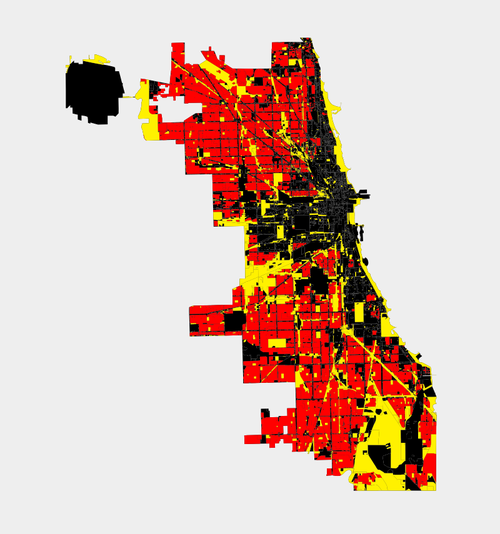
    Well it turns out that Chicago is in a similar, if not worse, position. According to Aaron Renn of the Urbanophile blog, most of the city (outside of the city center) only allows for single family homes. Though in some cases you may be allowed a duplex or triplex.

    Here’s a map:

    image

    The red is where you’re only allowed to build single family homes. The yellow represents non-residential uses (parks, industry and so on). And the remaining black is where you’d see high density development. Note how it runs all along Lake Michigan. Both Toronto and Chicago are developing in a similar “T” formation.

    Now, some of you may be saying to yourself: So what? But it’s important to remember that this type of zoning effectively creates a supply constraint in the market, which, as I’ve argued before, will drive up prices. Chicago may as well be surrounded by mountains, because that red area seems almost untouchable from a development standpoint.

    With so many people rushing back to cities today, a lot of them are struggling to create the same market environment that our parents enjoyed. You know the one where you finish school, get a job, and then you’re able to buy a house. But I think it’s because many of our cities are at a turning point, and yet are clinging to outdated principles of city building, such as single-use zoning.

    But I’m certainly no expert on Chicago, so if you are, please speak up in the comment section below.

  • Say hello to Kingston&Co

    image

    As of today, Family Day Monday, you’re going to start seeing information released regarding TAS’s (in partnership with Main & Main) newest community called Kingston&Co. It’s located on Kingston Road, just east of Victoria Park Avenue, in a neat area called Kingston Road Village. You can already register at kingstonandco.ca. And as part of the registration process, we’re also soliciting feedback as to the types of retail the community would like to see added to the area. Note: There’s already a Starbucks 🙂

    At the same time, we’ve also launched a redesign of our corporate site (tasdesignbuild.com). The biggest change is that we’ve taken the blog—which was hidden under a “Neighbourhoods” tab—and made it front and center on the homepage. We see this as a pretty significant change. One that shows that we would like you to join us in a conversation around city building. We now allow comments on all of our blog posts and you can see right on the homepage who the author of the post is.

    If you have any feedback on either Kingston&Co or the new homepage, we’d love to hear from you in the comment section below.

  • Disrupting everything

    Last year when I started working on Dirt—which was really my first startup—I had a number of people say things to me like: “Wow, that’s quite a change, going from real estate into tech.” But that’s not the way I saw and see it.

    I don’t think you can silo industries like that anymore. Technology is touching everything. Some would even go so far as to say that every company in the world is, or will be, a software and technology company.

    The way I looked at it was that I was starting a technology-enabled real estate company. I was hoping to leverage the internet to improve the way things are done in an existing industry. Of course, by improve I really mean disrupt—which is arguably the biggest buzzword in the tech community today:

    “Disruption is not so much a trend as an especially lucrative world philosophy favored by technophilic entrepreneurs. It’s the only path towards progress. If you’re not disrupting something you might as well go collect kindling and roast raccoon meat in the hills of Cupertino.”

    A good example of how disruptive innovation is reaching all sectors of the economy, including government, is the New Haven-based startup called SeeClickFix (which I discovered via This Big City). What it does is allow citizens to report non-emergencies (like potholes) to their local government. Governments can then respond and manage these tasks. (Sorry Rob Ford. Now you don’t need to return all those phone calls.)

    But moreover, I think it shows that technology is not only going to disrupt business and industry, it’s going to disrupt the way cities function and the way we live. I don’t know what that’s ultimately going to look like, but I can already feel it underway.

    Albert Wenger, of venture capital firm Union Square Ventures, recently argued—in a talk at DLD—that we are still in the midst of a transition from the Industrial Age to the Information Age. And I buy that. With every new disruption, we’re one step closer to completely making that transition. But we’re not quite there yet.

    The Industrial Age drove people out of cities. It made cities dirty and undesirable. But in the Information Age, cities are damn important and it’s where people want to be. Look at all the people rushing back to urban centers.

    So if technology has the power to disrupt business, industry, and cities, I suggest we stop just thinking about technology in isolation and remember the powerful words of Marshall McLuhan: “The medium is the message.” Don’t just focus on the obvious or you’ll miss a tidal wave of change happening beneath the surface.

  • Alleys and laneways

    In addition to having an incredible mountain just 12 miles away, the town of Jackson is also a really cool place in its own right. It’s a cowboy town with endless wilderness all around it. But since it’s such a big tourist destination, the town is filled with great restaurants, art galleries, and the obligatory real estate brokerages trying to sell vacation properties.

    Here’s what the town looks like from the top of Snow King (the in-town ski mountain). Photo credit: David Stubbs for the New York Times.

    But from a land use standpoint, I also find the town really interesting because of its network of fine grain alleys. Here’s a picture of Gaslight Alley. For those of you who are regular readers of this blog, you’re probably aware that I’m a big supporter of laneway housing in Toronto. I think it’s a hidden opportunity. It could be another—more intimate—layer to the city.

    Today, building a laneway house is virtually a non-starter with the City of Toronto. Whether it’s issues of utilities or the fact that laneways don’t easily accommodate service vehicles (maybe we need smaller service vehicles), the city has a litany of reasons for why they just won’t work.

    But I’m absolutely certain that we could figure out solutions to all of the obstacles if we really put our minds to it. It’s not a question of not being able to do it, it’s a question of not wanting to do it.

  • Why Toronto should stop complaining about all its condos

    Below is my latest post from the TAS blog. You can find it cross-posted here.

    Last week I wrote a post on my personal blog about housing policy in San Francisco. My argument was that the backlash against the tech community (for allegedly driving up real estate prices) is actually misdirected and that housing policy should be the target. 

    The reasoning behind this is simple: More people are moving to San Francisco than new housing is being provided. And so regardless of whether you have tech workers or not, you have an environment where the rich are always going to outbid the poor for housing.

    If you look at the numbers from the past 2 decades, San Francisco on average builds 1,500 new housing units a year. And yet the city gained approximately 25,000 new people between 2010-2012 (that’s roughly 8,300 people per year). So what you have is a perpetual housing supply shortage.

    To correct this problem, San Francisco needs to start building. And I’m stealing this idea from Harvard economist Edward Glaeser, who wrote an article on this very same topic back in December of last year for Bloomberg (and a book called Triumph of the City). His argument was that “the surest way to a more equitable housing market is to reduce the barriers to building.”

    Now, if you compare San Francisco’s situation to Toronto’s, we’re almost on the opposite end of the spectrum. Toronto doesn’t have a problem building. We’re building lots. So much so that it’s become fashionable to joke around and complain about all the condos going up in this city.

    But it’s important to remember that all of these condos are making us a relatively affordable city by global standards. We have more people moving to this city every year than San Francisco and yet home prices are less. We’re also less expensive than Vancouver, where there are strong natural barriers to building, namely water and mountains.

    So rather than complain, I’m going to be the contrarian. I like seeing new housing built. I like knowing that the neighborhoods I love in this city are becoming home to more and more people.

    At one point, my home (which is in the St. Lawrence Market) was a “new development” and somebody could have fought and opposed it. But it was allowed to be built and I was allowed to move in. I’m thankful for that. And so my plan is to be just as gracious to the next person who wants to join the neighborhood.

  • A culture of transparency

    One of the things I think the real estate industry is notoriously bad for is transparency. It’s getting better, but we’re nowhere near as transparent as some other industries, such as tech. In tech, you get companies like San Francisco-based Everpix who fail and then release all of their private documents to the public, including revenue, subscribers, cap table and so on.

    Could you imagine a real estate developer failing and then releasing all of its financials? This is what we paid for the land. This is how many units we sold. And this is why we failed. It doesn’t happen (or at least I’ve never seen it).

    Sure you might be able to get some of this information with a publicly traded real estate company, but that’s because they have to be more transparent. Everpix was 7 employees working out of a co-working space. They didn’t have to do this. But they did it because they wanted to help the larger startup community. They didn’t want to let a good failure go to waste.

    But at the same time, I actually don’t think that transparency is all about being altruistic. Transparency can also drive the bottom line. Every company wants to stand out from the competition and engage with its customers on a deeper level. But in order to do that, I think you need to give your customers something to engage with. You have to put yourself out there.

    One way to do that is to be more open and transparent. Be genuine and tell your customers who you are, what you believe in and, perhaps most importantly, why you’re doing the things that you’re doing. I like Simon Sinek’s philosophy that “customers don’t buy what you do, they buy why you do it.