Daily insights for city builders, delivered every morning at 6 AM ET. I’m Brandon Donnelly — a Toronto-based real estate developer and founder of Globizen. I’ve been writing here since 2013.

Tag: real estate

  • Looking at Berlin from the back of a napkin

    image

    Depending on who you ask, the current condo boom in Toronto might be viewed as either a good thing or a bad thing (most will have an opinion). Some people think we’re simply building too many condos. And that too many of them are small, crappy, and geared towards investors – as opposed to end-users.

    While I do agree that we could be doing more to create complete communities – that is communities which serve everyone from young singles to families with 3 kids – I think there are also a lot of positives associated with Toronto’s condo obsession (full disclosure: I’m a real estate developer). It has made us more sustainable, more reliant on alternate forms of (non-car) transport, and it has made us a generally more exciting place to live.

    But that doesn’t mean we can’t do better.

    Lately I’ve been wondering about how other cities do it. Specifically, those European cities that somehow seem to always be able to build awesome housing projects. So today I thought I would pick one and profile it. What I really wish I had was a financial pro forma to share with you all, but in the absence of that, I’ll try and back into some of the numbers on my own.

    image

    Shown above is the 9-storey Charlotte Apartments in Berlin. It was developed by WI Concept and designed by Michels Architecture Office. I chose this building because I think it’s an attractive one and because it’s of the (mid-rise) scale that Toronto is trying to promote along its many avenues. Here are the stats I was able to find online:

    • Site area: 347 square meters / 3,735 square feet
    • Building area: 3,000 square meters / 32,291 square feet (says gross floor area, but I don’t know if that means the same thing as it does here)
    • Construction costs: €3.6 million / C$5,065,691 (as of today’s rate)
    • Units: 28 (sold within 1 week of launch)
    • Market: ~70% of buyers in Berlin are believed to be foreign investors

    Now, if we were actually building a development pro forma, we’d want to get a lot more granular in our calculations than what I’m about to do. We’d want to know gross construction area, net saleable areas, and so on. But for the purposes of this post (and because I have very little information), I’m going to simplify and do a back of the napkin set of calculations.

    Based on above, the FSI (or density) is about 8.65 (32,291 sf / 3,735 sf). That’s roughly in line with many of the residential developments we’re seeing in downtown Toronto. The average unit size works out to be about 1,153 sf (32,291 sf / 28 units), but in reality it would be less if that 32,291 number is truly the gross floor area. You would need to subtract the corridors and other non-saleable areas from it before doing this calc. Either way, that is big compared to most downtown Toronto condos, but small for Berlin standards according to this ArchDaily article. Finally, if we look at construction costs, we get $157 per square foot in Canadian dollars ($5.065M / 32,291 sf). That’s low. I wonder what the land costs were.

    Again, these numbers are rough rough. But I wanted to try and dissect a European development project and compare it to Toronto. The most surprising figure seems to be the low construction costs. If you have any additional insights, I would love to hear from you in the comment section below.

    Images: Werner Huthmacher

  • Taking a picture of the world, every day

    This morning I finished watching the rest of Steve Jurvetson’s Spark 2014 talk, which I shared with you all yesterday. And so I’ve got technology on the brain right now.

    I’ve said this many times before on ATC, but I truly believe that the pace in which technology is infiltrating “non-technology” companies is only going to increase. The video clip of Flux.io is a perfect example of that. After watching that demo yesterday, I immediately thought a handful of consultants that real estate developers use on projects that the Flux platform could replace.

    image

    So today I thought I would share another company that Steve talks about in yesterday’s video called Planet Labs. Planet Labs’ mission to image the entire world and make it universally accessible to people. But unlike Google and Microsoft – who already offer satellite photography – Planet Labs has figured out a cost effective way to do it on a daily basis.

    Because the problem with services like Google Maps and Bing is that they’re updated too infrequently. If I go to Google Maps right now, the building I live in doesn’t even exist in their aerial photography of Toronto – it’s still a parking lot. So there are limits to what you can do with this information.

    But once you increase the image frequency to daily, you create all sorts of new opportunities. You could track the number of cars in every parking lot in the world to measure retail activity (an example Steve gives in his talk). You could track changing water levels. You could track deforestation. You could track urbanization in China. And the list goes on. Here’s a blog post from Planet Labs that gives a few examples of the benefits of daily imaging.

    To return to my earlier point, consider the fact that every potential use case I’ve just outlined is in an industry that most of you wouldn’t consider to be tech. And yet Planet Labs is clearly a technology company. So the key insight here is really to focus less on the way things are done and classified today, and more on the way they could be – and likely will be – done in the future.

    Image: Planet Labs

  • How technology could completely change the real estate development industry

    If you’re involved in the built environment in any way, shape, or form – as a developer, architect, policy maker, and so on – I would highly recommend you watch the video below. My friend Candice Luck, who I went to Rotman with, sent it to me this morning with a link starting at the 24 minute mark. I haven’t yet watched the whole thing, but given how interesting this short section was, I plan to.

    The video is a talk by Steve Jurvetson, who is a venture capitalist with DFJ. He was one of the founding investors in Hotmail and currently sits on the board of companies like SpaceX and Tesla Motors. At the 24 minute mark he talks about a startup called Flux.io that hasn’t yet launched their product, but is working towards “reimagining building design”. They’re a spin-off from Google X and plan to officially launch in early 2015.

    Rather than try and describe the video here, I will just say that it’s an incredible example of how technology and digitization could completely change the real estate development industry. If you can’t see the video below, click here. The video starts at the Flux.io section.

    [youtube https://www.youtube.com/watch?v=IPgyb6euISs]

  • DUKE starts construction

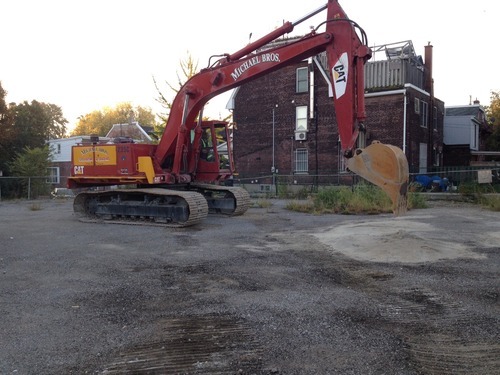
    Below was the scene at the DUKE Condos site in The Junction last Saturday morning at 7:00AM. Michael Bros. mobilized their equipment to begin site preparation so that shoring and excavation can begin. The plan is to be at the bottom of the hole by the beginning of next year.

    image

    image

    image

    We’re all very excited in the office and so I half jokingly told our VP Construction that I would meet him on-site at 7:15AM with beers. He responded with a one word email saying: champagne. In the end, I decided to go swimming instead (probably a better decision), but I am sure we’ll have a drink soon.

    There are still some killer suites available at DUKE, so feel free to drop into the sales office at 2800 Dundas Street West, give the sales team a call at 416-800-7738, or tweet the TAS team with any questions.

  • True Condos Podcast: Transparency in the Real Estate Industry

    A few weeks ago I was invited by Toronto realtor Andrew la Fleur to participate in his True Condos podcast series. I had actually never met Andrew before in person, but I knew of him because of Twitter, his blog, and because he was an early user of my past startup, Dirt.

    I was initially a bit apprehensive about being on a realtor podcast, because I thought it might end up as some sort of cheesy marketing piece. But I’ve come to learn that Andrew is not that kind of guy. He’s also interviewed some really great people in his podcast series (here’s the full list), so I feel honored to have been invited. 

    I’ve embedded the podcast below, but if for whatever reason you can’t see it, click here to be redirected to Andrew’s site. We talk for about 30 minutes, with a big focus on openness and transparency in the real estate industry. Thanks again for the invite Andrew. It was great to meet you in person.

    http://www.podbean.com/media/player/audio/postId/5289048?url=http%3A%2F%2Ftruecondos.podbean.com%2Fe%2Fbrandon%2F

  • Rise of rental

    image

    Last month Oxford Properties submitted a site plan application for the redevelopment of the rundown Cumberland Terrace in Toronto’s Yorkville neighborhood. If you’d like to browse the full application (including all the drawings), you can do that here.

    The proposal is a departure from previous plans and now includes 3 buildings: a 4.5 storey building, a 2.5 storey building, and a midblock 54 storey residential tower (the lobby is shown above). There will be both retail and residential uses.

    For those of you familiar with the mall, it should go without saying that Cumberland Terrace is in desperate need of redevelopment. So I’m not going to talk about that today. Instead, I’d like to mention 2 other points that stood out to me about the application.

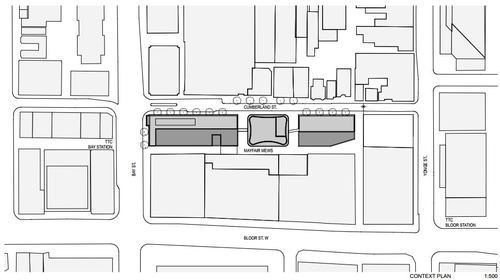
    The first is the 2 midblock connections on either side of the tower, running from Cumberland Street to Mayfair Mews in the rear (see below). Yorkville has a history of intimate laneways, and so it’s nice to see some of this being carried through in a new development. It also opens up the opportunity for an improved Mayfair Mews.

    image

    Secondly, it’s somewhat surprising to see that the 54 storey residential tower is being proposed as rental. Toronto doesn’t build a lot of purpose-built rental apartment buildings. There are some (from the likes of Morguard and Concert Properties), but we haven’t done it at scale for decades. And that’s largely because the demand for condos has been so great.

    But recently I’ve been noticing a renewed interest from the real estate community in multi-family rental assets. Cadillac Fairview also proposed a 65 storey rental building at the north west corner of Yonge Street & Queen Street last year – though they later withdrew their application.

    image

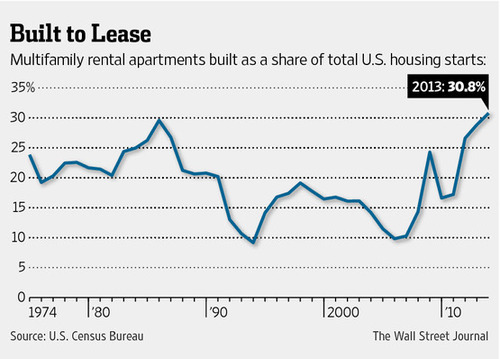
    In the US, rental apartments as a share of all new housing is also at record highs – over 30%. And that’s partly because credit remains tight (certainly compared to pre-2008) and economic growth has been tepid. But also because of demographic changes. People are having fewer children, later in life, and so many are putting off buying.

    So I think we’re going to see even more rental apartments being built in Toronto in the coming years.

  • Should you own or rent your home?

    image

    I was at a good friend’s wedding last night (congratulations again to Adrien + Rachel!), and one of the topics that came up at our table was whether it is better to own or rent your home. Now, in North America, conventional wisdom would suggest – almost mandate – that you have to own your place. If you’re still a renter, well then you’re “throwing away your money” my friend.

    But are you really? 

    A big part of the value of owning your home is that it’s forced savings. Every month when you make those principal and interest payments, you’re paying down your mortgage and socking away money for the future. And this can be a great thing for a lot of people, particularly if you’re not disciplined enough to save otherwise.

    But when you own a home, you’re also spending time and money on maintaining that home, and you’re also tying up capital that could be used elsewhere. So consider this: what if, instead of putting your savings towards a downpayment, you simply continued to rent and created an investment portfolio that you then contributed to on a regular basis just as you would a home?

    Depending on your assumptions, renting could turn out to put you further ahead financially. Here’s an example of that scenario from the Globe and Mail.

    Similarly, I remember being told in business school that companies that own their own real estate tend to under perform those that do not. And the rationale is that owning lots of real estate ties up capital that could otherwise be reinvested in the core business. In other words, if your core business is making widgets, then invest your money in making better widgets, not in real estate.

    But this is not to say that everybody should rent. Obviously I’m a big believer in real estate. And for a lot of people, owning may make sense. This post was really just to say that the owning vs. renting decision may not be as black and white as you might think.

    Image: Flickr

  • Why I didn’t go work for my favorite architect

    As a result of writing Architect This City, I’m fortunate enough to receive a lot of emails from random people. But I’m always open to meeting new people, and so I enjoy this very much.

    One of the most common questions I get is from architects, and students of architecture, who want to know about transitioning over to real estate development. (Posts related to this topic also happen to be some of my most popular.)

    So today I thought I would share a story with all of you about the one decision that ultimately lead me into real estate development.

    When I started graduate architecture school, I already had inklings that I was going to get into development. That’s one of the main reasons why I went to Penn. I knew that I could concentrate in real estate and I knew that I could take courses over at the business school. And that’s exactly what I wanted to do.

    But during my first year, I still wasn’t exactly sure how I was going to reconcile this dual interest. In fact, I remember feeling really conflicted. I loved architecture and design, but I also really enjoyed business and entrepreneurship. I was also interested in making money, and architecture isn’t often the best place to do that.

    So for my first summer internship, I decided to apply to both architecture firms and to real estate developers. I was fortunate enough to be offered jobs in both. And on the architecture side, I actually got my top choice, which was the Bjarke Ingels Group in Copenhagen. To this day, Bjarke remains one of my favorite practicing architects.

    But when I looked at the numbers, I quickly realized that real estate developers were prepared to pay me about 3x more than any architect would and that, if I were going to take an architecture job, I was going to end up going more in debt just to live throughout the summer.

    While internships are often career loss leaders, I took this as a sign of things to come. This was a 10 or 20 year decision in my mind. And even though I loved architecture, I figured I would quickly fall out of love with it if I couldn’t pay my bills or live the lifestyle that I wanted.

    So I accepted a real estate job and I moved to Dublin, Ireland for the summer to work for a small consultancy called Urban Capital (no relationship to the Toronto firm of the same name). And I haven’t looked back since.

    This may not have been the right decision for some of you, but it was for me. So if you’re at a crossroads, my advice is always to think about where you’d ideally like to be in 10 or 20 years. Because once you establish that, it’ll become much easier to make that decision today.

  • How smartwatches will augment location

    image

    So the rumors were right. Apple released a watch today. There will be 3 different “collections”, but lots of flexibility in terms of how each can be customized. There’s a big emphasis on health and fitness monitoring. Prices start at $350. And you’ll need an iPhone. Though you won’t be able to get one on your wrist until next year.

    Who knows whether or not it’ll catch on in the same way that iPod and iPhone did, but I think it has a damn good shot (more on this below). They’ve clearly put a lot of thought into both usability and the whole fashion side of the equation, which obviously needed to be done. Given that most people today use their phone for the time, the watch market strikes me as being heavily about style.

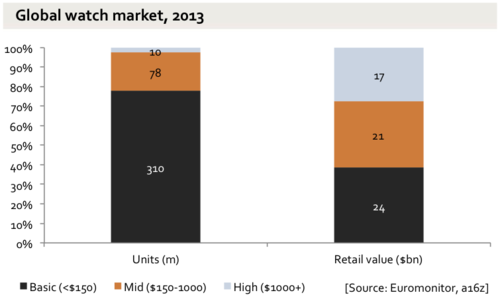
    In case you were wondering, here’s the watch market size as of 2013 (courtesy of Benedict Evans):

    image

    A lot of you might be skeptical about the need for a computer on your wrist (remember those watch calculators from the 80s?). But I think this time is different. Consider the number of people that now walk around with their phone in their hand and/or immediately pull it out whenever they have a free moment. We’ve become reliant (okay, addicted), to notifications and information.

    But in many of those cases, the smartphone isn’t the most efficient medium to be delivering those messages. Just like it’s not ideal to have to reach into your pocket to figure out what time it is, I think the watch could emerge as a new and better medium for a bunch of other pieces of information. And the big one could be location-aware or contextually-aware notifications.

    Here’s a tweet from Dennis Crowley – founder of Foursquare (Swarm) – talking about that exact thing:

    So what does this even mean?

    It means walking into a restaurant and having a tip pop up on your watch telling you what the best dish is (as shown in the tweet above). It’s driving down the street and having your watch notify you that there’s an open house 3 blocks away (and then giving you directions). It’s walking into a condo building and having your watch tell you that one of your friends is having a party on the 23rd floor. And so on.

    All of these notifications are currently already possible on your phone, but it’s not the ideal place for many of them. Which is why we’re all walking through life looking down at our phones. So while a computer strapped to your wrist may feel like we’re going further down that rabbit hole, it may actually free up more of our hands and our attention.

    And I’m sure there are many other possibilities that nobody has even thought of yet. Location just feels like a big one to me.

    //platform.twitter.com/widgets.js

  • How Energy Recovery Ventilation units work in a condo building

    Lately I’ve been thinking that I don’t talk enough about architecture and about buildings on Architect This City. So today I’m going to step away from transit, driverless cars, and the other topics I’ve been discussing lately, and instead talk about something a bit more technical: mechanical systems and Energy Recovery Ventilation (ERV) units. If you’re thinking about buying or investing in a condo, I think you’ll find it useful.

    Buildings work in many ways just like people do. They breathe in fresh air and they exhale out stale air. And just like you and I, once air has been exhausted out, it needs to be replaced, or made up, with more fresh air. In the world of buildings, this replacement air is called “makeup air.”

    It’s for this reason that you’ll often see no smoking signs directly outside of buildings. It’s because if you happen to be smoking next to a fresh air intake, you’d actually be distributing cigarette smoke throughout the entire building. The same goes for idling trucks and other pollutants.

    The amount of fresh air that needs to be pumped into a building will vary. For some uses – like hospitals and laboratories – the requirement for fresh air can be significantly higher. Sometimes as high as 100%. And that’s because you don’t want a building with toxic smells or lots of sick people to be relying on too much recirculating air.

    You might then be wondering why we don’t rely on 100% fresh air in all buildings. And the reason is that it is incredibly expensive to do so. When you take in fresh air from outside, it needs to be conditioned before it can be distributed. And that takes energy. In the winter when it’s -10 degrees outside (hello Toronto), you need to heat up that air. Whereas recirculating air is already conditioned. So you just, well, recirculate it.

    In most condo buildings, makeup air is supplied by dumping air into the corridors. To check if your condo functions like this, just look for a big vent outside in your hallway. This air then gets sucked into the individual suites by way of slits or openings around your front door.

    So another way to check if your building operates this way is to see if your front door is letting in air from the hallway (or if it’s sealed). There’s nothing necessarily wrong with this approach, but sometimes you might end up pulling in smells from outside of your suite.

    This now brings us to Energy Recovery Ventilation (ERV) units.

    The way an ERV works is very simple. Let’s use our winter example, where it’s -10 outside (and you’re questioning why you live in a place that’s so cold). In this scenario, you’d be pulling in freezing air and exhausting out warm air from your apartment.

    What the ERV does is transfer some of the warmth from the warm exhaust air to the cold intake air. This means the fresh air ends up coming inside your place at a warmer temperature and doesn’t need to be heated up as much. It’s “preconditioned.”

    This saves energy. And it saves in utility costs.

    But the other benefit of these ERV units is that, instead of pulling fresh air (or makeup air) from the corridor, it pulls it directly from outside of your condo suite. In other words, your front door is sealed and each suite is responsible for its own fresh air demands. The overall result is typically better indoor air quality, better energy efficiency, and lower utility costs.

    At both DUKE and Kingston&Co, which are two condo projects that I’m currently working on a TAS, we’re putting an ERV unit into every suite. We think it make sense. But there are always questions around how much purchasers actually care about measures like this. Things like fancy countertops and appliances are usually what sells. Not some hidden mechanical unit that you’ll never see or even know exists.

    But I think details like this matter. What about you?