Daily insights for city builders, delivered every morning at 6 AM ET. I’m Brandon Donnelly — a Toronto-based real estate developer and founder of Globizen. I’ve been writing here since 2013.

Tag: real estate

  • Developer Profile: The Adir Group

    In 2010, Gal and Tania Adir, aged 23 and 24, respectively, began renovating high-value apartments in central London.

    Today, they are known as The Adir Group and have about £50m in development under way.

    But more than just a developer, the group has grown to become “the parent company of a quickly expanding collection of complementary brands bound together by a desire to enhance people’s lifestyle through quality and beauty.”

    In addition to G&T (their residential development arm), they also founded Net.Works (a co-working space) and Nuper (a co-op living scheme). This last focus isn’t up on their website yet, but I read about it on Michael Mortensen’s blog. The goal of Nuper is to create affordable living solutions for young talent in London.

    I wanted to profile The Adir Group because I think it’s incredible how young they were when they got started (I was just starting graduate school at 23) and because I like their approach of creating a collection of complementary companies.

    I am excited to see where the next generation of developers (myself included) take this business. Already we are seeing some new approaches emerge.

  • School of Real Estate

    I’ve been getting a lot of (email) questions lately about what to study in order to become a real estate developer. So I thought I would reblog this post that talks about exactly that. I wrote it over a year ago and I almost forgot it existed.

    At the same time, I’m reminded of something: I think these questions really speak to the fact that there’s a significant opportunity (particularly in Canada) in terms of real estate development education. 

    Oftentimes when I get these questions, I end up recommending the Master of Science in Real Estate Development (MSRED) at ColumbiaMIT, and USC. Why don’t we have something similar (and better) in Canada? We are falling behind.

    I have raised this with some Universities here in Toronto, but the response I got was that they felt the real estate courses being offered as part of their existing MBA programs were more than sufficient. I think we can do a lot better.

    One professor suggested that I line up a big donor and work with them to spearhead the creation of the (Insert Donor Name Here) School of Real Estate. I think that’s a great idea, but not something I have the capacity for right now.

    Hopefully somebody else out there is of the same mind.

    Post Update: 3 days ago the Schulich School of Business (York University) announced a one-year full time Master of Real Estate and Infrastructure (MREI) program – the first of its kind in Canada. 

    This is great news. 

    Now I would love to see the University of Toronto and Ryerson University (as well as others) step up and leverage their respective architecture schools. Schulich is already out of the gate on this one.

  • Global home prices at the end of 2015

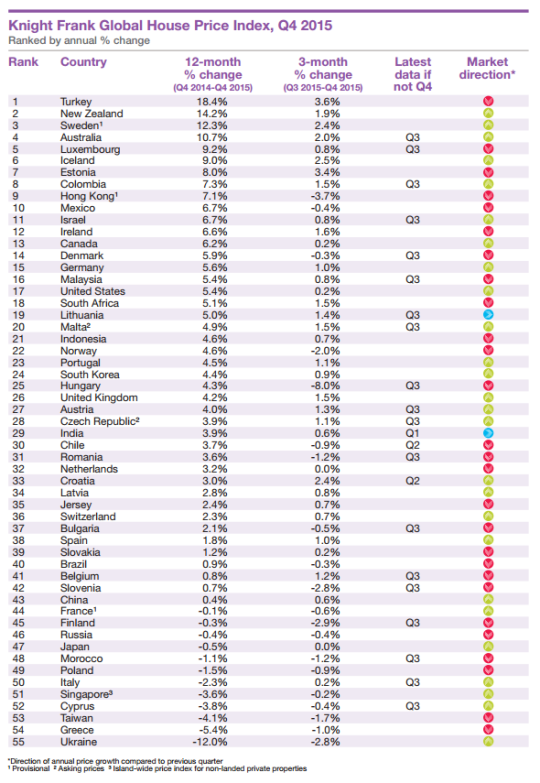
    Seeing how we’ve started looking at data from last year, I thought it would be interesting to look at global home prices as of Q4 2015. Here’s a chart from Knight Frank, which they refer to as their Global House Price Index:

    At the top of the list is Turkey, with an 18.4% increase from Q4 2014 to Q4 2015. (Supposedly this is because it has recently become easier for foreigners to buy property in the country.) Canada is 13th with a 6.2% increase (during this same time period) and the United States is 17th at 5.4%.

    This is obviously a high level analysis. There are lots of regional and local variations within each country. For instance in Canada right now, Calgary is a very different place than, say, Vancouver or Toronto.

    Nonetheless, it’s still valuable to see the relative performance of each country and see what their (Knight Frank’s) prediction is for 2016:

    “Our outlook for 2016 is muted. We expect the index’s overall rate of growth to be weaker in 2016 than 2015. The global economy is experiencing a potentially dangerous cocktail of low oil prices, a strong [US] dollar and a continued slowdown in China.”

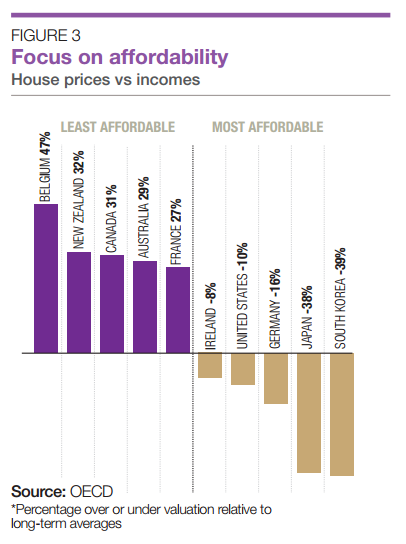
    It’s also interesting to see how the countries rank in terms of affordability:

    Once again, Canada ranks as being one of the least affordable countries in terms of home prices.

  • The social shift

    Those of you who know me or are regular readers of this blog, will know that I’m an avid social media user. 

    My favorites – judging by battery consumption on my phone – are Twitter, Instagram, and Snapchat (donnelly_b). I think it’s incredible what these platforms are doing to branding, marketing, personal connectivity, city building, and the list goes on.

    To that end, the March issue of Harvard Business Review has an interesting article by Douglas Holt called, Branding in the Age of Social Media. Whether you’re running a company, a city, or a real estate development project, I think you’ll find the information relevant.

    The article starts by describing a shift, brought about by social, whereby big brands are now struggling to capture the attention of consumers. Instead, consumers are listening to individuals and more grassroots movements.

    “Or consider Red Bull, the most lauded branded-content success story. It has become a new-media hub producing extreme – and alternative – sports content. While Red Bull spends much of its $2 billion annual marketing budget on branded content, its YouTube channel (rank #184, 4.9 million subscribers) is lapped by dozens of crowdculture start-ups with production budgets under $100,000. Indeed, Dude Perfect (#81, 8 million subscribers), the brainchild of five college jocks from Texas who make videos of trick shots and goofy improvised athletic feats, does far better.”

    So what should brands be doing? Holt argues that they need to tap into these developing subcultures and emergent ideologies:

    “These three brands broke through in social media because they used cultural branding—a strategy that works differently from the conventional branded-content model. Each engaged a cultural discourse about gender and sexuality in wide circulation in social media—a crowdculture—which espoused a distinctive ideology. Each acted as a proselytizer, promoting this ideology to a mass audience. Such opportunities come into view only if we use the prism of cultural branding—doing research to identify ideologies that are relevant to the category and gaining traction in crowdcultures. Companies that rely on traditional segmentation models and trend reports will always have trouble identifying those opportunities.”

    For me, this ties into one of my favorite lines from Simon Sinek: “People don’t buy what you do, they buy why you do it.” And now, thanks to social, it has become a lot easier to figure out what people and communities care about. It has become easier to figure out your why.

    Do you see this as being relevant to your work? I am certainly thinking about it in the context of mine.

  • Easier said than done

    Earlier this week I saw the Chief Planner of Toronto, Jennifer Keesmaat, tweet this out:

    //platform.twitter.com/widgets.js

    I responded with the below quote retweet because I figured I should probably devote a blog post to this topic and not just a tweet.

    //platform.twitter.com/widgets.js

    Now, I don’t know for sure, but I am guessing that her tweet was in response to the criticism from architects and developers that Toronto’s design guidelines are creating homogenous architectural outcomes. Some people – and I’ve written about this before on ATC – believe they’re too prescriptive.

    So today I’d like to talk about why playing creatively within the guidelines/zoning envelope, particularly at the mid-rise scale, is a lot easier said than done.

    Generally speaking, the value of land is dependent on what you can do with it or, in this case, what you can build on it.

    If all you could do was plant things on it, then the value of the land would be correlated with crop yields. If on the other hand you could build a building, it would be correlated, at least in theory, with the amount of space you could build and the rents you could charge for that space.

    Of course, this isn’t a perfect science. That’s why I said “in theory.”

    Landowners obviously want to maximize the value of their asset when it comes time to sell. So they, along with their brokers, will naturally try and stretch what is possible with the land. Why else do you think the best neighborhoods seem to magically grow new boundaries?

    When you combine this with the fact that mid-rise buildings are inherently less efficient to build and with the fact that their smaller size creates diseconomies of scale, it can be exceptionally difficult to find development sites where the numbers make any sort of financial sense. That is, even if you “maximize the envelope” and push rents or sale prices.

    So, with all due respect, not maximizing the envelope is almost unthinkable, unless you somehow managed to get a bargain on the land.

    Many of you will likely respond in the comments saying that all of this is simply a result of real estate developers being greedy capitalist pigs. But what we are talking about is no different than in any other competitive business environment. 

    Developers rent and sell products – albeit products that take an incredibly long time to make and bring to market. To make those products, there are a many costs, ranging from the cost of land to the cost of drawings. But hopefully within all of those numbers sits a profit margin that makes sense given the amount of work and risk that the developer has taken on. 

    Put differently, telling developers not to maximize the envelope is like telling a pizza maker to throw out 10-15% of her dough before she makes every pizza – even though she already (over)paid in full for the dough.

    If you’ve ever created a development pro forma, you’ll know that it’s not easy getting the numbers to work when you’re operating in a competitive market. This is not a knock against creative design. Trust me, I am a design snob. This is just business.

  • Ziggurats and gondolas

    Yesterday was an exciting day for Toronto city building announcements. 

    Firstly, Alex Bozikovic of the Globe and Mail published an exclusive preview of architect Bjarke Ingel’s plan for King Street West. Here’s a photo of the architectural model (it’s by Landon Speers):

    My favorite quote from the article is this one from Bjarke:

    “It would be sad if the most diverse city in the world had the most homogenous real estate.”

    It’s true.

    For those of you who emailed me about the details of his talk next week (there were a lot of you!), I believe I emailed you all back. But in case I missed some of you, you can click here for the event details. I should have included it in my original post about BIG, but I thought the event was already oversubscribed.

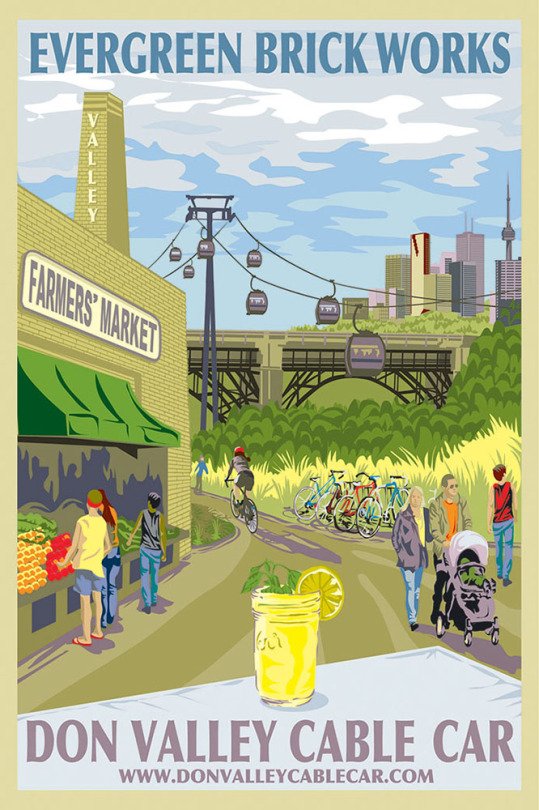
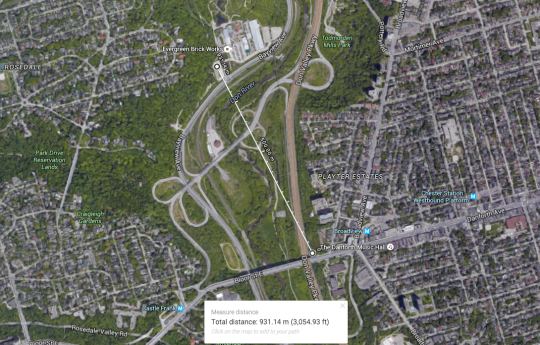
    Secondly, a private company called Bullwheel International Cable Car Corp. has just proposed to build a $20 to $25 million gondola running from Danforth Avenue (near Broadview subway station) to the Evergreen Brickworks. The total length would be almost 1 km and it, allegedly, wouldn’t require any public money. Here is their website.

    The timing of this proposal feels a bit serendipitous to me. When I was in Park City, Utah a few weeks ago, snowboarding right into the town and then taking their “town lifts” back up to traverse the mountain, I remember thinking to myself: what a wonderful form of transportation this is.

    Of course, Park City has giant mountains and Toronto, unfortunately, does not. But we do have spectacular ravines and a spectacular institution known as the Evergreen Brickworks.

    But one of the challenges with our ravines is that they can be a bit hidden – particularly for visitors to the city. Part of this is because we are trying to figure out the right balance between natural preservation and active use. But that’s one of the things that makes this proposal so intriguing. It’s a way to celebrate our ravines and natural landscape, without physically encroaching it.

    Here’s a map of the proposed gondola path:

    What do you think about these announcements?

  • A look at net migration by age group in Vancouver

    I’ve written quite a few posts about family formation and, more specifically, about where Millennials will move once they start having kids

    Many seem to believe that – despite the current Millennial love affair with urban centers – much of this cohort is destined to repeat the pattern of the previous generation. Meaning, once the kids come along, they’re headed to the suburbs in search of bigger and more affordable housing.

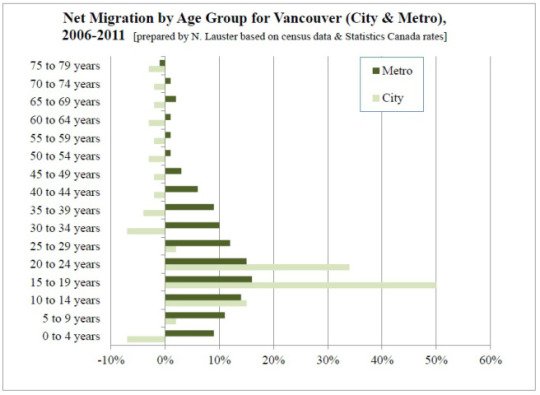
    If you look at the data, there’s a lot to support this prediction. Below is an interesting chart from Nathanael Lauster (Professor in Sociology at the University of British Columbia) that looks at net migration by age group for the City of Vancouver and the metro area.

    image

    What this chart shows is a flood of people in their late teens and early 20s migrating into the city (many of which are likely students), but then a fairly dramatic net loss of people leaving the city as they enter their 30s. The metro area, however, continues to grow – almost certainly because of people looking for more suitable family housing.

    But this data is from 2006-2011. We don’t yet have the 2016 census data. And I suspect that we will start to see an increase in the number of people opting to remain in the city across many different urban centers. 

    There are some very real economic pressures that successful cities today have to contend with. But I believe that the desire to remain in the city is there for a lot of young people.

  • My approach to blogging

    In yesterday’s post about the city as an egg, I received a comment basically saying that I use this blog to carefully curate my own image and that I would never argue against “dumb Toronto planning” because, after all, I’m a developer. I am going to do what breads my own butter.

    I welcome intelligent debate on this blog. That’s why it is open to anyone who would like to comment. But since I’ve received similar comments in the past, I thought I would use the opportunity to talk broadly about my approach to blogging.

    Firstly, there will always be some level of curation involved. That’s inevitable. We see it all over social media. But I’m a big believer in transparency and I try to do exactly that on this blog. I am keen to push the boundaries in this regard.

    At the same time, part of what makes blogs unique is that they’re often personal. That is the origin of blogging. Some of my favorite blogs to read are the ones that have figured out how to combine a particular niche topic with personal stories. And since ATC is ultimately my personal blog, I am going to continue taking that exact same approach.

    Secondly, I only write about things that I’m passionate about. I get asked all the time to write about and promote specific projects, causes, and events. But almost all of them do not get written about it. Because if I don’t care about it, then I’m not going to write about. It’s as simple as that.

    Thirdly, I believe in positivity over negativity. I believe that optimists, not pessimists, change the world. President Obama won his first term with a message of hope, not despair. To me, that is a stronger motivator.

    I’ve been told before that I’m overly optimistic and that my youthful exuberance will one day wear off. Boy, I sure hope it doesn’t. Because would you rather have a beer with someone who is optimistic or someone who is pessimistic? I will always take the former.

    However, this is not to say that I want to be blind to the realities of the world. Last summer I disagreed with Toronto’s decision to rebuild the elevated Gardiner Expressway East along the waterfront, and I continue to disagree with that decision. 

    When I believe something is a mistake, I am happy to make it public and put it in writing on this blog. But as a developer, I suppose I have certain biases working against me. That’s just the way it is.

    In any event, this is my rough and ever-evolving approach to blogging. As usual, I welcome any and all comments.

  • The city as an egg

    This week I have been thinking and reading about monocentric and polycentric cities. In urban real estate economics, the monocentric city model has historically been an important economic model. Developed in the 1960s, it attempts to explain land use in cities with one core, or central business district (CBD).

    In its most simplest terms, the model states that as you move further away from that core, land prices will fall. But since retail and employment need to be at the center of large catchment areas, they will remain in the middle, while the residential will naturally spread out.

    When you begin to factor in transportation costs, there is an argument to be made for why inner cities neighborhoods were often poorer in North American cities (no car; higher transportation costs) and why the suburbs were often wealthier. In this latter case, the rich wanted to consume more home/real estate and their transportation costs weren’t as significant. They had cars and subsidized highways in which to drive them on.

    Of course, there are many ways in which you could argue against the above. Today, urban neighborhoods are some of the most desirable areas in many cities. 

    But perhaps the most obvious thing to question is the idea that cities only have one central business district. I mean, just look at all the employment nodes in Toronto. Yes, downtown Toronto is still the dominant zone, but could we really be considered monocentric?

    From what I remember, the model had mechanisms for dealing with polycentricity. But at the same time, so much has changed since the 1960s. The central business district with its big department store was only just getting introduced to the likes of fully enclosed, climate-controlled suburban malls. And of course today, we are now living in a world of Amazon Prime and independent workers.

    So what does this mean for cities?

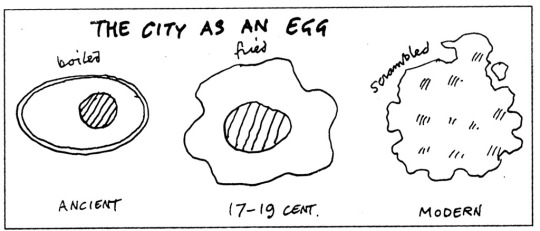
    Well, as I was reading up on this topic I stumbled upon this diagram by architect Cedric Price (1934-2003):

    I wish I knew exactly when this diagram was created, but I wasn’t able to find that online. In any event, the diagram uses different kinds of eggs – boiled, fried, and then scrambled – to explain the urban morphology of cities over time.

    In the ancient world, cities had a clearly defined core and a clearly defined perimeter – often a wall for defence (boiled egg). In the 17-19th centuries, cities started to expand outwards through the advent of technologies like rail. This gave them a more irregular shape (fried egg). And then finally, Cedric argues that the modern city had, or would, become all mixed together like scrambled eggs.

    I wouldn’t say that our cities have become completely scrambled. But I would agree that we are moving away from the simple fried egg of a city (or monocentric city model). So I guess the big question is really: How scrambled do you think we’ll get?

  • Urban, suburban, and rural home prices in the U.S.

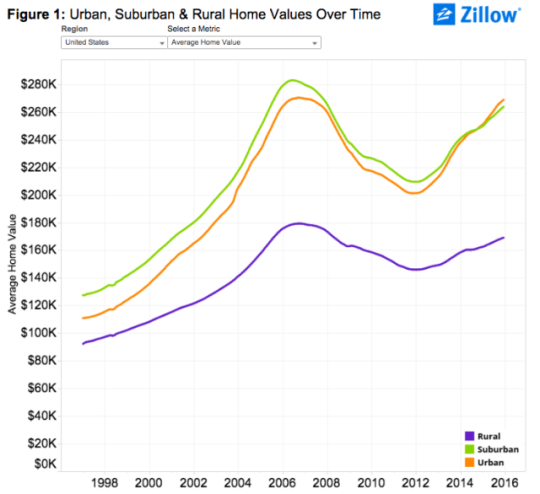
    Zillow.com recently published some research where they looked at U.S. home prices broken down according to location: urban, suburban, and rural.

    Here’s what they found:

    image

    As you can see, urban homes across the U.S. largely trailed their suburban counterparts in terms of absolute value up until the end of 2014. At that point, urban homes then surpassed suburban homes for the first time in the last two decades. (I wonder if this is a first or there was another crossover point before the late 1990s.)

    But if you dig a little deeper and look at both the rate of appreciation and prices per square foot (as opposed to just absolute value), urban home prices appear even stronger. 

    Here’s a snippet from Zillow’s post:

    “Over the past five years (2010-2015), average urban home values have grown 28.4 percent, compared to 21.1 percent for suburban home values. In the past year alone, U.S. urban home values grew 7.5 percent, compared to 5.9 percent for suburban homes.

    On a per-square-foot-basis, homes in urban areas nationwide used to be worth roughly the same as suburban homes, before a gap started emerging in the late 1990s which has become progressively wider over the past roughly two decades. Currently the gap stands at 24.5 percent, with suburban homes valued at $156 per-square-foot and average U.S. urban homes worth $198 per-square-foot.”

    And here is that same chart showing per square foot prices:

    Everyone who reads this blog knows that there is a growing interest in urban centers. But if you look at the above charts for specific cities, there are still many cases where urban home prices are well below suburban ones. 

    To me, that serves as a reminder of the spikiness of this urban transformation, but also that it is likely still in its infancy. As recent as 20 years ago, Toronto largely didn’t believe that people would want to live downtown in modern apartments. Today we take that for granted.

    So even with all of the gushing about urban centers, I still think we are only just getting started when it comes to creating the great urban neighborhoods of the future.