Daily insights for city builders, delivered every morning at 6 AM ET. I’m Brandon Donnelly — a Toronto-based real estate developer and founder of Globizen. I’ve been writing here since 2013.

Tag: real estate

  • A real estate dynasty without heirs

    Throughout history, real estate has been a tremendous source of wealth for a lot of people. Many family dynasties were created by accumulating property, holding it, and then riding the valuation wave.

    Here in Toronto, there was the Reichmann family. At one point they had created the largest real estate company in the world (Olympia & York). But I’m not sure exactly how much of that wealth remains today following the company’s bankruptcy in the early 90s. That was a tough time in Toronto real estate.

    In line with this, the NY Times recently published a fascinating account of the Wendel family in New York. In terms of how they conducted themselves, they were the polar opposite of some of today’s real estate families (i.e. Trump), but they certainly built an empire.

    Here are two snippets from the NY Times:

    In the early 20th century, the Wendels were perhaps the most powerful landlords in New York City, a dynasty with more than 150 properties in Manhattan worth over $1 billion in today’s dollars. The Wendels were the delight of the local papers, for, rich as they were, the family — six sisters and a brother, all unmarried — lived together in a shuttered mansion without electricity on the northwest corner of Fifth Avenue and 39th Street, and dressed in grim Victorian garb that had gone out of style half a century earlier. Tour buses regularly pulled up in front of “the House of Mystery.”

    Alongside their austere lives, they also practiced a strict and disciplined approach to investing: 

    Never mortgage a property; never sell anything; never pay for repairs; and never forget that Broadway moves uptown at a rate of 10 blocks a decade.

    In fact, they were so draconian in their approach, that the sisters were supposedly prohibited from marrying. Unions were not allowed because that, according to the NY Times, “would disperse the accumulated property and put it under other names than Wendel.”

    But in the end, this meant that the last Wendel – Ella, who died in 1931 – died alone and with no one to pass along the empire to. So instead it was distributed to various charities and the inevitable “cousins” that come out of the woodwork when a rich person passes.

    I guess the moral of the story here is the old saying that you have to “give to receive.” From the sounds of it, the Wendel family didn’t like to do that.

    Image from March 15, 1931 obituary

  • Nest or cave?

    I was recently introduced to the work and writing of Japanese architect Sou Fujimoto. One concept that he writes about that I really like is the idea of nest vs. cave.

    The way Fujimoto describes a cave is that it’s a naturally occurring and pre-existing condition. It is exists independent of humans. So if and when a human decides to occupy a cave, he or she must assimilate their lives to that which is already there. They have to deal with the ambiguity of the spaces because it is not clear how everything should be used.

    A nest, on the other hand, is something completely created by and for the benefit of a person or animal. It would not exist without someone creating it and so it is prescriptive and functional in a way that a cave is not.

    Fujimoto is interested in exploring architecture that is analogous to caves. Which is why he designs houses like this one (House NA) in Tokyo:

    In most countries, a house like this would not meet code and would be illegal. But in Tokyo it’s obviously allowed. And his hope is that the owners will discover new and unintended ways to interact with the unusual pairing of levels and platforms.

    However, I think about this juxtaposition differently – likely incorrectly in the mind of Fujimoto.

    I’m actually more interested in nests. Because in a way, mass produced housing is like a cave. It exists whether or not we decide to occupy it. And it is generally created to appeal to lots of people, rather than to the idiosyncratic tastes of one person. So when someone does occupy it, they invariably end up trying to shape it.

    But not to the extent of a nest. A nest is custom. It is what you would build for yourself given the opportunity to do so. And that thought is really appealing to me. Maybe it’s because I don’t like the ambiguity of a cave. That could be a possibility.

    I could also be thinking about it differently because I tend to think of Japanese homes as being quite individualistic. Since Japanese people generally don’t care about resale value, they don’t have the same fixation with marketability and future value. That means they’re more likely to just build what they want.

    I’d love to have my own nest.

    Image: Wall Street Journal

  • Coffee shops vs. fried chicken

    When it comes to a real estate market, there are always the typical metrics: sale prices, rents, vacancy and so on. But I’m always interested when somebody looks at the market in a different way and comes up with other kinds of metrics.

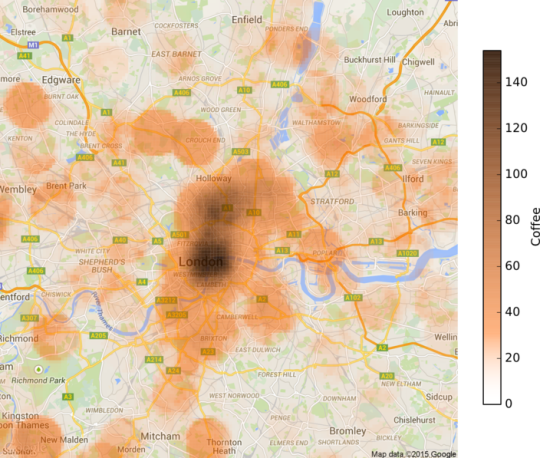
    That’s why I was intrigued when I stumbled upon this post by Sam Floy, where he looks at the concentration of coffee shops and friend chicken shops across London in order to determine which neighborhoods are in fact “up and coming.”

    To give you a taste, here’s his coffee shop map:

    His thinking was that if a neighborhood had a high density of coffee shops, a low density of fried chicken shops, and relatively low house prices, then it could probably be thought of as up and coming. 

    Coffee shops are often considered to be leading indicators of urban change (i.e. gentrification), and, well, friend chicken places I guess speak to a different kind of neighborhood.

    These sorts of playful studies aren’t going to tell you exactly which numbers you should be plugging into your development pro forma. But I think unconventional analyses can sometimes tell you a bit more of the story behind the numbers.

  • BARF is fighting for more housing in San Francisco

    A new YIMBY activist group is starting to gain meaningful traction in San Francisco. They were recently featured in the New York Times and they have managed to secure the financial backing of people like Jeremy Stoppelman – co-founder and CEO of Yelp. 

    (All excerpts in this post were taken from the NY Times.)

    image

    The group is called SF BARF, which stands for SF Bay Area Renters’ Federation. The group, however, supports new development of all kinds. So I think the name is more driven by the fact that the founder, Sonja Trauss, wanted the acronym to be BARF. It speaks to their shit disturbing approach:

    “Her group consists of a 500-person mailing list and a few dozen hard-core members — most of them young professionals who work in the technology industry — who speak out at government meetings and protest against the protesters who fight new development. While only two years old, Ms. Trauss’s Renters’ Federation has blazed onto the political scene with youth and bombast and by employing guerrilla tactics that others are too polite to try. In January, for instance, she hired a lawyer to go around suing suburbs for not building enough.”

    The impetus for all of this, of course, is San Francisco’s lack of affordability and severe housing shortage. Housing supply is decades behind the city’s population and job growth. 

    Most people are directing the blame at the tech community for bidding up housing. But there’s clearly growing recognition that housing supply matters.

    As a real estate developer, my industry obviously benefits from fewer barriers to building. So let’s get that out there:

    “Ms. Trauss’s cause, more or less, is to make life easier for real estate developers by rolling back zoning regulations and environmental rules. Her opponents are a generally older group of progressives who worry that an influx of corporate techies is turning a city that nurtured the Beat Generation into a gilded resort for the rich.”

    But let’s also be clear that I don’t believe we should be developing roughshod over our cities. New development should respond to what’s already there and give back. 

    At the same time, housing supply matters a great deal. A big part of the reason that cities like San Francisco, New York and Vancouver are so expensive is that they’re naturally supply-constrained markets. Geographically, they are either peninsulas or islands.

    When you overlay tight land use restrictions, fierce community opposition and/or foreign investment on top of this geography, it should come as no surprise to anyone that demand is outstripping supply. 

    New supply won’t solve every problem, but I do agree that it is an important part of the solution.

  • Building Toronto Tomorrow

    I’m going to be speaking on a panel on May 3rd, here in Toronto, called Building T.O. Tomorrow. The topic is the future of this city.

    It is being put on by the good folks at BuzzBuzzHome and it will be held in the lobby of Allied’s new Queen-Richmond Centre (134 Peter Street). If you haven’t yet been to this building, that alone makes attending worthwhile.

    Here’s the event poster:

    If you’d like to attend, make sure you RSVP to aleks@buzzbuzzhome.com.

    On a largely unrelated note, I recently picked up the handlebar bicycle mount for my GoPro and I’m looking for some fellow city geeks who would like to ride around the city and film some – potentially cool – videos.

    I find that being on a bike is one of the best ways to experience a city (at least the cities that are actually bikeable). So I’m hoping some of that magic will translate into video. If that sounds at all interesting, drop me a line.

  • New curated city building bulletin

    I have decided to spin-off the Architect This City identity into a weekly newsletter that I’m referring to as a “curated city building bulletin.” (This is as a result of the unbranding of this blog last week.)

    The inaugural issue went out this past Monday at 9am eastern with a collection of city building-related links. And that was it. This is not another blog. I’m not writing any new content for it. It’s simply going to be a collection of links to things that I think city builders would find interesting and/or valuable.

    Here’s why I decided to do this:

    It allows me to keep this new bulletin entirely focused on one thing. You’re not going to find me sneaking in a link about snowboarding, wine or something else that I’m interested in. It’s strictly about targeting city builders. (Of course, city building can be a pretty broad topic.)

    Keeping in mind what I wrote yesterday about saying no, I also chose this format because the additional workload for me will be minimal. In order for me to write a daily blog like this one, I have found that I need to keep a running list of reading material. But a lot of what’s on this list (stored in Pocket) never sees the light of day – there’s only so much I can write about. This new bulletin will be a quick way for me to share the rest of it.

    Finally, I’m also hoping it’ll be an efficient way for me to share the links, events, projects, and other things I receive from readers. In an ideal world, the bulletin will evolve into having a “links” section and a “from the community” section – which will be things that subscribers send me but today don’t get shared.

    So that’s the plan. If that sounds good to you, please subscribe at architectthiscity.com

    To kick things off, I’m going to be giving away 5 x free ATC t-shirts. (See photo at the top of this post.) To win one, just (1) subscribe and tweet out a link to this new city building bulletin, (2) tag @athiscity, and (3) tell everyone which city/town you live in.

    Regularly scheduled programming will resume tomorrow.

  • The Death and Life of Great Italian Cities

    image

    I am sure that a lot of you know where the title of this post comes from. It’s a riff on one of the most important and influential books in the world of city planning: The Death and Life of Great American Cities by Jane Jacobs (1961).

    But when Jane Jacobs first wrote this book, there was no such thing as smartphones and nobody was “checking-in” to hipster dive bars on Foursquare

    So instead of leveraging big data, her analyses and arguments were based on observation. She walked the streets of New York and Toronto and figured out what made cities thrive and what made cities die. That was her brilliance.

    Today, however, we have data – lots of it. And so recently, a group of researchers set out to test Jane Jacob’s theories using mobile phone data. The study was called, The Death and Life of Great Italian Cities:
    A Mobile Phone Data Perspective
    .

    More specifically, they set out to test the following 4 essential conditions:

    “She [Jane Jacobs] argued that, to promote urban life in large cities, the physical environment should be characterized by diversity at both the district and street level. Diversity, in turn, requires four essential conditions: (i) mixed land uses, that is, districts should serve more than two primary functions, and that would attract people who have different purposes; (ii) small blocks, which promote contact opportunities among people; (iii) buildings diverse in terms of age and form, which make it possible to mix high-rent and low-rent tenants; and (iv) sufficient dense concentration of people and buildings.”

    To accomplish this, the team assembled and studied data from the following sources:

    • Mobile phone activity (specifically internet activity)
    • OpenStreetsMap Data
    • Census Data
    • Land Use Information
    • Infrastructure Data
    • Foursquare Data (Venues API)

    Ultimately, they determined that Jane Jacobs knew what she was talking about. The above conditions are essential to urban vibrancy and they apply to Italian cities, just as they did and do to American cities. But this test was valuable, because the more that we can measure and quantify cities, the better I think we’ll get at creating and promoting urban vitality. 

    Now imagine if you overlaid the findings of their report with residential and commercial rents. I bet you’d also find that there’s a strong business case for urban vitality.

    I’ve heard a number of people say that, eventually, every company will be a software/technology company. And I don’t think we’re far off from that reality. To me, this study feels like an early example of what that might look like for city building.

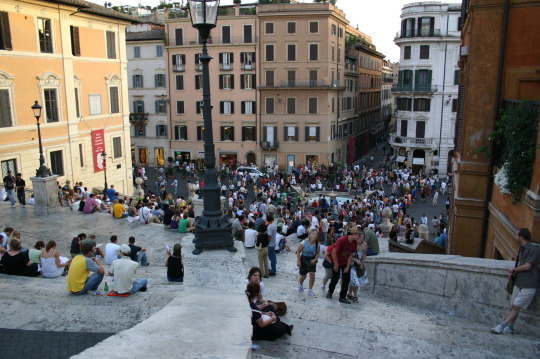
    On a side note, the picture at the top of this post is of the Spanish Steps in Rome. I took it on a weekend trip in 2007. I was living in Dublin at the time.

  • Enhancement Zones: The mid-rise performance standard that didn’t make the cut

    I’ve written a lot about mid-rise development on this blog and elsewhere. 

    I recently wrote this post responding to a tweet by the Chief Planner of Toronto. And towards the end of last year, I wrote a longer piece for developer Urban Capital’s annual magazine. If you missed it, you should definitely download a copy. Not so much for my article, but because, overall, the UC magazines are excellent. (Credit to David Wex.)

    Today, I’d like to focus on one specific “performance standard” from Toronto’s mid-rise guidelines that I’ve been thinking about lately. But more specifically, I’d like to focus on a performance standard that was initially contemplated but never actually got adopted. 

    (I apologize in advance if this post gets a bit too geeky for some of you. It refers to a specific land use policy in Toronto, but it has much broader relevance.)

    If you take a look at the final Avenue & Mid-Rise Buildings Study and turn to page 56, you’ll see that Performance Standard #5B (Rear Transition to Neighbourhoods: Shallow Properties) was stricken from the report. It was never adopted as a standard.

    So what is this all about?

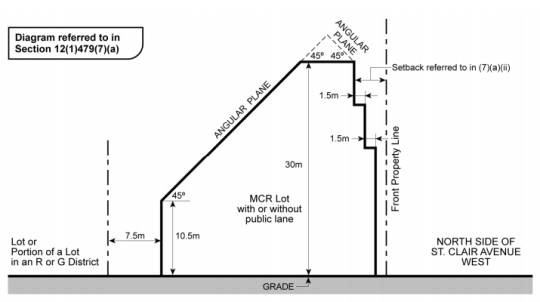
    This performance standard had to do with something called “Enhancement Zones”, which was proposed as a way to deal with shallow parcels of land on Toronto’s main avenues. You see, because of the other performance standards – namely the angular plane (see images below) – the depth of an avenue site is hugely important for determining what can ultimately be built on it.

    From the city’s perspective, this is a double edged sword. In the case of exceptionally deep lots, you can actually meet all of the performance standards while at the same time exceeding the recommended densities. But in the case of shallow lots, the performance standards sometimes/often make it so that you can’t even achieve the recommended densities. In fact, a lot of sites simply become un-developable.

    To give you a visual for what I’m talking about, here’s a section drawing from a zoning by-law that was adopted by City Council for St. Clair Avenue West in midtown:

    image

    Here you can quickly see that if you were dealing with a shallow lot of, say, 25m in depth, you wouldn’t have much left over after taking into account the rear property line setback (7.5m above), the front property line setback, and the 45 degree angular plane. Now you’re beginning to see why I said that it is easier said than done to play creatively within the guidelines envelope (thick black line above). When you look at the feasibility of these projects, you quickly end up getting pushed right up against the glass.

    But this is where Enhancement Zones comes in. 

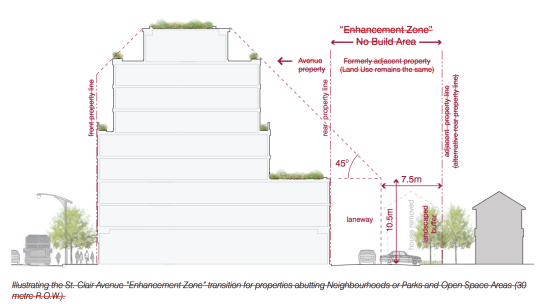
    The idea here is that an adjacent low-rise residential property (or pair of properties in the case of attached houses) could be included in mid-rise development proposals to create a deeper site that then meets the requisite separation distances between the mid-rise scale and the low-rise scale. To be clear, nothing would be built in the Enhancement Zones. They would just help to relieve some of the setback pressures from the original shallow lot and maybe even create a rear laneway system where one did not exist before.

    Below is a drawing from the Mid-Rise Buildings Study showing that new condition. The same 7.5m setback applies at the rear, but now it sits within an Enhancement Zone – formerly an adjacent and separate property. All the text is crossed out because, again, this standard was not adopted.

    image

    From a mid-rise development and feasibility standpoint, this makes a lot of sense. Sites that may have been un-developable before, now become developable. This makes it easier for us to achieve the European-scaled mid-rise vision that Toronto has for its avenues.

    But for reasons that I am sure you can guess, there are concerns with this performance standard. Probably the most obvious is that, to a certain extent, it destabilizes “neighbourhoods.” And they are intended to be completely stable entities that see little to no intensification. As soon as you allow this to happen, properties sitting in Enhancement Zones would become the prey of developers.

    However, there are counter arguments you could make. The owners of these properties would likely receive offers above market value. So maybe they end up better off. At the same time, you could also argue that the more development we unlock outside of “neighbourhoods”, the more stable they can actually remain.

    In any event, I’ve been thinking about this lately and I thought it would be interesting to debate the pros and cons of these magical-sounding Enhancement Zones. For those of you inclined to engage in geeky planning discussions, I’d love to hear from you in the comments.

  • Do you podcast?

    I have never really gotten into podcasts. 

    Sometimes I listen to The Urbanist on Monocle Radio when I’m puttering around my place, but generally speaking I don’t consume a lot of content in this format.

    Part of this might be because I don’t have a commute (commuting sucks) and I don’t drive enough that I feel the need to fill my time with stimulating things. 

    Sometimes I also find it hard to do other meaningful things at the same time. I just want to sit and listen attentively. (That probably speaks to my multitasking abilities.)

    But every now and then I feel like I should be taking more advantage of all the information embedded in podcasts.

    So below are three that I’m going to try and listen to more often and that you might also enjoy. If you know of any great podcasts, please share them in the comment section below.

    If you can’t see the embedded podcasts below, you’ll need to visit this blog post on the web.

    99% Invisible with Roman Mars

    [soundcloud url=”https://api.soundcloud.com/tracks/252094403″ params=”auto_play=false&hide_related=false&show_comments=true&show_user=true&show_reposts=false&visual=true” width=”100%” height=”450″ iframe=”true” /]

    The Urbanist on Monocle 24

    [soundcloud url=”https://api.soundcloud.com/users/25784122″ params=”auto_play=false&hide_related=false&show_comments=true&show_user=true&show_reposts=false&visual=true” width=”100%” height=”450″ iframe=”true” /]

    Unlisted with Brand Inman (Real Estate)

    [soundcloud url=”https://api.soundcloud.com/tracks/254352869″ params=”auto_play=false&hide_related=false&show_comments=true&show_user=true&show_reposts=false&visual=true” width=”100%” height=”450″ iframe=”true” /]

  • Thoughts on inclusionary zoning

    Ontario is looking to pass legislation that would allow municipalities in the province to implement something known as inclusionary zoning. If passed and should municipalities decide to use this tool (Toronto almost certainly would), developers would then be required and/or incentivized to include some percentage of affordable housing in their new market rate developments. 

    Politically, inclusionary zoning tends to be popular. It’s believed to be a way for governments to create new affordable housing using relatively small public subsidies. Not surprisingly though, the development industry generally hates IZ. It’s another cost that needs to be added to the development pro forma – though some municipalities rightly offset these additional costs with additional density, breaks on levies, and so on.

    What I always think about when this topic comes up is the broader economic impact of the land use policy. Because I’m suspect that it’s as simple as: mandate affordable housing; get more affordable housing for free. Generally there are always trade-offs.

    So here’s some reading material for you all this morning.

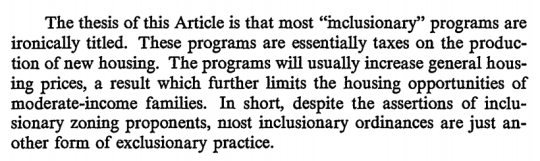
    In a classic paper (1981) by Yale Professor Robert C. Ellickson – called The Irony of Inclusionary Zoning – he argues that these practices can actually increase general house prices:

    image

    As a counterargument Owen Pickford over at The Urbanist argues that IZ simply reduces land prices as a result of the new tax. Land, after all, is the residual claimant. Therefore, he believes it’s an effective affordable housing policy. (I’m not so sure I believe that land prices would decrease in practice.)

    There’s also debate about the effectiveness of inclusionary zoning to actually deliver affordable housing at a meaningful scale. City Observatory wrote a post that looked at the total number of units produced (through IZ) across a number of American cities and the results were spotty. It should, however, be noted that not all inclusionary zoning policies are mandatory.

    Finally, the Furman Center for Real Estate & Urban Policy at New York University published a housing policy brief back in 2008 that looked at this exact topic. While they admit that the data is scarce, they come to the conclusion that IZ had no meaningful impact on the prices and production of single-family housing in San Francisco, but that IZ seems to have slightly decreased production and slightly increased pricing in the suburbs of Boston.

    What this last point suggests is that inclusionary zoning policies are not all created equal. So like all difficult questions, the answer to this one is likely: it depends. If anyone can point me to better data on inclusionary zoning, I would love to see it.