Daily insights for city builders, delivered every morning at 6 AM ET. I’m Brandon Donnelly — a Toronto-based real estate developer and founder of Globizen. I’ve been writing here since 2013.

Tag: real estate

  • Sharing walls with strangers

    Barry Ritholtz recently published an article in Bloomberg View called: Still a Lot of Negativity on Housing

    He basically says that “many people” should go out and buy a home given the current state of the US housing market and the historically low interest rates. That’s a perfectly fine argument. But it’s not all that interesting.

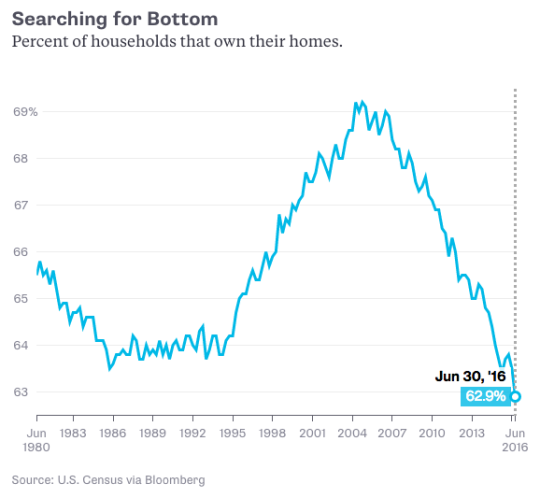
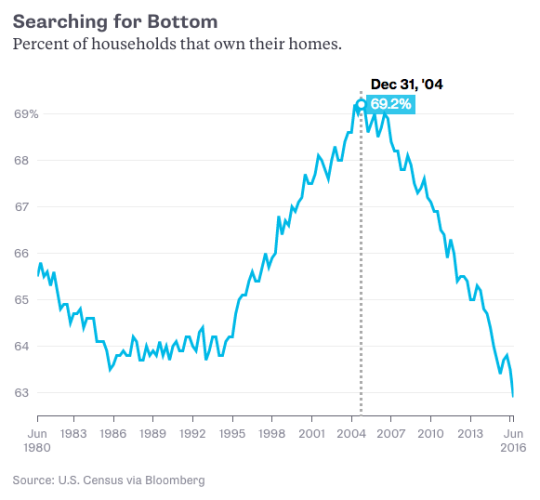
    The article does, however, have a moderately interactive chart showing the percentage of US households that own their homes.

    It shows the pre-2008 peak:

    image

    And it shows, somewhat surprisingly, the recent “search for bottom.” I knew there was a significant post-2008 decline, but I guess I thought it had stabilized. Instead, the US is hitting homeownership rates not seen since the mid-1960s.

    image

    Big cities tend to have a higher percentage of renters. Millennials are flooding into cities. The digital economy now encourages mobility, which contradicts traditional notions of homeownership. There are all kinds of potential hypotheses that could be extracted here.

    But the other interesting thing I noticed in the article, was this:

    However, at some point in life, you probably no longer want to have a landlord telling you what color your walls can be or become tired of having strangers share a wall with you. I am not a zealous believer that everyone should go out and buy a home. However, for many people, buying makes sense – especially with mortgage rates as low as they are (the current rate of about 3.45 percent for a 30-year fixed-rate mortgage is just 0.10 percent higher than the record low).

    I couldn’t help but notice the embedded cultural bias. The inference is that when you rent, you share walls. In other words, you live in some sort of multi-family apartment. 

    But when you finally go out and buy a home, you graduate from that. You no longer need to share walls with strangers. Because an owned home equals a single-family detached dwelling. That’s how you know you’ve made it.

    Well, I have shared walls in my owned home. I guess I’m not there yet. 🙂

  • The institutionalization of development

    Jones Lang LaSalle recently asked: Is there still room for the buccaneer property developer?

    But in the contemporary world of real-estate – corporatized, institutionalized and massively capitalized – is there any longer room for the swashbuckling “merchant developers” or are they doomed to go the way of the wildly-gesticulating floor traders in colourful blazers that once symbolized financial markets?

    “There is always room for the entrepreneur,” says Richard Bloxam, JLL’s head of capital markets, Europe, the Middle East and Africa. “It is, however, fair to say that real estate has been on a journey away from total reliance on the entrepreneurial model.”

    I’ve written about the institutionalization of the business before. And it’s something I’ve been asking developers that I interview for my BARED blog series. Are the days of the eccentric and larger than life developer behind us?

    The consensus appears to be no. 

    All that has changed is the capital source / stack. The skills that make for a successful developer haven’t changed. You still need to be creative and look for opportunities that others don’t see. You still have to navigate through all of the various constraints – of which there is probably more of today. You still need to be entrepreneurial in spirit.

    What I wonder though is if this change hasn’t undemocratized the business to a certain extent. It seems to me that it’s harder, today, to fly by the seat of your pants with just an idea (and no capital). The barriers to entry feel more significant. But as Richard says, “there is always room for the entrepreneur.” And I believe that.

    I would be curious to hear your thoughts. 

    Also, the next BARED post will be up shortly. Stay tuned.

  • The Lofts at SoDoSoPa

    Introducing The Lofts at SoDoSoPa and The Residences at The Lofts at SoDoSoPa (South of Downtown South Park).

    The following South Park video is a great parody of every real estate marketing video you’ve ever seen. Real estate marketing can be so terrible.

    [youtube https://www.youtube.com/watch?v=pAPmjcBnxIs?rel=0&w=560&h=315]

    This video is probably old news, but I never watch TV and so it’s the first time I’m seeing it.

    If you can’t see the embedded video, click here.

  • BARED: David Wex, Urban Capital Property Group

    image

    David Wex started his career working for one of the big Seven Sister law firms in Toronto. But right from the outset, it was clear that he wasn’t in it for the long run.

    In fact, only a few days after he started, David had the clever idea of turning his desk around so that it faced the window, instead of the hall. That way, he could avoid eye contact with partners as they walked by his office, and reduce his chances of being assigned a file.

    Of course he couldn’t avoid being tracked down all the time. But whenever someone would try to assign him work, he would simply say: “I’m sorry, but I’m really busy working on something right now.” His nickname quickly became “One File Wex” and it was clear that he was headed towards the departure lounge and not a corner office.

    But already, David had his mind set on doing something related to cities. So while still working as a lawyer he decided to complete his Graduate Record Examination (GRE) in preparation for going to planning school. Ultimately, he decided not to go back to school, but instead leave the firm and just figure things out. He left in 1992.

    After leaving, he did in his words, “nothing” for a few years. He lived off his savings, spent some time working with a bunch of guys cleaning up the Don River, and tried to figure out a way to put together a development project.

    Eventually he met a friend of the Goodman family and this led to an introduction to the Dundee Corporation.

    It was the early 90’s and nothing was happening by way of development in Toronto. The real estate industry was in a deep recession. Ask anyone who was “active” during this time. It was a painful time to be in the business. But the Goodmans told David that he if could find a suitable site to develop, they would invest. Lesson: Developers are constantly leveraging other people’s money.

    So David went out and found a site on a sleepy street named Camden in Toronto’s Fashion District. This is not the Camden Street of today, which has an Ace Hotel currently in the works. It was a dead zone. By this point we are in 1995 and few people believed that anyone would want to live on a downtown street like Camden.

    Given the perceived undesirability of the site and the continued lull in the market, David tied up 29 Camden for C$700,000 with a 2 year option. What this means is that he had 2 years to figure out if he actually wanted to close on it. He could put very little money down and get the project going before having to worry about carrying the land. It wasn’t until midway through sales that he actually went firm.

    It’s hard to imagine being able to do this in today’s competitive real estate market, but that was the market at the time.

    Of course, the flip side to all of this is that it also took him 2 years to sell about 20 condominium units (out of a total of 55), at an average price per square foot of $195. Today you could sell those units in 2 hours at $800 psf.

    Brad Lamb – who was just starting out at the time – was the broker on the project. And activity at the sales office was so scant that everyone would get excited even when a car would drive down Camden Street. That’s how dead it was in the Fashion District.

    Eventually Dundee got impatient. Sales were slow. A lot of money had been spent on marketing. And the partners didn’t believe that “the bump and grind of Queen Street” (original marketing pitch) was the right way to position the product. David was also in the midst of rebranding his company from Red Rocket (named after our transit commission) to Scrappy Dog Real Estate Investments. By that point Dundee came in and said: “You’ve fucked up this project. You’re out.”

    David had felt like he had made it and become a developer with Camden Lofts. But just like that – before construction had even started – he was off the project.

    The deal that David struck with his partners was that he didn’t want any money out of the project (it didn’t end up making much money anyways). But he wanted to stay involved and be able to call Camden Lofts his project. And so to this day, Camden Lofts remains the first development project of his very successful real estate career.

    But Camden Lofts didn’t solidify David as a real estate developer. After the fumble, David took on the role of managing a loft conversion for what turned out to be some pretty dodgy landowners. The total management fee was a princely $5,000, but David wanted to complete his own project from beginning to end. And so he did just that with Century Lofts at 365 Dundas Street East. He also spent a great deal of time learning Illustrator, Photoshop, and other design tools so that he could do all of the marketing himself. This is an experience that would later manifest itself in his company’s business model.

    After tuning his craft for a couple of years, David met his current business partner, Mark Reeve. Mark was a corporate real estate developer and planner, and they talked about doing something together. So they did, and the result was Urban Capital Property Group. Mark was also able to planning consult on the side and that helped fund their fledgling business as they worked on breaking into the development game.

    The first project to come out of this relationship was The Sylvia, which was also on Camden Street (#50). However, you won’t find this project on their website because it was done in partnership with developer Intracorp. The relationship ended up not being a productive one and both David and Mark vowed never again to be involved in a project that they weren’t actively managing themselves. That vow continues to this day.

    The first project that Urban Capital did on their own was the 66-unit Charlotte Lofts. It’s the first project they completed from A to Z. They sourced the site, secured the financing, worked on the design, marketed it, and constructed it. It was a success.

    The partners did well but the learning curve remained so steep that neither felt that they had really “made it” with this project. Indeed, my interviews have uncovered that this is a common experience amongst new developers. It can take a few projects before they really hit their stride and, in some cases, even make any money.

    But who ever remembers the stumbles?

    Today, Urban Capital has completed over 4,000 urban condominiums and has another 2,500 in the works. They have developed over $2 billion worth of real estate to become one of Canada’s most influential urban infill developers.

    Unlike other Toronto-based condo developers, they have branched out beyond Toronto: east to Montreal, Ottawa and Halifax; and west to Winnipeg and Saskatoon, with other cities on the horizon. Their mission is to act as an urban regenerator by bringing high design urban living to new markets across the country.

    They have come a long way since the days of Scrappy Dog Real Estate Investments. Clearly David is the furthest thing from “One File Wex.”

    You can follow Urban Capital on Twitter and on Facebook.

    Image: River City 2, Toronto

    ———————————————————

    This is the first post in my new blog series called BARED (Becoming A Real Estate Developer). More posts to come in the following weeks. Subscribe to stay in the loop.

  • Introducing: BARED blog series

    I was out with for a bike ride the other night with a good friend of mine and we were talking about all of the creative and social media-based projects that we would like to do. Everything from a daily vlog to a regular podcast. Sadly there are only so many things one can focus on.

    If you’ve been reading this blog since the beginning of this year, you’ll know that I’ve been trying to write a book on “becoming a real estate developer.” I believe there’s a lot of interest in this topic. It’s the number one question I receive from readers: “How do I become a developer?”

    But with everything that’s going on this year, I have decided to turn the research and writing I have done to date into a blog series that I’m calling BARED (Becoming A Real Estate Developer). I’ve interviewed a lot of fantastic people in the business and I want to get that information out there.

    The focus of the series – which was the intent of the book – is to uncover the early decisions and first projects that these now successful developers made and took on. In other words, it’s less about their current successes and more about what they did to get there.

    So no book. But expect to see the first BARED post very shortly. I think I’ll start with 3 posts and then gauge the response.

  • Dear City Council

    Kate Downing was formerly a planning commissioner in the City of Palo Alto. She recently resigned from her position and, about about a day ago, she posted her resignation letter on Medium. It has since gone viral.

    The reason it has spread so quickly, I think, is because it addresses the very same issues that so many cities around the world are facing: a lack of housing supply and eroding affordability.

    As a developer, I obviously have a vested interest in this matter. But to the extent that I can put that aside, I really do believe that our goal should be to build inclusive, rather than exclusive, cities.

    For instance, when I think of great cities such as New York and Toronto, I think of their history of taking in a large number of immigrants and then empowering them to climb the socioeconomic ladder. There’s something magical about that. One of my best friends likes to talk about this potential as “immigrant hustle.”

    But when we sterilize our cities by allowing only the incumbents to survive, I believe we place that socioeconomic potential in jeopardy. So for that reason, I am reposting Kate’s entire letter. I have bolded the points that stood out for me. Let me know what you think in the comments.

    ———————————————————

    Dear City Council Members and Palo Alto Residents,

    This letter serves as my official resignation from the Planning and Transportation Commission. My family has decided to move to Santa Cruz. After many years of trying to make it work in Palo Alto, my husband and I cannot see a way to stay in Palo Alto and raise a family here. We rent our current home with another couple for $6200 a month; if we wanted to buy the same home and share it with children and not roommates, it would cost $2.7M and our monthly payment would be $12,177 a month in mortgage, taxes, and insurance. That’s $146,127 per year — an entire professional’s income before taxes. This is unaffordable even for an attorney and a software engineer.

    It’s clear that if professionals like me cannot raise a family here, then all of our teachers, first responders, and service workers are in dire straits. We already see openings at our police department that we can’t fill and numerous teacher contracts that we can’t renew because the cost of housing is astronomical not just in Palo Alto but many miles in each direction. I have repeatedly made recommendations to the Council to expand the housing supply in Palo Alto so that together with our neighboring cities who are already adding housing, we can start to make a dent in the jobs-housing imbalance that causes housing prices throughout the Bay Area to spiral out of control. Small steps like allowing 2 floors of housing instead of 1 in mixed use developments, enforcing minimum density requirements so that developers build apartments instead of penthouses, legalizing duplexes, easing restrictions on granny units, leveraging the residential parking permit program to experiment with housing for people who don’t want or need two cars, and allowing single-use areas like the Stanford shopping center to add housing on top of shops (or offices), would go a long way in adding desperately needed housing units while maintaining the character of our neighborhoods and preserving historic structures throughout.

    Time and again, I’ve seen dozens of people come to both Commission meetings and Council meetings asking Council to make housing its top priority. The City Council received over 1000 signatures from Palo Alto residents asking for the same. In the annual Our Palo Alto survey, it is the top issue cited by residents. This Council has ignored the majority of residents and has chartered a course for the next 15 years of this city’s development which substantially continues the same job-housing imbalance this community has been suffering from for some time now: more offices, a nominal amount of housing which the Council is already laying the groundwork to tax out of existence, lip service to preserving retail that simply has no reason to keep serving the average Joe when the city is only affordable to Joe Millionaires.

    Over the last 5 years I’ve seen dozens of my friends leave Palo Alto and often leave the Bay Area entirely. I’ve seen friends from other states get job offers here and then turn them down when they started to look at the price of housing. I struggle to think what Palo Alto will become and what it will represent when young families have no hope of ever putting down roots here, and meanwhile the community is engulfed with middle-aged jet-setting executives and investors who are hardly the sort to be personally volunteering for neighborhood block parties, earthquake preparedness responsibilities, or neighborhood watch. If things keep going as they are, yes, Palo Alto’s streets will look just as they did decades ago, but its inhabitants, spirit, and sense of community will be unrecognizable. A once thriving city will turn into a hollowed out museum. We should take care to remember that Palo Alto is famous the world over for its residents’ accomplishments, but none of those people would be able to live in Palo Alto were they starting out today.

    Sincerely,

    Kate Downing

  • Transparent offer platform

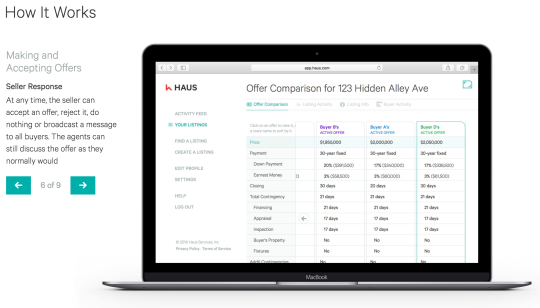
    A new “transparent offer platform” called Haus has just launched in California to serve the residential real estate market. The way it works is that all offers are submitted online. And once an offer has been confirmed, it – along with all of its terms – gets revealed to every other potential buyer. See image below.

    image

    I’ve seen a number of different iterations of this same idea, which tells me that this is a well-identified problem in the real estate market. Here’s a snippet from a recent TechCrunch article announcing Haus:

    “We think the openness will create a more efficient market and that the number of offers and price will ultimately be dependent on demand,” said Haus GM Sarah Ham. “Bidding wars are a common, almost accepted, part of the real estate process today. But with our approach, buyers know where they stand. Buyers will know what they need to offer to make their offer competitive, but they also won’t negotiate against themselves.”

    I completely agree that this is a problem that needs to be solved. It will create a more efficient marketplace. However, in this market, I suspect that the current information asymmetries largely benefit sellers, to the detriment of buyers. So I wonder if the supply-side of the marketplace will be willing to participate at scale. What’s really in it for them?

    Side note: Haus is the latest project from Expa, which is a “startup studio” that works on its own ideas, as well as partners with other founders. I am very interested in this approach to creation because I think you have to try and make a lot of things if you want to do truly innovative things.

  • What I’m doing next

    image

    A number of you have asked if I’m moving to New York. I can see why that was inferred from some of my posts, but that was actually not my intention. I am not moving to New York. (Sorry New York friends. I’ll visit soon.)

    Toronto is home base. I hope it’s clear how much I love this city. Sure, I’m a big fan of New York and Miami and Vancouver and Berlin and Tokyo and Jackson (to name some of the places I have on my phone’s weather app), but I made a deliberate choice to station myself here.

    Because unlike some of the other industries I write about on this blog, city building is hyper local. What I do involves the built environment. And that doesn’t generally happen via a laptop on a beach in Bali (at least not for extended periods of time).

    It happens by being on the ground, interfacing with local communities, meeting face-to-face with the city, and poring over drawings with smart people who know far more about their respective disciplines than I ever will. It is a collaborative and local effort. It’s about getting into the details.

    And so to be successful in this business, I think it helps to find a home and take long bets. I’m not saying that I will never work on projects in other cities (I have and I would), but I am saying that I’m not moving to New York right now and that home remains Toronto.

    On that note, here’s what I have to tell you. Later this year I’ll be joining Slate Asset Management as VP of Development.

    A bit about Slate:

    Slate is one of the most active acquirers, owners, and managers of real estate in Canada right now. Founded in 2005 by two brothers (Blair and Brady), Slate has over $3 billion of assets under management across over 16 million square feet and over 130 properties.

    All of this is done through four main investment vehicles: 

    1) The first is Slate Advisors. It acts on behalf of and alongside private institutional investors — such as Greystone.

    2) The second is Slate Office REIT (TSE:SOT.UN). It is a pure play Canadian office REIT focused on downtown and suburban properties all across the country.

    3) The third is Slate Retail REIT (TSX:SRT.U). It is a pure play REIT entirely focused on grocery-anchored U.S. retail properties. (Remember how many times I’ve written on this blog about how grocery has one of the lowest online shopping penetrations?)

    4) And the fourth: Slate is also starting a grocery-anchored retail platform in Germany. It is similar to #3, except that it’s in Germany.

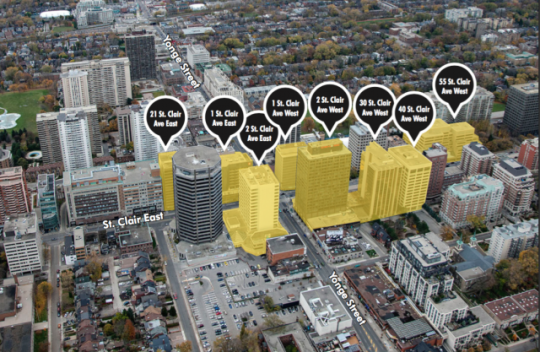
    Most recently, Slate has been in the news because of the position it has taken at Yonge + St Clair in midtown Toronto — a perfect example of “finding a home and taking long bets.” Slate, in partnership with Greystone, owns all 4 corners of the intersection and about 60% of the properties along the St. Clair corridor.

    Here’s a diagram of those Slate buildings:

    image

    In case you didn’t put two and two together, the 8-storey mural I wrote about two weeks ago is going up (right now) on the side of a Slate building (1 St Clair Avenue West — shown above). The British street artist known as Phlegm is doing it.

    Up until today, the focus of Slate has largely been on acquiring undervalued / overlooked real estate and creating value through re-leasing and overall repositioning. That will certainly continue. But given what I do, I am sure you can posit what’s also next.

    I’m genuinely excited to be joining such a talented group of real estate professionals. As I mentioned last week, I wasn’t in the market for anything new. I was heads down working on cool projects. But life happens. And Slate quickly demonstrated to me that the incredible success they have seen to date is precisely because of how progressive, nimble, and entrepreneurial they are.

    On that note, I have “one more thing” to share today.

    In parallel to all of this, and with the support of Slate, I am also starting a boutique city building company called Globizen. The name is derived from Global + Citizen.

    The objective is to build a company that embodies everything I write about on this blog. I want it to be lifestyle and design-driven. I want it to leverage technology to improve the way that cities and the building industry operate. And I want it to function as a vertically integrated real state + design firm, focused on sustainable urban infill development. Think of it as city building by and for the responsible global citizen.

    It’s still early days, but the thinking is that this new platform could compliment the larger Slate platform in some way. It’s too early to say how exactly, but everyone is open to having those discussions. And that’s what matters at this stage.

    I am going to end with a quote. It’s by Partner and Co-Founder, Blair Welch:

    “On all of our deals we have had people say ‘can’t’ to us. They say ‘Can’t be done, can’t do that, can’t raise money, etcetera.’ At Slate, we don’t do ‘can’t’ well.”

    I like that a lot. So here’s to finding a home, taking long bets, and not saying can’t. Onward my friends. 

  • Two open real estate development positions

    I recently alluded to some life changes on this blog. Well, I am now ready to share: I am leaving my development position at CAPREIT.

    I wasn’t intending to leave. I wasn’t looking to leave. And frankly, I felt conflicted. But sometimes life has a funny way of presenting opportunities that you just have to say yes to. As my mother likes to tell me: “Life is what happens to you while you’re busy making other plans.” More on this in a later post. Stay tuned.

    What I would like to talk about today are the opportunities that this may create for some of you. There are now two open development positions at CAPREIT. Both positions would be based in downtown Toronto (St. Lawrence Market).

    The first opportunity is essentially a Director level role where you would be responsible for growing the development team at CAPREIT. You should be able to lead a team, identify new development opportunities, create pro formas, assemble/manage consultant teams, secure development approvals for complex urban infill sites, and generally lead projects and people through the entire development lifecycle. For more information and to apply, click here.

    The second opportunity is at the Coordinator level. You would be reporting day-to-day to the above person and you should have working knowledge of the development process. For more information and to apply, click here.

    I would just like to add that in both cases you would be working on some very exciting urban infill projects and you would be joining an organization with great people and a great corporate culture. I mean this sincerely. If you have any questions about the two roles, feel free to reach out to me directly. And if you’re in the market, consider applying.

  • Real estate company? No, a lifestyle brand.

    This past weekend a rooftop restaurant, pool, and entertainment venue called LAVELLE opened upon atop 629 King Street West here in Toronto. It’s on the rooftop of a condo by Freed Developments, that for some reason is no longer called the Thompson Residences.

    Here’s a sampling of their Instagram to paint you a picture:

    imageimageimageimage

    I mention this not because I went, but because I think it’s interesting to see how Peter Freed is evolving his company and brand. He is best known as a real estate developer. But what he wants to do and what he is doing is turning Freed Developments into a “vertically and horizontally integrated progressive lifestyle company.”

    According to this recent press release, LAVELLE is the first venture of Trademark Hospitality Inc., which itself is “a branch of Freed Hospitality.” This is him selling not just selling a place to live, but selling a particular lifestyle and a certain community – and then taking an active and ongoing role in the programming of it.

    The other example that comes to mind is that of Equinox Fitness. I’m sure you all know this company, but what you may not know is that it’s owned by a real estate development firm called Related. The New York-based company acquired them in 2005 (closed in 2006) for about half a billion dollars. 

    Here’s why they did it (excerpt from this press release):

    Related and Equinox have historically shared similar visions. Both companies are known for their commitment to lifestyle, service, innovation and design, and have a passionate following amongst dedicated upscale consumers. The companies’ respective customers have similar demographic and psychographic profiles and both foster fiercely loyal clientele who are passionate about their brands.

    Related has redefined the residential marketplace, created the benchmark for sophisticated urban living and has been committed to quality fitness facilities in its buildings since the mid-eighties. Since its inception 15 years ago, Equinox has been widely recognized for being an industry innovator and for delivering an unparalleled fitness experience.

    Both companies will enjoy a number of key strategic opportunities from the partnership. Related will secure a well known brand as a quality anchor tenant for key current and future developments. This will also help Related to enhance the quality of its amenities and facilities available to residents.

    So this is not a new thing. In both of these cases, the goal is to create a brand and identity centered around a precise lifestyle. I mean, Related even mentions “psychographic profiles” in their news release. They know who their audience is, just as Freed does.

    Another way of looking at this is how it ties into what I see as a broader shift away from just development to more city building. It’s not just about throwing up a building and then moving on. It’s about trying to foster a certain kind of community and lifestyle. We may not all agree on what that community should be, but overall I think it’s an exciting direction for cities.

    If you’re taking a similar approach in your business (or even if you’re not), I would love to hear from you in the comments below.