Daily insights for city builders, delivered every morning at 6 AM ET. I’m Brandon Donnelly — a Toronto-based real estate developer and founder of Globizen. I’ve been writing here since 2013.

Tag: real estate

  • Low-rise vs. high-rise

    Yesterday I sent out this tweet, which included this graph:
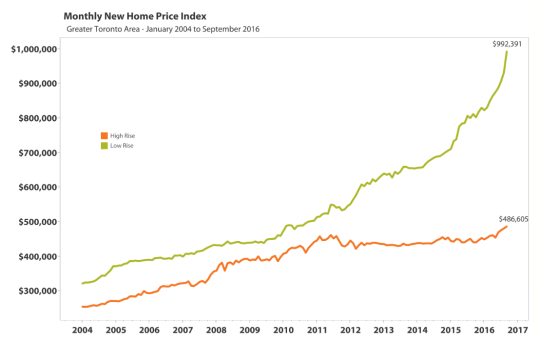
    The chart is from Altus Group and it is a monthly price index of new low-rise vs. high-rise housing in the Greater Toronto Area (GTA). I have posted similar charts in the past, but every time this chart gets updated the spread widens and the market looks even crazier.

    Some people responded on Twitter by saying that this is clearly an indication of a bubble. I don’t know if that is the case. 

    But, as I have said many times before, I do believe that it tells a vivid story around supply. Low-rise housing is severely supply constrained in the GTA and high-rise housing is less so. That has helped to stabilize pricing in the latter case.

    Now, you could look at this chart and say that the pace of low-rise price increases is simply unsustainable. The market must correct. 

    But you could also look at it and say that the market is going through a fundamental shift whereby more and more families will start living up, as opposed to out – which should then translate into high-rise pricing trending upwards as unit sizes increase. This is where I think we are headed. 

    What do you reckon is happening?

  • 6 things about cities from Richard Florida

    Last week Richard Florida headlined an “Urban Lab” panel at the NYU Schack Institute of Real Estate. It was moderated by Sam Chandan, who is dean of the Shack Institute. 

    Here are 6 takeaways from the discussion, with a few of my own thoughts attached:

    1. Suburban brain drain. This is happening. Florida states that (real estate) development is the key to rebuilding the suburbs. It will challenging to reorient the suburbs away from the car (though suburbs vary greatly), but I do agree that many suburban areas need a refresh to keep them relevant against this brain drain.

    2. Decline in home ownership. Florida believes we will see owning vs. renting drop to about 50-50. This would be a pretty big change given that US homeownership is currently hovering in the low 60s and this is already at historic lows. However, the trend is towards urban and that often means more renting.

    3. New city characteristics. Access to urban amenities, cultural capital, and transportation is critical and should drive new development. Transit and rail infrastructure can “open up” new areas and combat issue #4, below.

    4. Housing affordability. Florida reiterates “the great inversion.” Poverty moving to the suburbs; cities now housing the rich. He also isn’t sure that capitalism alone will solve this problem. Gives example of Manhattan where market is focused on high-end luxury residential.

    5. Florida argues that planning and real estate knowledge need to come together to overcome some of the information-asymmetries inherent in the development industry. I’ve written about similar ideas before. I try and apply this sort of multi-disciplinary thinking to urban issues.

    6. Micro-living is not a silver bullet for “chronic poverty.” I think it serves a segment of the housing market.

  • Sonder — intimate neighborhoods, consistent quality

    Airbnb has been a game changer. I know many people who have made Airbnb their full-time career or who “stay for free” when they travel because they Airbnb their home. Airbnb likes to focus on the “community” rather than on the business possibilities, but regardless, it unlocked space in a new way.

    Here’s another take on decentralized vacation rentals: Montreal-based Sonder. Similar to Airbnb, you submit your property to their platform. But unlike Airbnb, they take care of everything from reservations and guest communication to operations and housekeeping. It’s a completely hands-off approach for owners.

    The value proposition to guests is that they get a more consistent experience, but with all the “local color” of a traditional vacation rental. And for owners, they get to maximize revenue without having to be as hands-on as with an Airbnb. (Presumably Sonder’s take is greater.) In many ways, it’s like a decentralized hotel chain. Same supply source as Airbnb, but they are now unifying the customer experience.

    It’s fascinating to watch this software/internet layer developing on top of real estate. It’s giving me all sorts of ideas.

  • Flynn in the city

    I very much enjoy the branding and marketing side of the development business. It’s probably an architect / designer thing. So I’m always looking out for interesting case studies.

    Recently I came across The Flynn in Chelsea, New York. The developer is IGI and the agency is Winkreative.

    What they did was create a namesake character named Flynn. Everything then became about a day in the life of. 

    The Instagram account is flynninthecity. They made colorful animations. And they even partnered with the Spring Street Social Society to host in-person performance art pieces. The Being Flynn series was a bunch of vignettes that combined “dance and physical comedy” and highlighted a cast of fictional characters who all, of course, reside at The Flynn.

    As you all know, selling condos is typically about selling a lifestyle. A dream. In this case, they created a character to show you exactly what that dream should be.

    Real estate marketing can sometimes often be cheesy. But I thought this was a clever and overall creative approach. Winkreative does great work.

    What do you think of the approach?

    Image: Winkreative

  • Tools for promoting healthy, responsive, affordable, high-opportunity housing markets

    This month the White House released a Housing Development Toolkit. The report starts by talking about the local barriers to building and makes this statement:

    “The growing severity of undersupplied housing markets is jeopardizing housing affordability for working families, increasing income inequality by reducing less-skilled workers’ access to high-wage labor markets, and stifling GDP growth by driving labor migration away from the most productive regions.”

    It then goes on to highlight a number of tools that American cities have adopted or should adopt “to promote healthy responsive, affordable, high-opportunity housing markets.” 

    They are:

    • Establishing by-right development
    • Taxing vacant land or donate it to non-profit developers
    • Streamlining or shortening permitting processes and timelines
    • Eliminate off-street parking requirements
    • Allowing accessory dwelling units
    • Establishing density bonuses
    • Enacting high-density and multifamily zoning
    • Employing inclusionary zoning
    • Establishing development tax or value capture incentives
    • Using property tax abatements

    None of this will be news to regulars of this blog. We have spoken about almost every single tool in the above list. 

    I’m not necessarily sold on all of them (good discussion to have), but I have gone on ad nauseam about eliminating parking minimums (off-street parking); the value of accessory dwelling units (commonly called laneway housing here in Toronto); and the negative impacts of barriers to building.

    The good news is that there’s growing alignment around a similar set of actions. Change takes time. There’s usually a heavy bias towards the status quo.

  • Building crap

    Last night I participated in an excellent dinner discussion with a group of planners, architects, city officials, and politicians from Amsterdam. They were visiting Toronto to see first hand what rapid intensification has done to this city. And I very much appreciated the invite. Thank you.

    My message was that intensification has created a far more vibrant and exciting city compared to 15 or so years ago. It’s hard to know what exactly could be correlated with intensification, but we have certainly seen an explosion of culture, innovation, and pride in this city – among many other things. (It could be all Drake’s doing.)

    However, the counter argument at the dinner table was that Toronto is letting unfettered development produce unremarkable architecture. We are simply building glass tower after glass tower. And I know that, for many of you, this will ring true. I hear it all the time, including in the comments of this blog.

    Now, I will be the first to admit that there has been a lot of shit built in this city. No argument there. Some people have no taste. But at the same time, I think it’s myopic to assume that it’s strictly because of profit-motivated developers. 

    Oftentimes the perception is that development projects are awash in cash. There’s tons of money in which to do the right thing. Developers just need to stop being so greedy and start being more creative.

    The reality is that developers operate within a market. There are real limits to what people will pay for new space. And when, for instance, land prices go through the roof (an input), municipal fees jump (cost of doing business), and approvals drag (time value of money), guess where everyone starts looking for savings? In the build.

    I say this not to justify building crap. If I had it my way, everything would be beautiful. I champion design whenever possible. I say it simply to shed light on the process. Because when we all understand the factors at a play, I believe we all become more effective at finding solutions.

  • $10,600 per square foot

    It was just announced that the full floor 8,255 square foot penthouse in the Rafael Viñoly-designed 432 Park Avenue (New York) has closed at a sale price of USD$87.7 million. That works out to be just over $10,600 per square foot.

    It was purchased by Fawaz Al Hokair and is currently the most expensive sale in the building. However, the most expensive sale, ever, in New York remains the penthouse of One57, according to Curbed. It was purchased for $100.5 million.

    Architecturally though, I much prefer 432 Park Avenue. I love its simplicity.

    Each floor plate is 812 square meters. But because of the building’s height (424 meters / 1,395 feet) it appears a lot smaller. The ratio of building width to building height is about 1:15.

    Because of this “slenderness ratio” the building is split up into 7 distinct volumes with a void between each. These voids – which are completely empty save for the building’s core – reduce wind loading and help with the building’s overall structural stability. (I’m sure it’s fine.)

    The structural system is the exposed concrete grid. This leaves the interior of the floors completely column-free. Every window within this grid is exactly 10 square meters. 

    Here’s a good interior example of that:

    On a none architectural note, the building also features a private restaurant. I am curious how a private restaurant can operate sustainably in a building with 100 and some apartments owned by many people who probably don’t spend all (or much?) of their time in New York. Perhaps it’s partially carried by the ~$2.10 per square foot monthly maintenance fee.

    Occupancy is available immediately if you happen to be in the market.

    Images: 432 Park Avenue

  • A new kind of homeownership

    Yesterday Andreessen Horowitz announced an investment in the startup Point. They led an $8.4 million Series A round.

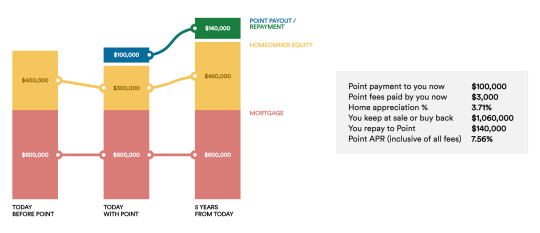
    Point is an alternative to traditional home equity loans and HELOCs. The way it works is that you actually sell a portion of your property. Here’s an example:

    In this scenario, the home is worth $1M. Point makes an offer to buy 10% of today’s value in exchange for 20% of the home’s future appreciation on a 5 year term. You pay a 3% fee when the $100,000 (10%) is paid out, but you don’t make any monthly payments. You just give up potential future appreciation. (If the home doesn’t appreciate, Point doesn’t make money.)

    What’s interesting about this model is that traditionally “housing” has meant one of two things. Either you own 0% of the home (i.e. you rent) or you own 100% of the home (usually with the help of a mortgage).

    Point is making it easier for you to potentially own 95% or 90% of your home. They are taking an equity stake, which is why there are no monthly payments associated with it. 

    The investment angle is that homeowners get to diversify their wealth out, and (Point) investors get to diversify in, without having to worry about actually managing the property.

    Would you use this as a tool to unlock your home equity wealth?

  • Where are rates going?

    Real estate is a highly levered asset class, which means
    that pricing is sensitive to interest rate changes.

    Larry Summers recently published a post on his blog
    where he argued that the Fed (US) is being far too complacent about their
    ability to respond effectively to a future recession. He sees this as their
    biggest monetary policy challenge going forward.

    Given the potential impact to real estate and city building
    as a whole, I thought I would summarize some of his key points:

    • Private sector GDP growth in the US averaged
      1.3% over the last year
    • Since the 1960s, this level of tepid growth has
      typically foreshadowed a recession
    • Larry sees > 50% chance that the US economy
      will enter a recession in the next 3 years
    • 400-500 basis points of monetary easing is
      usually needed to counter recessionary pressures
    • The Feds will likely not have this much room to
      play with when the next recession comes along

    I don’t think anyone could have predicted that rates
    would remain so low for so long. (10-year Treasury = ~1.6% at the moment.) Still,
    my view has been that rates in Canada and the US won’t be posting meaningful
    increases anytime soon. And Larry’s post reinforces that for me.

    What’s your view?

  • I can’t spend unrealized gains

    image

    Earlier this week the Wall Street Journal published an article claiming that the celebrated venture capital firm Andreessen Horowitz was lagging behind its elite peers in terms of returns.

    The firm then responded with a well-written blog post explaining why this accusation is off the mark. Their response was simply that you can’t measure returns on “unrealized gains.” Until there is a liquidity event – that is, the company gets sold or goes public – it’s just paper returns. And what matters is cash. 

    As the post clearly states: “I can’t spend unrealized gains.”

    But beyond just a rebuttal, the blog post is a great primer on how the venture capital industry works. We talk a lot about the tech space on this blog, so I thought some of you might find it interesting. 

    One of the reasons I like to follow the VC space is that there are many similarities to real estate development. Not only in the way that the funds are structured, but also in the way that the gestation periods are incredibly long.

    The post talks about this as a “J curve.” In the early years of a fund, the returns are negative. Money is going out the door to invest in immature and risky startups. And it’s not until the harvesting period (7+ years later) that the realized gains start getting paid out to investors (LPs).

    It’s also interesting to note that the exit timing for companies – at least according to Andreessen Horowitz – seems to be increasing (10+ years). This is yet another similarity to real estate development where it seems to be getting harder and harder to build and deliver new supply.