Daily insights for city builders, delivered every morning at 6 AM ET. I’m Brandon Donnelly — a Toronto-based real estate developer and founder of Globizen. I’ve been writing here since 2013.

Tag: real estate

  • One of the most expensive neighborhoods in LA

    image

    Oftentimes when I visit a city I like to ask myself: Which neighborhood would I want to live in if I were to move here?

    Today I spent much of the afternoon hanging around Venice. After we got there, I told my friend that if I moved to LA, I would probably want to live there. I told him that, relative to the rest of the city, I liked the compressed scale of the neighborhood. There are many pedestrian-only lanes and streets beyond the boardwalk. And I told him that I thought it was interesting how the neighborhood seems to combine both bohemians and yuppies (though many people seem to hate the yuppy part).

    But I’m obviously not alone in my thinking. My friend quickly informed me that Venice is one of the most expensive neighborhoods in LA and that it’s been adding essentially no new housing supply. Here’s an excerpt from an LA Weekly article published at the beginning of this year:

    Anti-development activists like to argue that development fuels gentrification, that the construction of new, high-end apartment buildings makes the whole neighborhood more expensive.

    But the case of Venice is a counterpoint. For the last 50 years, Venice has successfully fought developers to a stalemate. The housing supply stayed constant, while demand grew. As a result, the value of property in Venice has soared.

    In 1996, according to data provided by Zillow, the average home value in Venice was $251,000 — more expensive than Silver Lake and Encino but cheaper than Westwood, Studio City, Mid-Wilshire and Los Feliz. Today, Venice’s average home value is nearly $1.6 million, more expensive than all of those neighborhoods — more expensive, in fact, than its historically tony neighbor to the north, the city of Santa Monica, which, according to Alvarez’s research, added more than 10,000 dwelling units between 1960 and 2010.

    Perhaps I should give this some more thought.

  • Building Tour: Oben Flats Leslieville

    I toured Oben Flats Leslieville today, which is a 48-unit purpose-built rental building at 1075 Queen Street East in Leslieville (Toronto). It was designed by superkül

    Oben Flats is doing some very cool things, so I would encourage you to check them out if you’re in the market for a new luxury rental (or you just want to nerd out about property). The image at the top of this post is the west view from the rooftop terrace.

    Here are 3 things that stood out for me:

    1. One of the interior amenity spaces for the building is actually on the ground floor attached to the main entrance. There’s a fireplace, a wet bar, a set of wine fridges and free wifi. Oben Flats hosts regular events in this space, but I was told that residents also regularly hang out in it. They’ll bring their laptop down and have a glass of wine. 

    What I like about this is that it encourages social interaction within a multi-family building typology. I would love to see more of this kind of thinking. Part of the reason you live in a city is to interact with other humans.

    2. Oben Flats has developed their own signature scent and regularly curates a music playlist with the help of BELLOSOUND. Both of these items are pumped throughout the common areas of the building, which is not that dissimilar from what you might find in some luxury hotels. I have one of their candles sitting on my desk right now, so my office smells like Oben Flats. I’m into it.

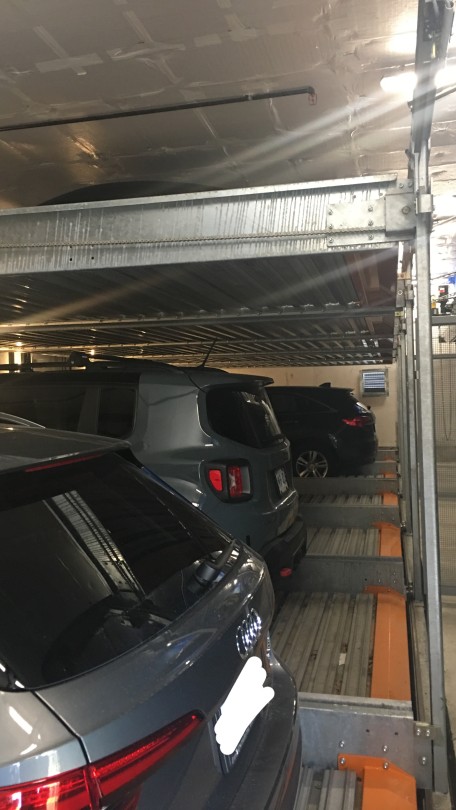
    3. Another unique feature of the building is the fully automated hydraulic car-stacking system. Here’s a photo of what the guts of that looks like:

    There are 3 platforms in each bay (the bottom one is below-grade in the above picture). And there’s always one empty spot so that the platforms are able to shuffle around both horizontally and vertically. However, as a user, you never see this. You simply hit a button and drive into your bay. It’s always the same one.

    I’ve said many times before on this blog that I think we will see way more of these types of parking solutions

    in the city

    going forward.

    There are other cool things I could mention about the building, but it’s far too nice out to sit at my desk any longer. Before I sign off though, I should mention that this is in no way a sponsored post. I simply admire what Oben Flats is doing. 

    See you tomorrow.

  • We’re working with superkül

    Today I am excited to announce that we are working with superkül architects on a new mid-rise condo project here in Toronto. Details about the site and project to follow.

    I am excited about this for a few reasons.

    It should go without saying that I love their work. Check out Compass House, SHIFT Cottage, Harbord Towns, and Oben Flats Queen East.

    You may also notice that they work at a variety of different scales and have a lot of single-family / custom home work. This was important to us because one of our goals for this project is to create really great homes within a boutique building. Emphasis on home.

    The other exciting piece is that one of the founding principals of superkül – Meg Graham – was one of my professors in architecture school. So there’s a sense of coming full circle.

    This matters to me because when I became a developer I told myself that I was going to be the kind of developer that gave a shit about design and actively worked to improve the built environment.

    I guess what I’m saying is that there’s a feeling of continuity. I haven’t forgotten where I came from, which was the world of architecture.

    Image: Blok Design

  • Instagram Stories has more active users than all of Snapchat

    Instagram has a company chart that shows: Days to Reach the Next 100 Million Users. It is only the chart where they want to see it decline. The first 100 million users took 28 months. And the last took only 4 months. Instagram now has 700 million active users.

    Instagram is also saying that they have 200 million people using their Stories feature – you know, the feature they blatantly stole from Snapchat. This would mean that more people are using Instagram Stories than Snapchat has daily users (~158 million).

    Anecdotally, I can tell you that I’ve almost completely stopped using Snapchat. (Snapchat battery usage over the last 7 days = <1%.) I still prefer Snapchat’s direct messaging functionality, but not enough to continue using the platform. Instagram now provides basically the same functionality – plus my photos – in a single app. 

    But more importantly, Instagram’s network and my network are bigger there. And network effects are clearly the most important thing. In fact, by directly copying Snapchat, Instagram (Facebook) made sure that this competition was only about network size and not about features. Monopoly power.

    In real estate, if you own a property in a great location, your position is pretty defensible. (Though you may not be completely immune.) But in tech, that is clearly not the case. Someone might copy everything you’ve done and beat you at your own game.

    As someone who used to be very bullish on Snapchat, I am now wondering if I need to remove my Snapchat handle from the header of my blog emails. I mean, I’m not there very often anymore. But maybe, just maybe, Snapchat will find a way to compete outside of network effects at a game that Instagram/Facebook can’t play.

    How would you or are you placing your bets?

  • HOT, HOT HOUSES

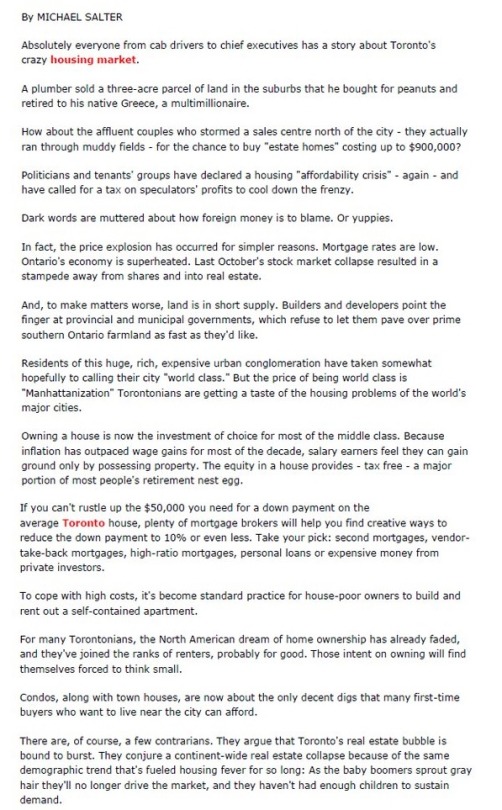
    Below is a piece by Michael Salter from the Globe and Mail. It’s all about Toronto’s HOT, HOT housing market. Michael’s message: Here are the real reasons why home prices are skyrocketing and why they are going to remain high.

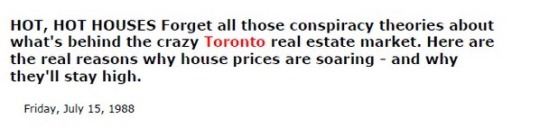
    Did you find yourself agreeing with this article or did you notice that something was off? If you noticed something, it may be because this article was originally published on Friday, July 15, 1988. And by that time, the North American dream of home ownership had already died in Toronto.

    Here’s the header I cut out from above:

    Thank you to Tamsin McMahon for tweeting this out last weekend.

  • Envelope Beta

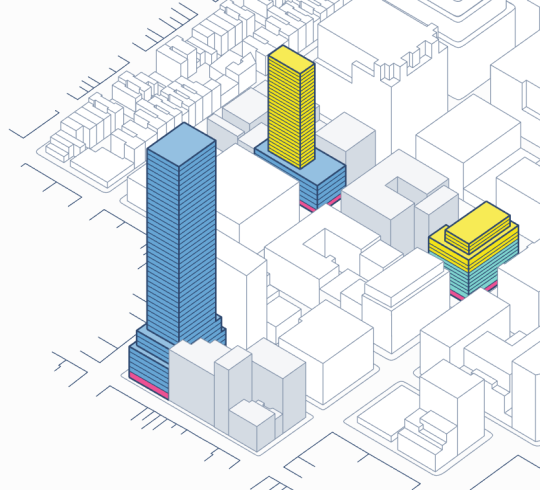
    My friend Bruce of getrefm.com (real estate financial modeling) just introduced me to a new real estate startup called Envelope. Basically it’s 3D mapping software that allows you to quickly visualize the zoning envelope for a particular site. It’s similar to what Flux.io was initially trying to do.

    Now, I think this is very cool, but my first reaction was: What if the zoning is out of date? What if approvals/entitlements are done a site-specific basis? This isn’t the case in every city, but I’ve heard some people in Toronto argue that this city basically has no zoning code. (We can debate that one in the comments, I’m sure.)

    That being said, there are still many design guidelines in this city that shape built form and I could see a tool like this being incredibly useful. They’re still in private beta but I would like to try it out. Hopefully they’ll see this blog post and let me have an early peek.

    Image: envelope.city

  • Toronto real estate is out of control

    You can’t have an Easter dinner in Toronto right now without somebody bringing up the topic of our “crazy” real estate market. 

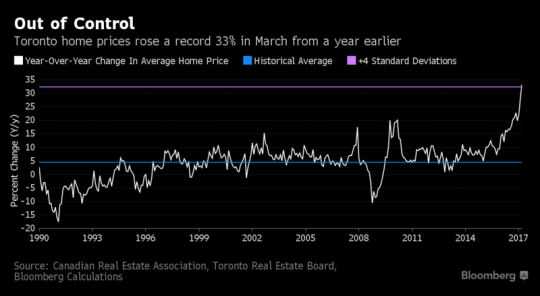
    Below is a chart from Bloomberg showing the year-over-year change in home prices in the Greater Toronto Area since 1990. It also shows the historical average (in blue) and how in March 2017 we hit 4 standard deviations above that. Home prices rose 33% in March compared to a year earlier.

    If I were a realtor, I’d probably tell you that the market is hot hot hot. Now is the time to sell because you’ll get some absurd number above your asking price and now is the time to buy because prices are going nowhere but up. Don’t miss out. 

    I would like to try and be a bit more nuanced than that. Here are 3 thoughts:

    1)

    There’s no question that low rates / cheap money is one of the root causes of the real estate valuations we are seeing today. But frankly I have no idea when or if that will change. There is an interesting argument out there that capital is no longer scarce. Our economy is going through a fundamental shift, which is why real estate is not the only asset class seeing these sorts of valuations and growth figures.

    2)

    There are a number of global factors which are helping to cement Toronto’s position as an alpha global city and destination for human capital. Think Trump, Brexit, and so on. I agree with Richard Florida’s argument that our real estate market will see more – not less – pressure going forward. Here is a snippet from a recent interview with Florida in Toronto Life:

    I think Toronto is going to get an even bigger influx of the creative class. With the rise of Trumpism, more and more people who might otherwise have gone to the United States are going to come to Canada. We’re going to see American tech companies invest more and more in Toronto. And if we think the housing affordability and economic divide we see today is bad, it’s going to grow ever more gaping. 

    3)

    I believe that there are always opportunities in the real estate space, but that you have to be disciplined, focused on fundamentals, and willing to do things that others won’t. What bothers me is when I hear people say things like: “Real estate only goes up. You can never go wrong.” I started my career pre-2008 and lived in both the United States and Ireland. I saw what down looks like.

  • Case Study: Chophouse Row, Seattle

    The Urban Land Institute recently published an interesting case study for a project in Seattle called Chophouse Row

    It is the last phase in a series of projects that the developer, Liz Dunn, has been involved with in the neighborhood over the last 16 years.

    This particular project has 25,317 sf of office, 6,379 sf of retail, and 4,795 sf of residential (3 penthouses). It also incorporates a heritage building. Good example of fine-grained urban infill.

    Here is the video (click here if you can’t see it below):

    [youtube https://www.youtube.com/watch?v=_PmAMsWEv98?rel=0&w=560&h=315]

    On a related note, ULI’s 2017 Toronto Symposium is coming up later this month (April 24 – 25, 2017). Here is the program. 80+ speakers. If you’d like to register, you can do that there.

  • Amazon is just getting started

    image

    The Economist has an article up talking about what a behemoth Amazon has and will continue to become. Here are some interesting stats for you to think about:

    • More than half of every dollar spent online in America now goes to Amazon
    • Amazon’s share price has increased 173% since the beginning of 2015 (12x faster than the S&P 500)
    • With a market capitalization > $400 billion, it is the 5th most valuable company in the world
    • 92% of its value is supposedly being derived from profits expected after 2020 – they are playing the long game
    • Investors believe that revenue will go from $136 billion (2016) to half a trillion over the next decade

    If I can buy something online, instead of in person, I will do it. And that very often leads me to Amazon. In fact, I bought my new camera lens from them last week. Many others seem to be doing the same.

    When I go to a store now it’s because I need something immediately or because I’m looking for a new experience. I want novelty and I want to feel something special when I walk in. That, or I just need groceries.

  • February housing numbers

    The Building Industry and Land Development Association (BILD) announced its February (2017) numbers today for the Greater Toronto Area. Here are some of the highlights:

    – At the end of February, there were 324 detached homes available in developer inventories. Ten years ago, this number was was 12,064 (detached only). 

    – If you consider all low-rise homes (detached, semi-detached, and towns) the above numbers are 1,001 (2017) and 17,304 (2007), respectively.

    – Average price of a new detached house is now $1,469,449. For all ground-related housing – again, including semis and towns – it’s $1,081,013.

    – There were more than twice as many condo apartments sold than low-rise homes in February.

    – Condo inventory is also dropping and reached a low of 10,342 units.

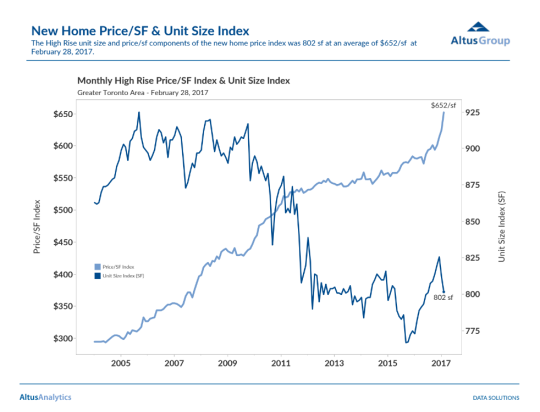
    – Average price of a new condo increased to $652 per square foot and the average unit size decreased to 802 square feet.

    Here’s that information in a chart from Altus Group:

    image

    The overall story here continues to be about decreasing inventory and increasing prices. There’s also the ongoing shift from low-rise to higher density housing, which I don’t view as a bad thing.