Daily insights for city builders, delivered every morning at 6 AM ET. I’m Brandon Donnelly — a Toronto-based real estate developer and founder of Globizen. I’ve been writing here since 2013.

Tag: real estate

  • Slate closes on $1.14 billion asset portfolio

    Today, the Slate Canadian Real Estate Opportunity Fund I closed on a 6.2 million square foot portfolio that it previously announced it was acquiring from Cominar Real Estate Investment Trust for approximately $1.14 billion.  

    The portfolio includes office, retail, and industrial properties in the GTA, Atlantic Canada, and Western Canada. This brings Slate Asset Management’s total assets under management to over $5 billion.

    Great work team Slate.

  • Vancouver’s Empty Homes Tax

    In an effort to curb the much talked-about and much debated empty home situation in Vancouver (supposedly the number is ~20k vacant homes), the city, as many of you know, implemented an Empty Homes Tax.

    To enforce this, the City of Vancouver now requires that every year, every owner of residential property must file a status declaration. If you don’t file this by the deadline, the property is automatically deemed vacant and the tax (1% of assessed taxable value) and a penalty ($250) are applied.

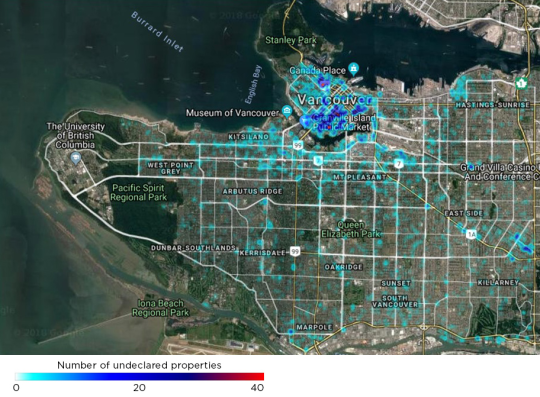
    Last month, 11 days before the 2017 deadline, the city published the below heat map showing the concentration of Vancouver property owners who hadn’t yet made their declaration. There were just under 4,000 undeclared properties.

    image

    But as Jens von Bergmann points out on his blog, Mountain Doodles (great data-driven blog), this was really just a map of where people live. Because if you also create a map of residential properties subject to the tax, which he did, it looks pretty similar to above.

  • New high-rise home prices up 39.5% year-over-year

    February data (2018) for the new home market in the Greater Toronto Area was released this past week by BILD and Altus. I seem to have gotten into the habit of writing about this every month.

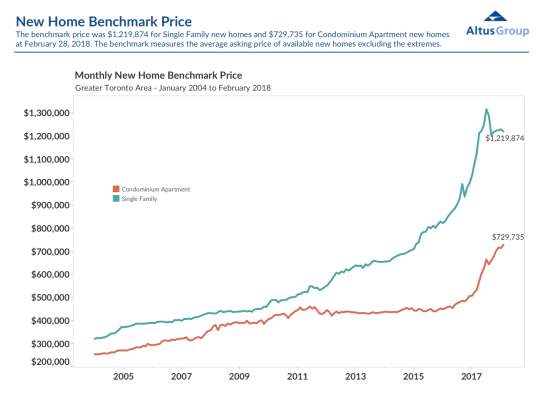
    The benchmark price for new low-rise single-family housing was down slightly from January to $1,219,874, but still up 12.8% from a year prior.

    The benchmark price for new high-rise housing was up a whopping 39.5% year-over-year to $729,735. But part of this is being driven by an equally dramatic increase in average unit sizes.

    Here is the relevant graph:

    image

    The story continues to be about tight supply, historically low developer inventories, and a lack of affordable low-rise product. 

    As I have argued many times before on this blog, I believe these factors — and in particular the last one — are, at least partly, driving this recent pop in high-rise pricing. People are priced out and now searching for substitutes.

    So my prediction continues to be that we will see a convergence (i.e. diminishing spread) between new low-rise and high-rise pricing.

    That will also bring about design and product changes on the high-rise side.

  • My new gig…

    image

    So this is interesting.

    Earlier this month, Travis Kalanick – co-founder of Uber and its former CEO – formed a new venture fund called 10100. According to the WSJ, it was funded with his own money after he sold 30% of his position in Uber for a cool $1.4 billion. 

    Ten-one-hundred’s spartan website explains that the goal of the fund is “large-scale job creation, with investments in real estate, ecommerce, and emerging innovation in China and India.” On the non-profit side, the initial focus will be on “education and the future of cities.”

    Then this week, Travis tweeted out “My new gig…” and disclosed that 10100 had entered into an agreement to buy a controlling interest in a real estate holding company called City Storage Systems (CSS) for $150 million. 

    He also announced that he would become CEO.

    The focus of CSS is on the redevelopment of distressed real estate, particularly parking, retail, and industrial assets. He goes on to say: “There are over $10 trillion in these real estate assets that will need to be repurposed for the digital era in the coming years.”

    This whole series of events is a big bet on some significant changes in the real estate space.

    Photo by Martin Reisch on Unsplash

  • Neighborhood depopulation

    Recently we’ve been talking about California’s Proposition 13 and how it may be creating a disincentive for longtime homeowners to move. They’re enjoying below market property taxes, and so they stay put, even if they may have too much house.

    But this concept of “overhousing” isn’t unique to California. The Globe and Mail just ran a piece talking about how Toronto’s designated “Neighborhoods” are losing people as the nests empty out, seniors remain put, and the broader city booms.

    The rate of depopulation that created the spare bedrooms in Toronto’s low-rise neighbourhoods is stark: “Since 2001, about 52 per cent of the land mass of Toronto has reduced in density of population by about 201,000 people,” Mr. Smetanin says. “Other parts of Toronto have grown by 492,000.”

    The irony of this phenomenon is that the city’s Official Plan considers these Neighborhoods to be “physically stable”, as well as “one of the keys to Toronto’s success.” However, things are clearly changing behind that physical stability.

    Photo by Verne Ho on Unsplash

  • UNStudio announces new tech architecture company (and thoughts on the smart home)

    Dutch architecture firm UNStudio has just launched a new company called UNSense, whose purpose is to explore and develop “new sensor-based technologies that are specifically designed to positively impact people’s physical, mental and social health.” They are calling the new business an “arch tech company” and it is their belief that, at some point, all architecture firms will become arch tech companies. You can learn more about UNSense, here.

    This announcement got me thinking about the state of smart home technologies, which, of course, is this massive buzzword that everyone is throwing around these days. Many of us have smart thermostats, voice assistants (that may be listening to our every word), wifi lights, and so on. And you can do some pretty neat things with software like IFTT, such as program your lights to come on at sunset or when you walk in the door.

    But as cool as they may be, these smart home devices have always felt like patchwork add-ons to me. I understand that this is partially driven by what customers can easily adopt and I don’t mean to discredit the value that they bring, but today’s post is about reminding us to also think more fundamentally, as opposed to just incrementally.

    Smart thermostats, for instance, give us the functionality to adjust our heating/cooling from our phone. But at the end of the day, they still control the same underlying system, which, by the way, is a fairly simple one. When it gets cold (because of our R-3 windows), the heat turns on. When it gets warm enough, the heat turns off. Zoned systems certainly add another layer of sophistication, but are we optimizing for the right variables?

    UNSense works at three scales: Cities, Buildings, and Interiors. And if you look at what they are trying to do at the building scale, it is around the interface between inside and out. Designing transformable facade systems and buildings that can respond to their environment and our changing needs. These are not new ideas, but in today’s tech-driven world, the timing may just be right.

    If you think about the climate we have here in Toronto, it is actually an incredibly difficult design problem. We have cold winters and hot humid summers, which means we have to solve for two different extremes. Mechanical systems have made that a lot easier to do, but if we’re going to meet the energy and greenhouse gas emission targets that we’re all talking about, we’re going to need a hell of a lot more than just smart thermostats.

    Image: UNSense

  • Would it be insider trading if Kylie Jenner traded on her tweets?

    Lately I have really gotten into Matt Levine’s daily newsletter about “Wall Street, finance, companies and other stuff.” Maybe that’s how I should describe this blog: Cities, real estate, design, and other stuff.

    If you aren’t familiar with Matt’s writing, here is an article that he wrote about Kylie Jenner’s recent tweet concerning Snapchat. You know, the one that wiped out $1.3 billion of market value because she revealed – using only 88 characters, I might add – that she was no longer using the app.

    https://platform.twitter.com/widgets.js

    The article was spurred on by this question:

    “Would it be insider trading for Kylie Jenner to buy short term out of money put options on Snap and tweet out that she’s no longer using Snap?”

    And this is the start of his answer:

    Insider trading, as I am constantly saying around here, is not about fairness; it is about theft. It is not illegal to trade on your own nonpublic knowledge of your own intentions. Warren Buffett can buy stocks before he announces that he’s bought them, even though that announcement will predictably make the stocks go up. 

    If I did describe this daily blog like Matt describes his daily newsletter, this post would clearly fall into the “other stuff” camp. But maybe you too will find it interesting. If you do, you can subscribe here

  • Thoughts on housing in the Bay Area

    I was out for drinks recently with a friend of mine who is a developer in California and she mentioned a few things to me that I thought were really interesting. 

    First, she talked about how virtually nothing gets built in the Bay Area “as of right.” And so the market is hugely supply constrained. She said, you’re lucky if you can get your entitlements in 2 years. It’s starting to take longer. I immediately said: “That’s Toronto.”

    Second, we talked about Proposition 13, which was timely given this recent post. One of the consequences of Prop 13, beyond helping golf clubs survive, is that longtime homeowners seem to be highly incentivized not to move. 

    Their property taxes are so below market that it can be more cost effective for them to stay put as opposed to downsize – even if they have too much house. This means far less turnover in the housing market.

    Third, there really does seem to be a feeling in the Bay Area that it’s at a breaking point in terms of affordability. When a successful software engineer making $200,000 a year can’t afford housing, people naturally start to look to other cities.

    We hear this refrain all the time in the media, but because I’m not active in that market, it was far more impactful hearing it from a friend.

  • “I hate golf”

    I am a big fan of Malcolm Gladwell, and not just because he’s Canadian and went to the University of Toronto (my alma mater), although those facts certainly don’t hurt.

    I’m late to his podcast, Revisionist History, so in case some of you are as well, I would encourage you to check it out. Every episode reexamines something from the past and questions: Did we get it right the first time? It’s very Gladwell. It’s a must listen.

    The episodes span a secret research project setup by the Pentagon in downtown Saigon during the Vietnam War to why rich people are obsessed with the game of golf. Spoiler: He hates golf.

    The golf episode will be of particular interest to many of you because it deals with real estate. Malcolm wades into something known as California Proposition 13, which is a constitutional exemption that keeps property taxes artificially low.

    It is what has allowed these “vast, gorgeous, and private” golf courses to continue to exist in expensive cities like Los Angeles. Otherwise they would have long ago drowned under the property taxes following reassessment.

    This also leads to a philosophical debate about what constitutes a change in ownership, since many clubs are member owned and Proposition 13 requires that there not be a change in more than 50% of the ownership. 

    But I’ll stop there. Give it a listen. Malcolm is just excellent.

    Photo by Rémi Müller on Unsplash

  • You can now buy a new home, online

    My friend Matthew Slutsky runs a company called BuzzBuzzHome that allows you to search for new construction homes. This week they launched a feature that allows you to put down a deposit on a new home – online – with your credit card. It’s live right now for the Barra on Queen in Kitchener, Ontario.

    I know that Matthew and his team have been working on this for years (I saw earlier demos), and so I wanted to publicly congratulate them on the blog. I’m not sure who their competitors are right now, but this feels to me like one of the first online real estate marketplaces where you can actually just hit “buy now.” Huge accomplishment.

    I am sure many of you will have objections that we will hear about in the comment section below. But I have little doubt that this is the future. People used to say that the masses aren’t going to buy clothes online because of the need to try things on. I own suits that I have purchased online. People will buy real estate online.

    The more important question: When will it go mainstream?