Daily insights for city builders, delivered every morning at 6 AM ET. I’m Brandon Donnelly — a Toronto-based real estate developer and founder of Globizen. I’ve been writing here since 2013.

Tag: real estate

  • Why Millennial homeownership is so low

    The Urban Institute has a new study out that looks to explain why Millennial homeownership rates are lower than that of previous generations. The typical refrain is that Millennials have a lot more student debt and that the cost of housing in urban centers has risen faster than income levels. But this report tries to put some math behind those explanations. All data is for the US.
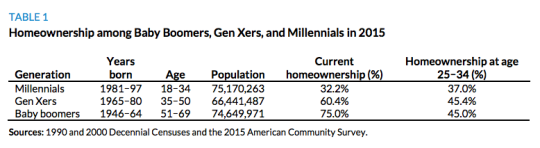
    Not surprisingly, marriage and kids are significant drivers, and Millennials appear to be delaying both. According to the study, being married increases the probability of owning a home by 18%. If marriage rates in 2015 were the same as they were in 1990 (this is the time period for the study), the Millennial homeownership rate would be 5% higher. Having a kid increases the probability by about 6.2%.

    There’s also a widening spread between the homeownership rates for more educated and less educated Millennials. Presumably the distinction is a 4 year university degree. Between 1990 and 2015, the spread between the two groups increased from 3.3% to 9.7%. This was identified as an area of “great concern” because of the possible long term implications.

    Combine this phenomenon with the stats that white households have a higher homeownership rate compared to all other racial groups and that having parents who are homeowners increases the likelihood of also owning a home (let’s ignore, for a second, the other intergenerational transfers of wealth), and you have a recipe for rising wealth disparities.

    Of course, some of you will undoubtedly argue that in this part of the world we are overly fixated on homeownership as a mechanism for wealth creation. I mean, there are many examples of very wealthy countries with homeownership rates that are far less than what they are here in Canada and the US. But that’s a discussion for a different blog post.

    If you’d like to go through the full Millennial Homeownership report, you can do that here.

  • Hypervacancy in America’s legacy cities

    I was reading Aaron Renn’s post this morning on America’s vacant housing challenge and I was reminded of the stark contrast between what we are experiencing here in Toronto and what the US is experiencing in a lot of its coastal cities, compared to what is happening in many legacy cities in the US. The former industrial centers. In this latter case, the discussion is around neighborhoods reaching a tipping point in terms of vacant homes and then spiralling out of control. Below is an excerpt from a study that Renn cites in his post. It is from the Lincoln Institute of Land Policy and it’s called “The Empty House Next Door.” The above chart should also tell you a lot about the magnitude of this problem.

    Hypervacancy has been rising steadily in legacy cities since the 1990s. Although only one out of sixteen census tracts in Cleveland was hypervacant in 1990, by 2010, one out of two tracts in that city had reached hypervacancy. When vacancies rise above approximately 20 percent of an area’s total properties, the number of vacant buildings and lots may continue to grow indefinitely. Although vacancies rarely reach 100 percent—because even the most distressed neighbor- hood may have a few long-term owners—the market effectively ceases to function. Houses sell, if they sell at all, only to investors at rock bottom prices while the neighborhoods become areas of concentrated poverty, unemployment, and health problems.

  • More on One Delisle and the block

    image

    Now that things have quieted down from last night, I would like to say that we are thrilled by the response to One Delisle and the broader ideas for the block. There was a lot of positivity last night at the open house and today the project team received countless emails and messages from people telling us that they are excited and/or looking forward to working with us over the coming years. Many were from the local community.

    image

    Following yesterday’s Globe and Mail piece by Alex Bozikovic, One Delisle was also covered in Urban Toronto (read the comments), designboom (they’re allergic to capital letters), ArchDaily, Canadian Architect, Dezeen, The Architect’s Newspaper, and probably other places that I am missing. The comments have been interesting to read and there seems to be a fatigue around boring glass boxes. This project team does not want to do that.

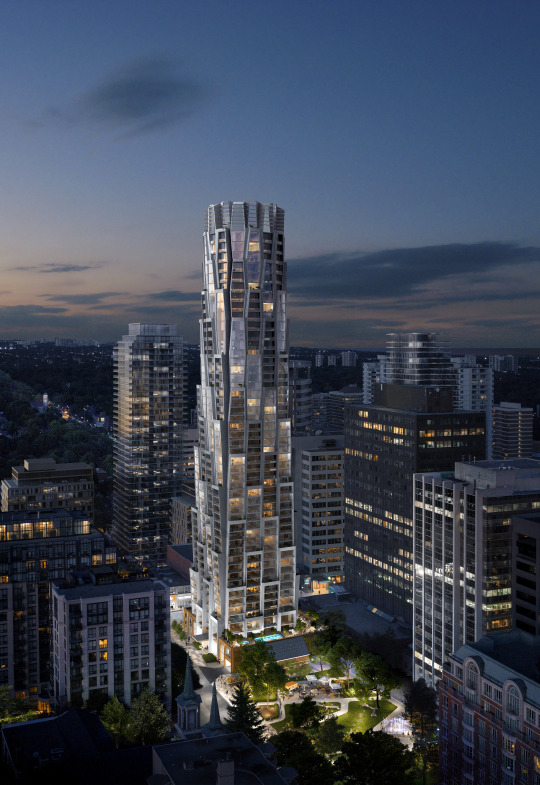
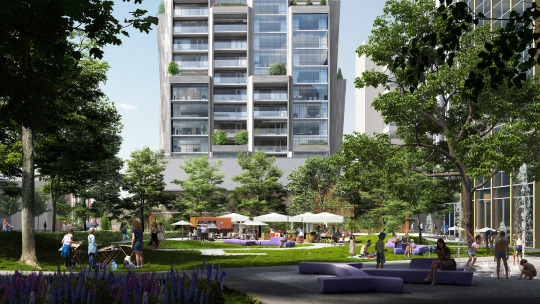
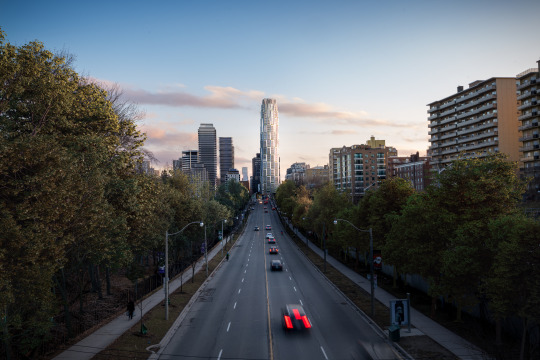
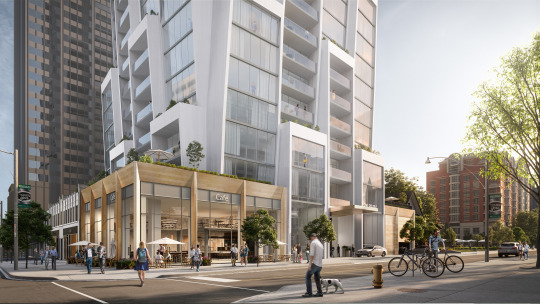
    Though the project has been making the rounds, there are two images that I don’t think have been widely shared and so I would like to do that today (below). Both were presented at last night’s open house. And they are intended to show the relationship between One Delisle and Delisle Park, which is proposed to be revitalized and expanded by ~50% as part of the project’s block and enhanced public realm strategy. Credit to ADHOC Studio for these renderings.

    imageimage

    In fact, it is important to keep in mind that while a lot of attention is being paid to the architecture of the building, there’s a broader city building strategy that is attached and integral to it:

    • Revitalize and expand Delisle Park by 50%
    • Add residential uses to a block of office buildings
    • Reduce the number of vehicular access points across the block from 5 to 3 in order to improve traffic flows in the area
    • Create below-grade vehicular connections across the block to consolidate and legitimize access/loading and once again improve traffic flows in the area 
    • Significantly widen the sidewalk along Yonge Street to eliminate existing pedestrian pinch point
    • Significantly widen the sidewalk along Delisle Avenue to strengthen connection to Delisle Park
    • Introduce pedestrian laneway with art canopy to connect St. Clair Avenue West back to Delisle Park
    • Create a unified and consistent public realm across the block and provide retail animation along its edges
    • Retain Art Deco facade along Yonge Street
    • Target the 2nd tier of the Toronto Green Standard (voluntary sustainability target)
    • Continue to explore the feasibility of district energy solutions across the block to take advantage of the different energy demand curves for office, retail, and residential uses

    Once again, a big thanks to the ~300 people who came out last night – in the rain – to engage with the project team. And a big thanks to the full project team who worked tirelessly to prepare for this week’s community open house. But as was said on Thursday night, in many ways this is really just the beginning. To stay informed about the project and to provide your feedback to the team, stay tuned to yongedelisle.ca.

    Photos: Khristel Studios

  • Studio Gang’s first project in Canada

    imageimage

    This evening Slate Asset Management hosted the community meeting that I’ve been writing about on the blog over the last little while. 

    And at this open house Jeanne Gang of Studio Gang introduced a new block plan and mixed-use building at the southwest corner of Yonge Street and Delisle Avenue in midtown Toronto.

    I think it went really well. We had over 200 people RSVP, but based on my imprecise head count, over 300 people actually showed up. 

    I would tell you more right now, but it’s very late. So I’m going to instead leave you with this article by Alex Bozikovic, titled, Studio Gang’s new Toronto tower follows the right recipe: tall, innovative and excellent.

  • Blackstone enters Canadian multi-family sector

    image

    A few days ago it was announced that Blackstone has entered the multi-family space in Canada through a JV with Starlight Investments. They are buying 6 undisclosed multi-family buildings. 5 in Toronto. And 1 in Montréal. The total is 746 units.

    The message in the press release is that apartment buildings in Canada are difficult to find and buy at meaningful scale. Most are held by small private investors and those owners are reluctant to sell. 

    At the same time, places like Toronto and Montréal have built relatively little purpose-built rental over the past few decades. Supply is restricted. 

    This is an interesting stat from the announcement: The Canadian rental market is about 2 million housing units. Dallas, alone, is 500,000 units. But this must only be purpose-built, investment grade, and/or some other subset of units. Because there are over 14 million private households and over 4.4 million rented households in Canada (2016 data).

    They also hint at a longer-term relationship between Blackstone and Starlight. Perhaps that will translate into some purpose-built rental development in the future.

    On a related note, I recently picked up the book, King of Capital: The Remarkable Rise, Fall, and Rise Again of Steve Schwarzman and Blackstone. It was published in 2012, so it’s not new. But as soon as I stumbled upon it, I picked it up. It was new to me.

    Once I’m finished it maybe I’ll report back here on the blog.

    Photo by Warren Wong on Unsplash

  • Airbnb and affordable housing

    image

    Fred Wilson published a good post last weekend on the proposed bill that went to New York City Council this week regarding new reporting requirements for Airbnb and their hosts in NYC. You can read more about his position on his blog, but he is in favor of a comprehensive bill that would properly legitimize short-term rentals. He is also not opposed to city and state taxes on the service.

    What I wanted to focus on today were his comments around housing. This is already sounding like a broken record, but Fred draws attention to the severe supply-demand imbalance that is occurring in the boroughs of Brooklyn, Queens, and the Bronx, precisely because many/most young people were priced out of Manhattan long ago and want to live in these places.

    But I particularly like his comments around what makes for good policy and what makes for good politics. I agree with his view that it is often a case of the latter over the former. I think a lot of the excitement around Airbnb is a red herring. For me, it’s akin to the fixation on foreign buyers and their impact on the local housing market in places like Toronto and Vancouver.

    Yes, they are factors. But the data suggests they are marginal ones. As Fred points out, they are almost certainly not the root cause of the problem. The reality is that we need a lot more housing – both market-rate housing and subsidized housing. The challenge is that nobody wants to pay for the latter and so we’ve instead decided to focus on things that sound like they’re going to help.

    Photo by Jon Tyson on Unsplash

  • An open house with Jeanne Gang

    image

    On Thursday, July 5th, Slate Asset Management, Studio Gang, and the rest of the project team will be hosting a community open house where we will introduce designs for a new block plan and mixed-use building at Yonge + St. Clair. This will be Studio Gang’s first project in Canada. We’re pretty excited.

    It’s important to note that while the proposed design has been influenced by some of the early discussions we had with city staff and the local Councillor, we are still very much at the beginning of this process. Which is why alongside this community open house, we are also launching yongedelisle.ca.

    This will be our “neighbourhood engagement” website as we go through the planning process. You’ll find updates from the project team as they become available, and you’ll also have a direct way to get in touch. We’re also testing out this interactive page where you can vote on the city building principles that matter most to you.

    So hopefully we’ll see you on Thursday, July 5th. Invite details above. Please RSVP, here, if you can. But if you forget to do that, don’t worry, you can still just show up. For more on Jeanne Gang, click here.

  • Where are all the kids?

    This evening, when I was reading the internet, I came across this New York Times article from 2017 talking about how San Francisco has the lowest percentage of children of any of the largest cities in the U.S. It’s around 13% of the population. (Supposedly it was the second lowest in 2015. Pittsburgh was first.)

    The article goes on to claim that the city has approximately the same number of dogs as it does children. That number is somewhere around 120,000. Not surprisingly, many blame the city’s prohibitive housing costs as the main culprit for the lack of kids. Families simply cannot afford to live in the city.

    This got me searching for more information. Richard Florida looked at similar data back in 2015, but it’s important to note that he looked at metro areas and not the city propers. So the data doesn’t speak to whether families were forced to move out from the urban core to the suburbs in search of more affordable housing or for more space.

    Nevertheless, he finds no statistical association between the share of children in a city and things like urban density, economic output per capita, or median home prices. He instead finds that the share of children is positively correlated with two main factors: immigration and with ethnicity – specifically people of Latin origin.

    Click here if you’d like to read the rest of Florida’s analysis. And if any of you have additional data on this topic, please do share it below. I think I’m going to continue digging into this question of kids and cities.

    Image: Photo by William Bout on Unsplash

  • How New York City became boring

    image

    On the cover of the July 2018 issue of Harper’s Magazine is a picture of New York City – with Rafael Viñoly’s 432 Park Avenue as the focal point – and the title: Death of a Great American City. New York and the Urban Crisis of Affluence.

    The long-form article is by Kevin Baker and it is an account of how New York City has transformed itself over the past few decades from a place of culture and character (and of cockroaches and discarded crack vials) into a place for the ultra-wealthy to buy ultra-luxury real estate that may or may not sit empty for more often than it is occupied.

    “As New York enters the third decade of the twenty-first century, it is in imminent danger of becoming something it has never been before: unremarkable. It is approaching a state where it is no longer a significant cultural entity but the world’s largest gated community, with a few cupcake shops here and there. For the first time in its history, New York is, well, boring.”

    This narrative and/or phenomenon is of course not unique to New York City, though it is surely more pronounced when you are one of, if not the, preeminent global city. In fact, I was sent this article by a reader who was wondering about the possible parallels here in Toronto. Thank you Natasha.

    The desire, which is how Baker ends his article, is that New York City should be a city of “workers and eccentrics” as well as “visionaries and billionaires.” It should be a place for “street photographers” and “hedge fund operators.” That sounds like a pretty cool place to me.

    But we all know how challenging this has proven to be for cities.

    Photo by Dean Rose on Unsplash

  • Birth rates in the United States last year

    The National Center of Health Statistics just released this update on births and birth rates for the United States in 2017. The provisional number of births last year was 3,853,472, which represents a 2% reduction from 2016 and the lowest number in 30 years. The general fertility rate was 60.2 births per 1,000 women aged 15-44, which represents a 3% reduction from 2016. Also a record low.

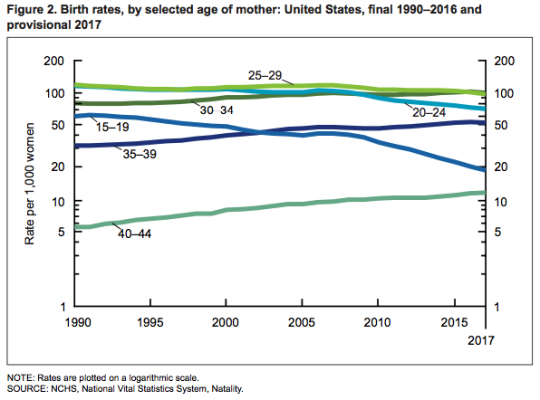
    Here is a chart from the report showing birth rates for selected age ranges from 1990 to 2016 (the 2017 numbers are provisional):

    image

    Many of the age ranges have remained stable. Notable are the decline in the teenage (15-19) birth rate and the increase in births to women aged 40-44. The teenage birth rate declined 7% from 2016 and has averaged a decline of nearly 8% a year since 2007. And the birth rate for women aged 40-44 has generally been rising since 1982.

    I am sure that you can all think of many explanations for the above phenomena without even diving into the report. I find all of this relevant because demographics obviously impact the real estate business and how we build cities.