Daily insights for city builders, delivered every morning at 6 AM ET. I’m Brandon Donnelly — a Toronto-based real estate developer and founder of Globizen. I’ve been writing here since 2013.

Tag: real estate market

  • This U.S. housing boom is different

    Just a few days ago, The Federal Reserve Bank of San Francisco published an interesting research study where they argue that this U.S. housing boom is different than that of the early 2000s.

    During the last boom, U.S. home prices peaked in 2006 and then dropped about 30% in the wake of The Great Recession. Since then prices have rebounded – almost to their pre-recession levels. This has some people asking whether this story is headed towards the same ending.

    But the FRBSF is saying no:

    “We find that the increase in U.S. house prices since 2011 differs in significant ways from the mid-2000s housing boom. The prior episode can be described as a credit-fueled bubble in which housing valuation—as measured by the house price-to-rent ratio—and household leverage—as measured by the mortgage debt-to-income ratio—rose together in a self-reinforcing feedback loop. In contrast, the more recent episode exhibits a less-pronounced increase in housing valuation together with an outright decline in household leverage—a pattern that is not suggestive of a credit-fueled bubble.”

    And here’s the chart:
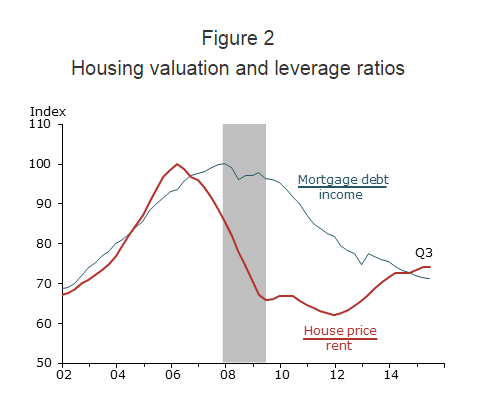
    Source: Flow of funds, Bureau of Economic Analysis (BEA), CoreLogic, and BLS. Data are seasonally adjusted and indexed to 100 at pre-recession peak.
  • New York’s 8-figure apartments

    Whenever you’re starting to feel like real estate prices in your city are getting out of hand, just turn your attention to New York. It’ll make you feel better.

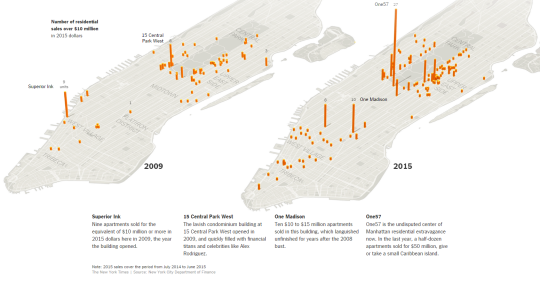
    The New York Times published an interactive overview of the Manhattan real estate market today. It was spurred on by the fact that the average residential sale price in Manhattan just hit $1.7 million (a new record) and that there’s a growing number of 8-figure apartments being bought up.

    Last year half a dozen apartments sold for more than $50 million in the One57 tower at 157 West 57th Street. (The New York Times calls this building the “undisputed center of Manhattan residential extravagance.”)

    Here’s one of their diagrams showing the number of residential sales over $10 million in 2009 and then in 2015:

    image

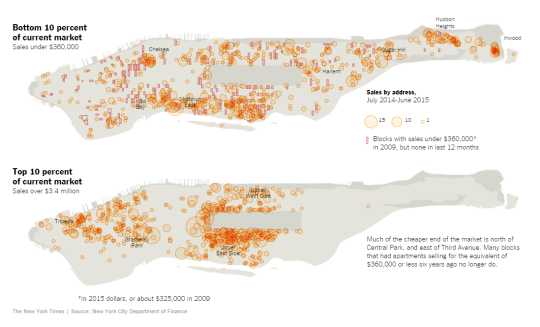
    And here’s another one of their diagrams showing the bottom and top 10% of the current market:

    image

    It’s interesting to see the clustering in certain areas and also the lack of clustering at the high end around the top of Central Park.

  • Multifamily vs. single family

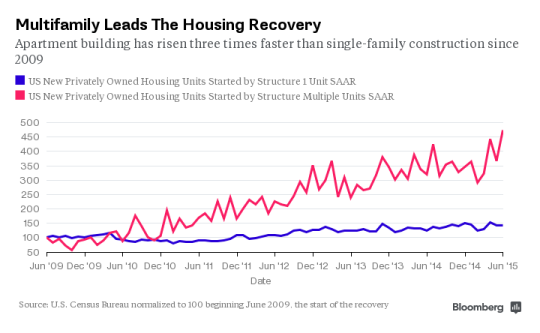
    Since 2009 when the U.S. economy started to recover, housing starts (i.e. new residential construction) have favored multifamily buildings over single family housing. Apartment/condominium construction has grown 3 times faster according to the U.S. Census Bureau (via Bloomberg).

    image

    A lot of this multifamily construction is assumed to be rental apartments, but this category also includes for sale condominiums. The classification has to do with building typology rather than housing tenure. (I would love to see how the above graph breaks down in terms of the latter.)

    The typical explanations for this trend often relate back to Millennials being poor and saddled with student debt. That’s why they’re delaying buying single family homes. But eventually the expectation is that they will resume doing

    (largely) what previous generations have done.

    Money and the economy, I’m sure, have something to do with the above trend. But I’m not convinced that it’s the whole story. 

    There are also shifts happening with respect to consumer preferences and with respect to how we plan and build our cities. That’s why I’m very interested in monitoring family formations and housing choices. 

    At the same time, I’m also a Millennial. And whenever I catch myself thinking a certain way, I assume that there are probably other Millennials out there who feel similarly.

  • Where are Millennials going to move when they start having children?

    Photograph Kembangan by Jason Waltman on 500px

    Kembangan by Jason Waltman on 500px

    Earlier this week I attended RealNet’s Q1 2015 market update webinar for the Greater Toronto Area. If you don’t already subscribe to RealNet, you should consider it. They’re one of the best sources for Canadian real estate market information.

    During their webinars, they occasionally run interactive surveys where they ask the audience a question and participants respond using their web browser. On this particular webinar, they asked the following question, which I thought was interesting:

    What is the likely housing moving by Millennials in raising their families?

    A) Move Up – Embrace urban high-rise housing forms

    B) Move Out – Accept extended commutes (including the Greater Golden Horseshoe and Hamilton Area) to find affordable ground oriented housing

    C) Move In – Cohabitate parental homes

    It’s an interesting question because it’s one that I’ve asked myself a number of times. Sure, Millennials are rushing back to cities and living in high density and walkable communities, today, but what are they going to do and where are they going to move when they start having children?

    As a Millennial myself, I know that I’ve always told myself that I want to stay urban for as long as I can (i.e. Move Up). But I’m only one data point. And given the seemingly endless demand for low-rise housing in Toronto, I always felt like I was in the minority. I figured that the majority of people, at least here in this city, still want a ground-related home when it comes time to raise a family.

    Putting aside economics, I still think that may be the case for a lot of home buyers. But the majority of people on this week’s RealNet webinar (which would be almost exclusively folks from the real estate industry) either think that preference is going to change (or already has) or that consumers won’t have a choice due to affordability.

    50% of the people on the call answered A – move up and embrace urban high-rise housing forms. The balance was about 44% for B and 6% for C.

    That’s not the outcome I expected to see. So today I’d like to re-ask this question to the Architect This City Community. Where do you think Millennials are going to move once they start having children? Please let us know in the comment section below.

  • The value of cheap housing

    Photograph Houston Sunrise by Cliff Baise on 500px

    Houston Sunrise by Cliff Baise on 500px

    Urbanists generally don’t like to talk about cities like Houston. It sprawls. It’s car oriented. It’s over air-conditioned. In other words, it’s the antithesis of the dense and walkable cities that urbanists today like to tout as being exemplary. 

    But despite all this, Houston is one of, if not the, fastest growing city in America. According to The Economist, the population of the Houston metro area grew faster than any other city in America between 2000 and 2010. And between 2009 and 2013, its real GDP grew by 22%.

    So why is that? Here’s a snippet from that same Economist article (“Life in the sprawl”):

    Paradoxically, perhaps the city’s biggest strength is its sprawl. Unlike most other big cities in America, Houston has no zoning code, so it is quick to respond to demand for housing and office space. Last year authorities in the Houston metropolitan area, with a population of 6.2m, issued permits to build 64,000 homes. The entire state of California, with a population of 39m, issued just 83,000. Houston’s reliance on the car and air-conditioning is environmentally destructive and unattractive to well-off singletons. But for families on moderate incomes, it is a place to live well cheaply.

    So while Houston may not check off all of Jane Jacobs’ boxes, it does provide one important thing: cheap housing. And that’s clearly valuable for a huge number of people.

    But the other interesting thing about the snippet above, is that it starts to illustrate how frequently supply constrained markets operate with housing deficits. 

    The fact that the entire state of California issued only about 30% more building permits than the Houston metro – which you could easily argue is closer to a “perfect market” – tells me that there’s probably a lot of people bidding for the same housing in California.

    That’s less so the case in Houston.

  • How wise are crowds?

    Earlier this week I wrote a post about a new build home under construction at 37 Canerouth Drive in the west end of Toronto. As part of that post, I asked people what they thought the home would be valued at when it was completed. There were just under 10 responses (many thanks!) and I thought it was really fascinating to see the ranges.

    A lot of you responded in the comment section of the post, but a bunch of the other estimates came in via Facebook, Twitter, and email. It isn’t a huge data set, but I’ve nonetheless consolidated the ones I could remember I received:

    $2,375,000
    $2,750,000
    $1,800,000
    $3,000,000
    $8,500,000
    $2,600,000
    $3,500,000
    $1,750,000

    If you average these estimates, you come to a value of $3.3M. However, the clear outlier is the $8.5M. So let’s take that one out and see how the number changes. If you do that, you then get an average estimate of $2.5M. A pretty big swing.

    Now, I don’t know offhand how accurate that number really is, but I’m fascinated by this idea of “the crowd” determining value. Particularly for markets such as housing where supply can be completely heterogeneous and there isn’t a lot of transaction volume to refer back to (compared to other types of markets).

    Because my strong belief is that under the right circumstances and with enough data points, this number could end up being hugely accurate. And, it could also be more forward looking since it’s capturing current market sentiment as opposed to being based on historical transaction prices.

    If you have any thoughts on this, I’d love to hear from you 🙂

  • Should you own or rent your home?

    image

    I was at a good friend’s wedding last night (congratulations again to Adrien + Rachel!), and one of the topics that came up at our table was whether it is better to own or rent your home. Now, in North America, conventional wisdom would suggest – almost mandate – that you have to own your place. If you’re still a renter, well then you’re “throwing away your money” my friend.

    But are you really? 

    A big part of the value of owning your home is that it’s forced savings. Every month when you make those principal and interest payments, you’re paying down your mortgage and socking away money for the future. And this can be a great thing for a lot of people, particularly if you’re not disciplined enough to save otherwise.

    But when you own a home, you’re also spending time and money on maintaining that home, and you’re also tying up capital that could be used elsewhere. So consider this: what if, instead of putting your savings towards a downpayment, you simply continued to rent and created an investment portfolio that you then contributed to on a regular basis just as you would a home?

    Depending on your assumptions, renting could turn out to put you further ahead financially. Here’s an example of that scenario from the Globe and Mail.

    Similarly, I remember being told in business school that companies that own their own real estate tend to under perform those that do not. And the rationale is that owning lots of real estate ties up capital that could otherwise be reinvested in the core business. In other words, if your core business is making widgets, then invest your money in making better widgets, not in real estate.

    But this is not to say that everybody should rent. Obviously I’m a big believer in real estate. And for a lot of people, owning may make sense. This post was really just to say that the owning vs. renting decision may not be as black and white as you might think.

    Image: Flickr

  • Thoughts on real estate marketplaces

    The responses are still coming in from yesterday’s real estate marketplace survey, but I wanted to thank everyone who took the time to complete it. I really appreciate it. I was reviewing the responses this morning and I thought there were a couple of interesting takeaways.

    First, most people who own a home have at one point or another thought about selling that home. And even the people who haven’t thought about it, said they would be willing to sell under the right circumstances. That is, they would sell for the right price, for a better place, and so on. At the time of writing this, nobody said they would never ever sell.

    I think this is interesting because, even though the real estate market is a highly illiquid market, my hunch is that it could be made a lot more liquid with the right frameworks in place and if the barriers to selling could be reduced.

    And sure enough, many of the folks who said they have thought about selling (but haven’t yet), said it’s partially because it’s too expensive and too much work to sell. But in addition to these barriers, two other points emerged that I hadn’t given a lot of thought to before – but make total sense. 

    Homeowners also said that they haven’t sold because they’re too emotionally attached to their home and because they’re afraid they won’t be able to find another place to move into. 

    Because of how illiquid the real estate market is and because home transactions are typically asymmetric (that is, buying and selling are independent actions), there appears to be a real concern that you could sell your home and never find anything better.

    And since a home is such an emotion filled asset (as opposed to, say, a stock), people are naturally afraid of making the wrong choice. But then that begs the question: Are we, as real estate consumers, being left with suboptimal outcomes because we’re simply too afraid of the making the wrong choice?