Daily insights for city builders, delivered every morning at 6 AM ET. I’m Brandon Donnelly — a Toronto-based real estate developer and founder of Globizen. I’ve been writing here since 2013.

Tag: real estate market

  • Buy quality

    When the market is hot, it becomes more difficult to buy real estate. You end up with more buyers than sellers. And because of this, there’s a natural tendency to look further afield for opportunities. You don’t want to overpay for the obvious assets, and so you start to pioneer.

    This can work out just fine, particularly if the market remains strong. But oftentimes, when the market does turn, it is the peripheral stuff that gets hit the hardest. There is a flight to quality and pioneering gets quickly viewed as too risky.

    Here in Toronto, I am consistently being told that there are peripheral development sites that have seen their value drop to 20-25 cents on the dollar compared to the peak, and that’s if you can actually find a buyer. In many cases, the sites are now unsellable.

    This, to me, is our periodic reminder that while it’s important to search for overlooked opportunities and buy cheap, you can’t forget to also buy quality.

  • Some 60,000 condominium units were purchased last year in Toronto

    So 2021 was a pretty good year for condominiums here in the Greater Toronto Area. According to the latest data (Q4-2021) from Urbanation, this is what happened last year:

    • 30,844 new condominium sales. This is a 69% increase compared to 2020, which saw 18,282 new unit sales.
    • Fourth quarter alone saw 8,361 unit sales, which is the best quarter on record according to Urbanation.
    • Unsold inventory dropped 26% year-over-year because sales exceeded the number of new project launches by over 4,000 units.
    • Average price for an unsold condominium unit in Q4-2021 reached $1,322 psf, which is an 18% increase compared to the year before.
    • Resale condominiums also did exceptionally well with 29,880 unit sales — a 49% annual increase.
    • All in all, some 60,000 condominium units were purchased last year in the GTA. Of course, some were ready to be lived in and some were future homes.
  • Toronto condos on the rise again

    CIBC Deputy Chief Economist Benjamin Tal was recently interviewed by Larysa Harapyn of the Financial Post about the state of the housing market in the Greater Toronto Area. The message he delivers is pretty clear: “If you think that Toronto is unaffordable now, you wait.” The long-term fundamentals in this market remain strong. Demand is outstripping supply and will likely continue to do so, which is why Tal also stresses the importance of delivering more purpose-built rental housing. If you can’t see the video above, click here. (And with that, I think it’s time to switch topics for tomorrow’s post. That’s enough Toronto housing for one week.)

  • How Trump’s tax plan would impact the mortgage interest deduction

    image

    In the US you can reduce your taxable income by deducting the mortgage interest you pay toward your principal residence. You can’t do this in Canada, at least not on the property where you live.

    However, there are limitations. It is capped at loans up to $500,000 or up to $1M if you’re married and you file jointly. On the other end of the spectrum, you also need a loan big enough such that an itemized deduction will save you more money than the standard deduction.

    Not surprisingly, the MID is popular among homeowners. And from a public policy standpoint, one of its selling features is that it’s supposed to stimulate homeownership. But many have argued that it doesn’t actually do this – it unequally benefits people with larger mortgages. (Canada has a higher homeownership rate than the US.)

    Right now it looks like you need to buying a home worth at least $305,000 in order for the mortgage interest deduction to make economic sense for you. Again, if your loan isn’t big enough, you’re simply going to opt for the standard deduction. 

    In 2015, about 22% of all US taxpayers opted to take advantage of the MID. According to Zillow, only about 29% of all homes in the US are valuable enough for the MID to actually make sense. Though in some cities, like San Francisco, it’s pretty much all of the homes. Of course.

    Zillow also recently looked at what the recent tax reforms put forward by the Trump Administration would mean for the MID and the real estate market

    One of proposed changes is a doubling of the standard deduction. What this means, based on Zillow’s math, is that you would need to be buying a home worth at least $801,000 today for the MID to make sense. This also means that the deduction would now only benefit about 5% of all homes in the US.

    This would seem to only exacerbate the criticism that the MID does not in fact stimulate homeownership in the segment of the market that needs it the most. But perhaps this is the only politically palatable way of removing it – gradually.

    Photo by Erol Ahmed on Unsplash

  • 16 new housing measures

    The big news today in Toronto real estate is that the province of Ontario introduced 16 new measures intended to rein in the housing market. 

    Some of the most notable measures, which many of you will have seen in the headlines, include a 15% tax on home purchases by non-residents and expanded rent control for buildings completed after 1991. Previously it only applied to older buildings. The maximum annual rent increase for existing tenants will now be capped at the rate of inflation, up to a maximum of 2.5%.

    Here’s some more information from the Globe and Mail and CBC.

    I’ve had a few people ask me to blog / comment on the above, but I haven’t yet had time to do a deep dive into the details. I would like to do that first rather than provide a knee-jerk reaction. In the meantime, I would love to hear your thoughts in the comment section below.

  • Toronto real estate is out of control

    You can’t have an Easter dinner in Toronto right now without somebody bringing up the topic of our “crazy” real estate market. 

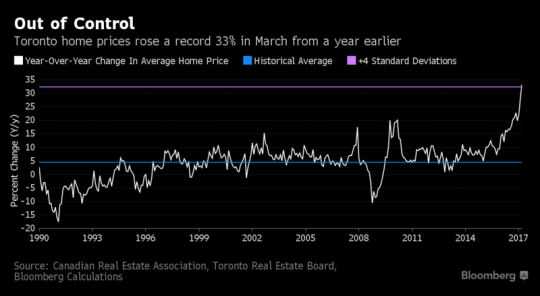
    Below is a chart from Bloomberg showing the year-over-year change in home prices in the Greater Toronto Area since 1990. It also shows the historical average (in blue) and how in March 2017 we hit 4 standard deviations above that. Home prices rose 33% in March compared to a year earlier.

    If I were a realtor, I’d probably tell you that the market is hot hot hot. Now is the time to sell because you’ll get some absurd number above your asking price and now is the time to buy because prices are going nowhere but up. Don’t miss out. 

    I would like to try and be a bit more nuanced than that. Here are 3 thoughts:

    1)

    There’s no question that low rates / cheap money is one of the root causes of the real estate valuations we are seeing today. But frankly I have no idea when or if that will change. There is an interesting argument out there that capital is no longer scarce. Our economy is going through a fundamental shift, which is why real estate is not the only asset class seeing these sorts of valuations and growth figures.

    2)

    There are a number of global factors which are helping to cement Toronto’s position as an alpha global city and destination for human capital. Think Trump, Brexit, and so on. I agree with Richard Florida’s argument that our real estate market will see more – not less – pressure going forward. Here is a snippet from a recent interview with Florida in Toronto Life:

    I think Toronto is going to get an even bigger influx of the creative class. With the rise of Trumpism, more and more people who might otherwise have gone to the United States are going to come to Canada. We’re going to see American tech companies invest more and more in Toronto. And if we think the housing affordability and economic divide we see today is bad, it’s going to grow ever more gaping. 

    3)

    I believe that there are always opportunities in the real estate space, but that you have to be disciplined, focused on fundamentals, and willing to do things that others won’t. What bothers me is when I hear people say things like: “Real estate only goes up. You can never go wrong.” I started my career pre-2008 and lived in both the United States and Ireland. I saw what down looks like.

  • Housing is a bitch

    I just discovered Steve Randy Waldman’s blog called Interfluidity and, more specifically, a post he wrote called: “Home is where the cartel is.” I am now following him.

    He starts off by saying that housing is a bitch, which is just him saying that urban housing is a difficult problem to solve. A truism for this audience.

    He doesn’t profess to have all of the answers, but he does write a thoughtful piece that covers, among other things: the “market urbanist” (supply-side) solution to solving housing affordability, the reasons why the “housing cartel” will never approve of this, and the inherent contradiction between housing as an investment and housing as a sustainably affordable good.

    He also offers up Singapore and Germany as examples of two very different housing markets. It reminded me of a tweet I retweeted this morning which shows Germany as having the 2nd lowest homeownership rate (45%) among OECD countries.

  • The yellowbelt

    We talk a lot about the greenbelt here in Toronto. Some argue that it’s squeezing the housing market and driving up prices.

    But what about the yellowbelt? (Credit to Gil Meslin for the term.)

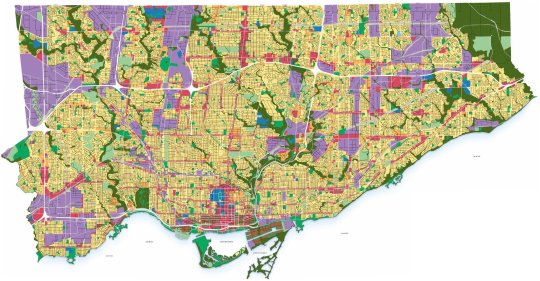
    Here is a land use map of Toronto:

    The yellow areas are “neighborhoods.” They, along with parks, ravines, watercourses, and valleys, make up ¾ of the city’s land area. The Official Plan describes these areas as being “stable” – meaning they will see little physical change. Supply cannot adjust to demand.

    I get why this is the way it is and I understand how difficult it would be change something like this. But let’s not ignore the impact that this land use constraint has and will continue to have on the housing market. 

    It’s the yellowbelt. Thank you Gil for letting me to steal the name.

  • Transparent offer platform

    A new “transparent offer platform” called Haus has just launched in California to serve the residential real estate market. The way it works is that all offers are submitted online. And once an offer has been confirmed, it – along with all of its terms – gets revealed to every other potential buyer. See image below.

    image

    I’ve seen a number of different iterations of this same idea, which tells me that this is a well-identified problem in the real estate market. Here’s a snippet from a recent TechCrunch article announcing Haus:

    “We think the openness will create a more efficient market and that the number of offers and price will ultimately be dependent on demand,” said Haus GM Sarah Ham. “Bidding wars are a common, almost accepted, part of the real estate process today. But with our approach, buyers know where they stand. Buyers will know what they need to offer to make their offer competitive, but they also won’t negotiate against themselves.”

    I completely agree that this is a problem that needs to be solved. It will create a more efficient marketplace. However, in this market, I suspect that the current information asymmetries largely benefit sellers, to the detriment of buyers. So I wonder if the supply-side of the marketplace will be willing to participate at scale. What’s really in it for them?

    Side note: Haus is the latest project from Expa, which is a “startup studio” that works on its own ideas, as well as partners with other founders. I am very interested in this approach to creation because I think you have to try and make a lot of things if you want to do truly innovative things.

  • Coffee shops vs. fried chicken

    When it comes to a real estate market, there are always the typical metrics: sale prices, rents, vacancy and so on. But I’m always interested when somebody looks at the market in a different way and comes up with other kinds of metrics.

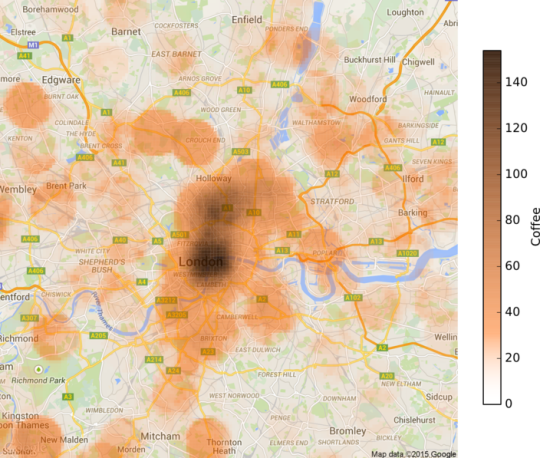
    That’s why I was intrigued when I stumbled upon this post by Sam Floy, where he looks at the concentration of coffee shops and friend chicken shops across London in order to determine which neighborhoods are in fact “up and coming.”

    To give you a taste, here’s his coffee shop map:

    His thinking was that if a neighborhood had a high density of coffee shops, a low density of fried chicken shops, and relatively low house prices, then it could probably be thought of as up and coming. 

    Coffee shops are often considered to be leading indicators of urban change (i.e. gentrification), and, well, friend chicken places I guess speak to a different kind of neighborhood.

    These sorts of playful studies aren’t going to tell you exactly which numbers you should be plugging into your development pro forma. But I think unconventional analyses can sometimes tell you a bit more of the story behind the numbers.