Daily insights for city builders, delivered every morning at 6 AM ET. I’m Brandon Donnelly — a Toronto-based real estate developer and founder of Globizen. I’ve been writing here since 2013.

Tag: real estate development

  • Planning dinner, smart cities, and privacy

    image

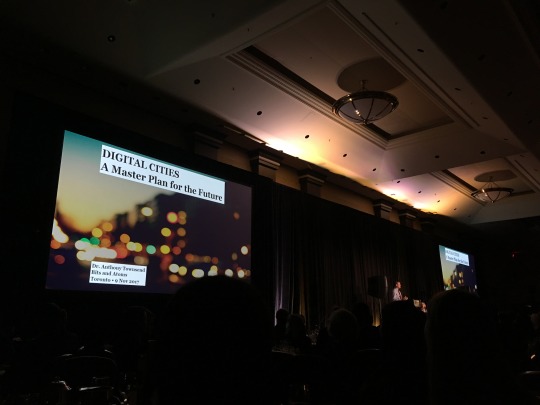
    This evening I attended the 27th Annual Toronto Planning Dinner. It’s an annual dinner for people in planning and development, put on by the University of Waterloo Planning Alumni of Toronto. Thank you Wood Bull LLP for the invite.

    The keynote speaker was Dr. Anthony Townsend. He is the author of SMART CITIES: Big Data, Civic Hackers, and the Quest for a New Utopia. I haven’t read it (yet), but his talk offered a preview of it and I think it would be of interest to all of you.

    It deals with many of the topics that we discuss on this blog, one of which is the interrelationship between our physical environment and the networks and software layers that we are now building on top of it.

    These layers have the potential to augment and enhance our cities (maybe make them smarter), but they also have the potential to do us harm. One important issue that Townsend brought up is that of privacy.

    Cities used to enable anonymity. 

    When essayist and art critic Charles Baudelaire wrote about “modernity” in 19th century industrializing Paris, it referred to an ephemeral and fleeting kind of urban environment. Pass someone on the street and you may never see them again. That must have felt sad at the time.

    Today we live in a fish bowl. 

    Networks connect us, check us in, ping us when we are nearby people we know, and help us find people to meet and date. And we already have devices, like Alexa, that spy on us in our homes so that companies can serve us targeted ads. (This is deplorable by the way.)

    Will the city of the future endeavour to do the same as we equip it with more “smarts”?

    I guess that’s why Townsend believes that privacy will define a big part of 21st century urbanism. There’s no doubt that it will be very important.

  • Bringing laneway suites to Toronto

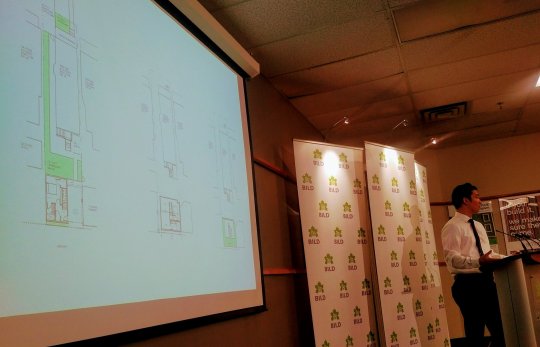
    This morning I presented and sat on a panel at BILD called “bringing laneway suites to Toronto.” The other participants were Councillor Mary-Margaret McMahon, George Pantazis (Planner at the City of Toronto), Mike Collins-Williams (Director, Policy at OHBA), and Andrew Sorbara (co-founder of Lanescape).

    Here is a photo that Mike took of me while I was talking about my failed laneway house:

    image

    For those of you wondering if/when this will happen in Toronto, here are the key takeaways from this morning: The city is already drafting laneway suite policies specific to Toronto & East York (not the other parts of the city) and they are due to report back to council in Q2-2018. Nothing is 100% certain at this stage, but there’s lots of optimism. 

    Councillor McMahon delivered this morning’s opening remarks and I was impressed by her deep commitment to laneway suites. I was also impressed by her stance on NIMBYISM, saying that education is important and that we can’t let NIMBYs stop what makes sense for the greater city.

    She gave the example of the 6 storey condominium in her ward that faced fierce community opposition a number of years back. If you can’t put a midrise building on a main street in this city, where can you put it? 

  • How to make money with low-risk licensing deals

    image

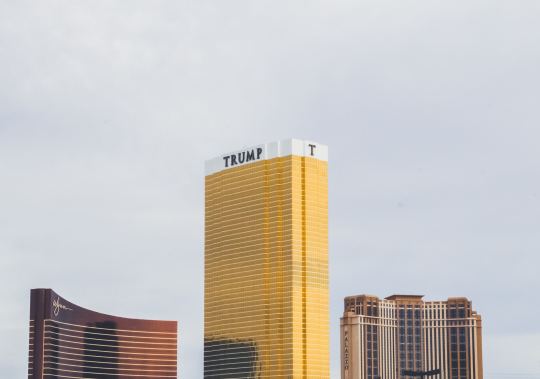
    This morning the Toronto Star published a detailed autopsy of the failed Trump International Hotel and Tower Toronto. It outlines the players, the investors, and what supposedly went wrong. Of course, the headline is all about how Trump managed to make money from the deal – through his well-publicized licensing business – even though the project went bankrupt.

    At the beginning of this year, the Washington Post reported that Trump’s name had been licensed and linked to over 50 properties and that these contracts have earned him at least USD$59 million in revenue. Outside of the US and Canada, the Trump Organization has (or had) deals in Brazil, Turkey, Azerbaijan, India, Indonesia, the UAE, and so on.

    There would have been more money to be made in the actual development of these properties, but the beauty of these licensing deals – for Trump – is that they are “low-effort, low-risk, high-reward.” In fact, this past summer it was reported that the breakup fee at Trump Toronto – the fee to exit all contracts with the Trump Organization – was at least $6 million (guessing that’s in USD).

    This story is not unique to Toronto. And so I have got to believe that there’s major brand dilution happening here. Does the Trump name really bring credibility to projects in some markets? How sustainable is this licensing business? 

    The only other thing that I would add to the Toronto Star article is that the hybrid condo-hotel model has proven to be difficult in this city. It’s perfectly fine to have residential condos and a hotel in one tower. There are lots of successful examples of those. But when the condo units can be put into a hotel pool (and there’s an IRR expectation on the part of individual owners), many seem to have been disappointed.

    Part of the challenge with this model here in Toronto is that the condo-hotel units typically end up with a commercial property tax rate, which, in this city, is much higher than the residential rate. This can suppress values.

    Photo by NeONBRAND on Unsplash

  • Building relationships

    2003/2004 was roughly the time period when I started to become interested in development as a career. My good friend Rick Sole and I used to talk about it all the time in architecture school. How do we break into this space? There are no formal paths, like law for instance, and so we felt like we had to create our own opportunities.

    What I ended up doing was creating a list of every developer that I felt was doing cool and interesting work. I didn’t know enough about the industry at the time to assess other things and so that was really my only criteria. Do they care about design in their projects? I then started cold emailing and cold calling.

    Not everyone got back to me, but many did and some agreed to meet with me. This was at a time when I had zero experience and I was frankly not very valuable as a hire. So I am incredibly grateful to all of the people who said yes and took the time to speak and meet with me.

    As you go through your career, this curve eventually flips. You go from having no experience and begging people to meet with you to having experience (and other things you can offer people) and people now wanting to meet with you. Generally people want to meet when they think they can gain from you.

    But the best way to build a relationship is to start when you don’t need anything. I will never forget the people that met with me when I had nothing to offer them. And you can bet that I will always have all the time in the world for them.

    I’m not going to claim that I respond to every one of my cold emails. I definitely do not. But I respond to as many as I can and I try and pay it forward with some time. You could say it’s playing the long game, but it’s probably also the right thing to do.

    How do you approach relationship building?

  • Seattle vs. Vancouver

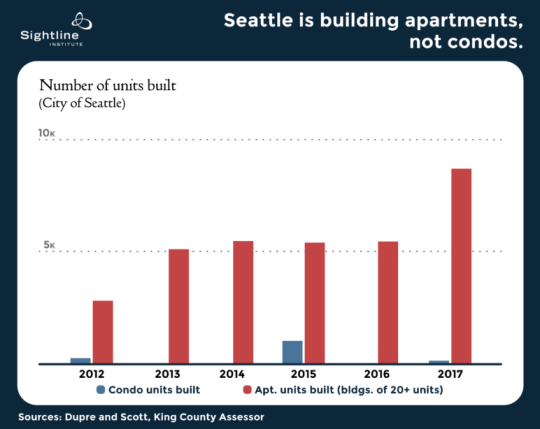
    A reader recently shared an article with me called: Why Seattle builds apartments, but Vancouver, BC, builds condos. Thanks for that.

    It’s a good summary of the differences between these two markets and why over the last five years less than 4% of all new residential units built in Seattle have been condos. The story is obviously very different in Vancouver.

    It’s also a good reminder that incentives matter. Capital has a funny way of flowing to where the returns are greatest.

    Chart: Sightline Institute

  • The Hong Kong window ledge

    image

    My friends at the architecture practice Valente Rodgers told me something fascinating about the Hong Kong real estate market last night. Both partners worked as architects in Hong Kong for a number of years.

    In Hong Kong, you’re allowed to deduct certain projecting windows from your calculation of Gross Floor Area

    This is provided they’re a certain height above the finished floor level, they don’t project beyond certain distances from the outer face of the building’s structural elements, and so on. The precise measurements seem to vary depending on things like the building’s use.

    Since space is such a precious commodity in Hong Kong, it shouldn’t surprise you that lots of developers and architects take advantage of this. The result being a proliferation of these projecting window ledges all across the city. 

    It’s a phenomenon that happens in many cities when a perfectly legal loophole is found in the land use policies.

    In Toronto it used to be solariums. You could also deduct these from your overall GFA, which means a lot of them them got built in condos and apartments of a certain vintage.

    In New Orleans it was the camelback house. These were houses with a single storey toward the street and a second storey toward the rear of the property. This was done because property taxes were assessed based on the height of the house as it met the street. Pushing the density toward the rear of the lot meant homeowners weren’t taxed more. 

    I find these outcomes fascinating because they have absolutely nothing to do with architectural intent and everything to do with trying to optimize within a given framework.

    But what’s even more interesting about the Hong Kong example are some of the downstream externalities.

    Firstly, it sounds to me like these projecting windows have become a normal part of underwriting projects in Hong Kong. Meaning, if you don’t factor in these projections, you’re effectively giving up free GFA. (Can anyone familiar with the HK market confirm this?)

    However, building these projections also means you can’t do unmodulated and clean floor-to-ceiling windows. And if that’s the desired aesthetic, somebody has got to be willing to pay for that “luxury.” So arguably there’s a socioeconomic dimension to having and not having this ledge.

    Secondly, because space comes at such a premium, these ledges are fully taken advantage of and furniture makers have responded by designing pieces that can dovetail with them.

    Below is a photo of a bedroom in Hong Kong that I found on bohemia.life:

    image

    This may be a custom bed and I don’t know how deep that window projection is, but it begins to show you how valuable these ledges can be from a space perspective.

    I think we should try and come up with a name to describe these sorts of built form phenomena. If you have any ideas, please drop them in the comments below. And if any of you are familiar with the HK market, let me know if I’m off the mark with any of the above.

    Photo by Jason Wong on Unsplash

  • How permissive zoning created Toronto’s King-Spadina district

    image

    Over the weekend, Marcus Gee of the Globe and Mail published a terrific article about Toronto’s King-Spadina district and how “condos conquered a rundown district of the city.” (This post will argue that condos were not the catalyst, but an outcome of other changes.)

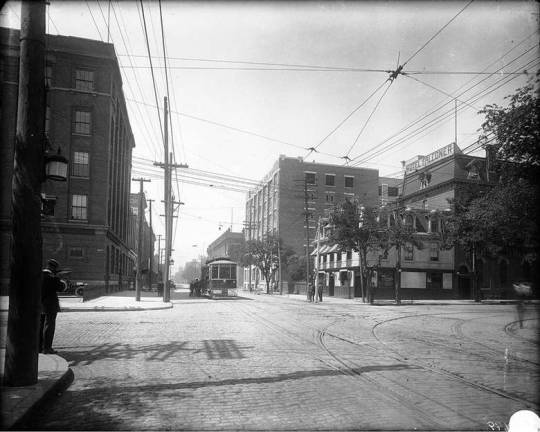
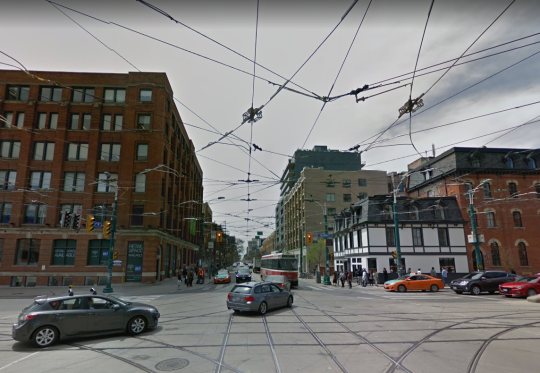
    The image at the top of this post (City of Toronto Archives) is the intersection of King Street and Spadina Avenue around the early 1900s. And here is roughly that same view from May 2016 (Google Streetview):
    image

    From this perspective, it may look like not much has changed. The buildings at the two corners are still there, although their uses have changed. The streetcars are still running, although we now have slightly newer machines. And there are overhead lines providing a canopy across the intersection.

    But as Gee points out, the reality is that in recent years King-Spadina has arguably seen more change and development than any other precinct in the city:

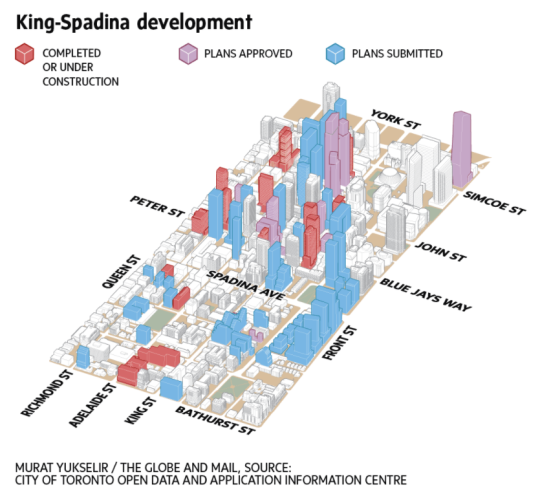
    No fewer than 99 projects have been built, approved or pitched since 2004. That’s one quarter of the total for the entire city and more than the count for two vast suburban districts – Scarborough and Etobicoke – combined. King-Spadina is overtaking even high-rise hubs such as Yonge and Eglinton in midtown Toronto and the Bay and Yonge corridors downtown.

    Below is a diagram showing the built form of that change.
    image

    But as we talk about this massive change, I would argue that this didn’t happen by accident. 

    Gee starts his piece by saying that “cities have an endless ability to evolve, to rebound, to reinvent and regenerate themselves, sometimes in ways that would astonish generations past.” I would add one word: Successful cities have an endless ability to evolve.

    King-Spadina has indeed reinvented itself many times. Prior to its current iteration, it served as a manufacturing district and as the center of Toronto’s garment industry. But from the 1970s through to the early 1990s, the area fell into decline as its manufacturing base left.

    The game changing moment happened in 1996 when “The Kings” – which includes the areas around both King-Spadina and King-Parliament – were redesignated as “Regeneration Areas.” The overarching goal was to deregulate away from single-use industrial zoning and allow the area’s buildings, both old and new, to take on almost any use.

    Now all of a sudden it was possible to have light industrial, commercial, entertainment, retail, residential, and live/work uses all mixed together. And with the bones already in place, the market responded. 

    In my view, it is these earlier changes that laid the groundwork for what has become one of the most exciting neighborhoods in the country.

    However, today some are worried about whether or not this is too much of a good thing. And I am sure that many would like to blame developers for piling up in this neighborhood. Why continue to build here when there’s lots of land elsewhere?

    King-Spadina is a perfect example of what Richard Florida would call “winner-take-all urbanism.” There are powerful clustering forces at play both globally and locally in our cities. And so there are real economic reasons for why King-Spadina has seen more development than Etobicoke and Scarborough combined.

    Permissive land use policies and the right building stock may have kickstarted things, but now economies of agglomeration have taken over. Retailers, restaurants, clubs, tech companies and people, among many others, are now fighting for space in this area for the same reason that Toronto’s garment industry once felt the need to cluster here. There are tangible benefits to doing so.

    What people are effectively asking today is at what point do we start to see diseconomies of agglomeration. This is an important question and one that needs to be actively managed. 

    Without getting into any of the details, I believe that the King Street Pilot Study – which puts transit first along the King corridor – is one very appropriate answer to this question. It is a direct response to diseconomies of agglomeration, in this case traffic congestion.

    But there are important corollaries to this question that are also worth considering: How do we now create more King-Spadinas and how do we create more broad-based and inclusive urbanism in the face of these powerful clustering forces? These are questions that go well beyond King-Spadina, but there are lessons to be learned from the successes seen on the west side of downtown Toronto.

    Images via The Globe and Mail and Google Street View

  • Crazy girl down in Virginia Beach

    Last night I received an email from a 27 year old woman in Virginia Beach that really made my day. With her permission, I am sharing that email in full here on the blog, but redacting her identity. Here it is:

    Brandon,

    You don’t know me, but I just wanted to take a moment and say, thank you. I am a 27 year-old woman living and working in Virginia Beach, VA, with a Civil Engineering degree from Virginia Tech. Up until recently, I have been trying to “find myself” in my career with little success. I always had a feeling that I was “meant to do something” with my career. The problem was that I didn’t know what the hell I wanted to do. 

    Anyway, fast-forward to November 2016, and I decided to start applying to real estate development companies in the area. After all, it seemed like a pretty cool job. I began sending random emails to a few companies to see if they would hire me…. There wasn’t a real position open – I sort of just begged. Through all my random internet searches, I happened to find your blog one day… And to be honest, you have become a great inspiration to me.

    I began to love real estate development. Not just normal development, I want to make a difference. I began to feel excited and passionate about a science, a line of work, and an end vision and goal that several people share. I want to build these wonderful, competitive, beautiful, sustainable cities. I want to make our world better and more beautiful one place at a time. I was finally able to find myself through your work, so I thank you. You have helped me to commit to a career switch, be patient with my job hunt, and apply for an MBA program.

    Thank you for doing what inspires you because by doing it, you are also inspiring this crazy girl down in Virginia Beach! Keep it up.

    I wanted to share this email for two reasons.

    One, if you’re a firm in the Virginia Beach area, you should consider meeting her for a coffee. Send me an email and I’ll forward it along to her. It’s always challenging breaking into a new industry.

    And two, her email does a great job illustrating how important it is for people to feel fulfilled with their work. People want to make a difference. And some would argue that this desire is even more pronounced in the next generation coming up and entering the workforce.

    I feel lucky that I love what I do. And I know that many of my colleagues feel the same way. 

    Sometimes my friends in the development business will say to me that it’s hard not to become cynical and jaded over time. You start out wanting to change cities for the better and you think you’re doing the right thing, but then it feels like you’re getting punched in the gut every step of the way trying to do exactly that.

    That’s what life will do to you every now and then: It will punch you in the gut. If you want to accomplish great things, you have to take those. But it’s a hell of a lot easier to take them when you’re fulfilled by the work you do. 

    Trying to build better cities is pretty damn fulfilling. I am sure that many of you would agree, regardless of what side of the industry you happen to be on.

    Photo by Ravali Yan on Unsplash

  • Laneway housing — right now feels different

    image

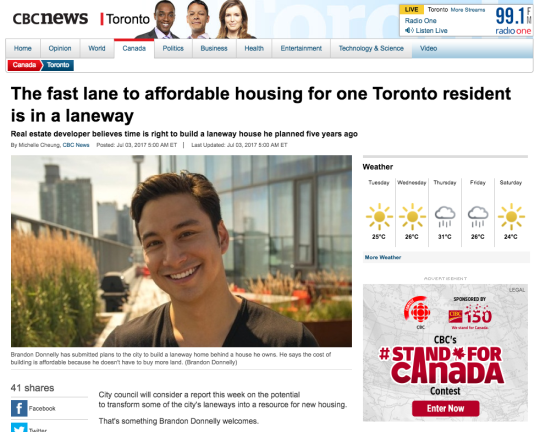
    The CBC published a piece this morning on my laneway house proposal. The subheadline: Real estate developer believes time is right to build a laneway house he planned five years ago

    It’s true. As many of you already know, this proposal has been in the works for a number of years. But right now feels different. I continue to be encouraged by all of the interest and support surrounding laneway housing in this city. 

    Thank you Michelle Cheung for covering this.

  • New Slate website

    Earlier this week, we (Slate Asset Management) launched our new website. You can check it out at slateam.com. It’s now much clearer who we are and what we do. (There’s also a neat drone video of the Toronto skyline.) 

    On the landing page and in the very first tab (What We Do) it shows our different business lines: Private Equity, Institutional Separate Accounts, and Public. This is all about matching the right capital to the right real estate.

    Lots of people in our office worked very hard on this website and so I’m excited to share it on the blog. Let me know what you think in the comment section below. You can also subscribe to the Slate newsletter here and follow on Twitter here.