Daily insights for city builders, delivered every morning at 6 AM ET. I’m Brandon Donnelly — a Toronto-based real estate developer and founder of Globizen. I’ve been writing here since 2013.

Tag: real estate development

  • The value equation

    On Tuesday night I attended a great industry event that Quadrangle Architects organized about mid-rise buildings. 

    Mid-rise buildings (somewhere around 4-12 storeys) are all the rage in Toronto these days. But there are many challenges associated with this building typology and this was an event to talk about them and hopefully push things forward.

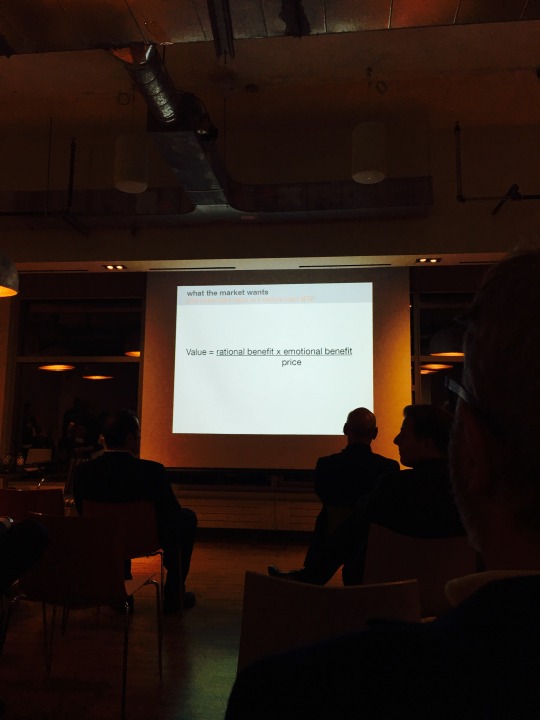
    One of the speakers at the event was Jeanhy Shim of Housing Lab Toronto. And I’d like to share one of her slides here:

    It reads:

    Value = (rational benefit x emotional benefit) / price

    I believe she admitted to taking it from someone at Bruce Mau Design. But that’s okay. That’s how ideas build. What I really like about it is that it attaches a value to the things that are difficult and sometimes impossible to measure: the emotional stuff.

    As I mentioned in this post over the weekend, we are all obsessed with the quantitative side of our businesses. In the case of development, we look at prices, per square foot prices, apartment sizes, and the list goes on. And we often reduce our “products” to these sorts of key metrics.

    But if you’re competing just on numbers, then you’re missing a big and important part of the equation. People consume things – and housing is no different – for a number of different reasons. We buy things because of how it makes us feel, how it reinforces our sense of self, how it improves or promises to improve our lives, and so on. These are all harder to measure than square footage. 

    But we are living in a data driven world and more and more of this type of information will become available for city building. If you and your business can get your head around it first, you’ll have a huge advantage. 

  • #donthave1million

    Tiny Park by David Brookfield on 500px.com

    https://500px.com/embed.js

    After I wrote this week’s post about Chinese homebuyers in Vancouver, I was surprised to learn about the racism debate that flared up in the city / on Twitter. I guess this really is a touchy subject. (See: #donthave1million)

    My reaction to the research was: Great to see someone (Andy Yan) putting in the time to try and better understand a market phenomenon. It’s painful how opaque real estate markets can be. Let’s get even more data so that we can make even better policy decisions. I didn’t read it as: let’s deliberately single out a race.

    Because the reality is that we all knew this was happening.

    Bloomberg recently published an interesting and related article that talks about China’s money exodus and how the Chinese logistically get their money out of the country. There are restrictions in place. 

    But first, here are two snippets from Bloomberg that describe the order of magnitude we’re talking about:

    This flood of cash is being felt around the world, driving up real estate prices in Sydney, New York, Hong Kong and Vancouver. The Chinese spent almost $30 billion on U.S. homes in the year ending last March, making them the biggest foreign buyers of real estate. Their average purchase price: about $832,000.

    In total, UBS Group estimated that $324 billion moved out last year. While this year’s numbers aren’t yet in, during the three weeks in August after China devalued its currency, Goldman Sachs calculated that another $200 billion may have left.

    Now here’s how it is being done:

    It works like this: Chinese come to Hong Kong and open a bank account. Then they go to a money-change shop, which provides a mainland bank account number for the customer to make a domestic transfer from his or her account inside China. As soon as that transaction is confirmed, typically in just two hours, the Hong Kong money changer then transfers the equivalent in Hong Kong or U.S. dollars or any other foreign currency into the client’s Hong Kong account. Technically, no money crosses the border – both transactions are completed by domestic transfers.

    And here’s a snippet that stood out for me because it shows how easy this has become:

    While the first exchange has to be set up face-to-face, customers can place future orders via instant-messaging services such as WhatsApp or WeChat, and money changers set no limit on how much money they can move.

    Given the scale and complexity of this issue – housing affordability – I have to believe that cities and policy makers would be far better off with more, rather than less, information. I hope we can work towards that.

  • Should condo reserve fund balances be made publicly available?

    No Need For Love by Michael Muraz on 500px.com

    https://500px.com/embed.js

    I’ve been thinking a lot lately about condominium governance and how things might be improved.

    If you own a condominium, you pay a monthly maintenance fee. Let’s say, for example, you own a 833 square foot condo and your maintenance fee is $500 per month. That works out to be $0.60 per square foot.

    For a lot of people, this fee probably feels like a bit of a black hole. The money goes out every month and that’s the end of it.

    But as I explained here, a portion of that fee goes into the condo’s reserve fund to cover future capital expenditures. This is basically an investment you are making for the future benefit of the building.

    As an example, if you’re paying $500 per month, somewhere around 25% could be going towards your condo corporation’s reserve fund. That’s $125 per month. $1,500 per year. $7,500 over a 5 year period. And $15,000 over a 10 year period.

    Now this is an investment that you’re obliged to make, but one that you might not be around to directly benefit from if you decide to sell before capital expenditures are made using the money you’ve invested.

    Of course, if you’re a savvy buyer, you’re going to scrutinize the reserve fund and the corporation’s overall financials before you buy into a building. And sometimes the unit valuations do get deeply depressed by out of control maintenance fees and/or special assessments. So you could maybe argue (as an owner) that your reserve fund investment ends up getting recaptured in an eventual sale.

    But what I wonder is to what extent a properly funded reserve gets accurately reflected in the valuation of the individual units. I suspect not that well. And as far as I know, there isn’t great data on this metric. (If you know of anything, please share it in the comments.)

    It’s certainly important information to have and consider. Again, when you buy a condo unit you’re not only buying the unit itself, you’re also buying the future investments (and liabilities) that others have left before you.

    So what I really want to know: Why aren’t reserve fund balances and building studies made publicly available? This is not easy information to get today.

    But imagine what would happen if the market had full transparency. Imagine if you could see a map of every condo building in your city and sort by age and reserve fund balance. In theory, unit pricing would become more accurate. But even more than that, there would be significant opportunities for collective intelligence.

    Now all of a sudden buildings would be able to benchmark themselves against other buildings to see if their reserve fund is sufficient, as well as learn from other buildings with respect to their history of capital expenditures. It would also hold the building’s management more accountable and allow owners to easily see if the contracts in place are competitive with the overall market.

    I know that a lot of people get nervous when it comes to sharing information like this. I mean, what would happen if your building is underfunded relative to its peers? Would that pull down property values? It certainly could. But if you’re underfunded and you get stuck with a special assessment in 5 years, then your property values are going to drop regardless.

    So I would love to see a lot more condo information made available to the public for free. In my view the benefits outweigh the potential negatives, particularly if this were to be done at scale. Condo corporations are also non-profit entities, so it’s not as if their balance sheets and income statements are filled with sensitive trade secrets.

    But what do you think? Would you feel comfortable if your condo’s reserve fund balance was made available online to the public? Do you even know off the top of your head what the balance is for your own building? I would be curious to know.

  • How small is too small?

    I was up early on Sunday morning and I tweeted this out:

    //platform.twitter.com/widgets.js

    It’s a link to a Dwell article about a New York family of four that lives in a 620 square foot apartment. It’s technically a one-bedroom apartment but the way they have it set up is that the two kids share the bedroom and the parents sleep in the living room similar to as if it were a studio apartment.

    And my question in the tweet was, could you do it?

    Part of the reason the article caught my attention was because I currently live in a 640 square foot apartment – but as a family of one. And not surprisingly it’s more than enough space for me. Would I still feel the same way if it were a family of two? I believe so. But what about if it were a family of 3 or 4? I suspect it wouldn’t be as effortless, though certainly not impossible.

    I love the idea of distilling one’s life down to only what is absolutely necessary. And if you happen to live in a city, like New York, where the median price of a one-bedroom apartment is somewhere around $3,400 per month, there can certainly be lifestyle advantages to doing more with less.

    So I’d like to re-ask the question here to the Architect This City community: Could you do it? How minimalist could you go?

  • What tax policy could be doing to home sizes in Ontario

    Golden City (of Toronto) by Evgeny Tchebotarev on 500px.com

    https://500px.com/embed.js

    In yesterday’s post I made a remark that we have antiquated tax policies here in Ontario that encourage the building of smaller new construction condominiums. There seemed to be a lot of interest in that comment, and so I’d like to talk about that today.

    Some people thought I was referring to development charges, but I was actually thinking of the GST/HST New Housing Rebate in Ontario

    The way it typically works in Ontario is that when buy a new construction home, the price you pay is inclusive of HST (harmonized sales tax) and net of any applicable rebates, such as the rebate program mentioned above. 

    This means that the price you see on your agreement is usually the price you pay. I say usually only because there are ways that you could disqualify yourself from the New Housing Rebate program. But that’s a different post.

    So what does this mean in practice?

    Let’s say you went out and bought a new construction condo for $368,200 (there is a reason I’m picking what seems like an arbitrary number). If there was no such thing as the New Housing Rebate program, then the sales tax owing on this home would be the full 13%. And that would mean that the price paid before any taxes is actually $325,841 (x 13% = $368,200). This is an important number because it represents revenue to the developer.

    But since there is a New Housing Rebate program, the effective tax rate actually works out to be 5.20% for this particular sale price, which means that the price paid before any taxes is now $350,000 (a nice whole number). And so because of rebates and because they are now paying less HST, the developer’s revenue number has increased. It has gone from $325,841 to $350,000.

    The way this logistically works is that purchasers usually assign the New Housing Rebate benefits to the developer who then processes all the paperwork. This is what I mean when I say that the “sticker price” is inclusive of HST and net of any rebates – it already factors in the possible deductions.

    So far things are looking good. And I want to be clear that I don’t have concerns with the New Housing Rebate program in its entirety. In fact, it’s a hugely important part of the new home industry. Without it, many projects would simply not be feasible to build.

    However, as the price of the new home increases (which typically happens as the home gets bigger), the rebates start to fall off. The federal portion of the rebate maxes out at a base purchase price of $350,000 (which is why I chose that number) and the Ontario portion maxes out at a base purchase price of $400,000.

    What all this means is that as the unit sizes get bigger and more expensive, the effective tax rate is no longer at 5.20%, as was the case in the example I gave above. It increases. And if you hold prices constant for the purchaser, it means that the developer’s revenues now start to drop.

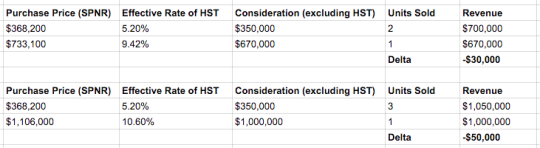
    To illustrate why this matters, consider the following chart:
    image

    In the first scenario, the developer builds and sells 2 units for a price of $368,2000. This translates into revenue of $700,000. However, if the developer instead decides to combine those 2 units and sell the larger single unit for $733,100 (roughly double the price) then the effective rate of HST goes up and revenue drops by $30,000.

    The second scenario is similar to the first one except that instead of 2 units, it’s 3 units which then get combined into one. Here revenue drops even further – by $50,000.

    Now, you could argue that there are some cost savings associated with building fewer suites, but I don’t think it would offset the differentials shown above, especially if you multiply those revenue numbers across an entire project. So what this all means is that it can be more profitable for developers to build smaller units priced below the thresholds mentioned above, as opposed to a smaller number of larger units. 

    Again, I’m not saying that HST rebates are bad. They’re critical to the industry. I love them. But I do believe we should be thinking about the possible implications that the current set up could be having on what we’re building and in particular on unit sizes.

    If you’d like to learn more about how the rebates work, check out this PDF from the Canada Revenue Agency. I tried to keep things simple in this post.

  • Thoughts on land-value taxation

    Yesterday I wrote about a new book that was just released called The Next Urban Renaissance

    The first essay in the book, written by Ingrid Gould Ellen of New York University, is centered around three ideas to help cities deal with the affordable housing problem. This is something that successful cities all around the world are grappling with.

    The first idea is land-value taxation, which is also known as a “split-rate” tax. I’ve touched on land-value taxation before on ATC, but I never really dug into it. So this was a good reminder to do that.

    The idea behind land-value taxation is to split property taxes into a land tax and an improvements tax (i.e. the building), and then shift more of the burden over to the land side. Economists tend to really like this model because taxing buildings/improvements can discourage property investment and development, whereas taxing land doesn’t impact supply. The supply of land is fixed.

    So in the context of affordable housing, land-value taxation is thought to be a way to encourage more development and to increase the supply of new housing – which is usually a good way to keep home prices in check.

    Here’s how Ingrid Gould Ellen described it:

    …a land tax would discourage speculators from hoarding
    undeveloped land and incentivize them to develop their parcels to the
    full extent allowable. Regardless of whether a parcel sits vacant, houses a
    partially occupied, one-story retail strip, or holds a 30-story apartment
    tower, the annual tax bill would be the same. By switching to a land tax,
    a city could therefore increase the supply of housing and, by doing so,
    reduce prices across the board.

    But I can’t help but wonder if this isn’t more applicable to cities or areas that are currently struggling to encourage development. For instance, would boom town Toronto really benefit (in terms of affordable housing) from a tax change that ends up encouraging more high-rise development?

    It also strikes me as being exceptionally difficult to implement, particularly in city like Toronto that is growing and changing so quickly. Is it reasonable to ask the owner of a small downtown parking lot to being paying property taxes as if a 90 storey supertall had been built on top of it? Because that is the reality in some parts of this city.

    And if we opted to phase in this new land tax, would it then become a game of arbitrage where developers look for properties with the lowest land taxes but the highest achievable densities?

    Finally, I wonder if it wouldn’t exacerbate some of the problems that already exist in rapidly growing cities, one of which is the preservation of smaller heritage buildings in centrally located neighborhoods:

    In the case of a split-rate tax,
    the losers will be owners of parcels with high land-to-building value
    ratios, or owners of small buildings on valuable, centrally located parcels,
    who will likely see an increase in their tax bills after the switch to
    a split-rate tax.

    Land-value taxation is something that I’ve been thinking about for a number of months now. But I am struggling to come up with a decisive position. If you have any thoughts on this, it would be great to hear from you in the comments.

  • City building jobs

    I get a lot of emails from readers of this blog. I try my best to answer every single one of them, but sometimes I fall behind and fail spectacularly at that. (The snooze feature in Mailbox and Google Inbox is one of the best inventions ever.)

    One of the most common emails I receive is about careers. Sometimes it’s someone looking for a new job or for advice on how to break into the industry (usually real estate development). And sometimes it’s an employer (or recruiter) with a role they need filled. 

    It’s hard to match up supply and demand when they arrive in my inbox on an ad hoc basis like this, but I have been thinking about ways I might be able to help these people out.

    So today I thought I would try something new. If you have a relevant job listing that you’d like me to distribute to the ATC community (something in architecture, planning, real estate, tech, and so on), email it to me at b@brandondonnelly. 

    If I get enough high quality listings, I’ll send them out in my newsletter. And if everyone finds it valuable, I may make it a regular feature.

  • The future of housing in Toronto

    On Monday evening I gave a 45 minute talk at the Rotman School to a delegation of about 70 people from Portland. The talk was about Toronto housing, but more specifically about the history and possible future of high-rise housing in this city. 

    Thanks to everyone who commented on my lead-up post over the weekend. It was really helpful to hear what other people in this city (as well as people not from this city) are thinking. Many of the comments also echoed my own beliefs.

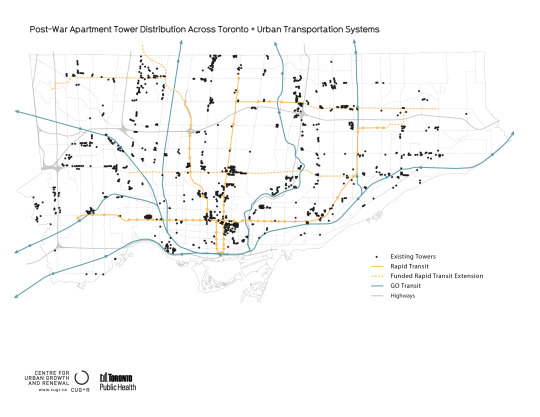
    The narrative I told in my presentation was about two significant, yet very different, periods of time when Toronto built more high-rise than low-rise housing. The first was our post-war suburban slab tower boom. And the second, which we are currently living through, is really the outcome of the Places to Grow Act (2005).

    But as I mentioned over the weekend, the really interesting question is: what’s next?

    In my view, what we are seeing today is fundamentally different than what we saw in the post-war years. Despite the fact that we were building towers then and we are also building towers now (albeit much taller ones), the ideology behind them has changed. It has gone from suburban to urban.

    Toronto’s post-war towers were built upon a particular dream. The dream of getting in your car, escaping the decay of the city, whisking up the Don Valley Parkway (nobody whisks on the DVP), and being rejuvenated by all the light, air, and green space afforded to you in your Ville Radieuse.

    But it turns out that people of means didn’t want that back then. They wanted a suburban house. That was the dream.

    Today, however, cities are back in vogue

    Companies are moving into city centers to compete for the best talent. Retailers are moving downtown to capture disposable income. And the most pressing problems are no longer about decay and urban blight, they are about housing affordability, gentrification, and too many rich people pushing out the poor.

    The narrative has changed.

    So in the context of Toronto, I feel as if we are at an inflection point when it comes to housing. The multi-family dream may not have stuck decades ago, but I believe it will stick for many, though not all, today. And this will happen for a variety of reasons ranging from sheer preference to sheer necessity. The alternative is no longer an affordable bungalow on a 50′ x 150′ lot that happens to be 10 minutes from the subway.

    But as a result of this shift, I also think a number of other things will happen. 

    Eventually, Toronto will look to loosen some of the land use restrictions on its single family neighborhoods. This could mean “gentle” low-rise intensification (new planning buzzword, take note), as well as the acceptance of laneway or accessory dwelling housing. This won’t be popular, as one person said in the comments over the weekend, but eventually the pressures will become too great.

    At the same time, I think we’ll be brought full circle with respect to our suburban towers. The suburban ideals in place at the time means that many of these tower communities have relatively low densities. That represents a tremendous opportunity for this city and it’s only a matter of time before we truly figure out how to unlock them.

    But for all the change and disruption that’s happening in Toronto, I think it’s also worth saying that those of us who live here should consider ourselves a lucky bunch.

    One of the things I actually asked the delegation from Portland was, what struck you the most when you arrived in Toronto? The response I got was: its vibrancy. 

    Everywhere you walk downtown, they said, people are on the streets – walking, cycling, and hanging out. In fact, some said it’s almost hard to remember which street is which because every street seems to be so full of activity. Most North American cities do not have this kind of sustained vibrancy in the core, I was told. And so that makes us a pretty special place. We must be doing something right.

    It’s easy to take those sorts of things for granted when you live somewhere. So today I’m trying to do the exact opposite of that. I’m trying to stop and appreciate the place I call home.

  • Toronto housing — where we came from and where we’re probably headed

    This morning I’m working on a presentation that I’m going to be giving one evening next week to a delegation coming in from the US. The title of the presentation is the title of this blog post: Toronto housing – where we came from and where we’re probably headed.

    My plan is to start in and around the 50s and 60s and talk about Toronto’s first tower boom following the war. For this time period, I’m relying a lot on the work of Graeme Stewart of ERA Architects, who is one of, if not the, expert on post war towers in this city.

    image

    I’m then going to move onto our current high-rise condo boom and compare the two.

    Because the interesting thing about the first boom is that, after it finished, we basically returned to the typical North American housing model: building single-family homes. And it wasn’t until this recent boom of the early 2000s that we once again resumed building more high-rise than low-rise housing. That is still the case today.

    But the question I want to address is really, what’s next? Where are we headed? Is history going to repeat itself or is – dare I say – this time different?

    I’ll eventually get to those questions here on Architect This City, but first I want to hear from you. So here’s what I’m proposing: leave your thoughts in the comment section below and I will feature the best ones in my presentation next week as the voices of Toronto. I’m sure many of you know that I’m a big fan of crowdsourced information.

    So here goes. Where is Toronto housing headed and how will we be living in the next 10+ years? Will we be raising families up in towers or not? Please comment by Sunday, September 27, 2015 at 6pm (ET) to make sure I have time to feature you in the presentation. 

    Thanks for participating 🙂

  • Products people love

    Ruler, compasses, eraser, protractor, pencil and tracing paper r by Alexander Melnikov on 500px.com

    https://500px.com/embed.js

    I recently heard someone say, in a pejorative way, that all real estate developers think of what they build as “products.” I imagine this is in contrast to thinking in terms of buildings as spaces for people to live, raise a family, do their life’s work, and so on.

    When I heard this I immediately thought to myself, yeah, we (or at least I) do think of our spaces as products. But I also didn’t see it as a negative thing.

    In my view, there’s no reason that classifying something as a “product” has to make it any less beautiful, functional, and/or filled with design intent. My iPhone is a product. The wine on my shelf that somebody labored over is a product. The chair I’m sitting on right now is a product. All of these items were produced by people and then I consumed them because I liked what those people had made.

    When I was completing my first master’s in architecture and real estate, I used to walk back and forth across campus between the design school and the business school. And in these two places, we talked about bricks-and-mortar in very different ways.

    In the business school, buildings were the proverbial widget. How much does this widget cost to produce? How much can I sell or rent this widget for in the market? And how do I scale up my business so that I can sell/rent more widgets?

    On the other hand, in the design school we weren’t all that concerned with the cost of the widget or even what people would pay for it. Instead we were concerned with making it something so much more than just a plain old widget. These weren’t buildings. This was capital “A”, Architecture.

    I don’t think either school was wrong in their thinking. I just think they were missing each other. 

    Business is business. If you don’t make a profit then you’re not going to be around for very long. And while many companies can survive by making shitty products, those aren’t great businesses. The best businesses also deliver products that people absolutely love.

    So whether we call it architecture, a product, or even a widget, the goal should be to delight people. (Am I allowed to say “customer”?) Make people so happy that they have to tell their friends about it. If we’re doing that, then frankly I don’t care what we call it.