Daily insights for city builders, delivered every morning at 6 AM ET. I’m Brandon Donnelly — a Toronto-based real estate developer and founder of Globizen. I’ve been writing here since 2013.

Tag: real estate development

  • Mr. Robinson — Architect as Developer

    I first learned about the work of Jonathan Segal back when I was in architecture school. And he was somebody I immediately admired. 

    At the time, I was struggling to figure out where I wanted to position myself between architecture and real estate development, and he was somebody who had seemingly figured it all out: he simply merged the two.

    For those of you who are unfamiliar with Jonathan Segal, he has made a name for himself by being a pioneer of the “Architect as Developer” business model. That is, he acts as both the architect and the developer/client.

    This business model isn’t going to suit everyone, but I suspect that we’ll see more of it in the future.

    Of course, it doesn’t just have to be an architect acting as a developer. It could also be an architect and a developer joining forces or some other permutation. Whatever the case may be, design and innovation are central to business today and that’s why I think this model will only become more relevant.

    Below is a short 3 ½ minute video about Segal’s latest project, called Mr. Robinson. It is located in San Diego. If you can’t see the video below, click here.

    [vimeo 155403927 w=500 h=211]

    If you’d like to see the typical floor plans or rent one of the apartments (they start at $2,400/month), click here.

    Now I’d be curious to hear your thoughts. Do you like the project?

  • Yes, just do it

    Waves on a snow-sea by Jason  Hummel on 500px.com

    https://500px.com/embed.js

    I have started to meet with developers for my new book – becoming a real estate developer – and I can’t begin to tell you how impressive and inspiring it is to learn about their stories.

    It’s easy to look at someone who is successful and feel overwhelmed by everything they’ve accomplished. But nobody starts at the top of their game (unless maybe they were born with a silver spoon in their mouth). Usually there’s a backstory of sweat and struggle that rarely gets told. As the saying goes: success has many fathers, but failure is an orphan.

    But those are exactly the kinds of things I hope to uncover with this little project. I am less interested in the successes and more interested in the early decisions, struggles, and thoughts that went into making those successes even possible.

    And one thing I’ve noticed is a tendency to just go for it. In fact, when I asked one developer if he had any advice for young aspiring developers, he said: just fucking do it.

    As soon as he said this I couldn’t help but think of my elementary school English teacher who used always tell us the same thing – minus the expletive – whenever we’d ask him something such as, how long should this paper be, should we focus on this or that, and so on. He would always say: What does Nike say? Just do it. No buts. Just do it.

    At the time, I obviously didn’t give this much thought. But the fact of the matter is there’s so much value in doing. And it’s easy to overthink at the expense of doing. What he was teaching us was to have confidence in ourselves that we would figure it out along the way.

    The reason there appears to be a lot of interest in “how to be a real estate developer” is because there isn’t really a set path. You don’t go to school, apprentice for a year under the wing of a developer and then, boom, you’re a developer. 

    Most developers have carved their own paths. They just did it.

  • Understanding building areas is not as simple as it seems

    Understanding building areas is a fundamental component of real estate and development. But it can actually get surprisingly complicated. Definitions, naming conventions, and measurement techniques vary greatly around the world. 

    To some, “GLA” means gross leasable area. But to others, it means gross livable area. So it’s important to understand what exactly is being measured when someone tells you that that a building is X number of square feet. Are we talking gross building area, gross floor area, or rentable area? Does that number include the below-grade areas or just what is above-grade? To make matters even more complicated, there are nuances to consider depending on whether it’s a residential or commercial building. 

    By now, I am sure you’re starting to see how complicated something as seemingly simple as building areas can get. So let’s talk about some of the basics today. Again, definitions might vary depending on where in the world you area. They might even vary based on conventions you’ve adopted within your particular firm.

    Gross Building Area: Also referred to as Gross Construction Area by some, this is the total area of the building, measured to the outside walls without any deductions. As you’ll see later, some area definitions allow for certain deductions. Gross Building Area is important because it’s a big driver of your costs – specifically construction costs. This is how much building you’re building. But, and this is important, it does not drive your revenue. That comes later.

    Gross Floor Area: This is usually a specific locally-defined measurement convention. It often allows you to deduct certain areas from your gross building area, such as “major vertical penetrations” and below grade parking areas. This number doesn’t directly drive construction costs or revenue (saleable/rentable area), but it’s important because it’s what the city will use to determine important planning numbers such as the building’s density/floor space index and to calculate any applicable levies. It’s also a fairly public number and might be what the brokers are using to calculate, as one example, what certain land sold for on a per buildable square foot basis.

    Net Saleable/Rentable Area: This is a hugely important number because it directly drives revenue. It’s your top line. It’s the amount of space you can collect rent on or the amount of space that you can sell. And unless your revenue exceeds your costs (which you’ve calculated using the numbers above), you’re not going to be able to build. 

    Note: Commercial spaces (at least in this part of the world) often work a bit differently in that there is what is known as a gross-up factor. What that means is that tenants pay rent on portions of the common areas (such as corridors) that fall outside of what is known as their “usable area.” In this scenario, the rentable to usable area ratio (R/U) becomes important. Naturally tenants don’t like paying for a lot of space beyond their usable area.

    This is just a brief overview of building areas. A good architect will make sure that your building area calculations are meeting all local rules and conventions. But as a developer it’s important to know and understand what exactly is being measured and what the “loss factor” of your building is. In other words, how much space is being lost to areas that cannot be sold or rented? Typically, you want to minimize lost space, unless maybe you’re pushing some new concept.

    Anything to add to this building area summary? Do you use different terminology or conventions in your part of the world? Let us know in the comment section below. That would make for a fascinating discussion.


  • 16 mobile theses and how tech might change the built environment

    Caucasian woman standing near passing subway in train station by Gable Denims on 500px.com

    https://500px.com/embed.js

    One of the things that I try and do here on this blog is examine the intersection of design, real estate, and technology. I didn’t explicitly set out to do that, but more and more I find myself thinking that way when I’m writing and when I’m giving talks.

    Part of that is because of my passions, but part of it is because there is a big and important overlap. One example of that is autonomous, self-driving cars. The tech community is enamoured with driverless cars, but everyone involved in the built environment should also be thinking about their impacts. Because it’ll be significant.

    Benedict Evans – who is a venture capitalist with Andreessen Horowitz in the Valley – recently published a post called, 16 mobile theses. It’s a look at 16 topics, trends, and shifts that are happening in the tech space. (There’s also a related podcast discussion.)

    If you’re involved in internet products, you absolutely need to give it a read. But I also think it’s interesting to read it through the lens of a designer or real estate person. Productivity is changing. Notions around the living room are changing. And yes, autonomous vehicles are going to have a profound impact on the urban landscape of our cities – just as cars did initially.

    Below are 3 excerpts from Benedict’s post that I really enjoyed.

    The first is about mobile and just how massive it is:

    “The mobile ecosystem, now, is heading towards perhaps 10x the scale of the PC industry, and mobile is not just a new thing or a big thing, but that new generation, whose scale makes it the new centre of gravity of the tech industry. Almost everything else will orbit around it.”

    The second is about how “networked” is quickly becoming a given:

    “Our grandparents could have told you how many electric motors they owned – there was one in the car, one in the fridge and so on, and they owned maybe a dozen. In the same way, we know roughly how many devices we own with a network connection, and, again, our children won’t. Many of those uses cases will seem silly to us, just as our grandparents would laugh at the idea of a button to lower a car window, but the sheer range and cheapness of sensors and components, mostly coming out of the smartphone supply chain, will make them ubiquitous and invisible – we’ll forget about them just as we’ve forgotten about electric motors.”

    And the third is about those self-driving cars:

    “The move to electric and the move (if and when) to autonomous, self-driving cars fundamentally change what a car is, but also what the whole automotive system might look like. Electricity changes the mechanical complexity of cars and hence changes who might build them and what they might look like. Autonomy and on-demand services change who buys them, meaning the buying criteria will be different. But they could also change the urban landscape just as much as cars themselves did – what do mass-market retail or restaurants look like if no-one needs to park?”

    Can you think of other ways in which tech will impact cities and the spaces we occupy?

  • I’m writing a book on becoming a real estate developer

    typerwriter closeup by Sean Gladwell on 500px.com

    https://500px.com/embed.js

    One of the most common questions I get from readers of this blog is: How do I become / get into real estate development?

    In fact, I get it so often that I’ve decided to write a book as my response. It may be a short one or it may end up a long one. If you’ve emailed or messaged me with this question and I haven’t responded, I’m sorry. There’s a lot of you out there. But I do want to help and that’s why I’ve decided to take on this hobby book project.

    As part of the book, I’ll be talking about my own journey, as well as the actual nuts and bolts of development. But I would also like to feature some much more established players in the business. In order to do that, I’ve decided to crowdsource some of the content for this book. 

    So here’s my ask to you: If you’re a real estate developer and would like to share your story, please complete this short questionnaire. You can be located anywhere in the world.

    My plan is to select a handful of developers from around the world and then feature their stories, one-by-one. I’m confident that there will be a lot of interest in hearing how successful developers established their careers and/or own businesses.

    I’ve been thinking about doing this for quite awhile now. It feels good to get started. 

  • The highs and lows of mid-rise

    Last week
    was developer Urban Capital’s 5th annual “Naughty or Nice” party. It’s obviously a holiday tradition of theirs and it has become a tradition of mine to attend. Judging by my vast collection of photo booth photos, there’s a chance I may have been to all of them. It’s easily one of the best holiday parties in the business.

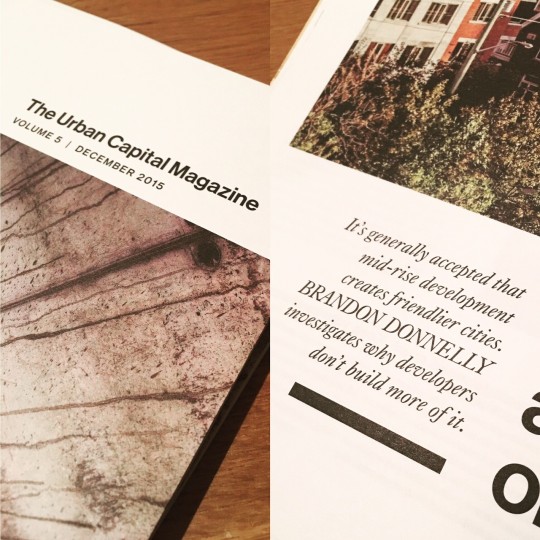
    One of the things that Urban Capital does at its annual party is release its annual magazine. And this year I was fortunate enough to be invited to write a piece for it on the highs and lows of mid-rise development. Put differently, it’s about the challenges facing developers who want to build mid-rise, but also why they’re pretty great for cities.

    If you’d like to have a read, you can do that online by clicking here. And if you’d like to receive a hard copy of the magazine, I can make that happen as well. Tweet at me. Alternatively, you can also pick up the magazine at any Urban Capital sales office.

    I deliberately tried to make it so it wasn’t your typical real estate puff piece: condos are great, yada, yada, you should buy one from us. I tried to make it an intelligent piece on some of the real challenges facing mid-rise developers. And that’s what Urban Capital wanted as well. I hope you enjoy it 🙂

  • Why multi-family developers are shifting their customer focus

    One aspect of the Toronto housing market that I’ve been paying close attention to is the adoption of multi-family dwellings by both long-term end-users and families. 

    I’ve written about this before (here and here, over a year ago) and have argued that here in Toronto we are at an inflection point. Multi-family dwellings – both rental and condo – are evolving to now target these new customer segments. Whereas previously, the new construction multi-family housing market was heavily geared towards investors and first-buyers. And often it was simply a stepping stone towards a single family home.

    Now, every city and real estate market is different. And I have heard many people in U.S. cities say that Millennials are simply deferring what we saw with previous generations. At the end of the day they (or we, I’m a Millennial) are going to move to the suburbs and buy that car. The current trends we are seeing around city living and reduced driving are just that – short-term current trends.

    But I think it’s worth reiterating: I do not believe that the status quo is what’s happening right now in Toronto. And I’m sure it’s also happening elsewhere. Time and time again I speak to developers in this city who are starting to shift at least some, and in some cases all, of their focus towards end-users, families, and larger units – particularly for new mid-rise product in the “neighborhoods.”

    And if you think about it, this makes perfect sense. 

    The average price of a detached single family house in Toronto is well north of a million dollars. So when a developer brings to market a 1,200 sf family sized apartment at $600 psf ($720,000) or even at $700 psf ($840,000), that home now becomes a relatively “affordable” option in many desirable areas of the city. Particularly if you value location amenities and your time (i.e. shorter commutes) over raw quantity of space. I know I certainly do.

    I know this isn’t going to appeal to everyone. But there is a big market here. Get ready.

    What are you seeing in your city? Let us know in the comment section below.

  • Insecure cities

    Miami city by night by beatrice preve on 500px.com

    https://500px.com/embed.js

    I am back in Toronto and ready to resume my normal routines. I am definitely a creature of habit.

    But boy is Miami an incredible city.

    The interesting thing that I noticed about Miami though is that – despite its reputation as a global capital of glam – it still shares the same kinds of insecurities that many other cities experience.

    I was reading the December 2015 / January 2016 issue of Surface this past weekend and there was an interview with billionaire real estate developer Jorge Pérez. He’s the CEO of The Related Companies and worth somewhere over $3 billion. In the interview he said that his biggest focus these days is on “Miami becoming a world-class city.”

    I love that. Cities need strong proponents. And he is doing a lot. To give one example, he donated $40 million (half in cash and half in art) to create the new Pérez Art Museum Miami.

    But for the Torontonians reading this post, how many times have you also heard the words world-class? At this point it makes me cringe when I hear someone say it. Usually it accompanies a sentence such as: “If we do (insert thing here), we will then be world-class.”

    I also attended a talk at Design Miami, where some of the panelists were going on about how Miami’s restaurant scene was pretty pitiful about 10 years ago, but how that’s not the case today. Now, it is finally becoming remarkable.

    That struck home for me because I’ve said similar things about Toronto: “10 years ago Toronto was like that, but now we are like this.” Makes me think that I’ll be saying the same thing about Toronto 10 years from today.

    So it seems like many, or perhaps most, cities have an insecure side to them. And that can be a powerful motivator for driving growth and change. Cities, like people, need that fire in the belly.

    But at the same time, there’s something nice about being grateful for what you have. And Miami certainly has a lot going for it. See you soon, Miami.

  • Vancouver approves first laneway apartments in the West End

    It’s no secret that Vancouver is way out in front of Toronto and many other cities when it comes to laneway housing. 

    Good luck trying to get a laneway house approved in Toronto. They’re only allowed under rare circumstances where there is already an existing house in the lane and/or you’re willing to fight it all the way to the province.

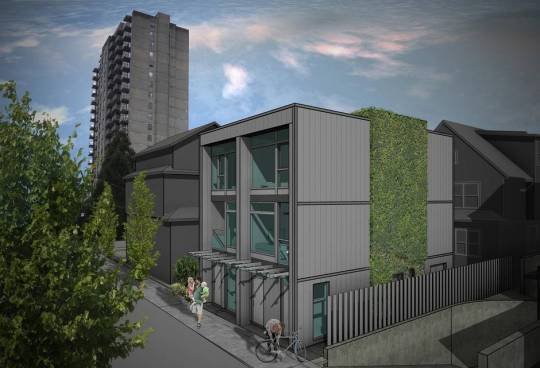
    But in Vancouver, it’s a different story. And they’ve even taken it a step further according to this recent Globe and Mail article by Frances Bula. The city recently approved small scale laneway apartments in the West End:

    “The city, which created the possibility for laneway apartments when it approved a new West End plan last year, has approved the first four buildings with 47 units in total. Three are in this particular alley between Nelson and Comox on either side of Cardero, around the corner from Cardero Bottega and Firehall No. 6. Others are in the pipeline. Many more are expected.

    They’re the first of a new kind of infill that planners hope will produce 1,000 new small homes in this popular downtown neighbourhood.”

    Here’s a rendering from the article to give you an idea of what these laneway apartments might look like:

    Readers of this blog have argued that Toronto doesn’t need laneway housing. There’s enough room for intensification elsewhere. 

    But what is clear to me is that Toronto is continuing to build less and less ground-related housing. There’s little to no room for that. And what is left of our low-rise stock is becoming increasingly unaffordable.

    So if we believe that social diversity is important for building a great city – which I do – then I think it behooves us to figure out how to not only increase the supply of new housing, but also increase its diversity. This is something Andrés Duany argued for in yesterday’s video post.

    The biggest hurdle is community opposition. But below is how one of the neighbours in Vancouver responded to the proposed laneway apartments. He gets it.

    “Dean Malone, who lives across the street from one of Mr. Sangha’s three projects, took the trouble to go to city hall to support it because the laneway apartments provide a way of creating new housing that isn’t a tower and isn’t a luxury development.”

    What this also does is allow the private sector to do more before the public sector needs to step in with affordable housing subsidies. I believe that laneway housing will help, but not solve, the affordable housing problem happening in most of our cities. 

    But every little bit helps. And this is one solution that many cities are simply ignoring.

  • What a “buy now” button will mean for the new construction real estate industry

    Colored apartments by Pierre-Yves Babelon on 500px.com

    https://500px.com/embed.js

    Recently it has been in the news that BuzzBuzzHome.com – the new construction real estate site – will be launching a “buy now” feature in the new year (2016).

    This will allow people to buy condos and homes online with their credit card, which means that people will be able to pay the $5,000 deposit online and process all the paperwork that today happens within a sales office.

    This is huge.

    If you’re somebody who has used a computer and the internet before, the process today feels archaic. Typically you go online to register for a project and then somebody will call you to arrange an appointment. If you ask them to email you the price sheet and floor plans ahead of time, they’ll almost always tell you that they can’t do that and that you’ll need to come into the sales office for an appointment. 

    But what about if you end not liking the floor plans and you’re about to waste a few hours of your time? Too bad. The sales funnel requires you to be present in person. This is nothing against the many talented sales professionals working in new construction; it’s just that if I can design and price out a car online and if Mark Cuban can buy a $40 million jet online, then I should be able to shop for a new condo online.

    BuzzBuzzHome has been chipping away at the current model for years and they’ve managed to get a lot more information online than was previously available. When Matthew and Cliff first launched BuzzBuzzHome in the late 2000s it was almost unheard of for developers to put any sort of pricing and floor plans online. Now they at least have some of that on their site. I’m glad they stuck with it.

    Because what’s equally exciting about what BuzzBuzzHome is doing is that in order to offer a “buy now” feature, they also need to have an accurate account of all developer inventory on hand. And so alongside this “buy now” feature they’re also building out a full cloud-based inventory management system for developers. 

    This means that BuzzBuzzHome will soon be managing the supply-side of the new construction marketplace. Think of the data and analytics you can extract from a platform like this. It’s going to bring much greater transparency to this industry.

    But if your business is in any way connected to the new construction real estate market, I would take this morning and think about how the above innovations could impact your business model. I can think of a few winners and losers.

    Some of you might be thinking that people aren’t going to make the biggest purchase of their life online. But I would bet the farm that many people will. I know I would.