Daily insights for city builders, delivered every morning at 6 AM ET. I’m Brandon Donnelly — a Toronto-based real estate developer and founder of Globizen. I’ve been writing here since 2013.

Tag: real estate development

  • Introducing: BARED blog series

    I was out with for a bike ride the other night with a good friend of mine and we were talking about all of the creative and social media-based projects that we would like to do. Everything from a daily vlog to a regular podcast. Sadly there are only so many things one can focus on.

    If you’ve been reading this blog since the beginning of this year, you’ll know that I’ve been trying to write a book on “becoming a real estate developer.” I believe there’s a lot of interest in this topic. It’s the number one question I receive from readers: “How do I become a developer?”

    But with everything that’s going on this year, I have decided to turn the research and writing I have done to date into a blog series that I’m calling BARED (Becoming A Real Estate Developer). I’ve interviewed a lot of fantastic people in the business and I want to get that information out there.

    The focus of the series – which was the intent of the book – is to uncover the early decisions and first projects that these now successful developers made and took on. In other words, it’s less about their current successes and more about what they did to get there.

    So no book. But expect to see the first BARED post very shortly. I think I’ll start with 3 posts and then gauge the response.

  • For the love of compactness

    I’m in Provincetown, Cape Cod right now. One of the things that is great about this town is the scale of it. It’s compact and many of the streets feel like laneways or alleys (I’m obsessed, I know). It’s all about pedestrians here. Even the main drag, Commercial Street, is effectively a pedestrian street – though it’s not technically closed to cars most of the time.

    There’s something liberating about being able to get where you need to go by walking or biking or skateboarding. And all of those things are done here. I enjoy the inherent efficiency that compactness brings. That’s why I was excited to learn this morning about the following proposal at 24 Mercer Street in Toronto (via Urban Toronto):

    image

    It’s a 12 unit, 17 storey building on a 195 square metre lot. The proposed FSI is 16.8. And it will have zero parking. I would be incredibly curious to know what the construction costs will be and how the overall project pencils out. But regardless, it’s exciting to see someone trying to make use of such a tight site. I would love to see more of this in Toronto and I am certain we will.

    What do you think about projects like this? Some of you may call this “poor planning,” but I see the efficient use of resources.

  • What I’m doing next

    image

    A number of you have asked if I’m moving to New York. I can see why that was inferred from some of my posts, but that was actually not my intention. I am not moving to New York. (Sorry New York friends. I’ll visit soon.)

    Toronto is home base. I hope it’s clear how much I love this city. Sure, I’m a big fan of New York and Miami and Vancouver and Berlin and Tokyo and Jackson (to name some of the places I have on my phone’s weather app), but I made a deliberate choice to station myself here.

    Because unlike some of the other industries I write about on this blog, city building is hyper local. What I do involves the built environment. And that doesn’t generally happen via a laptop on a beach in Bali (at least not for extended periods of time).

    It happens by being on the ground, interfacing with local communities, meeting face-to-face with the city, and poring over drawings with smart people who know far more about their respective disciplines than I ever will. It is a collaborative and local effort. It’s about getting into the details.

    And so to be successful in this business, I think it helps to find a home and take long bets. I’m not saying that I will never work on projects in other cities (I have and I would), but I am saying that I’m not moving to New York right now and that home remains Toronto.

    On that note, here’s what I have to tell you. Later this year I’ll be joining Slate Asset Management as VP of Development.

    A bit about Slate:

    Slate is one of the most active acquirers, owners, and managers of real estate in Canada right now. Founded in 2005 by two brothers (Blair and Brady), Slate has over $3 billion of assets under management across over 16 million square feet and over 130 properties.

    All of this is done through four main investment vehicles: 

    1) The first is Slate Advisors. It acts on behalf of and alongside private institutional investors — such as Greystone.

    2) The second is Slate Office REIT (TSE:SOT.UN). It is a pure play Canadian office REIT focused on downtown and suburban properties all across the country.

    3) The third is Slate Retail REIT (TSX:SRT.U). It is a pure play REIT entirely focused on grocery-anchored U.S. retail properties. (Remember how many times I’ve written on this blog about how grocery has one of the lowest online shopping penetrations?)

    4) And the fourth: Slate is also starting a grocery-anchored retail platform in Germany. It is similar to #3, except that it’s in Germany.

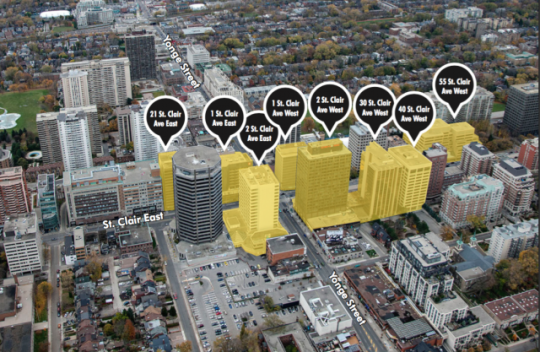
    Most recently, Slate has been in the news because of the position it has taken at Yonge + St Clair in midtown Toronto — a perfect example of “finding a home and taking long bets.” Slate, in partnership with Greystone, owns all 4 corners of the intersection and about 60% of the properties along the St. Clair corridor.

    Here’s a diagram of those Slate buildings:
    image

    In case you didn’t put two and two together, the 8-storey mural I wrote about two weeks ago is going up (right now) on the side of a Slate building (1 St Clair Avenue West — shown above). The British street artist known as Phlegm is doing it.

    Up until today, the focus of Slate has largely been on acquiring undervalued / overlooked real estate and creating value through re-leasing and overall repositioning. That will certainly continue. But given what I do, I am sure you can posit what’s also next.

    I’m genuinely excited to be joining such a talented group of real estate professionals. As I mentioned last week, I wasn’t in the market for anything new. I was heads down working on cool projects. But life happens. And Slate quickly demonstrated to me that the incredible success they have seen to date is precisely because of how progressive, nimble, and entrepreneurial they are.

    On that note, I have “one more thing” to share today.

    In parallel to all of this, and with the support of Slate, I am also starting a boutique city building company called Globizen. The name is derived from Global + Citizen.

    The objective is to build a company that embodies everything I write about on this blog. I want it to be lifestyle and design-driven. I want it to leverage technology to improve the way that cities and the building industry operate. And I want it to function as a vertically integrated real state + design firm, focused on sustainable urban infill development. Think of it as city building by and for the responsible global citizen.

    It’s still early days, but the thinking is that this new platform could compliment the larger Slate platform in some way. It’s too early to say how exactly, but everyone is open to having those discussions. And that’s what matters at this stage.

    I am going to end with a quote. It’s by Partner and Co-Founder, Blair Welch:

    “On all of our deals we have had people say ‘can’t’ to us. They say ‘Can’t be done, can’t do that, can’t raise money, etcetera.’ At Slate, we don’t do ‘can’t’ well.”

    I like that a lot. So here’s to finding a home, taking long bets, and not saying can’t. Onward my friends. 

  • Two open real estate development positions

    I recently alluded to some life changes on this blog. Well, I am now ready to share: I am leaving my development position at CAPREIT.

    I wasn’t intending to leave. I wasn’t looking to leave. And frankly, I felt conflicted. But sometimes life has a funny way of presenting opportunities that you just have to say yes to. As my mother likes to tell me: “Life is what happens to you while you’re busy making other plans.” More on this in a later post. Stay tuned.

    What I would like to talk about today are the opportunities that this may create for some of you. There are now two open development positions at CAPREIT. Both positions would be based in downtown Toronto (St. Lawrence Market).

    The first opportunity is essentially a Director level role where you would be responsible for growing the development team at CAPREIT. You should be able to lead a team, identify new development opportunities, create pro formas, assemble/manage consultant teams, secure development approvals for complex urban infill sites, and generally lead projects and people through the entire development lifecycle. For more information and to apply, click here.

    The second opportunity is at the Coordinator level. You would be reporting day-to-day to the above person and you should have working knowledge of the development process. For more information and to apply, click here.

    I would just like to add that in both cases you would be working on some very exciting urban infill projects and you would be joining an organization with great people and a great corporate culture. I mean this sincerely. If you have any questions about the two roles, feel free to reach out to me directly. And if you’re in the market, consider applying.

  • Real estate company? No, a lifestyle brand.

    This past weekend a rooftop restaurant, pool, and entertainment venue called LAVELLE opened upon atop 629 King Street West here in Toronto. It’s on the rooftop of a condo by Freed Developments, that for some reason is no longer called the Thompson Residences.

    Here’s a sampling of their Instagram to paint you a picture:

    imageimageimageimage

    I mention this not because I went, but because I think it’s interesting to see how Peter Freed is evolving his company and brand. He is best known as a real estate developer. But what he wants to do and what he is doing is turning Freed Developments into a “vertically and horizontally integrated progressive lifestyle company.”

    According to this recent press release, LAVELLE is the first venture of Trademark Hospitality Inc., which itself is “a branch of Freed Hospitality.” This is him selling not just selling a place to live, but selling a particular lifestyle and a certain community – and then taking an active and ongoing role in the programming of it.

    The other example that comes to mind is that of Equinox Fitness. I’m sure you all know this company, but what you may not know is that it’s owned by a real estate development firm called Related. The New York-based company acquired them in 2005 (closed in 2006) for about half a billion dollars. 

    Here’s why they did it (excerpt from this press release):

    Related and Equinox have historically shared similar visions. Both companies are known for their commitment to lifestyle, service, innovation and design, and have a passionate following amongst dedicated upscale consumers. The companies’ respective customers have similar demographic and psychographic profiles and both foster fiercely loyal clientele who are passionate about their brands.

    Related has redefined the residential marketplace, created the benchmark for sophisticated urban living and has been committed to quality fitness facilities in its buildings since the mid-eighties. Since its inception 15 years ago, Equinox has been widely recognized for being an industry innovator and for delivering an unparalleled fitness experience.

    Both companies will enjoy a number of key strategic opportunities from the partnership. Related will secure a well known brand as a quality anchor tenant for key current and future developments. This will also help Related to enhance the quality of its amenities and facilities available to residents.

    So this is not a new thing. In both of these cases, the goal is to create a brand and identity centered around a precise lifestyle. I mean, Related even mentions “psychographic profiles” in their news release. They know who their audience is, just as Freed does.

    Another way of looking at this is how it ties into what I see as a broader shift away from just development to more city building. It’s not just about throwing up a building and then moving on. It’s about trying to foster a certain kind of community and lifestyle. We may not all agree on what that community should be, but overall I think it’s an exciting direction for cities.

    If you’re taking a similar approach in your business (or even if you’re not), I would love to hear from you in the comments below.

  • Market vs. subsidized

    Miriam Zuk and Karen Chapple of the University of California, Berkeley, recently published a research brief called Housing Production, Filtering and Displacement: Untangling the Relationships

    It’s a nuanced look at the impact of both market-rate and subsidized housing production on affordability and displacement within the San Francisco Bay Area.

    The report is essentially a response to the debate around whether increasing market-rate housing production alone can address affordability and displacement concerns, or whether the only way to do it is through subsidized housing. What they found was that both matter, but…

    “What we find largely supports the argument that building
    more housing, both market-rate and subsidized, will
    reduce displacement. However, we find that subsidized
    housing will have a much greater impact on reducing displacement
    than market-rate housing. We agree that market-rate
    development is important for many reasons, including
    reducing housing pressures at the regional scale and housing
    large segments of the population. However, our analysis
    strongly suggests that subsidized housing production is even
    more important when it comes to reducing displacement of
    low-income households.”

    If you’re interested in this topic, I recommend reading the full brief. It’s only 12 pages. I particularly liked the information around filtering and how new housing steps down over time to ultimately serve lower-income households.

  • Fluted glass curtain wall

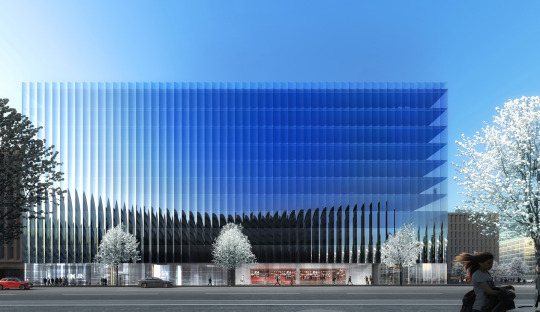
    New York architecture firm REX is working on a new office building in Washington DC that will incorporate a beautiful fluted glass facade. Here’s a rendering of what it is intended to look like:

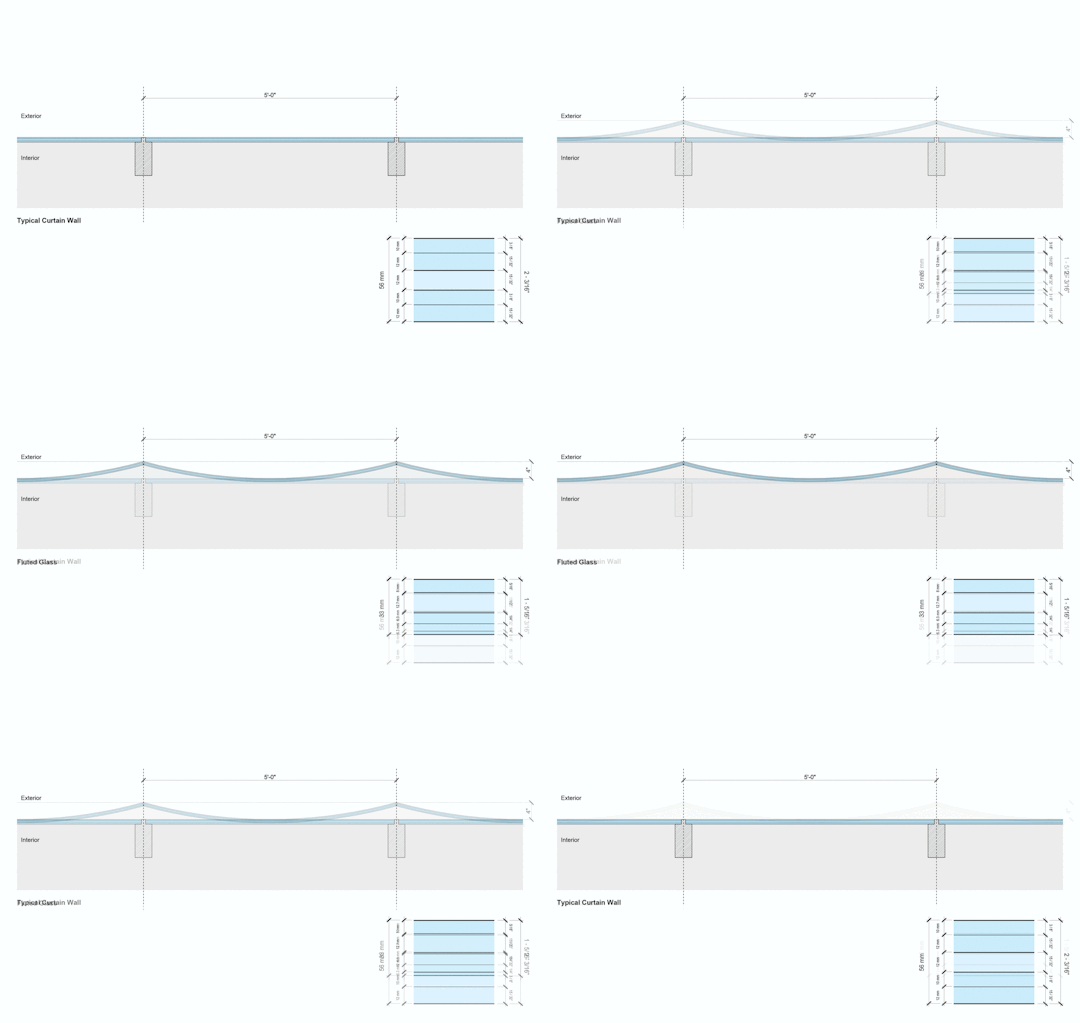
    Here’s what that looks like in plan (it’s a GIF that should show typical curtain wall vs. proposed fluted glass):

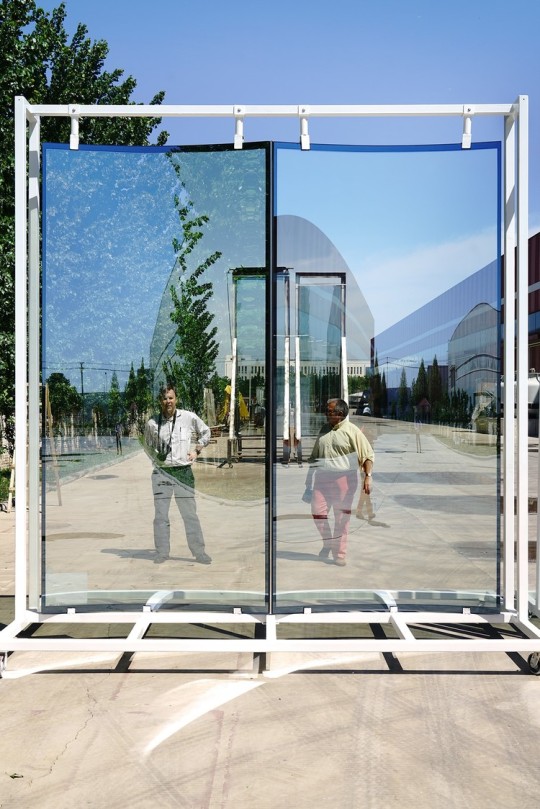
    Here’s a photo of the 1:1 mockup:

    And here’s a description from the architect:

    The façade’s approximately nine hundred identical, insulated-glass panels—3.2 m tall by 1.5 m wide (11’-6” tall by 5’-0” wide)—are subtly curved to a 2.9 m (9’-6”) radius through a heat roller tempering process. The curve yields structural efficiency, which meets wind load requirements and enables a thinner monolithic outer lite than normal, providing greater transparency. 

    Because of the curve’s inherent rigidity in compression, only the top and bottom edges of the panels are supported from the floor slabs, while the mullionless vertical edges are flush-glazed for a minimalist aesthetic that improves sight lines, while gaining usable floor area.

    They are working in collaboration with Front Inc., which if you haven’t heard of, you should check out. They are a design/engineering consultancy that specializes in facades and building envelopes. They work with many of the big name starchitects. The developer of the project is Tishman Speyer.

    It’s worth noting that part of the impetus for the fluted glass facade was to try and innovate within the confines of DC’s draconian zoning – which mandates that no building can be taller than 130 feet. Because of this, developers and architects are usually forced to build out to the allowable area, leaving little room for architectural variation. 

    But in this case, the fluted glass removed the need for thick mullions and also allowed them to extend out beyond the lot area by 4 inches every 5 feet (the curves are considered “architectural features”). So this move has created both architectural variation and more rentable area.

    It doesn’t appear that the building will have any operable windows, but other than that, I think it promises to be quite beautiful. What do you think?

    All images from REX.

  • Rental apartment expansion in Detroit

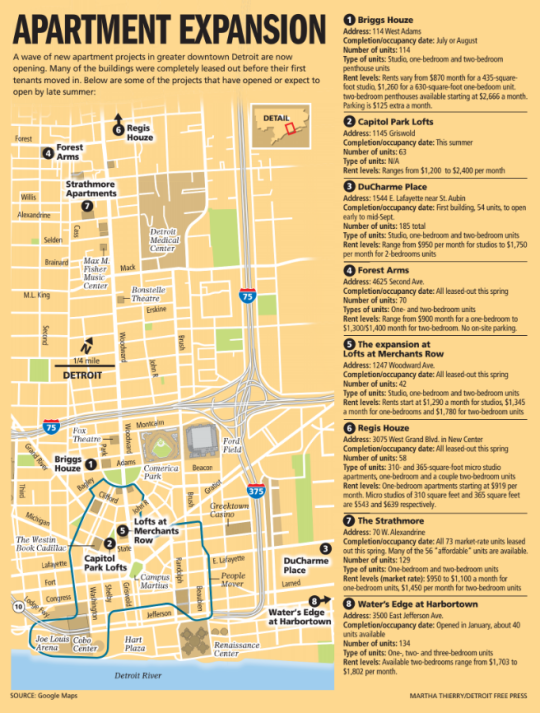
    The Detroit Free Press recently published a summary of some of the new rental apartments coming online in and around downtown Detroit. Here’s the map that they published along with their piece:

    image

    Based on this article, demand is outstripping new supply and rents are starting to push above $2 per square foot. This strikes me as a solid number given that there are also for sale lots/houses in the city going for $10,000.

    Going back to some of the posts I have written about rental apartment development in Toronto, you might remember that $3 psf is roughly our magic number given current cost structures.

    In some special circumstances you might be able to get a project off the ground with rents closer to $2 psf, but that’s an exception to the rule. There are many areas in the Toronto region with $2 psf rents and few, if any, new rental apartments.

    But Detroit is obviously a different city, as is every real estate market.

    Land would be cheaper. Many of these new rental apartments are conversions of existing buildings (which were probably bought for cents on the dollar). And I wouldn’t be surprised if there are tax abatements and other incentives to encourage more development. 

    I also wonder if people in the city aren’t being at least partially drawn to multi-family buildings because of the safety and security benefits. That’s something that certainly came up when I was in Detroit last weekend.

    Regardless, this is a good news story for Detroit, which is not always the story you hear people telling of the city.

  • Towards car-free living

    Right now, there’s an apartment building in San Francisco that is trying to encourage car-free living by offering residents a $100 per month credit that can be used for Uber and/or for public transit. Prospective residents can even get a $20 credit to go check out the community. (The program is a partnership with Uber.)

    The reason this leasing strategy caught my attention is because we’re at a point where city builders are now trying to recalibrate themselves to this new emerging world. 

    When I was at the Land & Development conference earlier this month, one developer brought up this exact point. He more or less asked: If you’re starting development on a new building today and you’re expecting approvals in 2 or so years and completion in another 3 or 4 years, what do you think the state of cars/driving will be at that point? Should you really be building all that underground parking?

    These are great question. And they highlight one of the challenges of development. It takes a long time to bring new supply to the market and a lot can change during that time period. My sense is that we are pretty clearly seeing downward pressure on driving and car ownership.

    That said, this isn’t the case in every city or in all parts of a particular city. I just got back from a trip to a Detroit where it’s pretty hard to imagine the city being oriented around anything but the car. But in cities like San Francisco and Toronto, car-free living is already a reality for many people and so we need to respond to that.

    How do you see yourself driving, or not driving, in the next 5 to 10 years?

  • Towards decentralized city building

    One of the
    most profound shifts taking place today – because of new technologies – is
    that of decentralization. I’ve written about this before, but I keep coming
    back to it because I find it so fascinating.

    It’s
    happening to varying degrees, but as a general trend, I believe it is leading
    to better data (less information asymmetries), more efficient markets, and the
    removal of many middle people. In the past, some intermediaries were necessary in
    order to act as proxies for portions of the market. But I believe that is
    changing.

    So what’s
    an example of this? Bitcoin. Bitcoin is an example of decentralization because
    no one entity controls it. It operates through a decentralized public ledger.
    And because of this, it has the potential to be highly disruptive to the way we
    think about currencies today.

    Put another
    way, I see decentralization as a way to leverage the wisdom of crowds. I am
    convinced that large groups of people can be incredibly intelligent when they’re
    allowed to contribute in the right ways. And I think this could solve many
    different problems, from the infighting we see within cities to broader market phenomena.

    As another example,
    there’s something new in the venture capital space called DAO – which stands
    for Decentralized
    Autonomous Organization
    . Essentially it’s a decentralized VC platform based
    off of a Bitcoin derivative currency.

    But perhaps
    the most noteworthy and relevant feature is that it allows its large pool of
    investors to anonymously vote on which investments to pursue. This is in
    contrast to a more centralized approach where an investment committee would
    meet behind closed doors in a big boardroom and make a decision. This would be the
    more typical approach.

    If you’re
    not in the tech space, the above may not seem all that exciting to you. But I
    see many parallels between venture capital and real estate development, which is
    one of the reasons I follow the space. So I can’t help but wonder what this
    trend could ultimately mean for real estate, design, and other city building industries.

    I can
    certainly imagine a world where the forces that shape our cities are more
    collective and decentralized in nature. It’s already starting to happen through crowdsourcing, social media, ridesharing, and other online platforms.