
Daily insights for city builders, delivered every morning at 6 AM ET. I’m Brandon Donnelly — a Toronto-based real estate developer and founder of Globizen. I’ve been writing here since 2013.

Tag: real estate developer

  • Pulling the future forward

    I like the way that Scott Galloway describes entrepreneurship in this recent post about why he’s bearish on Tesla:

    Entrepreneur is a synonym for salesperson, and salesperson is the pedestrian term for storyteller. Pro tip: No startup makes sense. We (entrepreneurs) are all impostors who must deploy a fiction (a story) that captures the imagination and attracts capital to pull the future forward and turn rhyme into reason. No business I have started, at the moment of inception, made any sense … until it did. Or didn’t. The only way to predict the future is to make it.

    He then goes on to describe the difference between an entrepreneur and a liar:

    This is not the same as lying. There’s a real distinction between an entrepreneur and a liar: Entrepreneurs believe their story will come true, as they are laser-focused on making it true. A liar, well, they know they’re misleading people with false data. Usually for money (i.e., fraud). This is where Tesla turns gray.

    Scott continues to say things about Elon and Tesla. But that’s not the point of today’s post.

    The point I would like to make is that real estate development is an inherently entrepreneurial endeavor. You need to be a salesperson and a compelling storyteller, because that’s the only way you’ll be able to create the future. And creating the future is what developers do.
  • The growth of branded residences

    A branded residence is, as the name suggests, a residential building with a known branded attached to it. Historically, these have tended to be hotel brands. But it really just needs to be any brand that people know, care about, and will pay a premium for. So it could also be a fashion brand, a car brand, or whatever else.

    This is a growing segment of the residential market. According to UK-based Savills, there were only 15 or so of these “schemes” in the 1990s (the UK uses scheme in lieu of project, which always sounds conniving to me), but by the end of this decade they expect the pipeline of branded residences to exceed over 1,200.

    I would also argue that projects designed by celebrated architects and/or designers are a form of branded residence. And this is not being captured in Savills’ number above.

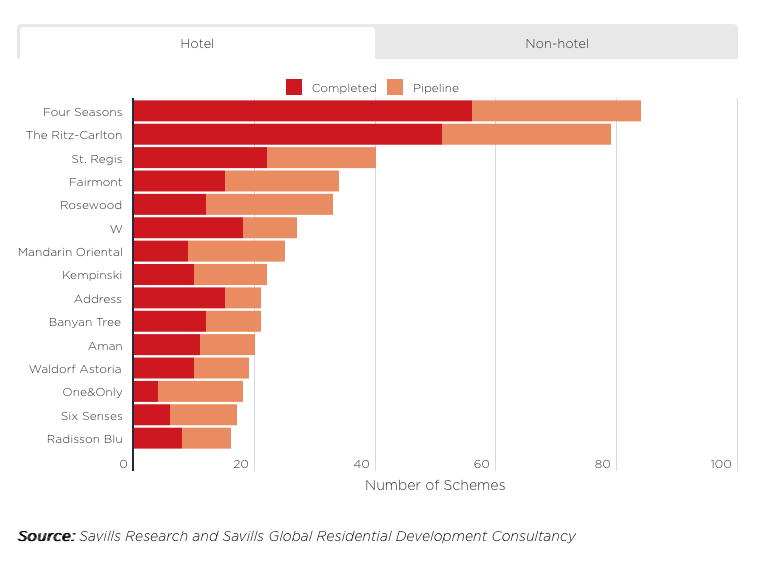
    Whatever your definition, today, the branded residence capital of the world seems to be Dubai, which feels right. And the biggest brands, by what appears to be a long shot, are Four Seasons and Ritz-Carlton (hotel side), and YOO and Trump (non-hotel side). Here are the full rankings from Savills:

    This is an interesting part of the real estate business for a few reasons. One, it makes sense. A New Balance shoe that gets co-branded with Aimé Leon Dore unlocks additional value for both sides. ALD has a brand that certain people care about. So, of course the same would be true of real estate paired with the right brand.

    Two, it’s a growing market, and I think this is aided by the fact that development is an intensely local business — so it can be hard to grow a globally-significant brand on your own. Sometimes you just need to borrow someone else’s.

    And three, it’s usually a less risky approach to getting your name on buildings. Branded residences typically operate on a licensing model, which means developers pay for the right to use the brand. The brand may also capture some of the upside in the form of a percentage of sales. That’s less risky than putting up your own money.

  • Being a real estate developer means asking a lot of questions

    I was having coffee with a developer friend of mine this morning and we got onto the topic of asking a lot of questions. We joked that that’s what we do all day.

    Development projects happen because of teams of very smart people all working together toward a common goal. It’s a beautiful thing. And as a developer, there are certain expertises and competencies that you should have.

    But for the most part, we usually sit in rooms as the least qualified person. We are not structural engineers. We are not geotechnical engineers. We are not architects (though I sometimes pose as a fake one). We are not planners. And we are not façade specialists, among many other things.

    But we are the ones taking on most of the financial risk and trying to bring everything together. And what that means is that you end up asking a lot of questions. You collect information, you try and consider what could go wrong, you lean on past experiences, and then you make a decision — often without perfect information or 100% certainty.

    This is how projects move forward. You have to rely on others and you have to make decisions. Because not making a decision is even worse. It burns time, which is why too many cooks in the kitchen can be the kiss of death for development projects.

    I’m sure the same thing can be said for many other things in life.

  • Innovation in real estate development

    I am moderating a panel at the Toronto Real Estate Forum later this year (it’s on December 2 to be exact). The topic is innovation in development. There is a great panel of speakers (more info here) and the plan right now is to cover everything from new design and construction approaches to the rise of crypto and blockchains. Topics that are all near and dear to this blog.

    But we are still in the early stages of planning and I haven’t yet figured out what the questions to the panel will be. So I thought it would be interesting to hear from all of you: What would you say are the most important topics to cover when it comes to innovation in development? What’s next for our industry, or what should be next for our industry?

    If you have any thoughts, please leave a comment below. That way everyone can see them. Supposedly this is one of the most asked for topics at the real estate forum, and so it’s clearly top of mind for many people.

  • The development manic meter

    We have a running joke in our office about the manic nature of the development business. Sometimes you feel like you’re having the best day of your life and everything is clicking and moving forward. And sometimes it feels like you’re about to die (slight exaggeration). Things are stuck, nothing is moving, and/or a new problem has just popped up. So our team likes to joke that we have a “manic meter” in our corner of the office. Sometimes it’s up and sometimes it’s down.

    Part of the challenge is that progress in the world of development generally takes a very long time. Whenever I talk to someone who isn’t in the industry and I explain our timelines, they are usually shocked and question why things move so slowly. For example, we just spent the last 82 days trying to pull a building permit that realistically could have been issued in an afternoon. That is frustrating. Meter down. We have also spent more than half a decade working on some planning approvals. That’s even more frustrating. Meter down.

    The way I have learned to respond to this dynamic is to try and move as fast as possible. Never assume you have enough time, because things will generally always take longer than you expect. You need to be constantly moving and pushing. So you need to be impatient in the short-term. I also find it helpful to break big projects down into smaller projects so that you have wins to celebrate along the way and you can feel some accomplishment. Having hobbies that don’t take decades to come to fruition may further help.

    But alongside being impatient in the short-term, you also have to be patient in the long-term. Our team started working on One Delisle in 2015. We are now in 2021 and preparing to start construction. That’s a marathon, not a sprint. So what you need to do is find the right balance between short-term impatience and long-term patience. This, I guess, is part of the manic nature of this business.

    Meter up.

  • Visionary vs. operational

    Fred Wilson wrote a great post last month about leadership. In it, he compares what he calls visionary leadership to operational leadership. Here’s a snippet:

    I like to keep things simple and in my simple mind, leadership comes in two flavors, visionary leadership and operational leadership. Founders are almost always visionaries (if they aren’t, run in the opposite direction) and hired CEOs are almost always operators.

    The post goes on to explain the dynamics between these two types of leadership. Vision, he argues, needs to come from the top. You need someone setting direction at a high level. Operational leadership doesn’t have to be this way, and often isn’t. You can hire for it.

    In some special cases, you have leaders who are both. Another snippet:

    Leaders who can provide both operational and visionary leadership are a rare but special breed. When you find one, get on their bus and stay on it for as long as you can. It will be an incredible trip.

    I have seen all of this play out in the real estate development space.

    There are people who are great at identifying new sites (land) and coming up with fresh and innovative ideas, but it is clear that they need an operator or two around them. There’s nothing wrong with this pairing.

    Development is also a very long and slow game and you need people who can operate — deeply in the weeds — over extended periods of time. Persistence and tenacity are crucial. Patience I guess, too.

    If this topic is of interest to you, I recommend you check out the rest of Fred’s post.

  • The war on beauty

    A recent essay by The School of Life asks: “Why is the Modern World So Ugly?” Here’s how it opens:

    One of the great generalisations we can make about the modern world is that it is, to an extraordinary degree, an ugly world. If we were to show an ancestor from 250 years ago around our cities and suburbs, they would be amazed at our technology, impressed by our wealth, stunned by our medical advances – and shocked and disbelieving at the horrors we had managed to build. Societies that are, in most respects, hugely more advanced than those of the past have managed to construct urban environments more dispiriting, chaotic and distasteful than anything humanity has ever known.

    Naturally, it turns out that this is, at least partially, the fault of greedy and unscrupulous real estate developers:

    When property developers heard that the artistic avant-garde was now promoting a concept of functionalism, they rejoiced. From the most high brow quarters, the most mean minded motives had been given a seal of approval. No longer would these developers have to spend any money on anything to do with beauty. Out could go the symmetry, the flowers, the nice but slightly more expensive materials. It could all be as quick, ugly and cheap as possible; after all, isn’t that what the great minds of architecture had advised?

    The author goes on:

    Yet this nuance was lost on the property developers who came after them. Their constructions weren’t elegantly pared down with grace. They were something far worse: sloppy, mean-minded and ugly. Except that now, because of the words of the modernist masters, there was apparently nothing one could do to charge them with a dereliction of duty. The concept of beauty had been rendered old-fashioned, it smelt elitist and woolly. No one could any more complain that beauty was missing from the world without sounding soft-headed.

    To be fair, the essay doesn’t entirely blame developers. It, more specifically, outlines six possible reasons for the ugliness of the modern world. And I do agree with some of them.

    Click here for the full essay.

  • We are hiring for the Development team

    Slate Asset Management is hiring.

    We are looking to hire an Associate or Director to join the Development team here in our Toronto office. The full set of responsibilities can be found over here on LinkedIn, but at a high level, we are looking for someone who wants to join an entrepreneurial team and lead — fairly independently — a portfolio of urban infill projects.

    Our approach to development really stems from the broader Slate platform. We are bold and thematic investors who work to create long-term value for our investors and partners. From a development perspective, that translates into an unwavering commitment to design & culture, innovation, and disciplined project execution.

    We pride ourselves on working alongside the world’s best architects and designers, and uncovering opportunities that others may be overlooking. We are proactive and hands-on in everything that we do. We also feel an inherent sense of responsibility for the buildings that we create and we want the work that we do to help improve our cities. We stand behind our product.

    If this sounds like a mission that you can get behind, then I would encourage you to learn more about us at slateam.com and submit an application via LinkedIn. Please note that we are also asking candidates to introduce themselves through a short video.

  • Carleton University’s Certificate of Real Estate Development

    Next Tuesday, January 19, I am helping to teach the introductory class of a Certificate of Real Estate Development program that is jointly offered by Carleton University’s Sprott School of Business and Azrieli School of Architecture & Urbanism. Here is a full list of the instructors and key note speakers that will be participating in the program. Obviously it is all being done online this time around.

    One of the great things about this program is that it’s a partnership between their school of architecture and their school of business. As you might expect given my background, I am biased in my view that this is a great way to teach real estate development. And it’s one of the reasons why I enjoyed my time so much at the University of Pennsylvania. I was free to take classes at whatever “school” I wanted to.

    When I later went on to study at the Rotman School, I actually tried to advocate for a better real estate development curriculum and for increased collaboration across the business and architecture schools (both alma maters). The response I got, at least back then, was that Rotman already had a real estate major and that it was fine just the way it was. Cool.

    For more information or to register for Carleton’s Certificate of Real Estate Development program, click here. I think there are only a few spots remaining.

  • Thinking differently and what courses to take in school

    When I was in grad school studying architecture and real estate, the Zell/Lurie Real Estate Center used to run a regular lunch series with real estate executives. The way it worked is that executives would come in to the school and 15 or so students — all of whom were studying real estate — could sign up to have lunch with them in a boardroom. I can’t remember if the school provided us lunch or we had to bring our own, but either way, you had an hour to hear them talk about the industry and ask them whatever you wanted to know.

    One time somebody asked a question about what courses they should take outside of their business and real estate classes. And I’ll never forget what the executive said. His recommendation was to take courses that were as far away from business, finance, and real estate as possible. He said take fine art history classes, learn about ancient civilizations, or whatever. Just take classes that force you to think a little differently than everybody else.

    The reason, I think, this resonated with me so much was because I had a certain amount of academic insecurity at that moment in time. I was coming from an architecture and design background and my classmates were former investment bankers and management consultants, all of whom had a far better grasp of “the numbers” than I did. It meant that real estate recruiters didn’t want to talk to me because I was the square peg for their round hole.

    But being a square peg really motivated me.

    I remember walking into the program director’s office at that time and requesting that I be put into what was considered to be the more difficult real estate finance class offered at Wharton. He said that he didn’t recommend it. Non-MBAs (which I was at the time) can’t typically handle it. And if he put me into it, I would likely come back to him crying about how hard it was. I asked him to put me in it and said that I would come back to show him my “A.” He put me in it and, yes, I got an “A.”

    But at the end of the day, the point that this executive was making at the lunch was that the math and mechanics behind things like cap rates, IRRs, and DCFs is not rocket science. Real estate is not rocket science. You of course need to know how this stuff all works, but it is not the be-all and end-all. The other critical parts of this are more art than science. What are the assumptions that I am making as part of my analysis? What do I believe about the future of the world? To answer these questions, you need think critically and laterally. And having a different perspective can help you do exactly that.

    This was true back in 2008 and it’s still true today.