Daily insights for city builders, delivered every morning at 6 AM ET. I’m Brandon Donnelly — a Toronto-based real estate developer and founder of Globizen. I’ve been writing here since 2013.

Tag: purpose built rental

  • RioCan REIT announces new residential group

    On Monday, RioCan REIT announced its new residential brand: RioCan Living. This is the group that will now be responsible for redeveloping the 43 properties within their portfolio that they have identified as having intensification potential. Here’s how they are describing the new brand: “RioCan Living delivers best in class purpose-built rental units and condos along Canada’s most prominent public transit lines.”

    It has been interesting watching RioCan over the last 6 months. In the fall they announced that they would be selling off somewhere around $1.5 billion of their portfolio to rebalance toward Canada’s six largest markets, and in particular the Toronto market. And with this recent unveiling it is clear that they are doubling down on transit-oriented mixed-use communities as a way to future-proof their retail portfolio against disruption.

    Major markets. High-density. Transit-oriented. This shouldn’t surprise any of you. Here is a link to their latest investor presentation in case you’re curious.

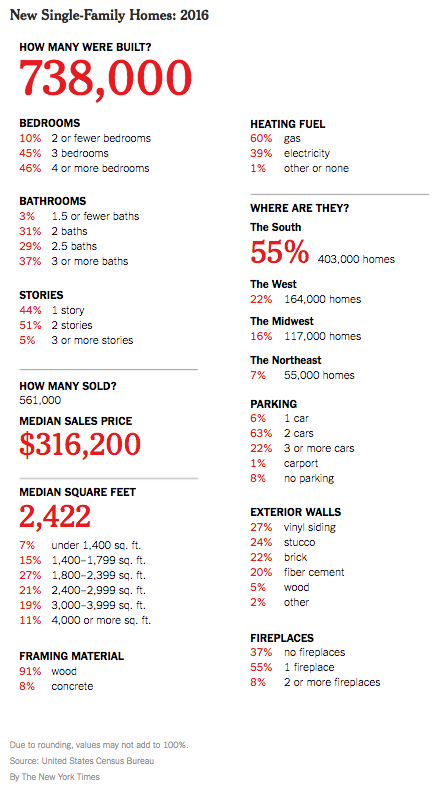
  • 738,000 single-family homes were built last year in the US

    The New York Times recently published “a portrait of new single-family homes” in the US in 2016. Here’s that portrait:

    For those of those living in dense urban centers, this portrait is perhaps a reminder that in many other places a large single-family home can be had for about the price of a studio apartment.

    Nothing in the above portrait likely surprised you, but it’s interesting to note that over half of all new single family homes delivered last year were in “The South.” Only 7% were built in the dense northeast.

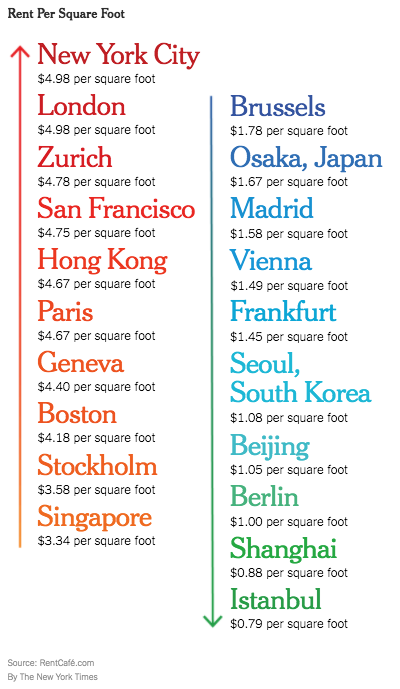
    The New York Times also recently looked at “international rents per square foot” using data from RentCafe. Here they are:

    New York City sits at the top with an average rent of $4.98 psf. This is across all boroughs. I am surprised by how low some of these international rents are. But averages rarely tell you the whole story.

    In any event, I do think that these two graphics start to speak to the economic spikiness that we are seeing across the US. 

  • Building Tour: Oben Flats Leslieville

    I toured Oben Flats Leslieville today, which is a 48-unit purpose-built rental building at 1075 Queen Street East in Leslieville (Toronto). It was designed by superkül

    Oben Flats is doing some very cool things, so I would encourage you to check them out if you’re in the market for a new luxury rental (or you just want to nerd out about property). The image at the top of this post is the west view from the rooftop terrace.

    Here are 3 things that stood out for me:

    1. One of the interior amenity spaces for the building is actually on the ground floor attached to the main entrance. There’s a fireplace, a wet bar, a set of wine fridges and free wifi. Oben Flats hosts regular events in this space, but I was told that residents also regularly hang out in it. They’ll bring their laptop down and have a glass of wine. 

    What I like about this is that it encourages social interaction within a multi-family building typology. I would love to see more of this kind of thinking. Part of the reason you live in a city is to interact with other humans.

    2. Oben Flats has developed their own signature scent and regularly curates a music playlist with the help of BELLOSOUND. Both of these items are pumped throughout the common areas of the building, which is not that dissimilar from what you might find in some luxury hotels. I have one of their candles sitting on my desk right now, so my office smells like Oben Flats. I’m into it.

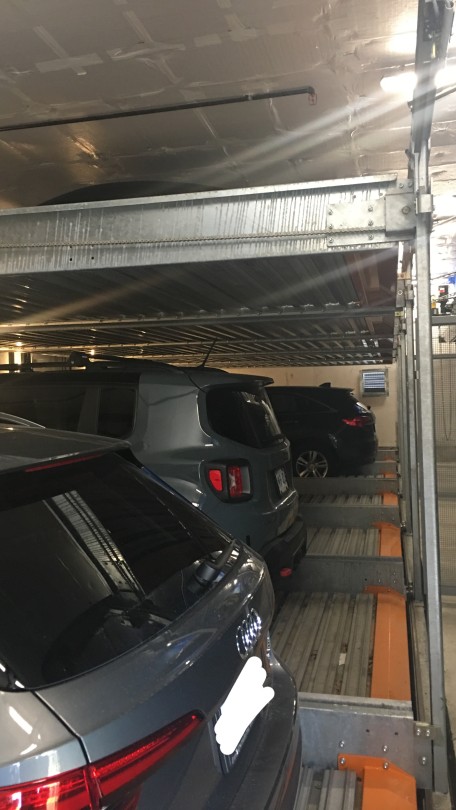
    3. Another unique feature of the building is the fully automated hydraulic car-stacking system. Here’s a photo of what the guts of that looks like:

    There are 3 platforms in each bay (the bottom one is below-grade in the above picture). And there’s always one empty spot so that the platforms are able to shuffle around both horizontally and vertically. However, as a user, you never see this. You simply hit a button and drive into your bay. It’s always the same one.

    I’ve said many times before on this blog that I think we will see way more of these types of parking solutions

    in the city

    going forward.

    There are other cool things I could mention about the building, but it’s far too nice out to sit at my desk any longer. Before I sign off though, I should mention that this is in no way a sponsored post. I simply admire what Oben Flats is doing. 

    See you tomorrow.

  • Affordable housing and the economics behind developing new rental apartments

    light trail in concrete jungle by Tassapon Vongkittipong on 500px.com

    https://500px.com/embed.js

    In most big cities around the world, there is a pressing need for more affordable housing. We know that inclusive cities make for better cities. But from San Francisco to Hong Kong, you always hear people talking about how expensive housing is.

    So why is this such a difficult problem to solve?

    Part of the problem, I think, is that many people don’t understand the economics behind building a new building. Oftentimes I hear people say that because developers make so much money, they should just build more affordable housing. Done. Simple.

    But things are not that simple.

    To illustrate my point, let’s walk through the thought process for developing a new rental apartment building.

    In its simplest form, developers are concerned with: revenue – costs = profit. And since many of the costs associated with building a new building just are what they are, it all starts with revenue, which in our case would be rents.

    To build a new rental tower in Toronto, your rents typically need to be at least in the high $2′s per square foot per month. Otherwise the economics don’t work. But to make the math simple, let’s say you need $3 per square foot in rent. That means a 1,000 sf apartment would rent for $3,000 per month.

    That’s not cheap. There are only so many people who can afford these kinds of rents and only so many areas where you can command these kinds of rents, which means there are only so many areas in Toronto where new rental apartments will be built by the private sector.

    If the rents instead happen to be $2 psf – meaning that same 1,000 sf apartment now rents for $2,000 per month – then for-profit developers will not build (barring any unique deal circumstances). Even at $2.50 psf / $2,500 per month, it would be difficult to make the numbers work here.

    And by the numbers, I am talking about tight returns that really only start to make sense in our environment of record low interest rates. Which means that when interest rates start to rise (pushing cap rates up), it may not even make sense to build rental apartments when the rents are in the high $2′s per square foot. This is particularly true if you’re competing against condo developers to buy the land. They can afford to pay more. 

    In this scenario (of rising interest rates), many real estate firms might simply opt to buy existing assets instead of taking on the risk of building anything new. Now all of a sudden your supply of new market rate apartments (not to mention affordable apartments) has dried up. Remember, it’s been decades since Toronto built rental apartments at any sort of meaningful scale.

    It’s for reasons like this that Vancouver launched a program called Rental 100. In a nutshell, it helps to reduce the “costs” variable in the equation mentioned above so that developers are able to meet minimum project returns and build more rental buildings. They do that through things such as reduced parking requirements, additional density, development charge waivers, and so on.

    In some ways, these items are subsidies. The city is giving up revenue that it could have otherwise collected from a developer building, say, a condo. But in other ways, they are freebies. The city could be unlocking development sites that may have otherwise not been developed. In which case it’s not really forgone revenue.

    Vancouver’s Rental 100 program is a market rental housing policy. But there’s no reason that similar thinking couldn’t be applied to create an affordable rental housing policy. It has been done and is being done in many cities.

  • 11th Annual Land & Development Conference

    Today I spent the day at the 11th Annual Land & Development Conference here in Toronto. I found it particularly good this year, but it’s now late, I’m tired, and I want to go watch game 6 of the NBA finals. So I think this is going to be a fairly short post.

    Here’s a summary of some of my key takeaways from the day (a lot of it is Toronto-centric):

    • Increasingly, the commercial and residential sides of the real estate development business are converging. And it’s being largely driven by the focus on urban intensification and mixed-use.
    • This is leading to an “institutionalization” of the residential side, which has historically been the domain of smaller private/local companies and rich families.
    • Merger is creating complexity around asset valuations: Is it about the income (cap rates) and/or the future development potential?
    • Low rise house prices in Toronto continue to skyrocket. Supply is highly constrained. This has been the story for a number of years now.
    • High rise condo prices in Toronto continue to be more or less flat (modest increase). The industry is going to need to figure out how to work with and compliment the current surge in rental apartment development. There is an element of competition between the two asset classes.
    • According the RealNet’s new home price index, the spread between low-rise and high-rise housing in the Greater Toronto Area widened to $326,659 as of this past April (2015).
    • Rental Apartment Case Studies: Motion on Bay by Concert Properties (Bay and Dundas) was underwrote at $2.60-2.80 psf rents back in 2009. Rents are now in the $3 range. The Heathview by Morguard (Bathurst & St Clair) had $2.80-2.90 psf rents in its pro forma. It achieved and beat these numbers.
    • There’s a flood of Asian money coming into (1) Vancouver and then into (2) Toronto looking for development projects. There appears to be a lot of impatient and/or dumb capital out there. Challenge remains finding good development sites.

    I will end by saying that I found there to be greater transparency at today’s conference. There was a lot of talk about deal specifics and I don’t remember seeing this much detail at past conferences. 

    Maybe I just wasn’t paying attention closely enough before or maybe the industry is slowly becoming more transparent. I hope it’s the latter.

    If you were there today and I missed something groundbreaking, please share it in the comments below!

  • A few thoughts on Toronto’s rental resurgence

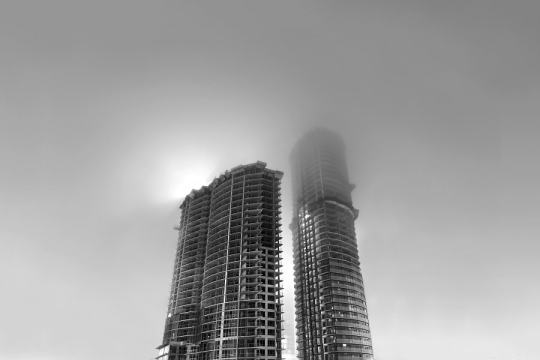
    Photograph Condos in Fog by Richard Gottardo on 500px

    Condos in Fog by Richard Gottardo on 500px

    Earlier today I attended a lunch and learn talking about the renewed interest in rental apartment development here in Toronto. Since this is a topic I’ve written about a few times here on Architect This City, I thought I would summarize some of my key takeaways from the panel discussion:

    • Market fundamentals are strong for purpose-built rental apartments. Vacancy is very low and demand will likely outstrip supply for many decades to come given the barriers to building (land availability, planning/approvals, and so on).
    • As of September 2014, CMHC reported 2,212 purpose-built rental units under construction in the Toronto region. And yet the annual demand for new rental housing is likely somewhere between 10,000 to 30,000 units (clearly some of this demand is being absorbed by condo rentals – the secondary rental market).
    • Millennials and retirees are seen as core markets for new rental apartments. Millennials want to live in urban centers and they like the flexibility that renting provides. Retirees want to know that they won’t be asked to move out because the owner wants to sell their condo unit.
    • It’s almost impossible to compete against condo developers when it comes to buying land (despite the next point). They (condo developers) will pay more. Therefore intensifying our “tower in a park” building stock is going to be a critical component of meeting rental demand in the region.
    • Part of what’s driving this interest in purpose-built rental (on the part of developers) is a softening condo market. So don’t be surprised when some developers flip back to condos when it makes financial sense to do so.

    It was interesting to hear this last point. It’s something that has been on my mind, but for whatever reason wasn’t really being talked about by the industry. That’s not to say that I think the condo market is in trouble though. It has just become more balanced. And ultimately that’s probably a good thing.

    Either way, I think that more rental and more housing options are a positive for the city and for consumers.

  • Condo or rental apartment — does it matter?

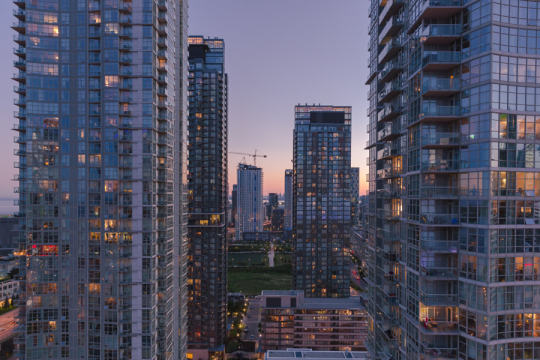
    Photograph Community by Evgeny Tchebotarev on 500px

    Community by Evgeny Tchebotarev on 500px

    Toronto is the condo capital of North America. For a number of years now, there have been more condos under construction in this city compared to any other in North America, including New York.

    But recently the real estate community has become incredibly interested in building multi-family apartments (also known as purpose-built rental buildings). Which is why about 7 months ago I wrote a post called, Rise of rental.

    It has been decades since Toronto built rental apartment buildings at any sort of scale. That means that our existing stock is generally pretty old and that condominiums – rented out by individual investors – have been almost exclusively fulfilling the need for rental apartments in this city.

    But given that purpose-built rental apartments are on the rise, I’ve been thinking a lot lately about them and about the consumer perspective. 

    And so here’s my question to you:

    If you were looking for a place to rent, would it make a difference whether it was a condominium (rented out by an individual investor) or whether it was a professionally managed apartment building? You can assume that the suite itself is identical.

    There are obviously many differences between both forms of tenure, but I’m curious to what extent that factors into the decision making process for consumers. It hasn’t really been an option in recent years, but that seems destined to change.

    I hope we can have a discussion in the comment section below.