Daily insights for city builders, delivered every morning at 6 AM ET. I’m Brandon Donnelly — a Toronto-based real estate developer and founder of Globizen. I’ve been writing here since 2013.
The Greater Toronto and Hamilton Area is expected to see 6,821 new rental homes completed this year. This is a “multi-decade high”, according to Urbanation’s latest rental report. Indeed, you need to go back to the 1970s to get rental supply figures of this magnitude.
A big part of this has to do with the fact that we are now taxing rental housing less. Toward the end of last year, the federal government removed their portion of the HST on new rental housing and, then in November, the province of Ontario followed with theirs.
But there’s another reason that many developers are now looking to purpose-built rentals: fewer people are buying new condominiums. And if you can’t presell condos, well then you’re going to need to find another path forward for your land.
However, flipping over to rental is not necessarily a panacea. The margins are generally razor thin (+/- 50 bps). It requires more and different capital (typically). And you need to believe in some fairly non-consensus assumptions (high rent growth, low cap rates, etc.).
It’ll be interesting to see how many developers are able to successfully flip over to rental and how sustained this rental supply number will be.
This morning I toured 1151 Queen East (here in Toronto). It is a new 47-suite apartment building that is being developed by Hullmark and that was designed by Superkül (the same architects as Junction House). It’s not quite finished yet, but it is looking terrific. The interiors feel, to me, like Berlin meets classic Miami Beach (if you can picture whatever this means). So a big congrats to the entire team. I’m sure it will be well-loved once people start moving in this year.
At the same time, it’s hard not to see small and beautiful infill projects like this and wonder, “why do we make it so difficult to build this kind of new housing? This is a 6-storey rental building that, according to Urban Toronto, was first proposed in 2018. It then had to go through the typical rezoning process, which, in this case, seems to have taken two years. Now we’re in 2024. Uh, why?
We should be looking at this kind of infill housing and saying, “Yes! You should go ahead and build this right now. Let us help you with that.” Instead, we erect barriers, which only force developers toward ever larger projects. If you’re going to spend two years in rezoning, no matter the scale of the development, why not build 470 homes instead of 47? And this has only been exacerbated with higher interest rates, because now time costs you that much more.
I say all of this because this is an objectively great infill project. Our city would be a better place with a lot more of these.
“Your local self-inflicted housing criss ouroboros” tweeted this chart out over the weekend, showing the number of new rental suites completed in Toronto since 1900. The data is from Open Data Toronto and it does not include any condominiums. It also only includes apartment buildings with 10 or more suites (which would be most of the supply anyway).
Housing became rightly viewed as a basic human right. But because of this, the policy landscape shifted away from facilitating the private sector, to intervening and regulating the private sector. This included tax changes which negatively impacted new housing development and, yes, rent controls.
Ironically, but not unexpectedly, this dramatically lowered the overall supply of new rental housing. To the point where we had effectively shut off the taps by the late 1990s. Thankfully, the condominium sector stepped in and started meaningfully delivering new housing — both for sale and for rent (via individual private investors).
The supply of new condominiums in Toronto is not shown above, but there is no question that this (shadow rentals) has formed the vast majority of our new rental stock over the last two decades. But in my view, this shift was largely the result of policy decisions. We decided that we didn’t want the private sector building so many new purpose-built rentals, and so we told them to stop.
This afternoon a few people from our team toured two of Fitzrovia’s recently completed rental apartment buildings here in Toronto. For those of you who may not be familiar, Fitzrovia is a relatively young company, but they have quickly become one if not the most active rental developers in the city. They are also ushering in an approach to purpose-built rentals that is more common in the US, but that is still fairly nascent in Canada. Part of this has to do with the fact that Canada took a few decades off from building rental apartments and instead focused on condominiums.
One of the first things you’ll notice is that they have programmed all of our lobbies with a coffee shop and bar called No. 10 Dean. This is their own brand. They operate it. And it serves as both an amenity for residents, as well as a cafe for the general public. This really helps to animate their lobbies, particularly at The Waverley, which is situated next to the University of Toronto and feels more like a co-working space in a cool boutique hotel than the lobby of an apartment building. I like this idea a lot. But it’s also an idea that is a lot easier to execute in an apartment building than in a condominium building.
Some of their other usual amenities include a rooftop pool (called LIDO), a gym (called The Temple), a signature amenity terrace (called STOA — which I’m assuming is a Greek architectural reference), and a pet spa (called Beauty for the Beast). When we went through this afternoon it was raining pretty heavily, but the pool was so great that I still felt a deep urge to pose and take multiple selfies. That’s how you know it’s doing what it’s supposed to. But perhaps more importantly, these amenities are all consistent brand offerings. Go into any Fitzrovia building and you’ll find a LIDO (pictured below).
Generally speaking, real estate companies usually aren’t as good at driving their brands in the same way as other consumer-facing companies. So it’s great to see this kind of design-forward and consistent brand offering being developed here in Toronto. Thanks for the tour and for hosting our team, guys.
The Greater Toronto Area builds a lot more condominiums than purpose-built rental units. This isn’t the case everywhere though. I was recently reading an article about Salt Lake City and how developers there don’t want to build condominiums. It’s mostly rental housing. There’s simply too much risk and liability with condominiums. I guess this is one of the reasons why real estate is often said to be a local business.
In any event, because of this dynamic in Toronto, condominium rentals are often used to measure the health of the overall rental market. There are simply more recent comparables to point to when you’re trying to figure out what is “market.” The Toronto Regional Real Estate Board recently published its Q2-2021 rental market report and here is what they found when it comes to condominium apartment rental transactions in the Greater Toronto Area:
Q2-2021 – 14,920 transactions
Q1-2021 – 13,168 transactions
Q2-2020 – 7,300 transactions
What this report tells us is that rental demand is returning. Transactions and rents are up compared to the first quarter of this year and certainly compared to Q2 of last year (2020), which was the low point of this pandemic. We are not yet back to where we were in Q1-2020 when the city was firing on all cylinders, but I have no doubt that we will get there and ultimately surpass those figures.
Condo developers are merchant builders. They build a project and then move on. Because of this, there’s a belief that there’s little incentive to build for durability, in comparison to say purpose-built rental buildings where the developer might continue to own over an extended period of time. While it is true that putting on an operations hat will make you hyper-focused on everything from garbage collection to how you’re going to manage all of your suite keys, there are a few things to consider in this debate.
One, as developers we certainly think and care a lot about our brand and our reputation, both with our customers and with Tarion (warranty program). We ask ourselves: “What will our customers think if we do this?” Irrespective of the tenure we’re building, we want our projects to be carefully considered. And in the case of condominium projects, we would like our customers to feel excited and comfortable about buying in one of our future projects. That’s the goal. This is no different than any other product that you might buy that doesn’t come along with some sort of ongoing subscription.
Two, there’s often a spread between condominium and rental values. For example, let’s consider a brand new 550 square foot condominium in a central neighborhood of Toronto and let’s say it would cost you $1,300 psf to buy it today. (Obviously it could be more or it could be less depending on the area and the building.) Now let’s start with a rent and back into a value, using some basic assumptions.
Unit Size (SF)
550
Monthly Rent
$2,400
Rent PSF – Monthly
$4.36
Rent PSF – Annual
$52.36
NOI Margin
72%
NOI
$37.70
Exit Cap
3.75%
Value PSF
$1,005
Here I’m assuming that same suite would rent for $2,400 per month. I’m converting that to an annual PSF rent. And then I’m assuming that if you were managing a whole building of these kinds of units, your operating costs might be somewhere around 28%. Crude back-of-the-napkin math to get to a Net Operating Income (psf). Finally, I’m capping this NOI at 3.75%. We can debate my assumptions and if this were in a development pro forma you might “trend” the rents. But I find this comparison helpful. Here we are getting to a value of around $1,005 per square foot. Less than our $1,300 psf above.
The point is that the margins are tighter, which helps to explain why for a long time we saw very few purpose-built rentals being constructed in this city. So even though you might argue that the incentives are in place to build for durability, you do have to weigh that against the realities of what you can actually afford to build. Development is filled with all sorts of these tradeoffs. But if you and/or your investors really want a consistent yield, this strategy can work just fine. Personally, I’m a fan of the long-term approach.
Three, rent control policies can have an impact both on the feasibility of new projects and on people’s ability to actually perform maintenance. If you have a scenario where your operating costs — everything from taxes to utilities — are rising faster than your allowable rent increases, then you’re in a bad situation and you have zero incentive or financial ability to actually invest in the building, despite being a long-term owner.
Finally, there is nothing stopping a purpose-built rental developer from also being a merchant builder. i.e. Selling the entire rental building once it is done and it has been stabilized. So you could argue that we’re right back at my first point. Whether you’re selling to individual condominium owners or the entire building to one entity, you as the developer have to sit back and ask yourself: “What will our customer(s) think if we do this?”
New rental housing measures were approved by Vancouver City Council this week. I haven’t gone through the policies in the detail (you can do that here), but they aim to increase rental housing supply by doing things such as “pre-zoning” for 6-storeys on main streets and by allowing rental apartments to be built on some side streets (up to 150m away from arterial roads).
Enabling new rental housing in all neighbourhoods would support an increase in supply and choice. The incentive programs have concentrated secured market rental development in selected neighbourhoods and along arterial streets. This has been effective at creating larger multi-unit projects, but has created an inequitable environment, where renters have limited housing choice. Expanding program coverage into low density areas, areas zoned for single detached housing and non-arterial locations to allow for a greater mix of structure types and densities (e.g. townhouses, small apartment buildings) are important considerations moving forward.
It is yet another data point for what I wrote about here — the loosening of single-family zoning. Turns out, it can be difficult to meet the demand for new housing when you set aside a large part — or most — of your land for low-rise single-family homes. And there seems to be growing acknowledgement of that on the part of cities.
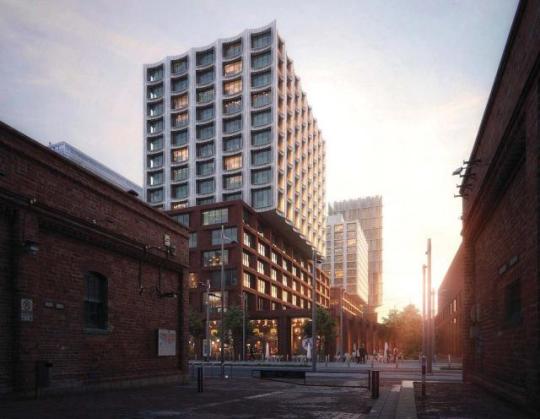
I really like what has been put forward for Block 8 in the newly developing West Don Lands neighborhood of Toronto. Here is a rendering looking east from the Distillery District toward the proposed westernmost tower:
It feels like an extension of the Distillery District, which was clearly the intent. The materiality also reminds me of Junction House. Red brick at the base to fit within its context, and a more modern material palette on the upper floors.
I also like how, in this instance, the building steps out on its south side, as opposed to in. It’s something different. Not every building has to look like a wedding cake, right?
The architecture is by COBE Architects and architectsAlliance. The developers are Dream, Kilmer Group, and Tricon. And the plan is for 756 rental apartments, of which 225 will be affordable and integrated throughout the 3 towers.
The NY Times reported this week that, as the ultra luxury real estate market in New York City continues to cool, developers appear to be making two kinds of product adjustments: (1) they are converting the penthouses and rooftops of their buildings from premium residential space into amenity spaces for the broader building and (2) they are shrinking unit sizes to help with overall sales and leasing velocity.
According to the New York Times, condo prices on Billionaires’ Row in midtown are down 20-40% since the peak of the market in 2014 when this record was set. So developers are responding with more studios and 1 bedrooms, and amenity spaces – many of which now include high end restaurants also open to the public – that ensure no other building has something you don’t have.
However, there are naturally some differences between condo and rental buildings. Since 2016, 35% of rentals projects in the city have had some sort of penthouse amenity, whereas the number is only 13% for condo buildings. This makes sense given that amenities are such a big driver of leasing. You definitely want your amenities ready for when your leasing office opens.
What product changes, if any, are you seeing in your market right now?
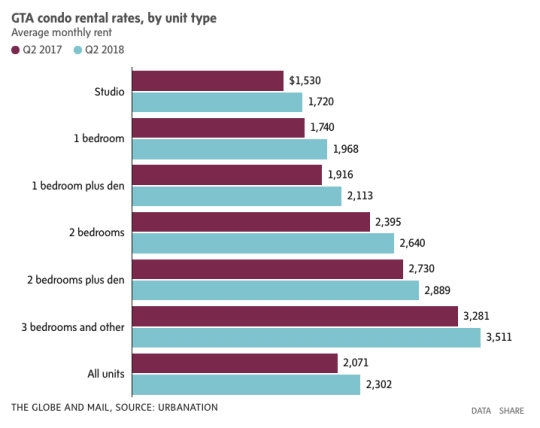
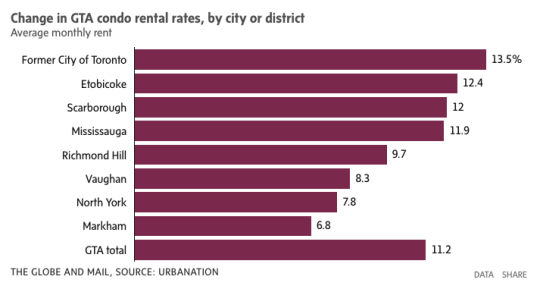
Yesterday Urbanation released its Q2-2018 rental report for the Greater Toronto Area. It tracks both purpose-built rentals and condominium rentals, the latter being condominium units that are listed for rent on MLS. The average condo rent, for all unit types across the GTA, is up 11.2% year-over-year to a face rent of $2,302 per month.
The former City of Toronto, which includes downtown, is actually up 13.5%:
But here are the stats that I really wanted to draw your attention to today (figures from the Globe).
According to Urbanation, there were some 384,000 condo apartments in the Greater Toronto Area in 2017 and nearly 1/3 of them were rented out. Given that the Canada Mortgage and Housing Corporation pegs the total number of rental apartments in the GTA at approximately 311,596, condo apartments represent about 40% of all our rental housing stock.
So condo buildings are actually doing quite a bit of heavy lifting when it comes to providing rental housing in this region.