
Daily insights for city builders, delivered every morning at 6 AM ET. I’m Brandon Donnelly — a Toronto-based real estate developer and founder of Globizen. I’ve been writing here since 2013.

Tag: public spaces

  • Laneway summit post-mortem

    image

    Last night was The Laneway Project’s inaugural summit here in Toronto. And I think it was a huge success. This is what the crowd looked like (don’t forget to check the upstairs balcony area):

    //platform.twitter.com/widgets.js

    Over 350 people showed up to fill The Great Hall at Queen West and Dovercourt. It was absolutely incredible. To be honest, I initially thought that it would end up as a small group of city geeks. I mean, it was a summit to effectively talk about back alleys.

    But it turns out that there are a ton of people in this city who are passionate about rethinking our urban fabric and finding new uses for these underutilized public spaces. And that’s both really encouraging and exciting. Many thanks to everyone who came out!

    The Laneway Project team did an incredible job spreading awareness and, given the success of this initial summit, I can only imagine where this initiative will end up in the future. So a big congratulations to Mackenzie Keast, Ariana Cancelli, and Michelle Senayah for making this happen.

    I’m not sure if the event was filmed or not, but hopefully it was and it’ll be made available online. But in the event that it wasn’t, I did want to share one question that the panel got during the Q&A session after our presentations.

    The comment made was basically that Toronto will never be Sydney, Melbourne, or Seattle when it comes to our laneways. They have a temperate climate and we don’t. So while it’s nice to show great pictures of their laneways, it’s just not going to happen here.

    And that really pissed me off.

    So I responded by saying that I disagree. Saying that we’ll never be Sydney or Seattle is capitulating. There are many months of the year where it’s beautiful outside in Toronto, so just because we have a winter doesn’t mean we should throw our hands up in the air and give up.

    I then went on to argue that the fact that we have a “shorter season” should be all the more reason that we need fantastic outdoor and public spaces. For the months of the year where it’s beautiful outside, we should be maximizing our enjoyment!

    I hope many of you agree as well. Happy Friday all 🙂
  • The first summit on laneways

    image

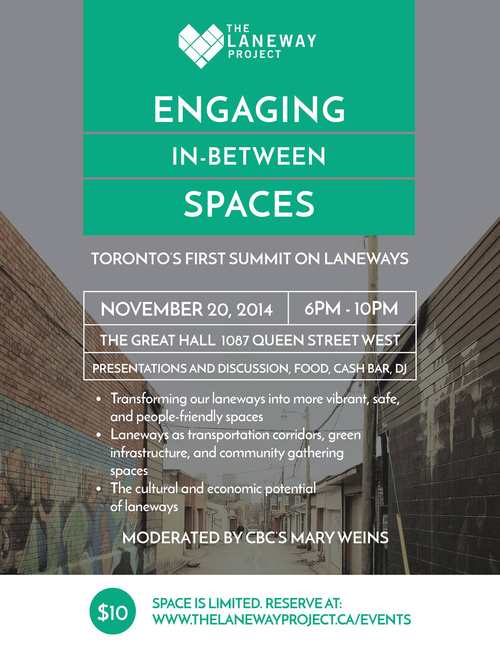
    Last month I wrote about an upcoming city building event in Toronto called called Engaging In-Between Spaces. It’s being hosted by a non-profit group called The Laneway Project and it’s going to be this city’s “first summit on laneways.”

    While many people associate the potential of Toronto’s laneways with laneway housing, the focus of this event will be on laneways in a much broader context. Laneway housing will certainly be a part of it, but the event will also look at our laneways as public spaces, gathering spaces, and so on.

    I’m going to be giving a short presentation that looks at Toronto’s laneways from a real estate development perspective, and so I hope that you’ll be able to attend. The event is only $10 and the money will help support the group’s mission of transforming our laneways into vibrant, safe, and people-friendly spaces. 

    Click here to reserve your spot. And if you are attending, please tweet me so that we can connect at the event!

  • Q&A on reimagining public spaces

    I received an email from an ATC reader yesterday who is working on a publication about reimagining public spaces in Toronto. She sent me a few questions and specifically wanted to talk about the Yonge Redux project, which I wrote about a month ago. After I responded to her questions, I figured I should just share them publicly. So here they are:

    How would citizens from different age groups benefit from the Yonge Redux project?

    I would bet you that this stretch of Yonge Street experiences more pedestrian traffic than it does car traffic. And yet we’ve allocated space in the opposite direction: cars have more space than pedestrians do. So what this project is really about is reallocating the street, or public right-of-way, so that the dominant uses are actually prioritized through urban design. It doesn’t need to be more complicated than that. Ultimately, this will benefit people both young and old.

    Do you know what kind of professionals are needed to complete a project like this?

    You’d need an architect/designer – one who is awesome at landscape/urban design work. gh3 here in the city comes to mind as a firm I like, if you want an example. You’d need a bunch of engineers to deal with stormwater management and other infrastructure items. You’d likely need a transportation/traffic consultant to assess traffic flows in the area and prove that this project won’t cause the entire city to come to a grinding halt (it won’t). You would need someone to manage the day-to-day of the entire project. And this is just naming a few of the professionals/consultants that you’d probably end up needing.

    You’d also have to work closely with the city, the local councillor, and the local community. It’s inevitable that some of the businesses will worry about the loss of potential customers – so that would need to be worked through.

    What are some areas in Toronto that, in your opinion, need reimagining in the next few years?

    My feeling is that Toronto is still at the early stages of this shift towards better public spaces and a better public realm. But in many ways, projects like Yonge Redux are much easier sells compared to the other areas that could use a face lift. Yonge Street is already urban and pedestrian friendly. The real challenge is going to be dealing with the areas outside of the core – most of which, frankly, aren’t that welcoming to pedestrians and aren’t all that urban. What do we do with those? And do the local communities even want them transformed? They’re going to be much harder to reimagine (though I’m not saying we won’t be able to do it).

    Where do you see the future of Toronto’s public spaces in the next 50 years?

    All signs point to a more dense, more urban, and more transit-oriented city. With that shift, we’re going to increasingly realize the importance of incredible public spaces. So if we continue down this path, I reckon our public spaces will only get better. I’m optimistic about the future.

    How would you personally approach a project like this?

    My understanding is that this project has legs. It just has to work through the city bureaucracy at this point. Jennifer Keesmaat supports it.

  • The Human Scale

    Earlier today I stumbled upon a documentary called “The Human Scale.”  I haven’t watched it yet, but I’m planning to rent it from iTunes later this weekend. Here’s the trailer. Click here if you can’t see it below.

    [youtube https://www.youtube.com/watch?v=5CyLNS_ljHw]

    One of the things that’s so fascinating about studying cities right now, is that it feels as if we’re at a major turning point with respect to how we think about them. We’re coming off a long period (decades) of infatuation with the car, where planners and engineers predominately cared about one thing and one thing only: efficiently moving cars in and around cities.

    But having now fully built out cities around the car, we’ve come to realize two important things. First, that it’s virtually impossible to keep up with the demands of the car. No matter how many highways and roads you build, there always seems to be gridlock. And second, by focusing so closely on the car, we’ve built cities that aren’t great places for people.

    If you take a look at this short clip from The Human Scale (featuring Siena, Italy), I think you’ll immediately see how differently we used to build our cities and how disruptive the car has been to them. 

  • How inclusive are your public spaces?

    I subscribe to a blog called Cities for People. It’s the blog of Gehl Architects out of Copenhagen and their focus–both the blog and the firm—is on how the built environment affects people’s quality of life. They call themselves Urban Quality Consultants.

    This morning, they wrote a post on gender mainstreaming in public spaces, which, I’m told, is top of mind in cities such as Copenhagen and Vienna.

    The key insight was that, for a variety of reasons, men and boys seemed to be engaging with public spaces more than women and girls. For example, they found that boys were generally more assertive than girls and so, if there was a toss up between who was going to use a space, the boys would usually win out. As a result, there’s been a lot of debate around creating more inclusive public spaces, both from a design standpoint and a policy standpoint.

    Interestingly enough, this is a debate that doesn’t seem to be happening here in Toronto. And I wonder if it’s because we don’t have the same problems (or I’m just oblivious) or if it’s because we don’t care enough about public spaces to do gender mapping exercises.

  • Can the creation of urban destinations transform or hinder a city’s development?

    I was recently asked by a Canadian architecture website called sixty7 Architecture Road to respond to the following: Can the creation of urban destinations transform or hinder a city’s development? It was for a regular Q+A series they do on their website. Here is my response (I was specifically asked about Dundas Square):

    The best line I’ve ever heard about public spaces and urban destinations was from Bruce Kuwabara of KPMB Architects. He said that the outside of buildings need to be thought of as the inside walls of the public realm. And I think that’s a really great way of framing this discussion. We often think of buildings inwardly and as self contained objects, but by virtue of their existence we’re creating and framing many other spaces.

    With that in mind, I absolutely believe that beautiful and well designed urban destinations–whether public or private–can transform a city and its development patterns. A perfect, but perhaps overused, example of this is the High Line in New York. Not only has it become a destination (“Have you been to the High Line yet?”), it has become an unbelievable city building catalyst. All of a sudden development is happening in, on and around the High Line, where as before developers would have tried to completely ignore it. And so today, the High Line, as an urban destination, is almost being continually reinvented by new development.

    To talk specifically about Toronto, I think that downtown needed a “public” space like Dundas Square. The design could have been less unidirectional (towards the Eaton Centre) and the building to the north is repulsive, but it provided a forum along Toronto’s main street in the heart of downtown. I also believe that good urban destinations give areas a sense of identity, which is why I’m somewhat bothered by the loss of the square at Yonge & Eglinton. Sure it was bad, but we could have made it better. It is the heart of midtown in my mind.

    So not only do urban destinations have the ability to transform, I would argue that they are essential to any great global city. Whether it’s the High Line in New York, the Spanish Steps in Rome, the old Love Park in Philadelphia, or Trafalgar Square in London, these spaces are integral to those city’s brands and identities. What do ours say about Toronto?

    For the full Q+A, click here.