
Daily insights for city builders, delivered every morning at 6 AM ET. I’m Brandon Donnelly — a Toronto-based real estate developer and founder of Globizen. I’ve been writing here since 2013.

Tag: public housing

  • An overview of rental housing in France

    Rental housing in France is both heavily regulated and supported through dedicated public funds. Here’s a high-level overview of what that means (via this 2021 Brookings case study by Arthur Acolin):

    • Homeownership rates in France went from 35% in 1954 to 56% in 2001
    • As of 2018, 58% of French households own, 40% rent, and the remaining 2% supposedly get free housing from either their employer or a family member
    • Not surprisingly, younger households are most likely to rent (the figure is > 60% for people aged 18-29)
    • Household size seems to play a major factor in how likely people are to live in public housing
    • France has some 4.5 million public housing units and 17% of all households live in them (which represents about 43% of all renter households)
    • Within the unsubsidized rental market, 93.5% of households live in homes owned by individual investors (this is as of 2013) and only about 3.5% live in homes owned by institutional investors
    • This is pretty typical of Europe, where multi-family isn’t an established real estate asset class like it is in North America; so for those of you who like to hate on individual condo investors, check out France
    • In the decade between 2010 and 2020, 28 metro regions in France adopted some form of rent control and, in a few markets, like Paris and Lille, there are also maximum rents that can be charged for specific housing types

    If you’re interested in rental housing, Brookings also has articles covering the US, Germany, Spain, Japan, and the UK. They can be found here.
  • Hong Kong is building new “light public housing” — why?

    We have spoken before about how the average wait time for public housing in Hong Kong is now over 6 years. This is a problem for the quarter million people who are on this list, and so the city has decided to start building modular housing as a kind of stopgap:

    The city has embarked on a $3.3 billion plan to build about 30,000 temporary apartments over the next five years, which Housing Secretary Winnie Ho has said is a “very important social project.” The aim of the program is to give people an option to move out of cramped quarters while waiting for public housing. Critics say it only shows the government’s inability to deliver enough permanent homes.

    I think many would agree that “light public housing”, which is what this is being called, is probably better than no public housing. But is this really the most effective move? According to some sources, this light varietal may actually cost more to build than their typical public housing.

    So why even bother? Is it just speed? I’m not sure.

    Also, it is interesting to note that even in a city as dense, built out, and in need of housing as Hong Kong, finding support for new development can be a challenge:

    “We understand that Hong Kong needs land to build public housing for people in need, so we never objected until this time,” said Andy Ng, an accountant who bought an apartment in the Upper RiverBank project early last year. The government is squeezing thousands of people on a single plot of land without planning or consultation, he added. “The district simply can’t stomach so many people.”

  • Why housing is so expensive

    A friend of mine sent me the above podcast episode this morning (click here if you can’t see it embedded above). I’ve only listened to a bit of it, but I plan to finish it up over the long weekend. Here are the topics it covers:

    We discuss why the states with the highest homelessness rates are all governed by Democrats, the roots of America’s homelessness crisis, why economists believe the U.S. gross domestic product could be over a third — a third! — higher today if American cities had built more housing, why it’s so hard to build housing where it’s needed most, the actual (and often misunderstood) causes of gentrification, why public housing has such a bad reputation in the U.S.; how progressives’ commitment to local democracy and community voice surprisingly lies at the heart of America’s housing crises, why homeownership is still the primary vehicle of wealth accumulation in America (and the toxic impact that has on our politics), what the U.S. can learn from the housing policies of countries like Germany and France, what it would take to build a better politics of housing and much more.

  • Pre-fall fashion and Le Corbusier in Firminy-Vert

    I’m not exactly sure what a “pre-fall” menswear collection is all about. But Louis Vuitton recently honored the late and great fashion designer Virgil Abloh by photographing one of them in and around Le Corbusier’s Firminy-Vert complex about an hour outside of Lyon, France.

    Abloh was apparently a huge fan of the work of architect Le Corbusier. And he tried to apply the same kind of utilitarian approach to fashion as Le Corbusier had done to cities, buildings, and housing.

    The Firminy-Vert complex is a series of buildings, one of which is the last of his “Housing Unit” designs (1965). Le Corbusier designed and built a number of these, with the most well known one being in the south of France in Marseille (1952).

    They were a utopian model for high-density housing, with “streets” instead of corridors and with schools and other social functions being housed high up and inside the building. They were intended to act as a kind of vertical city.

    To the untrained eye, they might resemble the kind of public housing that today goes unloved in many cities throughout the world. But for whatever reason, these particular renditions have largely stood the test of time.

    Maybe it’s because of their importance to the development of modernist architecture, or maybe it’s because most of them (if not all of them) are now UNESCO World Heritages sites.

    My take is that it shows you that architecture and built form alone can’t solve every problem. The same building in different places and different contexts, can and will perform very differently. In this particular case, in Firminy-Vert, the complex seems to be doing rather well. The perfect backdrop for a luxury pre-fall fashion collection.

  • The Sails of Scampia

    Italian techno DJ Deborah De Luca recently released this live set with Mixmag. Naturally she was playing by herself on a rooftop. Even if you don’t like techno, you may find this set interesting because of its setting. It was filmed in Vele di Scampia, which is a housing complex in northern Naples and the suburb where she grew up. But Vele is also one of the most notorious public housing projects in Italy and the world — known for its decaying brutalist architecture, its drugs and crime, and its role in housing the Camorra crime syndicate.

    Built between 1962 and 1975, the “Sails of Scampia” were designed by Italian architect Franz Di Salvo and inspired by the work and thinking of architect Le Corbusier. Obviously this is a recipe that has been tried out all over the world and the results here are not entirely unique (see also Pruitt-Igoe). The complex was based on two building types: towers and tents. The towers are what you might imagine and the tents are what create the “sails” that today define the complex.

    The apartments were designed to be simple. But the idea was to connect them with elaborate exterior common spaces that simulate, in a way, the many alleys and courtyards of Naples. (Does this sound like a co-living project?) There are many possible explanations for what went wrong. Perhaps the best place to look for answers is the book Gomorrah written by Robert Saviano.

    But what I always wonder is to what extent was the architecture and the approach to urban design responsible for these outcomes? In other words, how much of this is a result of built form and how much of this is a result of socioeconomic factors, such as poor management, high unemployment, and a lack of policing in the area? According to Wikipedia, Scampia had an unemployment rate of about 50% as of 2004.

    Le Vele initially consisted of seven buildings, but four of them have already been demolished. In the next few years two more will come down, leaving only one. Supposedly the plan is to keep this last building and refurbish it so that the history of Le Vele isn’t lost entirely. Some, including Robert Saviano, are questioning why the state would ever want to commemorate such a horrible place. But if it is repositioned and if it proves to be successful, it may actually help to answer some of my questions.

    In the meantime, we’ll just have to enjoy Deborah’s set.

  • DANCHI DREAMS

    Below is an interesting Kickstarter project by photographer and art director Cody Ellingham. I think many of you will appreciate it. It is a photobook of Japanese public housing apartments, which are known as Danchi. All of the photos were taken by Cory at night, hence the dream part. The book is about the promise that these projects represented in the post-war years, but it is also about their decline in the subsequent decades.

    https://www.kickstarter.com/projects/cbje/danchi-dreams-a-photobook-of-japanese-public-housi/widget/video.html

  • Spaces between buildings

    Doug Saunders recently published a great piece in the Globe and Mail about the “the dead spaces between buildings” and the architectural revolution that is taking place from Mexico City to Toronto to solve this underappreciated problem.

    The example in Mexico City is that of the San Pablo Xalpa public housing complex where architect Rozana Montiel transformed the underutilized spaces between the apartment buildings into vibrant “common-unity” spaces. 

    This meant removing 95% of the fences and gates that had previously been erected as safeguard against the unsavory people and acts that were taking place in these open spaces.

    The underlying goal was to try and address the socioeconomic decline that had taken root in Mexico’s public housing complexes. And there was a sense that part of the problem was simply their physical design.

    Of course, this is partially about trying to correct the failures of post-war planning. But I think this conversation around the “spaces between buildings” shouldn’t just be a corrective one. It can be broader than that.

  • The day modern architecture died

    image

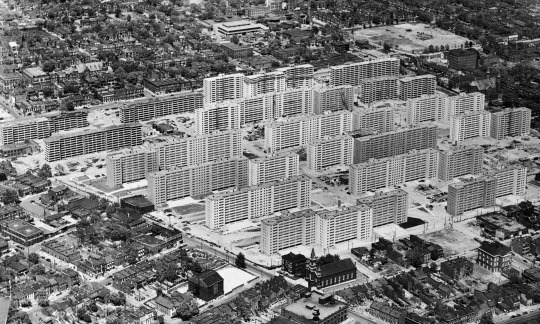
    In 1956, a large 57 acre urban renewal project was completed in St. Louis. It consisted of 33 apartment buildings, each 11 storeys tall. The entire complex was known as Pruitt-Igoe.

    Early residents seemed to really like the buildings. The first tenant, Frankie Mae Raglin, called it the “nicest place she’d ever had.” 

    But 16 years later in 1972, the first 3 buildings within Pruitt-Igoe were demolished. And in 1977, architectural historian Charles Jencks proclaimed that the day Pruitt-Igoe was demolished was the day that modern architecture had officially died.

    The modernist dream had failed. Architecture had failed us. Segregated “towers in a park” was not the way to socially engineer away poverty and slums from our cities. 

    This is the narrative that we have told ourselves, not only in St. Louis, but in cities all around the world.

    But was it really all architecture’s fault?

    Stuyvesant Town in New York (80 acres) shares many of the same architectural ideals that Pruitt-Igoe embodied and it seems to be holding up just fine. The same could be said for Lafayette Park in Detroit (46 acres), which is probably more telling given what the city witnessed in the years following 1956 – the year Lafayette Park was completed.

    So the reality is far more complex.

    Between 1950 and 1970, St. Louis lost about 30% of its population. Coming on the end, Pruitt-Igoe had a vacancy rate of 88%. Racial tensions were also surging. Here’s how the American Institute of Architects put it back in 2012:

    Pruitt-Igoe was built during a tumultuous time in U.S. race relations in a city with an intense history of racial segregation. Pruitt and Igoe were designed as separate, racially segregated projects: Pruitt for African-American residents, Igoe for whites. As the towers were going up, the Supreme Court’s Brown v. Board of Education decision banned segregation. Faced with the possibility of living next to African-American neighbors in an integrated Pruitt-Igoe, white residents moved out en masse, exacerbating Pruitt-Igoe’s vacancy problems.

    So while most cities rightfully would’t dare build in the spirit of Pruitt-Igoe today, this was not a strictly architectural problem. There is always an underlying social, political, and economic environment. And unfortunately architecture, alone, cannot solve everything. 

    If you’re interested in this topic, I recommend you check out a paper by Katharine G. Bristol called, The Pruitt-Igoe Myth.

    Image by Bettmann/Corbis via The Guardian

  • 50% of apartments in New York are under a form of rent control

    A friend of mine who lives in New York recently sent me this interesting article: “The Perverse Effects of Rent Regulation.” And he sent it to me, because he wanted me to take note of this stat:

    There are, effectively, two rental markets in Manhattan. Roughly half the apartments are under rent regulation, public housing or some other government program. That leaves everyone else to compete for the half with rents determined by the market.

    50% is a big number. I would never have guessed that the New York rental market would be split in such a way. But it is split because it’s fairly clear what would happen if it weren’t: 

    “Poor people would be priced out of Manhattan,” he says. “Period.”

    This, as the article argues, could threaten the diversity that has made New York the economic and cultural hub that it is today. But at the same time, there are a number of important questions: Is 50% the right split? And are the control mechanisms in place the right kind of mechanisms? Should rent controls be attached to people as opposed to apartments, which is how it’s typically done today?

    Diversity is hugely important and there will always be a portion of any city’s population that cannot afford market rents. But intuitively, and I could be wrong, 50% seems high. It seems high because these types of rent regulations achieve the exact opposite for the balance of the market that has to pay market rents: their apartments become more expensive.

    I’ve been having a lot of discussions lately about affordable housing and rent control always comes up. I think that in a lot of cities there needs to be some sort of intervention in the market to keep them from becoming homogenous playgrounds for the rich. But I also believe that many policies–which may sound great in theory–can have unintended market consequences. These need to be seriously looked at.