Daily insights for city builders, delivered every morning at 6 AM ET. I’m Brandon Donnelly — a Toronto-based real estate developer and founder of Globizen. I’ve been writing here since 2013.
Metro Vancouver is proposing to increase DCCs by roughly $23,000 per new single-family home; $21,000 per new townhome; and $14,000 per new apartment.For example, fees for a townhouse in Vancouver will rise from $10,027 today to $30,861 by 2027.
In response to this, federal housing minister, Sean Fraser, has just pulled $138 million in funding that was intended to accelerate housing permits and new affordable housing projects in Surrey and Burnaby.
This makes some sense. Because it is pretty weird to say, “Hey, we need more affordable housing. Give us some money for this and, while you do that, we’re also going increase the cost of building new housing.”
Of course, this is the whole growth-should-pay-for-growth mantra. And supposedly, there’s growth-related infrastructure that needs to be built.
To be fair, Metro Vancouver is also proposing to increase its property taxes: 12% in the first year, 11% for the next two years, and then 5% for the next three years. So this is not all going onto new supply.
I don’t know enough about the finances of Metro Vancouver to comment on these numbers specifically, but I do think it’s important that policy makers understand what the current market environment means for new housing.
It is difficult, and in many cases impossible, to underwrite new housing projects today. Which means that even if all fees and charges were to remain unchanged, we are going to see a decrease in new housing supply.
For next year’s budget (2024), the City of Toronto is projecting a $1.5 – $1.7 billion budget shortfall. And over the next 10 years, this shortfall is expected to grow to nearly $47 billion if changes aren’t made. This is according to a recent report prepared by Ernst & Young and Strategy Corp. So right now, all of this is being looked at and debated by Council.
Where are we going to get this money?
One persistent debate is whether the city actually has a revenue problem, or whether it’s simply an expense/spending problem. I can’t say that I’ve scrutinized the city’s expenses at any length, so I’m not going to get into that level of detail today. For this post, I’d like to focus on two specific things. The first is property taxes.
Here is a figure, from the report, showing residential property tax rates across southern Ontario:
What you will see is that Toronto has the lowest rate of the 35 municipalities that they looked at. Now obviously there are some nuances to consider. The average home price in Toronto is higher than it is in, say, Sault St. Marie. Toronto also has a large commercial property tax base. But even still, historically speaking, Toronto has tended to increase its residential property taxes at or below the rate of inflation.
This is a problem. And it is the exact same problem that we have talked about on this blog in regards to residential rent controls. If you own an apartment building where the rents are capped and your expenses are, therefore, growing faster than your revenue, you are (1) highly incentivized not to invest in the apartment (you can’t afford to) and (2) eventually going to hit a financial wall.
Sound familiar? As far as I can tell, that is, at least partially, what is happening here.
Secondly, one of the first things that I did when I opened the report was run a search for “road tolls” and “congestion charges”. Regular readers of this blog will know that this is something I feel strongly about. Here’s what I found:
In 2017, when the City considered implementation of tolls for the Gardiner and the DVP, staff estimated that a $2-per-trip toll would generate $5.6 billion in 10 years. The province has refused several requests to consider these options, with the Minister of Transportation rejecting any discussion of uploading or tolling as recently as December 2022.
This is also a problem. One of the general rules with taxes is that you should ideally tax the things you want less of. Hmm. So why not tax traffic congestion? There is no question that it works. There’s lots of evidence from all around the world. We just lack the political will to actually do it. Instead, we pay lip service with solutions that don’t work.
At the same time, if we were to actually implement road pricing, I don’t believe that a flat toll is the way to go. $2 also seems low. The best practice is dynamic road pricing that fluctuates based on actual congestion levels. Meaning, if you’re driving at 5am, expect a low rate. And if you’re driving at 5pm, expect a high rate.
Virtually overnight, we know this would do at least three things: (1) it would reduce/eliminate traffic congestion (congestion levels would become a function of pricing); (2) it would reduce overall carbon emissions in the city; and (3) it would take a meaningful chunk out of this $47 billion budget shortfall.
A blog reader responded to yesterday’s post about rent controls (and inclusionary zoning) with an excellent point: If you’re against rent controls, then you must also be against artificially low property taxes for homeowners. And I would agree with this.
One of the points I was trying to make yesterday was that if you’re in a situation where your revenue is capped but your operating expenses are free to grow based on the market, then you are likely heading down an unsustainable financial path.
This is true if the revenue is in the form of rent and this is true if the revenue is in the form of property taxes. A good example of this is California’s Proposition 13, which is the principal thing that keeps property taxes artificially low over on that coast.
Similar to what I argued yesterday with rent controls, it too creates a misallocation of housing. If you’re sitting on historic and artificially low property taxes, then you are now highly incentivized to stay put where you are. Why would you move only to have your taxes mark to market?
So this line of thinking cuts both ways, whether we’re talking about renters or homeowners.
Deeply affordable housing is mostly infeasible to build.
This is why you don’t see the market naturally building this kind of housing on its own. It, for the most part, doesn’t make any economic sense to do so. So this is also why the US has fabricated things like low-income housing tax credits. They are a way to make up the economic shortfall that exists with low-income rental housing and get the private sector building this kind of housing.
We sometimes try to convince ourselves — or maybe it is a way of shirking responsibility — that there can be such a thing as no-cost affordable housing through things like inclusionary zoning. But I think we all know that there’s no such thing as a free lunch. Somebody is ultimately going to need to pay. The big question, of course, is who should that be?
By definition, we acknowledge that the people who will ultimately live in these affordable homes cannot afford to pay market rates. So by default, the subsidies will need come from somewhere else. But again, from where and from who? Should it be specific people who pay or should it be mostly everyone who pays?
If we return to the Toronto building industry’s favorite topic right now — development charges — you’ll see that under the current rates, every new 2 bedroom or larger apartment that is constructed must pay $3,727 toward affordable housing. Under the proposed rates, this will increase to $12,545 for every new large apartment. It’s by far the largest proposed percentage increase (237%) and also one of the largest service items.
This raises two interesting philosophical questions.
One, should the buyers of new housing be responsible for contributing to affordable housing in this way? Because what we are in effect saying to these people is, “Hey, you can afford to buy a new market rate home, so we’re going to collect some additional money from you — $12,545 to be exact — so that we can try and help those that aren’t in the same position as you. We’re also going to mandate additional affordable homes within your building and we’d like you to subsidize those too.” This is one way to redistribute wealth.
But if the goal is to try and create more broad-based affordability, an alternative approach might be, “Hey, you already own a home and it has gone up a lot in value, so we’re going to collect some additional money from you over time so that we can try and help those that aren’t in the same position as you.” This would be the property tax approach. It’s probably not perfect, but might it be a more fair and equitable way to redistribute wealth?
The second interesting philosophical question has to do with whether this is consistent with the dogma that growth should pay for growth. The idea behind development charges (also known as impact fees in some parts of the world) is that they should pay for the cost of new development. This makes complete sense. When you build new housing you certainly need some additional stuff — everything from additional school capacity to emergency services.
But the question here is whether the construction of new housing in and of itself creates a direct need for more affordable housing, and therefore should be charged for it. Asked in the opposite way, if you weren’t building this new housing, would you then no longer need this affordable housing, just like you no longer need that additional school capacity?
This is definitely not the case. In fact, I would argue that the opposite is true. If you don’t build any new housing in a growing city, you actually exacerbate the problem of affordability. So here’s a provocative thought. Rather than a charge, should this affordable housing line item actually be a credit towards each new project given that it benefits affordability?
While it may not make any economic sense to build affordable housing, I think that many of us would agree that it makes a lot of social sense to build affordable housing. We know that our cities are at their best when they are both diverse and inclusive. The problem is that we can’t agree on who should pay for it.
According to the WSJ, New York City is budgeting to collect $30.8 billion in property taxes for fiscal year 2021. These tax bills will go out on June 1 and payments will start becoming due on July 1, which is the start of the city’s fiscal year. Here’s how the collections break down across houses, apartments, and commercial properties:
Overall — and despite the fact that values have softened in the wake of COVID-19 — this year’s property tax budget represents a 5.7% increase over FY2020. The reason for this is that each year the city completes its annual assessments on January 5. And so according to the city’s January numbers, everything is just fine.
Supposedly this January 5 date is usually non-negotiable. A lawyer is quoted in the Journal article saying that under normal circumstances, if your house were to burn down on January 6, you would still have to pay all of your taxes for the upcoming fiscal year.
Time will tell if this time is different. But it is interesting, though not surprising, to note just how significant property taxes are to New York City’s overall tax collections. They represent a little more half of all taxes collected.
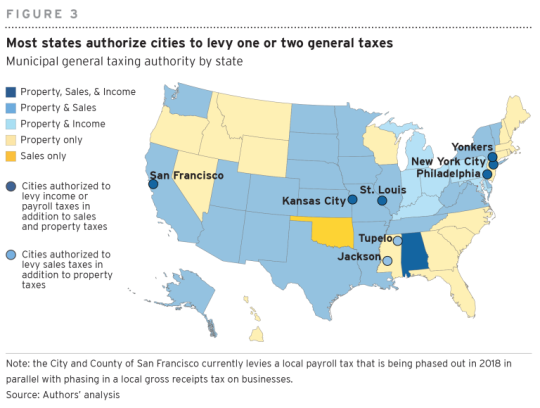
The below figure shows the taxing authority of US cities by state. In some cases there’s a city or two with additional taxing authority. New York City, for instance, has been authorized by the state to levy property, sales, and income taxes, whereas other cities in the state can only levy property and sales taxes.
The figure is from a recent report by Brookings called, City budgets in an era of increased uncertainty. In addition to revenue sources, the report also covers spending limits and tax structure alignment.
The report concludes that cities generally have a stronger fiscal position when their tax structure aligns with their economy. For example, cities such as Las Vegas that have lower than average property values and are only authorized to collect property taxes, do not score well.
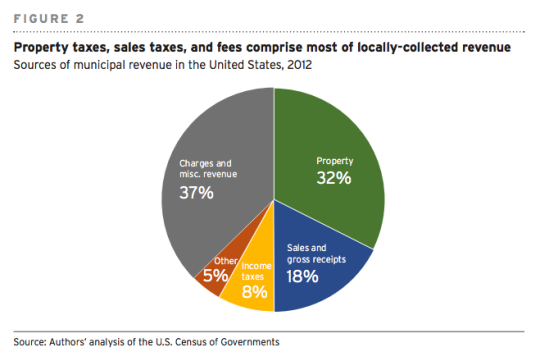
One thing that the above figure does not get across is that more money now comes in from non-tax revenues, user fees, and other charges. According to 2012 census data, 37% of all municipal revenue in the United States came from these sorts of charges.
Recently we’ve been talking about California’s Proposition 13 and how it may be creating a disincentive for longtime homeowners to move. They’re enjoying below market property taxes, and so they stay put, even if they may have too much house.
But this concept of “overhousing” isn’t unique to California. The Globe and Mail just ran a piece talking about how Toronto’s designated “Neighborhoods” are losing people as the nests empty out, seniors remain put, and the broader city booms.
The rate of depopulation that created the spare bedrooms in Toronto’s low-rise neighbourhoods is stark: “Since 2001, about 52 per cent of the land mass of Toronto has reduced in density of population by about 201,000 people,” Mr. Smetanin says. “Other parts of Toronto have grown by 492,000.”
The irony of this phenomenon is that the city’s Official Plan considers these Neighborhoods to be “physically stable”, as well as “one of the keys to Toronto’s success.” However, things are clearly changing behind that physical stability.
I am a big fan of Malcolm Gladwell, and not just because he’s Canadian and went to the University of Toronto (my alma mater), although those facts certainly don’t hurt.
I’m late to his podcast, Revisionist History, so in case some of you are as well, I would encourage you to check it out. Every episode reexamines something from the past and questions: Did we get it right the first time? It’s very Gladwell. It’s a must listen.
The golf episode will be of particular interest to many of you because it deals with real estate. Malcolm wades into something known as California Proposition 13, which is a constitutional exemption that keeps property taxes artificially low.
It is what has allowed these “vast, gorgeous, and private” golf courses to continue to exist in expensive cities like Los Angeles. Otherwise they would have long ago drowned under the property taxes following reassessment.
This also leads to a philosophical debate about what constitutes a change in ownership, since many clubs are member owned and Proposition 13 requires that there not be a change in more than 50% of the ownership.
But I’ll stop there. Give it a listen. Malcolm is just excellent.