
Daily insights for city builders, delivered every morning at 6 AM ET. I’m Brandon Donnelly — a Toronto-based real estate developer and founder of Globizen. I’ve been writing here since 2013.

Tag: pricing

  • Guest Post: For whom the road tolls?

    For those of who were following Architect This City during the Gardiner Expressway East debate here in Toronto, you might remember that Darren Davis (transport planner with Auckland Transport) wrote a guest post called, Three minutes that rule the world – Will demolishing the Gardiner East actually make traffic worse?

    It was an incredibly popular post at the time, so I’m thrilled that Darren volunteered to do another one on road tolls. This is a topic that I’m very interested in and have written about a few times. Road pricing, as you’ll see below, puts us in a bit of a chicken-and-egg situation. But sooner or later I think we will need to get our head around it, as will many other cities.

    I hope you enjoy today’s post. Thanks again Darren.

    ——————————-

    A recent post on Architect This City, The Tragedy of the Commons, raised a fundamental but all too often forgotten point about transportation: That in networks where the price of use doesn’t change when demand changes, there is no effective mechanism to manage that demand.

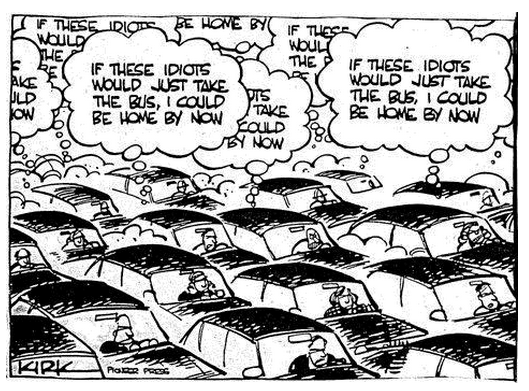
    Because there is no incentive to act in the public good, we often act in what we perceive to be our own personal interest, which is often the antithesis of the public interest. And remember that if we are driving, we are traffic. So often people will sit fuming in their cars in the midst of congestion with thoughts like in this cartoon. But of course with unpriced roads, there is no real price signal to these drivers to consider taking the bus.
    In a world where time is money, we are constantly berated about the economic costs of congestion. In 2011, the Toronto Board of Trade estimated that congestion in the Toronto region alone cost the regional economy $6 billion a year, rising to an estimated $15 billion in 2031 should no action be taken. More recent research by the CD Howe Institute pegs this figure at up to $11 billion.

    Given these sorts of eye-watering figures, one might be tempted to think that car drivers, and in particular the goods industry, would be flinging their wallets open at the chance to buy their way out of congestion. And in fact Toronto has the 407 Express Toll Route which has elements of variable road pricing. However, while the 407 ETR carries around 350,000 vehicles per day, price increases have been matters of controversy. It provides some ability for those who can afford it to bypass Toronto’s notorious traffic congestion, but its fundamental weakness is that it’s just one road in one of North America’s largest city-regions.

    Similar stand-alone efforts to address congestion in Metro Vancouver with tolled routes, such as the Port Mann Bridge on the Trans-Canada Highway and the Golden Ears Bridge, have fallen well short of their projected traffic volumes, while nearby untolled bridges such as the Patullo Bridge are heavily congested. We have a similar experience in New Zealand where our two tolls roads, with car tolls of $2 and $2.20 respectively, experience diversion rates of up to 30% to the alternative but substantially longer and slower free routes.

    This brings up a fundamental paradox: Congestion costs the economy a fortune and congestion is a top-of-mind frustration, yet people seem reluctant to pay even comparatively small amounts to bypass congestion.

    For example, the City of Toronto’s Roundtable on Gridlock & Traffic Congestion in February 2014 came up with the usual shopping list of “transportation systems management” responses – improved management of curbside space and construction projects; synchronized traffic signal phasing; better traveller information and improved incident response. While these are all worthwhile responses, they only improve system operation at the margins. Encouraging greater use of public transit was the very last recommendation and there was not a single mention of charging or pricing as a tool to address congestion. And the feverish activity continues with a hackathon called TrafficJam on October 2 – 4, 2015 with the goal of fixing Toronto’s traffic woes.
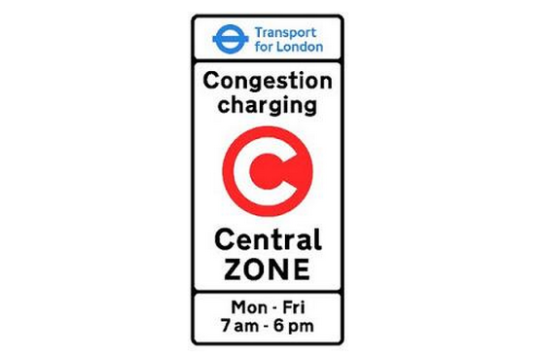
    The very few cities that have actually had significant success at reducing traffic congestion – notably Singapore, London and Stockholm – have done this through cordon-based congestion pricing wherein if you pass the cordon, you pay the congestion charge. Entering central London on a weekday between 7am and 6pm will set you back a cool £11.50 ($C23.30). From 2003 to 2013, about £1.2 billion ($C2.42 billion) of congestion charge revenue has been invested in public transport, road and bridge improvements and walking and cycling, of which £960 million ($C1.94 billion) was for bus improvements. These measures have included significant road space reallocation to improve conditions for pedestrians, cyclists, public transit and the urban realm.

    The latest Travel in London report states that “Over the 10-year period from 2003, total trips have increased by 11.4 per cent, with particularly notable increases of 52.3 per cent in rail trips and 32.0 per cent in Underground and DLR [Docklands Light Railway] trips, with cycle trips (as main mode) increasing by 53.9 per cent. Car driver trips decreased by 12.7 per cent over the same period” (my emphasis).

    One interesting insight is that Stockholm trialed congestion charging and then reverted to business as usual of unpriced roads in advance of a referendum on congestion pricing. This gave Stockholmers a clear sense of the difference in traffic congestion and was crucial in supporting a yes vote in the referendum.

    Stockholm has experienced a permanent reduction in traffic of about 20% across the toll cordon and congestion decreased by 30 – 50% – which demonstrates that traffic volume reductions have a disproportionately positive impact on congestion. About half of the “disappearing” drivers changed to transit, the rest to other alternatives such as different departure times and destinations and taking fewer trips.

    For more on Stockholm, I suggest reading the Tools of Change case study on Stockholm Congestion Pricing.
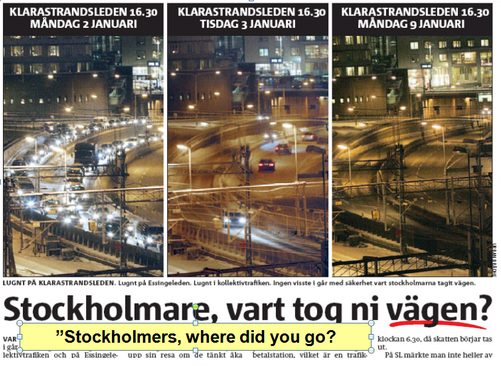
    Before and after congestion charge photos of traffic levels in Stockholm

    While this sounds very promising, congestion charging has significant equity implications and requires upfront investment to provide people who either choose to or can no longer afford to drive with transportation alternatives. Both Stockholm and London invested very heavily in public transit in advance of implementing congestion charging.

    And this brings up a big issue for Toronto. 

    For congestion charging to have a meaningful impact on congestion without stifling economic activity or impeding people’s ability to move around, the core capacity of Toronto’s transit system would need to be addressed first. In particular the Yonge Line capacity enhancements, Metrolinx’s Regional Express Rail and most likely the Downtown Relief Line would need to be in place to provide both capacity and choice for people who either needed or wanted a travel alternative to any congestion charge.  This would mean that Metrolinx’s Big Move might need to get even bigger.

    Disclaimer: The author of the above post is an employee of Auckland Transport, however, the views, or opinions expressed in this post are personal to the author and do not necessarily represent the views of Auckland Transport, its management or employees. Auckland Transport is not responsible for, and disclaims any and all liability for the content of the article.

  • How wise are crowds?

    Earlier this week I wrote a post about a new build home under construction at 37 Canerouth Drive in the west end of Toronto. As part of that post, I asked people what they thought the home would be valued at when it was completed. There were just under 10 responses (many thanks!) and I thought it was really fascinating to see the ranges.

    A lot of you responded in the comment section of the post, but a bunch of the other estimates came in via Facebook, Twitter, and email. It isn’t a huge data set, but I’ve nonetheless consolidated the ones I could remember I received:

    $2,375,000
    $2,750,000
    $1,800,000
    $3,000,000
    $8,500,000
    $2,600,000
    $3,500,000
    $1,750,000

    If you average these estimates, you come to a value of $3.3M. However, the clear outlier is the $8.5M. So let’s take that one out and see how the number changes. If you do that, you then get an average estimate of $2.5M. A pretty big swing.

    Now, I don’t know offhand how accurate that number really is, but I’m fascinated by this idea of “the crowd” determining value. Particularly for markets such as housing where supply can be completely heterogeneous and there isn’t a lot of transaction volume to refer back to (compared to other types of markets).

    Because my strong belief is that under the right circumstances and with enough data points, this number could end up being hugely accurate. And, it could also be more forward looking since it’s capturing current market sentiment as opposed to being based on historical transaction prices.

    If you have any thoughts on this, I’d love to hear from you 🙂

  • Road pricing chicken and egg

    Regular readers of this blog will know that I’m a big supporter of road pricing. I think it’s an incredibly efficient way of reducing congestion, improving regional productivity, making us more sustainable, and funding other infrastructure, like transit.

    But one of the arguments I often hear against road pricing is that it’s unfair to force a segment of the market out of their car if there’s no good alternative (ie. proper transit). And even if the revenue produced from road pricing goes towards transit, we all know that new infrastructure takes a very, long, time.

    So we end up with a chicken and egg problem: Road pricing is a great way to fund transit, but it’s difficult to implement without the proper transit in place. So what should we do? What comes next?

    I have two thoughts.

    First, road pricing doesn’t necessarily mean that you can no longer drive without paying. Effective road pricing matches price with demand. Therefore if there’s nobody else on the road, you wouldn’t be paying (or at least wouldn’t be paying much). This is what makes it efficient—it adjusts. So for somebody without the willingness to pay for peak congestion pricing, they could still have the option of driving at another time. Go in early or go in later.

    But what it does mean is that no matter what time you’re driving, the road could be priced so that it actually functions again. In Toronto today, many of our roads are completely failing. Demand greatly exceeds available supply (the amount of road we have) and so you can’t use them to get anywhere in an efficient way. So what we have is equal access to terrible non-functioning roads.

    Second, there’s no such thing as a free lunch and nobody said it was going to be easy to build phenomenal infrastructure. We all complain and say we want it, but when push comes to shove, are you willing to open up your wallet and pay for it?

    So I say forget pontificating about chickens and eggs and just do it. If we priced roads and setup other appropriate revenue tools, I’m sure there are some financial wizards in this city that could use tax increment financing or other mechanisms to ensure that we get shovels in the ground today for the new infrastructure that we so desperately need.

    These are important discussions to be having no matter what city you live in. I would love to hear your thoughts in the comment section below or on twitter.

  • The case for electronic road pricing

    I just finished reading an HBS business case on road pricing in Hong Kong for a class I’m taking as part of my MBA. Since it’s a topic that’s integral to cities, I thought I would post my case prep here. Below are the questions I was asked to my prepare, with my answers below.

    The case is essentially about traffic congestion in Hong Kong and a decision to either build more road (a bypass route running adjacent to the harbour: The Central-Wan Chai Bypass) or implement an Electronic Road Pricing (ERP) system, similar to what was implemented in Singapore in the 70s and in London in 2003.

    If you’re a reader of this blog, you can probably guess which side I’m going to lean towards. I believe fundamentally that the only way to construct a large well functioning urban region is on the shoulders of mass transit. 

    Q: For a typical commuter, what are the costs and benefits involved in using a car over using public transportation? Why would a commuter choose to drive? Who are the most likely to drive?

    A: In my view it’s a trade off between cost, time and, to some extent convenience, although convenience and time are somewhat linked.

    From a cost standpoint, your typical driver has the fixed cost of owning a car (payments, insurance, maintenance, etc.) and the variable costs of driving (gas, parking, applicable road prices, etc.). For those who have already committed to purchasing a car, probably as a result of where they’ve decided to live, it then becomes largely a question of variable costs. In most cases, these costs are higher for driving than they are for public transportation.

    But then comes the question of time and convenience. Residents of global cities, such as Hong Kong, are becoming increasingly cash rich and time poor. There’s a real value to time. And driving often offers speed, as well as the convenience of a personalized and “comfortable” ride (personally, I find gridlock highly uncomfortable). So if the value of the time you’re going to save by driving exceeds the variable cost of driving, you’re likely going to drive. In other words, higher income individuals should choose to drive.

    Q: What are the costs of traffic and congestion for society?

    A: The costs of traffic and congestion to society are huge. You have the lost productivity as a result of people and goods sitting idle. You have the strain on family life caused by working parents struggling to find enough time outside of work. And you have the environmental impact of idling cars.

    Here’s a few stats from Natural Resources Canada:

    “In fact, if Canadian motorists avoided idling for just three minutes every day of the year, CO2 emissions could be reduced by 1.4 million tonnes annually. This would be equal to saving 630 million litres of fuel and equivalent to taking 320,000 cars off of the road for the entire year. Eliminating unnecessary idling is one easy action that Canadians can take to reduce their GHG emissions that are contributing to climate change.”

    Q: Discuss the effect of electronic road pricing (ERP) on: (a) urban re-development and town planning, as well as residential property prices; (b) fare faced by public transport.

    A:

    (a) Based on London’s experience, their property market “recorded no impact, positive or negative, in or around the charging zone.” (Case) However, intuitively, I would expect development pressures and pricing to increase within the boundary of any charging zone and for prices to fall outside, along the periphery. The reason for this is that urban real estate models, such as the Monocentric City Model, argue that as you move out from the center of a city, land prices fall, but transportation costs increase. It ties into the whole “drive to affordability” notion. In the case of ERP, transportation costs have now increased for the periphery, so it could drive down land/property prices. 

    (b) Relatively speaking, an ERP system should make pubic transportation fares appear cheaper since the marginal cost of driving has now increased. Therefore, in the longer term, it may create an opportunity to raise fares.

    Q: Why is the use of road usually free of charge?

    A: Roads are thought of as a public good. And so they’ve been typically priced as such. However, roads, and in particular highways, are also thought of as an economic development engine. They’re a heavily subsidized form of infrastructure that have been used as a tool to spur suburban and exurban growth. By driving down the cost of transportation (without factoring in the environmental costs, of course), extensive highway networks have been used to unlock the value of previously under utilized outlying land. However, I disagree with the notion that all roads should be “free.”

    Q: Why roads are often provided and managed by the government and not by profit- maximizing firms?

    A: Because typically profit-maximizing firms require paying customers. Also, since they’re viewed as a public good, governments typically want to control them.

    Q: What are the differences between ERP and a classic toll?

    A: A classic toll is typically based on a fixed price that is paid regardless of the time of day. ERP is variable. Pricing fluctuates based on the time of day and/or the traffic and congestion levels. It’s the idea that as demand for the public good in question rises, so does the price of using it.

    Q: What are the advantages of implementing ERP?

    A: There are number of advantages. The first is that you get an immediate drop in traffic/congestion. This has been clearly shown through previous case studies in Singapore, London and Scandinavia. As a result of this, the city is then able to offer an improved user experience for those who are willing to pay the increased transportation costs. At the same time, the city now has a new revenue source that it can dedicate towards other infrastructure improvements, such as public transportation. Indirectly, the city will also benefit from increased productivity levels and a smaller environmental footprint.

    Q: Why are there such few cities that have successfully adopted ERP despite the fact that the idea is praised by many economists? Singapore is one of the few successful examples, why?

    A: It’s politically unfavourable. Nobody likes any sort of new “tax”. When Livingston first proposed a congestion charge in London residents called it “Carmageddon.” Few leaders have the guts to push something like this through.

    Singapore, on the other hand, had no choice. Geographically they couldn’t afford not to discourage car use and so the political will was there. I think that Hong Kong is in a similar boat.

    Q: Imagine that you were the government official responsible for the introduction of ERP. What would be your strategy to persuade the public to support your implementation?

    A: I would focus on two main ideas: (1) the value proposition being offered and (2) the future use of the funds being collected through ERP. 

    The main value proposition is reduced congestion for a segment of the population that I suspect would be willing to pay for the convenience. Again, I return to the idea of being cash rich and time poor. 

    For those with absolutely no willingness to pay for this convenience, the value proposition becomes increased investment in public transportation (as a result of the ERP funds). This is how I believe the funds should be allocated.

    I also think it’s critical to be open and transparent to the public about how exactly the funds will be used. You don’t want the public to think of ERP as a tax. You want them to think about it as investment in infrastructure in the region.

    However, it’ll take a change in mindset. People are accustomed to roads being “free.” But to paraphrase Harvard economist Edward Glaeser, from his recent book the Triumph of the City, if you offer a hugely valuable good—such as a road or highway—and make it free, you’ll never be able to keep up with demand. It’s for this reason that building new and more roads is rarely the answer. Traffic patterns simply adjust to take advantage of the increased supply.

    If you want to control usage, you need to slap a price tag on it.

  • Prospect Theory

    I just read an interesting chapter from Tim Smith’s book, “Pricing Strategy: Setting Price Levels, Managing Price Discounts and Establishing Price Structures.” It’s Chapter 5: Psychological Influences on Price Sensitivity.

    The chapter covers a number of pricing phenomenons, such as why prices ending in .99 tend to convey a discount and why whole prices ending in 0 tend to speak more to quality. It’s for this reason that art work is typically priced using simple round numbers.

    But one of most interesting theories from the chapter is that of Prospect Theory. Not only because of its impact on pricing strategies, but because, I think, it also applies to the real estate development business.

    Prospect Theory essentially describes the way people make decisions in the face of uncertainty. The two big takeaways for me are (1) that potential losses carry more weight than potential gains and (2) that both losses and gains experience diminishing returns.

    What this effectively means is that people, when faced with risk, tend to focus more on the negatives, and the potential losses, than on the positives. This means that the gains just can’t match the losses, they have to be significantly greater if you’re going to inspire action (a purchasing decision, a change in behaviour, or whatever).

    The second point basically means that these gains and losses become muted after a certain point. If you hit someone with enough of either, eventually they reach a point where they become desensitized in a way. Each additional amount of gain or loss produces less and less impact.

    Besides the obvious point of making sure that your product or service results in lots of gain for your customer, there are a couple of other things you can do to respond to this theory.

    The first is to “bundle losses” and “unbundle gains”. In other words, hit people with all the losses at once and then spread out the gains. What this does is maximize the psychological perception of gains and minimize the perception of losses because, remember, after a while people start to discount the losses.

    The other thing you can do is transfer losses, which is often just the cost itself, from direct to indirect. Big box stores, as an example, are great at this. They offer low prices (a direct cost) in exchange for greater indirect costs: higher transportation costs to the user, greater environmental impact, and so on. Studies show that people feel direct costs much more than indirect costs.

    There are a bunch of things you can do based on this theory, but again, one of the most fascinating things for me was how it also applies to the real estate industry. There’s a well known acronym in the industry called NIMBY. It stands for Not In My Back Yard, and it’s used pejoratively to refer to people who oppose development in their community.

    However, if you look at NIMBY’ism through the lens of Prospect Theory, you realize that it’s almost an innate human reaction. Development and construction is disruptive and the end result is change in somebody’s community. And I suspect that most residents view it as a risky and uncertain situation. Therefore, it’s no wonder that they’re first reaction is opposition. They’re weighing the potential losses more than the potential gains.

    So maybe we developers just need to apply a little Prospect Theory. We need to get better at producing and communicating gains.