Daily insights for city builders, delivered every morning at 6 AM ET. I’m Brandon Donnelly — a Toronto-based real estate developer and founder of Globizen. I’ve been writing here since 2013.
BlogTO recently asked: Is it a good time or a bad time to buy a condo in Toronto right now? My unsolicited opinion is that if you are someone who would like a home in Toronto, now is an excellent time to buy it. But that’s not actually what I want to talk about today.
If you read the post, you’ll come across this line: “She emphasized that these are unprecedented interest rates…” Hmm. I think it’s important to point out that these are not unprecedented rates. Rates today are certainly higher than they have been for about two decades. But they’ve been even higher before and, if you go back to say the 1980s, rates today still look historically low.
We just got used to ultra low rates and now we need to adjust to them being higher. And we will. The first step is feeling confident that rates won’t go even higher in the short term. Because if you think you know where rates are going to hang out, you can then make decisions around that.
Seth Godin recently posted this four quadrant chart on his blog. It is for plotting different products based on price and based on want vs. need. In his post, he asks his audience to think about what they’re offering and which quadrant it fits within. It can only be in one.
I am fascinated by questions of pricing. At at some point on this blog, I wrote about a pricing class that I took at Rotman while I was doing my MBA about a decade ago. It stands out to me as one of my favorite university classes.
So let’s consider these four quadrants.
In the top left, you have inexpensive products that are wants and not needs. This quadrant is where you’d place those novelty sunglasses you picked up for your friend’s theme party. Fun for that moment, but if they break or you lose them, that’s probably okay.
In the top right are expensive wants. Seth uses the example of a Hermès purse. The need is a place to put your belongings, but that’s not how these sorts of items are priced. The real value, arguably, comes from their “signaling” and how they make the owner feel.
This is the luxury goods category. Demand will likely be cyclical and sporadic, and so you’ll need to make sure that you have fat margins.
In the bottom right are expensive needs — like a pacemaker. Seth’s point is that these products need to work exceptionally well, all of the time. In the case of a pacemaker, it is truly a matter of life or death. At the same time, there’s going to be less price sensitivity.
In the bottom left are the inexpensive wants. Low cost products that people really want and are infinitely useful. Seth’s example is Amazon Web Services.
This quadrant of products is attractive because demand will naturally be extremely high. Cheap and invaluable will do that. However, Seth’s caution is that you still need to sustainably deliver the goods. These aren’t novelty sunglasses.
I find it helpful to think of products as existing in only one quadrant. But most offerings aren’t going to exist all they way in one corner. It’s perhaps important to consider the “job to be done.” (To borrow from the late Clayton Christensen.)
Take, for example, housing. On a fundamental level, it’s a need. We all need shelter. But it can also be a want, or have aspects of want. I need a place to live. But I want a place in the mountains. This subtle difference means something very different when plotted precisely.
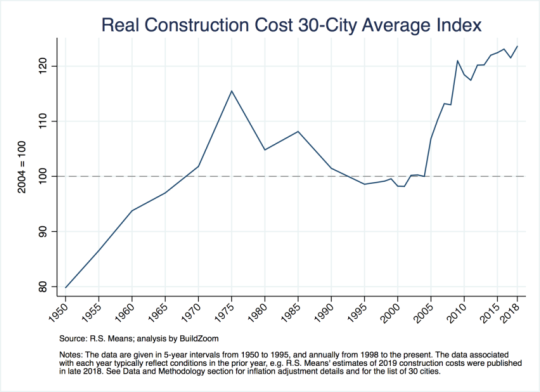
BuildZoom, which is a tool to help people find local contractors, recently looked at construction costs across the US.
Here is their 30-city average index running from 1950 to roughly today:
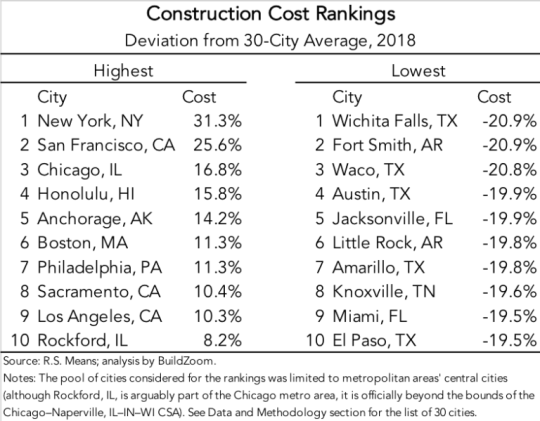
Here is a chart showing the most and least expensive cities (that is, the cities that deviate the most from their 30-city average):
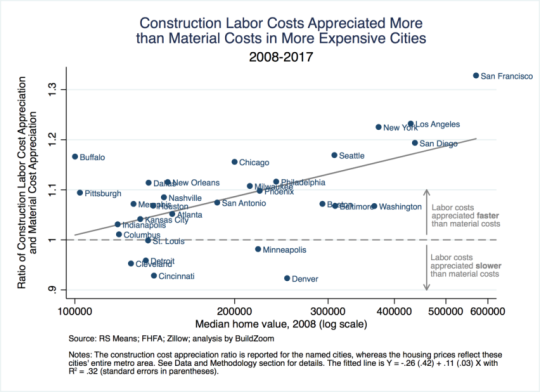
And here is a chart that compares labor cost appreciation to material costs:
Labor costs account for the bulk of the geographic variation in construction costs and the most expensive cities to build in also tend to have the highest median home prices.
The way to read the above chart is that any city with a y-axis value greater than 1 means that labor costs have appreciated faster than material costs from 2008 to 2017.
In the case of San Francisco, labor costs have appreciated 32.8% (> 1.3) faster than material costs.
Part of this likely has to do with the fact that San Francisco is an expensive city in which to live. People have to be paid more if they’re going to work there.
New York City is considering a congestion charge for drivers entering Manhattan below 60th street. It is part of Governor Cuomo’s Fix NYC plan. But we all know how difficult these things are to implement.
Last month, Felix Salmon wrote a piece in Wired where he argued that our cities are dying of traffic congestion and that the cause is ride-hailing services like Uber and Lyft. The solution: A tax on ride-hailing services.
The article elicited a few reactions, including this one by Charles Komanoff over at Streetblogs and this one by Joe Cortright over at City Observatory. Joe’s message: “The problem isn’t the ride-hailed vehicles, it’s the under-priced street.”
Precisely.
Felix later followed-up with a post on his blog where he clarified that the reason he loves this idea – of taxing ride-hailing companies, not riders – is that it’s far more politically palatable than a blanket tax on all cars. I don’t disagree.
Which is why I think my idea is something which is eminently politically possible, in contrast to congestion pricing, which has been implemented exactly nowhere in the USA.
Americans love their cars, and they love the freedom that cars represent, and they hate the idea that they should be taxed for driving their cars. Tolls on roads and bridges are bad enough, but a fee just to drive in to a city?
That said, I’m with Charles and Joe.
Last year, it was reported that roughly 25% of all Uber trips in New York City were UberPool trips. I’m not sure what the number is today, but these are people who are car pooling to get around. That’s generally considered to be a positive thing.
Are these really the trips we want to be discouraging (and singling out) with a charge simply because we don’t have the moxie to do what is right and makes rational sense?
Here are some stats about Manhattan real estate (from the paper) that you all might find interesting:
– In 1930, Manhattan housed 1.5% of the US population, but had approximately 4% of all US real estate wealth.
– To construct their price indices the authors randomly collected 30 real estate transactions per month in Manhattan between 1920 and 1939. The mean price per square foot in 1929 was $6.91 (year of Black Tuesday). And the mean price per square foot in 1939 – 10 years later – was $2.29.
– Buildings containing a store at grade tended to sell at higher prices. The authors speculate that this could be because a zoning change in 1916 made it difficult to open stores in “residential” areas.
– Buildings with three, four and five storeys tended to sell at a discount. Six storeys or higher and the buildings generally had an elevator, which resulted in higher pricing.
– Manhattan real estate prices reached their highest level in Q3-1929 before falling 67% by 1932. Prices remained more or less flat during the Great Depression.
– If you bought a “typical property” in 1920, it would have retained only 56% of its value (in nominal dollars) by 1939. In fact, it took until 1960 for assessed property values in Manhattan to exceed their pre-Depression pricing.
– An investment in the stock market index during this same time period, 1920-1939, would have outperformed real estate by a factor of 5.2x.
Much of this probably seems hard to believe given the market today. Imagine waiting 40 years for the value of your property to come back.
I find the topic of pricing incredibly interesting. How much is someone willing to pay for item X? I’ve said this before, but pricing was one of my favorite classes in business school.
Here is a line that I really liked from a recent blog post by Tomasz Tunguz’s on price anchoring:
“Relative pricing comparisons are among the most common method of price rationalization.”
The topic of his post may not be all that interesting to this audience – it’s about software as service platforms – but the principles should be.
In Tomasz’s post he talks about how companies building SaaS products aimed at salespeople will often have their pricing compared to that of Salesforce. In other words, people might say to themselves: Salesforce costs $X per seat. Is this other product worth half of $X? Salesforce is the anchor.
I can tell you that I do this all the time. (Do you?) I’ll say to myself, condos of this build quality are selling for $Y in this neighborhood. Is this other neighborhood better or worse? If better, how much of a premium might someone apply to it?
So if you’re in the business of pricing products, you may want to give some thought to how your customers might be anchored when assessing your offering. Relative pricing comparisons allow us to rationalize dollars in our mind.
“Maybe autonomous cars will be different from other capacity expansions,” Mr. Turner said. “But of the things we have observed so far, the only thing that really drives down travel times is pricing.”
The argument here is that capacity expansions – such as additional lanes – never solve the problem of gridlock. Yes lane widening projects increase capacity, but the latent demand is so strong that the problem never gets solved. Even in places like Houston.
We talked a lot about this phenomenon on the blog a few years ago when Toronto was embroiled in debate over the Gardiner Expressway East. But it’s interesting to think about self-driving cars as simply another incremental capacity expansion.
I have no doubt that this technology will make more efficient use of our roads. Carpooling will be a lot easier – as is already the case. Cars will be able to drive closer together. We’ll be able to stop abrupt breaking and swift land changes, which actually create systemic traffic problems for everybody else. And the list goes on.
But there will still be limits to how many people can be efficiently moved on a particular strip of road. Exactly how there are limits to how many people can be efficiently moved via a particular subway tunnel, streetcar line, and so on.
So if latent demand continues to outstrip available capacity, which has historically been the case, then we are once again back to the politically unpopular idea of pricing away congestion. As much as people criticize it as regressive, I believe that’s where we’re headed.
Earlier this week I was in an Uber heading up to Charles Street and the driver made a comment to me. He said that since he moved to Toronto in the 90′s, traffic has gotten progressively worse every single year. He continued on to say: and yet we continue to build, build, build.
My response won’t surprise anyone who reads this blog. I said that Toronto has become a far more exciting city since the 90′s because of intensification (though 1992 and 1993 were pretty awesome) and that the problem is our mental model. We haven’t moved beyond the car as the perceived solution to urban mobility.
A perfect example of this is what just happened with the province vetoing Toronto’s proposed road toll plan.
Firstly, I fully agree with Marcus Gee of the Globe and Mail that this is both an act of cowardice (the province gave every indication that they initially supported the plan) and an act of arrogance (we are talking about roads owned by the city, not the province).
I also find it incredibly frustrating that Toronto cannot control its own destiny. This is a mistake and it needs to change if we – and the rest of the cities in this great country – are to continue competing at a high level in this urban century.
But to my initial point, the problem with this move is that it signals a status quo mental model. It is a clear reluctance to make any sort of bold moves to move Toronto in a new direction. I guess we are happy with the current trend line. More traffic.
This afternoon I walked the High Line with a friend of mine who seemed to know everything there is to know about new residential development in Manhattan.
She recently purchased a place and so she had done her homework. She was pointing out every building and telling me the price per square foot range; whether the floor plans were well designed (or if they had misproportioned rooms and awkwardly placed columns); and who the architect was.
Takeaway: To be competitive in the luxury segment in New York, you really need to have a name brand architect on the project. That seems to be the price of entry.
As she was telling me about the “competitively priced” building in the low $2,000′s psf and the expensive penthouse that recently sold for $7,000+ psf, I started to wonder about historical pricing in New York. How has it trended?
I also told her that you could buy a really great condo in Toronto for $700 psf. She laughed at how affordable that was. It’s all about your point of reference.
In any case, I found a research report from 2004 called: Why is Manhattan So Expensive? The story is one that you’ve heard before. It’s about the impact of land use restrictions on home prices. But it does also include some historical data on average condo prices.
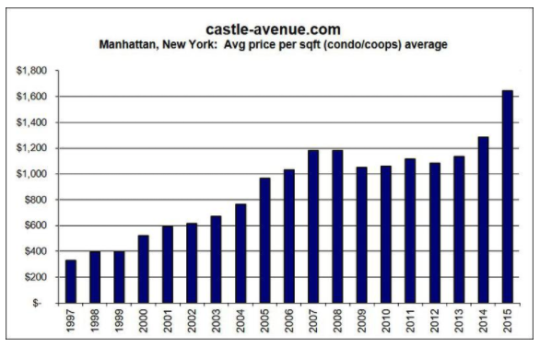
In 1984, the median price per square for a condo in Manhattan was $359 psf. It peaked in 1987 at $505 psf and then dropped back down to the $300′s in the early 90′s. That was not a great time for real estate. However, by 2002, the median price had rebounded to $606 psf. All USD figures.
From 2002 onwards, Manhattan saw a dramatic increase in home prices. Below are two charts from Corcoran (Q3 2016 data) and Castle Avenue, respectively:
Toronto is obviously not New York, but’s interesting to consider that the average price of a downtown Toronto condo, today, is probably in the low $600′s psf. That’s in Canadian dollars and that’s pricing that New York saw decades ago.
It reminds me that “crazy pricing” can oftentimes be a psychological reaction to a pricing anchor that we previously set in our minds. It feels crazy. But is it?
City
Observatory recently republished their
commentary on a report (released earlier this year) called Who Pays
for Roads. I missed their original post, so this is new to me.
The report
and commentary are all about the mispricing of roads/driving and the fallacy
that “user fees” (gas taxes, tolls, and so on) are enough to completely cover
the costs associated with driving.
I have been
a vocal supporter of road pricing and/or congestion charges here in Toronto, and
so I’d like to share two pieces from their commentary.
The first
is this paragraph, which talks about how mispricing leads to demand issues
(i.e. traffic congestion):
The conventional
wisdom of road finance is that we have a shortfall of revenue: we “need” more
money to pay for maintenance and repair and for new construction. But the huge
subsidy to car use has another equally important implication: because user fees
are set too low, and because, in essence, we are paying people to drive more,
we have excess demand for the road system. If we priced the use of our roads to
recover even the cost of maintenance, driving would be noticeably more
expensive, and people would have much stronger incentives to drive less, and to
use other forms of transportation, like transit and cycling. The fact that user
fees are too low not only means that there isn’t enough revenue, but that there
is too much demand. One value of user fees would be that they would discourage
excessive use of the roads, lessen wear and tear, and in many cases obviate the
need for costly new capacity.
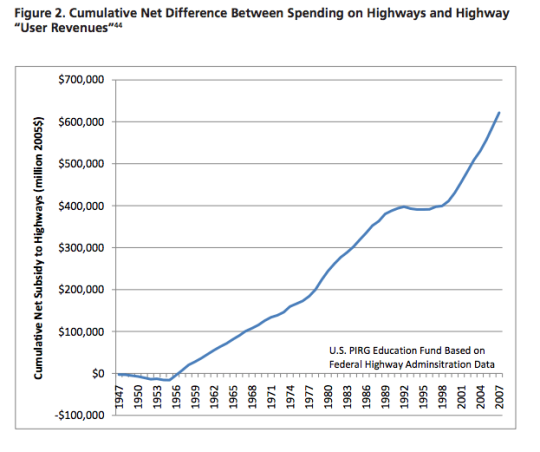
And the second is this chart, which shows the cumulative net
subsidy to highways in the US from the late 1940’s:
The point of all this is that when you subsidize something
it’s because you’d like to see more, not less of it. So why then are we even surprised by the crippling traffic that plagues our
cities? We are doing a lot to encourage exactly that.