Daily insights for city builders, delivered every morning at 6 AM ET. I’m Brandon Donnelly — a Toronto-based real estate developer and founder of Globizen. I’ve been writing here since 2013.

Tag: portland

  • Weird as a competitive advantage

    image

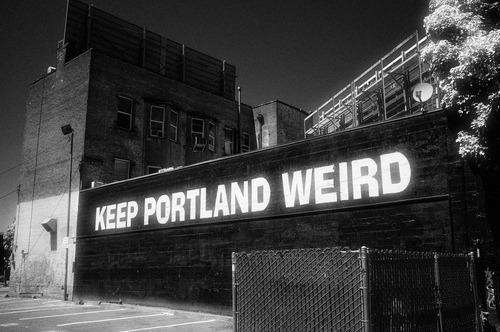
    Joe Cortright of City Observatory recently reposted an article that he wrote back in 2010 called, Keeping it Weird: The Secret to Portland’s Economic Success.

    In it he talks about a “weirdness index” that he developed for CEOs for Cities that measured and ranked 50 American cities across 60 different behavioural indicators. San Francisco and Salt Lake City come out as the weirdest, and Portland ranked 11th out of 50. The most “normal” part of the US was the Midwest. Normal meaning behaviours that are most similar to the national average.

    He then goes on to talk about weird as a competitive advantage. Here are a few snippets:

    When it comes to economic success in today’s economy, the key is to differentiate yourself from your competitors. Harvard Business School’s Michael Porter counsels businesses that “competitive strategy is about being different.” And the late, great urbanist Jane Jacobs told us, “The greatest asset that a city can have is something that’s different from every other place.”


    True entrepreneurship is about deviant behavior: starting a business that makes a product that no one else has thought of or thinks there’s a market for. Entrepreneurs and open-minded, experimental customers go hand-in-hand.


    We shouldn’t do things just to be different, but we should never be dissuaded from trying something simply because it is different or would make us different from other places.

    What this all comes down to is the simple fact that what is weird today, might very well become the norm tomorrow. But you need to be open enough to allow that to happen if you want to be the place that generates those news ideas.

    Could you have imagined that selfies would become as ubiquitous as they have? That would have been pretty hard to predict. It used to be the case that people were afraid to use their real name on the internet. Now we share our entire life online, including our faces.

    Image: Flickr
  • Where Uber operates and where it’s banned

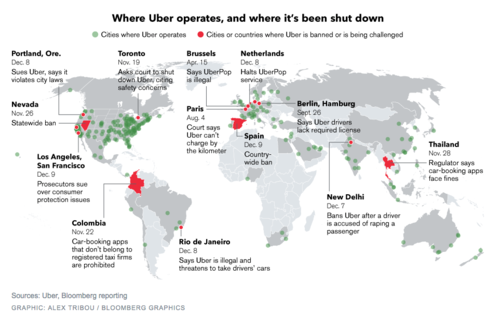
    Earlier this month, Bloomberg published this map showing where Uber operates and where it’s been banned (or is being challenged). You can click on the map for a larger version.

    image

    Uber operates in about 250 cities across the world. But it’s being challenged in a lot of them, including Portland, San Francisco, Los Angeles, Toronto, Rio de Janeiro, Paris, Berlin, as well as others.

    I don’t want to dismiss any of the safety concerns that have arisen lately, because those are very serious and they need to be addressed. Life safety is paramount. But I continue to believe that banning a service that many people clearly want to use isn’t the right solution.

    On top of that, I think it could lull many of the local taxi communities into a false sense of security about the future. Uber is moving incredibly quickly. UberX launched in Toronto in September of this year. And UberPOOL – their new carpool service – is likely next.

    With these releases, Uber is working towards a specific vision for the future: Their goal is to eliminate the need for private vehicle ownership. Should they be successful, this will not only impact taxis, but also car manufacturers and urban mobility in its entirety.

    So as difficult as it might seem right now, I think urban leaders would be better served trying to figure out how to harness these innovations. Cities have been trying for decades to get people out of their cars. Uber wants to do the same.

  • What happens when you demolish a highway

    Earlier today I tweeted this:

    //platform.twitter.com/widgets.js

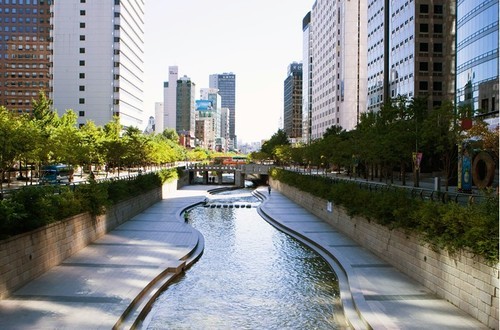
    It’s a link to an article talking about 5 cities – New York, Milwaukee, Seoul, Portland, and San Francisco – who all demolished an elevated highway that used to run through their downtowns.

    To be completely fair, some of these cities didn’t really have a choice. San Francisco’s Central Freeway was so badly damaged in an earthquake that it had to be closed. But it doesn’t make the lessons any less relevant.

    In all of these cases, the elevated highways were taken down and never replaced with another highway. Some were turned into large boulevards. Others were turned into parks. But in none of the cases was a new road of similar capacity built.

    Intuitively it might seem like this would cause utter chaos. I mean, where were all of these cars going to go? 

    But that didn’t happen. Instead, demand redistributed itself. Car volumes dropped dramatically. More people took transit. Some people took other routes. And some people traveled at different times. Oh, and nearby property values all went up.

    And the reason this happened is because of something that economists call induced demand (I’ve written about it before, here). What it means is that as you increase the supply of some valuable good (such as free highways), more of that good becomes demanded.

    In other words: more free highways = more cars on the road.

    So if you’re a city – like Toronto – with an elevated highway running through your downtown, you should give this some serious thought. The outcomes aren’t as bad as you might think. In fact, they’re quite good.

    Image: Seoul via D Magazine

  • Laneway summit post-mortem

    image

    Last night was The Laneway Project’s inaugural summit here in Toronto. And I think it was a huge success. This is what the crowd looked like (don’t forget to check the upstairs balcony area):

    //platform.twitter.com/widgets.js

    Over 350 people showed up to fill The Great Hall at Queen West and Dovercourt. It was absolutely incredible. To be honest, I initially thought that it would end up as a small group of city geeks. I mean, it was a summit to effectively talk about back alleys.

    But it turns out that there are a ton of people in this city who are passionate about rethinking our urban fabric and finding new uses for these underutilized public spaces. And that’s both really encouraging and exciting. Many thanks to everyone who came out!

    The Laneway Project team did an incredible job spreading awareness and, given the success of this initial summit, I can only imagine where this initiative will end up in the future. So a big congratulations to Mackenzie Keast, Ariana Cancelli, and Michelle Senayah for making this happen.

    I’m not sure if the event was filmed or not, but hopefully it was and it’ll be made available online. But in the event that it wasn’t, I did want to share one question that the panel got during the Q&A session after our presentations.

    The comment made was basically that Toronto will never be Sydney, Melbourne, or Seattle when it comes to our laneways. They have a temperate climate and we don’t. So while it’s nice to show great pictures of their laneways, it’s just not going to happen here.

    And that really pissed me off.

    So I responded by saying that I disagree. Saying that we’ll never be Sydney or Seattle is capitulating. There are many months of the year where it’s beautiful outside in Toronto, so just because we have a winter doesn’t mean we should throw our hands up in the air and give up.

    I then went on to argue that the fact that we have a “shorter season” should be all the more reason that we need fantastic outdoor and public spaces. For the months of the year where it’s beautiful outside, we should be maximizing our enjoyment!

    I hope many of you agree as well. Happy Friday all 🙂

  • Streetcars are just a tool

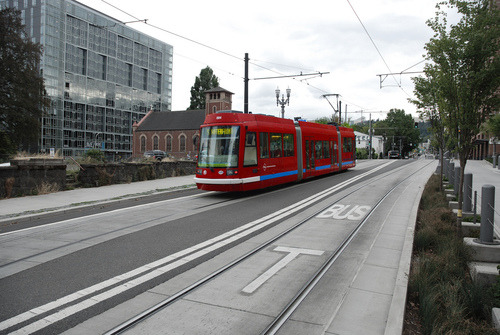
    Earlier this month the Toronto Star published an article talking about the resurgence of streetcars in American cities. According to the Star, 89 cities in the US are currently implementing or at least considering building some form of surface-rail system.

    But the article also goes on to argue that it could be a snobbish fad. Streetcars are new. They’re shiny. And they make yuppies –  who don’t like taking buses – feel better about themselves. But is the ROI really there? Is the economic impact of streetcars as big as people are making it out to be?

    To support this argument, the Star quoted transportation planner Jarrett Walker, who I’ve mentioned here before on Architect This City. But according to a follow-up post that Walker did on his blog, it would appear that he was misrepresented in the article. Here’s a snippet of his response:

    Here’s the bottom line. Streetcars are just a tool. They can be used in smart ways and in stupid ways. Asking a transit planner for an opinion about a transit technology is like asking a carpenter what his favorite tool is. A good carpenter sees his tools as tools and choses the right one for the task at hand. He doesn’t use his screwdriver to pound nails just because he is a “screwdriver advocate” or “hammer opponent”. Yet the Toronto Star assumes that nobody involved in transit debates is as smart as your average competent carpenter.

    I wanted to share this because I think it’s a great way to approach transportation planning and because I think it gets at a larger issue that we continue to face here in Toronto: We keep politicizing mobility tools. Cyclists have become pinkos. Streetcars are a war on the car. And the list goes on. How about we just look at the problem, and figure out what solution would work best?

    Image: Flickr

  • Is it time to get rid of parking minimums?

    The cost of a parking spot in downtown Toronto has reached as high as $60,000 (per stall) in some new construction projects. If you convert that to a per square foot price (which is typically how people measure condo prices), you’re looking at over $350 per square foot for that parking stall. Is it worth it?

    Most cities around the world have what is called a parking minimum. This means that to build, say a new residential condo, developers need to provide a certain number of parking stalls. In Toronto, those minimums will depend on your unit mix. Bigger units have more stringent parking requirements. 

    In some cities, though it’s much rarer, they actually have parking maximums. Portland, for instance, has a maximum number of parking stalls that you’re allowed to build, which fluctuates based on the development’s proximity to transit.

    And finally, there are some cities, such as Berlin, with no parking minimums or maximums at all. In those cases, the market dictates the number of parking stalls that should be built. If people want a parking spot with their apartment and won’t buy or rent it without one, then the developer builds it.

    Though parking variances do happen in Toronto (for reasons such as proximity to transit), the city is generally skeptical of a market led approach to parking requirements. And there are a couple of reasons for that. They worry that investors might be buying the units (with no parking) and so the sales data may not be indicative of the end-user market.

    The city also worries that developers might actively discourage purchasers from buying parking spots, as it’s usually more profitable not to build them. Underground parking is costly and often subsidized by the sale of the condo units themselves. In fact, I’ve heard of instances where underground parking has cost upwards of $100,000 per stall because of buoyancy forces and other technical details.

    But I’m generally a free market guy. So I question if the market really isn’t capable of figuring out how much parking there truly needs to be. Undoubtedly, there will be families who demand 2 parking spots. I also bought a parking spot with my condo. But there may also be a number of people who would rather pay less for their home than subsidize a parking garage that they’ll rarely use.

    And as I wrote in a recent post called, Is traffic the right question?, we could be losing sight of the greater goal. If we truly want to build a sustainable and livable city, then we should be considering how our development activity encourages transit usage over driving, and how we can promote a more balanced modal split across the city.

    What are your thoughts? Would you buy a home without parking? Should we get rid of parking minimums, just as cities like Berlin have?

  • Further evidence that laneway housing is going to happen

    image

    Earlier this week Fast Company ran a piece talking about “the next big thing in urban planning” – backyard cottages. As the name suggests, backyard cottages are basically accessory dwellings built in the backyards of existing single family homes. And the idea is that they’ll provide new affordable housing options in competitive and supply constrained markets such as the Bay Area in California.

    While somewhat different than laneway housing–which you probably know I support here in Toronto–they do share many similarities. We’re talking about the intensification of our residential neighborhoods at the scale of the single family home. And the potential benefits go beyond just affordability. It would also make our communities more sustainable, more walkable, and more conducive to transit.

    But there are challenges. I don’t know about the Bay Area, but many municipalities don’t allow a “house behind a house” and many communities don’t want to see their neighborhood itensify. However, we are seeing companies, like New Avenue, emerge to help homeowners navigate the process of building a backyard cottage. This company in particular claims to have worked with over 90 homeowners. 

    So I think we’re going to see more, not less, of these types of housing solutions. Vancouver is already doing it. And so is Portland

    Now here’s a question for you. If you owned a house in a single family neighborhood, would you be fussed if your neighbor erected a backyard cottage or laneway house? I’d love to get your opinion. Let me know in the comment section below.

    Image: New Avenue

  • Portland adopts the granny flat

    I’ve talked a lot about laneway housing here on Architect This City. I’m a big supporter and I wish that Toronto would get on board and formally allow them. It’s been done and it is being done in cities around the world. Just this morning, a friend of mine sent me this NY Times article talking about how Portland has embraced the “granny flat”, which is one of the many names used for this type of housing.

    Within the article, you’ll find a nice slideshow of “accessory dwelling units” ranging from 300 and something square feet to 700 square feet. (800 square feet is apparently the maximum in Portland.) But what I found really interesting from the article is how quickly these homes have caught on:

    Eli Spevak, a local alternative-housing developer who is among those who lobbied for A.D.U.-friendly policies, said, “The city changed two rules, and all of a sudden it went from 30 a year being built to 200 last year” — an impressive figure, considering the total number of applications approved for single-family houses in 2013 was 800.

    This is a hugely impressive figure that shows that these homes are not really a niche product. Laneway homes have become a meaningful chunk of the new home market in Portland. Given that they’re a relatively affordable and sustainable option, I’m not surprised. But I am surprised that more cities aren’t following suit.

  • A map of every building in the Netherlands according to age

    There are apparently 9,866,539 buildings in all of the Netherlands. And Waag.org has just plotted them all on a map and colour coded them based on the year of their construction (via Information Aesthetics).

    Here’s what Amsterdam looks like:

    As to be expected, you can see how the city grew out from its historic core. What would it make the map even better though, is if you could turn off “layers” and see each time period in isolation.

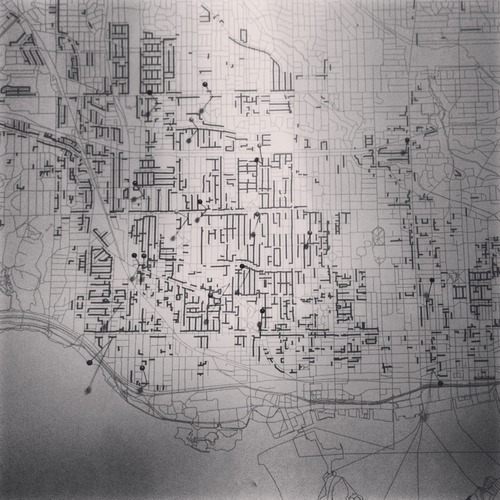
    If you’re interested in this sort of thing, here’s a similar map of Portland.