Daily insights for city builders, delivered every morning at 6 AM ET. I’m Brandon Donnelly — a Toronto-based real estate developer and founder of Globizen. I’ve been writing here since 2013.

Tag: population growth

  • Attainable housing is in short supply

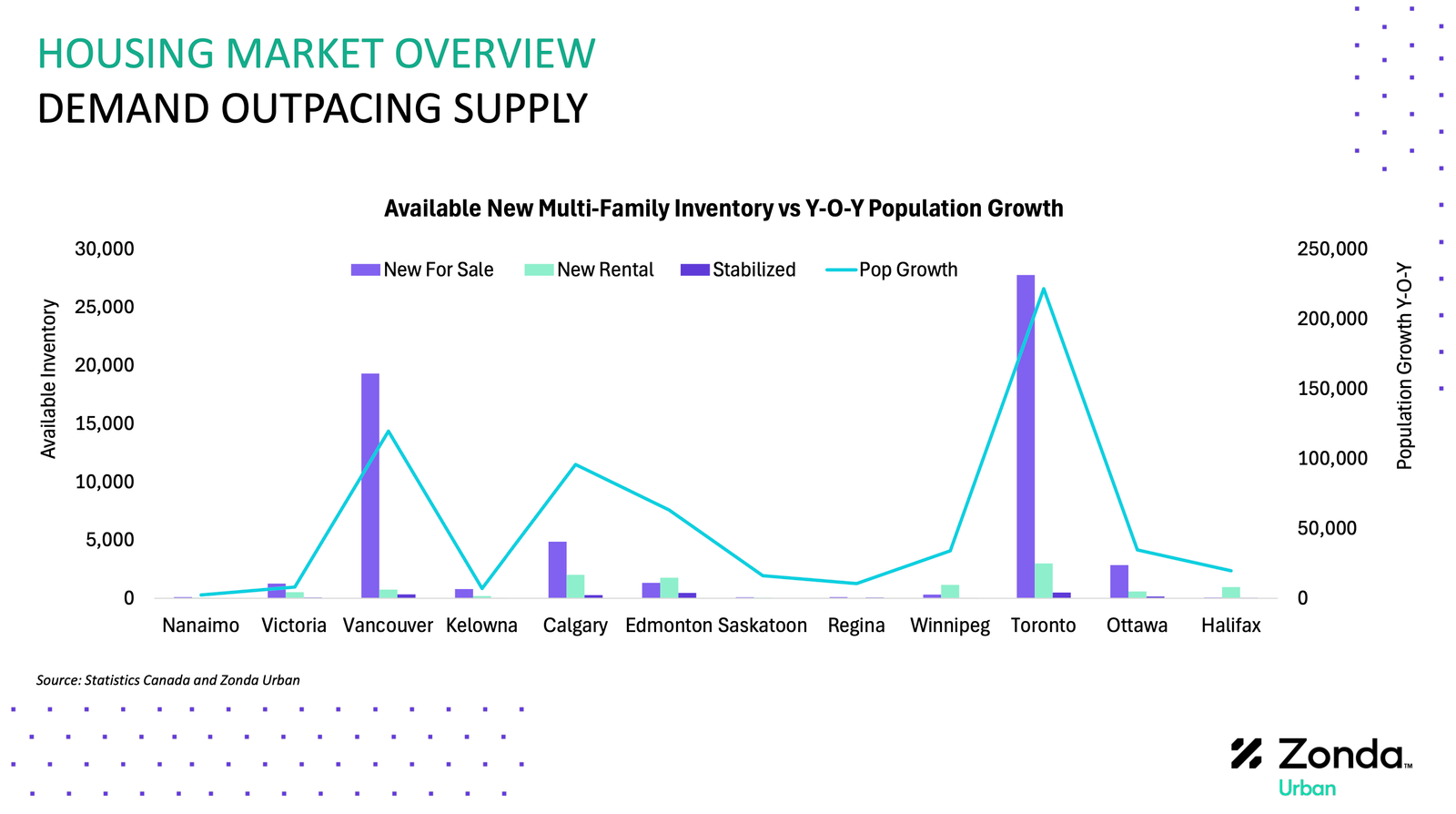
    Approximately 41% of the YTD population growth in Canada this year has been in Ontario. Here’s a slide from a recent presentation by Zonda Urban:

    So there’s an argument to be made that demand is still outpacing new housing supply in most of our major markets:

    Why then are new home sales continuing to slide? A reasonable answer would be that — by design — this new housing isn’t attainable to most:

    The result seems to be a long-term structural shift toward more rental housing:

  • Toronto is the fastest growing metropolitan area in Canada and the US

    Last month, I wrote a post called, More people, fewer new homes. And in it, was a chart showing that for the 12 months ending July 1, 2023, Toronto grew by approximately 126,000 people, and the Greater Toronto Area grew by about 233,000 people. Big numbers. At the end of the post, I also mentioned that this is more growth than the city has seen over the six preceding years.

    But how does this compare to other cities in Canada and the US? If we look at only central cities (not metro areas), Toronto is, in fact, first. Canadian central cities, in general, also seem to be growing more quickly than their US counterparts. After Toronto is Calgary, which added nearly 87,000 people for the same time period.

    Looking at metro areas, Toronto is still first. I don’t know why the ~222k figure, here, doesn’t reconcile with the ~233k figure from last month’s post, but presumably it’s some sort of boundary difference. In any event, Toronto is first. But now, once you include metro areas, US cities do much better in this list. Number two is Dallas-Fort Worth-Arlington.

    This difference between central cities and metro areas likely tells us something about the way in which these city regions are growing. Still, it would be interesting to see how much of this population growth is being accommodated through infill development vs. greenfield development. One way to measure that might be to look at changes in the footprint of their built up areas.

    For more about the above two charts, check out this recent post from TMU’s Center for Urban Research and Land Development.

  • More people, fewer new homes

    This is an interesting chart from the Centre for Urban Research and Land Development at Toronto Metropolitan University (TMU).

    It is based on recent population estimates from Statistics Canada, and what it is saying is that the Greater Toronto Area grew by 233,000 people during the 12 months ending July 1, 2023. If you include Hamilton, this number increases to 246,000. And if you include the entire Greater Golden Horseshoe, it increases to 340,000.

    This is significantly more population growth compared to any of the six preceding years. And assuming this 2021 population estimate of about 9.8 million people is more or less correct, it represents an almost 3.5% growth rate. That’s remarkable. It’s also happening at a time when housing starts are declining.

  • Fewer babies, fewer homeowners

    Since the 1940s, the US has been adding roughly 9 million new homeowning households about every 10 years. This, after all, is a fundamental component of the American Dream. But Aziz Sunderji — who writes over at Home Economics — has recently been arguing that this 80-year boom is now at an inflection point. And it is largely because the rate of population growth in the US is now declining. Here’s his chart, which uses data from the US Census Bureau and the World Bank:

    In fact, for the first time ever, the Census Bureau is now forecasting the US population to start declining. The current forecast has its population reaching a high of 370 million in 2080 and then declining to 366 million by 2100. But even before these far off dates, organic growth is expected to turn negative in less than 15 years (see above). So yeah, it makes sense that this would impact the real estate sector.

    For more on the future of homeownership, check out Aziz’s Home Economics.

  • Canada is growing a lot

    This week it was announced that Canada’s population grew by approximately 430,000 people over the last quarter (+1.1%). And that it represents the highest population growth rate of any quarter since the second quarter of 1957. Even more impressive, though, is the fact that in the first 9 months of this year we have already added over 1 million people in total. This beats all full-year periods since Confederation in 1867!

    Here’s what all of this starts to look like visually:

    The unfortunate side of these records is that it is coming at a time where we’re, perhaps counterintuitively, building a lot less new housing; which is to say that construction starts are declining. In fact, I was on a call this week where people who examine development and construction costs all day were predicting a 5-6% decline in hard costs in the Toronto region next year. And this is a direct result of fewer new projects getting started.

    Broadly speaking, this is how things tend to work in real estate development: there are heavy lags between changes in demand and changes in supply because of how long it takes to build new buildings. But what’s happening right now is more than this. Interest costs are impacting everyone. And investor interest in pre-construction homes has softened significantly, demonstrating how much our industry relies on individual investors. Many projects cannot go.

    What I ultimately think this is going to do is exacerbate our current supply-demand imbalances. Meaning that when the market does come back — and it of course will — it’s going to come back with a vengeance. And that’s because it is going to need to catch up to all of the new demand that is accumulating as we speak.

  • What makes cities grow faster?

    In may ways, this recent article by Brian Potter about how fast cities can grow, feels intuitive: Small cities tend to grow faster than big cities (on a percentage basis) and, as cities get bigger, their growth rates tend to decline. It is, however, still interesting to see the data behind this intuition:

    A city of less than 100,000 might be able to have growth rates of 10-20% or more, and cities of up to 3-400,000 can potentially have growth rates in the neighborhood of 10-15%. Potential growth rates tend to fall as cities grow larger, and cities above 1 million people almost all grow at less than 10% per year, and usually less than 5% per year. The US, the Middle East, Southeast Asia, Africa, and South America all seem to have followed this basic pattern, assuming the data is reliable.

    It is also a good reminder just how much of an outlier China is:

    Unsurprisingly, since 1950, Chinese cities have mostly exhibited higher growth rates than US cities. Only around 12% of US data points are above a 5% growth rate, whereas for China this is close to 50%. China also has 2.5x the fraction of cities growing above 10% per year, and 3.3x the fraction of cities growing above 15% per year.

    And some cities are outliers even within China. The most notable here is Shenzhen, which saw enormous growth after it became China’s first special economic zone in 1980. At a population of around 200,000, Shenzhen was growing at 35% annually, and it was still growing at over 20% annually when its population crossed 2 million.

    Just imagine these numbers compounded. Even small variances can result in significantly different outcomes over time:

    New York’s growth rate, however, declined less than Los Angeles or Chicago as the city grew larger. At around 3.5 million people, New York was still growing at over 3% per year, compared to less than 1% for LA and Chicago. This may not sound like much, but it’s the difference between doubling in size every 23 years vs. every 70 years.

    Now here’s what I’m wondering after reading the article: Should we be thinking of city size as the single most important factor in determining urban growth? Because my mind immediately went to population densities, zoning controls, and other factors that might constrain or encourage growth.

    But the data seems to suggest that, for many cities, this doesn’t seem to matter over the long run. It is as simple as saying, “this city has X number of people and so it’s more than likely growing at somewhere around Y% per year.”

    That said, what’s up with China? What is it that allows a city of 2 million people to still grow at over 20%? Is it the sheer influx of people migrating from rural to urban areas? Or is it that you need a one-party authoritarian state to really clear the way for growth?

    As cities get bigger there does appear to be a natural tendency toward slower growth. Part of this is the low base effect. But the declines are not always consistent and there are meaningful outliers. I am now curious to know what, for the most part, causes these differences.

  • Canada is about to pass 40 million people

    I learned this morning that Statistics Canada publishes a real-time population counter and that it is currently hovering at just below 40 million people:

    So by the time that many of you read this post, Canada will likely be over the 40 million mark. If you’d like to see for yourself, you can do that here.

  • Immigration to Canada is back

    According to the Globe and Mail, Canada’s census metropolitan areas (or city regions) grew by about 574,000 people for the year ending July 1, 2022. This is the highest number on record (or at least since Statistics Canada started tracking this figure in 2001), which is not entirely surprising given that immigration flows slowed dramatically during the pandemic.

    The other thing that the pandemic did was accelerate a trend of people leaving the biggest city regions for other parts of a province. During this same time period, Vancouver saw a net intraprovincial migration loss of about 14,300 people, Montreal saw about 29,500, and Toronto saw 78,077. But again, this was a trend that was building prior to the pandemic:

    It is perhaps no surprise that these losses follow the order of our largest city regions. And it once again suggests that we are not doing enough when it comes to housing supply/affordability and homes for young families. These intraprovincial losses are not because these city regions aren’t desirable. It’s in fact the exact opposite.

  • Consistency over intensity — rethinking Toronto’s low-rise neighborhoods

    Toronto’s chief planner, Gregg Lintern, published this piece in the Toronto Star over the weekend where he argued that “expanding housing options in [Toronto’s] neighbourhoods is the missing piece of the growth puzzle.”

    What he is saying is that if we’re going to have any chance at reasonably accommodating the 700,000 or so people who are expected to move to this city over the next three decades, we’re going to have to evolve our low-rise neighborhoods. That includes more retail, more amenities, more density, and yes, built form that houses multiple units.

    I immediately thought that this was meaningful progress in the right direction. It is acknowledgement that things need to change and that our low-rise communities need to change.

    But others felt that this was a case of soft-serve ice cream, arguing that there’s “danger in praising incremental, belated change when dramatic change is what’s needed.” I also see this point.

    To quote the late architect Daniel Burnham, “make no little plans.” But this is arguably a little easier to subscribe to when you’re rebuilding after a great fire has decimated your entire city (he was instrumental in the rebuild of Chicago following its fire of 1871).

    The unfortunate reality today, at least in this environment, is that bold vision isn’t often rewarded politically. The status quo bias is simply so great. Change is painfully slow. That’s why we rely so heavily on pilot projects when it comes to city building.

    So while I too am a fan of bold vision, I also see value in what Simon Sinek and others refer to as consistency over intensity. Small, repetitive, and compounding actions can have powerful long-term results. You just have to keep going in the right direction.

    And I think that many of us, or perhaps most, will agree that the right direction is rethinking our low-rise neighborhoods.

    Photo by Tungsten Rising on Unsplash

  • New York City is back

    So here’s the headline: More people are moving to Manhattan than before the pandemic. This is true. But an even more accurate description might be that New York City was losing people before the pandemic and it is still losing people. But things have rebounded since the lows of the pandemic and it is now losing less people. Here are two charts from Bloomberg:

    This is generally good news since the increased exodus (to places like Miami) led some to believe that one of the most important global cities in the world was now dying. I never thought that was the case. But there’s no arguing against the fact that the fastest growing cities in the US are the ones with more affordable housing and fewer constraints on new development.