Daily insights for city builders, delivered every morning at 6 AM ET. I’m Brandon Donnelly — a Toronto-based real estate developer and founder of Globizen. I’ve been writing here since 2013.

Tag: planning

  • Less is a bore

    image

    Architect Robert Venturi died this week at his home in Philadelphia. He was 93. Here is his obituary from the New York Times.

    Robert Venturi was, along with his partner and wife Denise Scott Brown, a central figure in 20th century American architecture. He is often referred to as one of if not the father of postmodernism. But apparently he wasn’t too keen on that moniker.

    Venturi is famous for writing both “Complexity and Contradiction in Architecture” and “Learning from Las Vegas”. But his firm also employed somewhere around 100 people at its peak.

    Venturi was critical of modernism for its hatred of ornament and for its purist belief that “less is more.” He argued that decoration had long been used in architecture to convey meaning, hence the response: “less is a bore.”

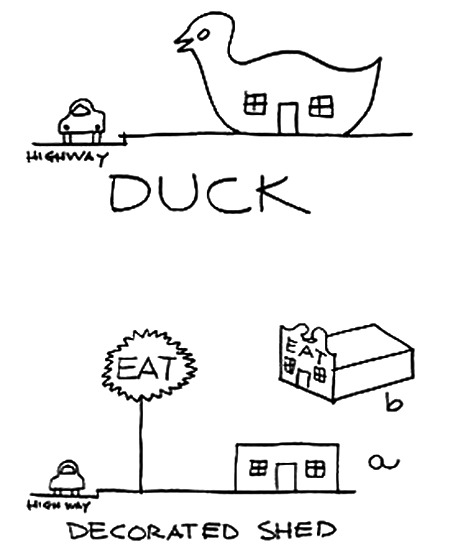
    Out of his work in Las Vegas came the notable comparison between a “duck” and the “decorated shed.” See above. The duck is modernism. The building itself becomes the symbol. No ornament is needed.

    The decorated shed, on the other hand, uses signage and other ornament to convey its symbolic qualities. The building itself can then be fairly nondescript, which also makes it flexible to a variety of different uses.

    This decorated shed approach is what guided the firm’s work and in 1991 he was awarded the Pritzker Prize in Architecture. 

    I love that he tried to have the award go equally to his partner Denise Scott Brown. The jury declined his request but he still used “we”, instead of “I”, throughout the entirety of his acceptance speech. Good.

    Thank you, Robert Venturi, for all of your contributions to architecture, as well as to the University of Pennsylvania.

  • Planning staff reports

    A bunch of people have asked me lately about what they should do if they want to get smarter on land use planning and on the entitlement process for development projects. It was specific to Toronto, but I don’t think my answer is specific to only this city.

    I took a few planning classes in graduate school when I was in the US. But I was more focused on architecture and real estate, and so I did not leave school an expert by any means.

    I learned about the failures of euclidian zoning and about things like the Low-Income Housing Tax Credit, which always seemed like a sensible supply-side tool to get the private sector to invest in affordable housing.

    But what I have found most useful is to just read planning staff reports. These are the responses to actual development proposals and they show you how staff interpret the policies that are in place and how staff apply them to real buildings.

    I may be in the minority in that I actually find these reports interesting. But regardless, they are a great crash course in planning and development approvals and they can help you manage your entitlement risk.

  • Architecture’s great injustice

    This morning Jeanne Gang of Studio Gang published an op-ed in Fast Company detailing how her architecture and urban design practice closed the gender wage gap. 

    It is also a call to action and an example of something the firm calls “actionable idealism.” Here is an excerpt from the article:

    What we discovered was that, despite our ideological commitment to equality (and though our numbers were significantly better than all the U.K. architecture firms reporting, in all categories), a small pay gap nevertheless existed between the women and men in my office. We fixed that with this year’s raises and now have no wage gap as an organization.

    To learn more about how they accomplished this, check out the full article. And if you’d like to meet Jeanne Gang in Toronto this week and learn more about what we’re up to at Yonge + St. Clair, click here.

  • Traffic signal inequality

    image

    David Levinson, who is based Sydney and authors the Transportist – a blog you should follow if you don’t – has a recent post up about signalling inequity and “how traffic signals distribute time to favour the car and delay the pedestrian.” In it he provides some background into traffic signal coordination (introduced in New York City in 1922), as well some some suggestions for how we could and should be prioritizing pedestrians.

    Here is an excerpt from the article:

    There is a reason that traffic engineers don’t automatically allocate pedestrian phases. Suppose the car only warrants a six second phase but a pedestrian requires 18 seconds to cross the street at a 1 meter/second walking speed. Giving an automatic pedestrian phase will delay cars, even if the pedestrian is not there. And there is no sin worse than delaying a car.  But it also guarantees a pedestrian who arrives just after the window to push the actuator passes will wait a full cycle.

    Sometimes pressing the walk button appears to do nothing. I suppose that’s why some cities call it the “placebo button.” And in other cases if you don’t press the walk button you’ll never get a walk sign. That’s usually a strong indicator that you are located in an environment not intended for pedestrians. David’s article also has me curious about the relationship between traffic signals/pedestrian phases and urban form. I bet you could tell a lot about the latter simply by understanding the former.

    Image: Transportist

  • Anachronistic employment areas

    Today I was at the Land & Development Conference here in Toronto. I started live tweeting during the breakfast, but my vintage iPhone 6 couldn’t keep up, so I had to stop. Some insights throughout the day. But a lot of what you would expect. I suppose it’s more about the networking.

    I would, however, like to reiterate something that Ken Greenberg mentioned about Employment Areas/Lands in Toronto. For those of you who aren’t familiar, these lands are essentially intended to serve one, and only one, purpose: employment. And the process for introducing a mix of uses, including residential, is an onerous one to say the least.

    I appreciate why this is the case. But I agree with Greenberg in that this kind of single use zoning is antiquated. It does not reflect the realities of the market today. There are other mechanisms we can use to maintain and provide for employment, and ensure that we don’t end up with a city of all residential.

  • Two new chiefs

    image

    There were some big announcements in the planning world this past week here in the Greater Toronto Area. Gregg Lintern (follow him on Twitter) was named the new chief planner of Toronto (he was previously the acting chief planner following Jennifer Keesmaat’s departure) and Andrew Whittemore (couldn’t find him on Twitter) was named the new chief planner of Mississauga.

    As I went through the articles announcing the above appointments, I couldn’t help but be reminded that this region is at an exciting and pivotal moment in its history. All of the talk is about improving urban mobility (i.e. becoming less dependent on cars); intensifying around transit stations (as well as gently intensifying neighborhoods); making downtown a better place for families; and so on.

    It can be easy to feel defeated in this big bad world of city making. Oftentimes things seem to get reduced to either urban vs. suburban rhetoric or, as if nothing else matters, this one simple question: “But, how tall is the building?” So its nice to know that those at the helm continue to see endless opportunity in this region. I know that I wouldn’t want to be doing what I’m doing anywhere else.

    Photo by mwangi gatheca on Unsplash

  • The 100 million city

    The Guardian recently published this reminder that the real population growth in the world today is happening in Asia and Africa. The article is called, “The 100 million city: is 21st century urbanisation out of control?” Much of the data is from this 2016 paper by Daniel Hoornweg and Kevin Pope, which projected the populations of the world’s biggest cities by 2100.

    The standout example is that of Lagos, Nigeria, which went from under 200,000 people in the 1960s to an estimated 20 million people today. Though, I would imagine that the ubiquity of informal settlements makes it difficult to come up with an accurate number.

    Still, it is one of the world’s top 10 largest cities and, by 2100, it may be the largest city in the world. The Guardian described the population as young, fertile, and increasingly urban. The median age in Nigeria is 18 and the fertility rate for the content is 4.4 births per woman.

    I am mentioning all of this today because I think it grants some perspective. This is an immense city building challenge, not only because of the unprecedented growth rate, but also because it remains largely poor. Lagos, a city, may add more than 2.2x the population of Canada, a country, during the balance of this century.

  • Neighborhood depopulation

    Recently we’ve been talking about California’s Proposition 13 and how it may be creating a disincentive for longtime homeowners to move. They’re enjoying below market property taxes, and so they stay put, even if they may have too much house.

    But this concept of “overhousing” isn’t unique to California. The Globe and Mail just ran a piece talking about how Toronto’s designated “Neighborhoods” are losing people as the nests empty out, seniors remain put, and the broader city booms.

    The rate of depopulation that created the spare bedrooms in Toronto’s low-rise neighbourhoods is stark: “Since 2001, about 52 per cent of the land mass of Toronto has reduced in density of population by about 201,000 people,” Mr. Smetanin says. “Other parts of Toronto have grown by 492,000.”

    The irony of this phenomenon is that the city’s Official Plan considers these Neighborhoods to be “physically stable”, as well as “one of the keys to Toronto’s success.” However, things are clearly changing behind that physical stability.

    Photo by Verne Ho on Unsplash

  • Last-mile electric scooters — will they work?

    I’ve been hearing a lot about Bird recently. Perhaps it has something to do with the $15 million Series A round they raised last month (February 2018) and the $100 million Series B round they announced earlier today.

    A “Bird” is small electric scooters that look like this and can be rented from your phone for short haul trips. They are currently available in Santa Monica, Venice, UCLA, Westwood, and San Diego, and they are intended to be ridden in existing bike lanes.

    What may be particularly interesting to this blog audience is the fact that Bird is calling itself a “last-mile electric vehicle sharing company.” The pitch: 40% of car trips (in the US?) are less than 2 miles long. Let’s replace those using electric scooters.

    One of the first things that came to my mind is that this feels more accessible than cycling. Cycling to work can be a commitment. You have to think about your attire and the sweat factor, among other things.

    Would you agree?

  • Are we entering a new era of tech-driven city building?

    Emily Badger of the New York Times published an interesting piece yesterday talking about the tech industry’s current obsession with trying to fix cities. And there are certainly many problems to fix.

    Staying true to tech and engineering parlance, there’s lots of talk of optimization. How do you technologically optimize a city, for things such as affordable housing?

    There’s no doubt that many of you will sympathize with this statement: 

    To planners and architects, all of this sounds like the naïveté of newcomers who are mistaking political problems for engineering puzzles.”

    But naïveté is not always a bad thing and with all of the money sloshing around in this industry, there’s also no doubt that this is likely a new era of city building.

    The article ends by quoting JD Ross, the 27-year old co-founder of Opendoor – a startup that we have discussed many times before on this blog and is now valued at over $1 billion.

    It is him saying that he wants to figure out how to put $100 million into this space as soon as he can figure out the right target to optimize for. “It’s better than buying a Bugatti.”

    Of course Sidewalk Toronto – which is mentioned a few times throughout the article – is already a perfect example of tech infiltration.

    But I think Dan Doctoroff gets it right when he posits that the real naïveté will come from disrespecting urbanist traditions.

    Photo by David Alacaraz on Unsplash