Daily insights for city builders, delivered every morning at 6 AM ET. I’m Brandon Donnelly — a Toronto-based real estate developer and founder of Globizen. I’ve been writing here since 2013.

Tag: parking

  • The most expensive parking spot in the world

    I saw in the news recently that Hong Kong just set a new world record for the most expensive parking spot. I think it also held the previous record.

    Last month somebody paid HKD 6 million for a single stall in the Ultima apartment complex in Kowloon. That’s about USD 765,000 or CAD 1 million based on today’s rates. And the spot is 16.4 feet x 8.2 feet, so that works out to about CAD 7,436 per square foot. 

    What is clear is that supply is not keeping up with demand. Here is the stat from a recent Toronto Star article:

    The number of parking spaces grew just 9.5 per cent to 743,000 from 2006 through 2016 [in Hong Kong], while the private car population surged 49 per cent to 536,025, according to a report by the city’s Transport Department.

    There are a number market forces which are undoubtedly bringing down the ratio of parking stalls to housing units. That same phenomenon is also pretty clear here in Toronto. But it is interesting to note the continued growth in private cars.

  • Form follows parking

    “Form follows function” is a famous axiom of 20th century Modern architecture. It is based on the rational notion that architecture and its associated shapes, geometries, and spaces should be a direct result of their function. 

    It was a way of trying to eliminate the arbitrary ornament that had adorned previous architectural movements. In this case, if it had no function, then it should be stripped away.

    There have been many bastardizations of this pithy statement over time, but one of my favorites is: “form follows parking.” Obviously derogatory, it is this idea that much of the built environment is a result of parking requirements, rather than of more human factors.

    We see this in suburban building typologies (large surface parking lots), but also in urban infill projects where the below grade parking begins to dictate the structural grid and layout of the upper floors. It is, of course, necessary in many cases, but there’s also something subversive about parking having such a lasting impact on the spaces we occupy.

    That said, we know where the trend line is headed when it comes to parking. Streetblogs recently posted an article about the scarcity of parking in Manhattan and cited number of interesting stats.

    Because of the city’s bike-share program (introduced in 2013) and because of all of the bike lanes that have been added in recent years, the city has (rightly) removed approximately 2,330 on-street parking spaces in Manhattan south of 125th Street.

    Here’s another set of stats: 

    In 1998, New York City had about 810 parking lots and garages south of 60th street. Together, they accounted for approximately 112,826 parking spaces. As of last year (2016), the number of lots and garages had dropped to about 643 and the number of parking spaces to approximately 95,000. That’s a decline of about 16%, during a period of when the population of Manhattan grew by more than 100,000 people.

    I would also imagine that these pressures are increasing. So it is quite possible that “form follows parking” could be on its way toward obsolescence. I certainly feel it waning.

  • Low cost energy efficient homes perched atop of surface parking

    A regular of this blog recently suggested (in the comments) that I take a look at the London-based design firm ZED Factory. ZED stands for Zero Energy Development.

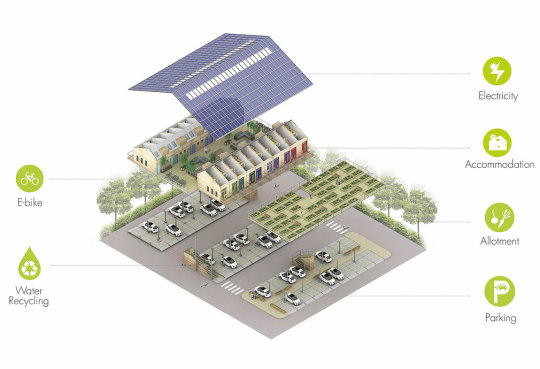
    The first project that caught my attention was ZED Pod. ZED Pod is a small, low cost energy efficient modular home that is designed to sit atop of surface parking lots. In other words, it’s a way to repurpose under-utilized surface parking without compromising existing parking ratios. All you really need are the air rights. And since the “land” is cheaper, the homes can be cheaper. They can also be easily relocated if the parking lot were to get developed in the future (though they are designed as permanent structures).

    image

    In some ways, there is something perverse about the way that driving and parking have such a profound impact on the urban landscape. Even when it’s buried underground and hidden from sight, the structural column grid needed to layout efficient parking will often carry up through the building impacting suite layouts. We’ll even restrict housing supply when parking requirements can’t be met. Should it be parking or people who come first?

    But cars aren’t going away. And ZED Pod is a clever way of dealing with an existing urban condition – however suboptimal it may be. I found the concept interesting and I thought you all might as well.

    Image: ZED Factory

  • How will self-driving vehicles change our cities and our habits?

    Last night
    I had a dream that I was driving around in a snowstorm and, for whatever
    reason, my tires had almost no tread on them. So I was all over the road.
    Strange. I have no idea what this means, if anything at all.

    But it did
    remind me that I can absolutely imagine a time when the thought of driving your
    own car (outside of it being maybe a hobby) will seem positively archaic. I
    mean, think about how messy our current system is. Roads are a chaotic and
    oftentimes dangerous place.

    The more
    interesting question for me though is: how will self-driving vehicles change
    our cities, our habits, and so on? In Elon Musk’s recently published Master
    Plan (Part Deux)
    he outlines 4 main goals for Tesla:

    1. Create stunning solar roofs with
      seamlessly integrated battery storage
    2. Expand the electric vehicle product
      line to address all major segments
    3. Develop a self-driving capability
      that is 10X safer than manual via massive fleet learning
    4. Enable your car to make money for
      you when you aren’t using it

    Let’s think
    about what these could mean.

    One
    translates into decentralized energy generation and storage. Now all of a
    sudden the cars on our roads will be roaming around our cities collecting and
    storing energy, eventually returning home at the end of the day to power our homes.
    I can already imagine fleets of sun worshipping cars chasing the light as it
    moves across our cities.

    Two is recognition
    that self-driving vehicles are going to have a meaningful impact on traditional
    public transit. (Elon reveals that Tesla is working on high passenger-density
    urban transport.)

    Three
    addresses the chaotic current state and the massive potential of networked
    cars.

    Four is particularly
    interesting to me. I wonder to what extent this income will simply subsidize
    car ownership or if it could actually transform cars into an investment (rather
    than purely an expense). Will people end up buying self-driving vehicles in the
    same way that people buy real estate for yield?

    Furthermore,
    how does this notion of a shared vehicle pool now completely change the way we
    think about parking requirements. For instance, today we think about parking in
    terms of individual usage. This tenant requires/wants X amount of parking. All
    2-bedroom apartments require Y amount of parking.

    But if we’re
    now all sharing our vehicles, parking requirements would then be based on some
    broader and collective demand curve. Parking would become less individualistic
    and instead become more of a yard where self-driving vehicles come to store
    themselves when not in use.

    Once again,
    we reach a point where utilization rates go up for each vehicle and overall
    parking demand goes down. Good thing we’re getting rid of parking minimums.

    What else could
    you see happening?

  • The cost of parking minimums

    Access Magazine has a good piece on parking minimums and the cost they create for our cities. The article is by Donald Shoup, who is Professor of Urban Planning at UCLA. He is also the author of The High Cost of Free Parking.

    Here is his argument:

    “Minimum parking requirements create especially severe problems. In The High Cost of Free Parking, I argued that parking requirements subsidize cars, increase traffic congestion and carbon emissions, pollute the air and water, encourage sprawl, raise housing costs, degrade urban design, reduce walkability, damage the economy, and exclude poor people. To my knowledge, no city planner has argued that parking requirements do not have these harmful effects. Instead, a flood of recent research has shown they do have these effects. We are poisoning our cities with too much parking.”

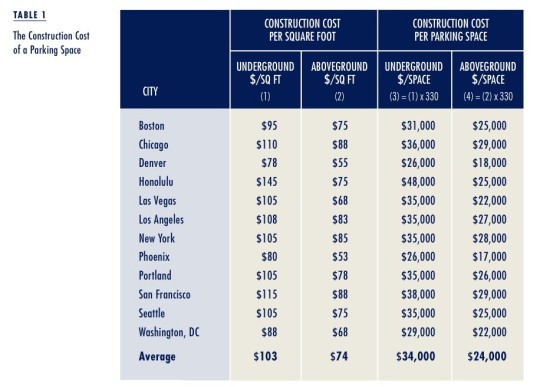
    And here’s his summary of what it costs to build a parking stall in various US cities (both underground and aboveground):

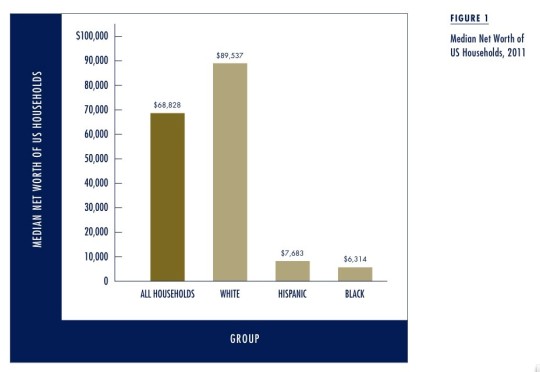
    To put these numbers into perspective, he also looks at the median net worth of US households (2011) to show just how expensive this parking is for some groups. 

    Because remember, these parking costs get embedded into the cost of housing, retail stores, and so on.

  • What it takes to unlock infeasible development land (and some thoughts on parking)

    image

    One of the questions that came up after my recent post about land pricing was: what is it going to take to develop underutilized land on the outskirts of city centers?

    So today I thought I would talk about a new development project that was also discussed at the Land & Development conference I recently attended. I think will begin to answer this question.

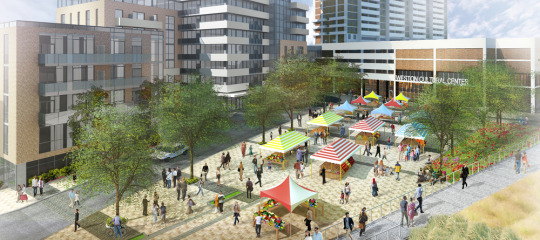
    The project today is known as the Rockport Weston Community Hub & Rental Building. And it’s going to include a community cultural hub, 26 live/work artist spaces, and 300 rental apartments. 

    It’s located in the Weston neighborhood of Toronto, which is designated as a “Neighborhood Improvement Area.” These are lower-income areas that the city considers to be “at-risk.”

    Given this, rents are naturally lower here than in other parts of the city, which means that it’s basically infeasible to develop here. There has been no large scale development in this community since the 1970s!

    To put some numbers to this, the developer said they were projecting rents somewhere around “two and a quarter.” So let’s assume for a second that the average apartment rents will be $2.25 per square foot. 

    At this rate, it means that a 600 square foot one-bedroom apartment will have a face rent of $1,350 per month. This may seem fairly high, but it almost certainly wouldn’t be enough to get a project like this off the ground under normal market conditions. At least, that’s the case here in Toronto with current cost structures.

    So what had to happen was a fairly complicated public-private partnership, which you can read all about here. But at a high level, there seems to have been 3 main economic factors that allowed this project to move forward:

    1) The developer was able to acquire the land for cents on the dollar. As I said in this post, land is expensive. So this helps a lot.

    2) The developer was able to make use of extra parking in an adjacent building. Assuming that underground parking could cost around $50,000 per stall, this is a huge cost savings.

    3) Lastly, the project is benefiting from the public invest made in the airport rail link that now quickly connects this site to both Pearson International and downtown Toronto.

    The moral of the story is that infeasible sites require some sort of subsidy or top up to make them work. Or, there needs to be an exceptional circumstance. Because if the rents aren’t there, nobody is going to build. It’s as simple as that.

    That said, here’s one idea…

    This discussion reminds me of a post I wrote a while back called, The hypocrisy of parking minimums. Frankly, I don’t understand why a city like Toronto still has parking minimums. If anything, we should have parking maximums.

    Underground parking is a huge cost that has to get carried by purchasers and renters in a new building. For example, let’s assume that 300 apartment suites would require 180 parking stalls (ratio = 0.6). Assuming $50,000 per stall, that’s a $9 million cost.

    So the second takeaway is that it’s probably time we took a good hard look at how we think about and plan for parking in our cities. Especially since the entire mobility space is being quickly disrupted.

    Image: Rockport

  • What do you think of parking stackers?

    One of the things that’s becoming a lot more common in Toronto is parking stackers. For small infill sites there’s simply no other way to fit in the parking. You can’t lay out a traditional parking garage.

    But while it’s still relatively new for Toronto, I think many of you would be surprised by how many projects there are in the pipeline right now that plan to use parking stackers. In the next 5 to 10 years, they are going to be quite common.

    Some of you might be wondering how they work. There are a bunch of different solutions, from stackers to elevators and palettes, but here’s an example of a triple car stacker:

    In this case, there’s a below grade pit and an open space that goes up into the second floor. This way each car remains accessible without having to move any of the others. If you want the car on the top shelf, just lower the other 2 into the pit. If you want want the car on the bottom shelf, just raise the other 2 into the second floor space (which is what’s shown above).

    But here’s what I’m really curious about: How do you feel about parking stackers? Would you live an apartment or condo where that was how you had to park your car? Or would it be a deal breaker? Please let us know in the comment section below.

  • Should you buy a car or just take Uber?

    Urban dawn by Raymond  on 500px.com

    https://500px.com/embed.js

    My friend Evgeny published a great blog post today called, On Car Ownership And The Future Of Transportation

    And in it he made the argument that instead of buying a car and an expensive downtown Toronto parking spot (average price: $40,000 – 60,000), most of us urbanites would be better of just taking a taxi or Uber.

    This got me thinking: At what point does it really make sense to completely forgo owning a car? (Full disclosure: I own both a car and a downtown parking spot.) So I decided to dig into the numbers a bit more and compare 4 mobility options:

    • Owning a car ($25,000 upfront) + downtown parking spot ($40,000 upfront) and driving yourself everywhere
    • Taking a regular taxi exclusively ($3.25 base + $1.75 per km)
    • Taking an UberX exclusively ($2.50 base + $1 per km)
    • Or, taking a futuristic driverless car everywhere (here I assumed $1.50 base + $0.25 per km)

    With the above numbers, I then assumed 15,000 km traveled per year and an average trip length of 15 km (so 1,000 trips per year). The trip length and number of trips per year matter because of the “base fare” that is charged when you take a taxi or Uber.

    I also assumed that the cost of owning a car is $0.60 per km (estimated from this Globe and Mail article) and that there is an opportunity cost to NOT renting out your downtown parking spot ($200/month). That is, every month that you spend driving yourself around and parking your car, you are forfeiting parking revenue.

    Finally, I looked at a 10 year time horizon and then “discounted” all the costs back to today’s dollars so that I could compare each mobility option.

    So what did I find?

    image

    What this says is that if you’re driving 15,000 km per year (average trip length 15km), then you’re better off taking UberX everywhere, as opposed to going out, buying a car and parking spot, and driving yourself around.

    But does this hold true at different travel distances?

    Based on my model, once you hit around 18,000 km per year, then you’re better of with option 1 (owning a car). That’s because the per km savings associated with driving yourself around are enough to offset the upfront costs of the car and parking spot.

    On the flip side, when you drop below 7,500 km traveled per year, even a regular taxi starts to make sense. That’s because you’re simply not traveling enough to reap the benefits of owning a car/parking spot. Again, high upfront costs; lower per km operating costs.

    Of course, there are a number of things I didn’t consider in my model. For one, most people finance their car and parking spot (it is bundled into their home mortgage). So I’m sure there are ways that you could change the above outcomes using leverage.

    At the same time, I didn’t account for the fact that when you’re being driven around (as opposed to driving around) you have the flexibility of doing work, responding to emails, and so on. If you want to attach a value to your time, then the scale would tip back in favor of taxis and Uber.

    But all of this was really just to make one point: look how cheap it could be to ride around in a driverless car. When that becomes the reality in our cities, which it will, it’s going to completely transform our current beliefs around cars, parking, and many other things.

    I guess that’s why General Motors just invested $500 million in the peer-to-peer ridesharing company, Lyft. They know the shit is coming.

  • 16 mobile theses and how tech might change the built environment

    Caucasian woman standing near passing subway in train station by Gable Denims on 500px.com

    https://500px.com/embed.js

    One of the things that I try and do here on this blog is examine the intersection of design, real estate, and technology. I didn’t explicitly set out to do that, but more and more I find myself thinking that way when I’m writing and when I’m giving talks.

    Part of that is because of my passions, but part of it is because there is a big and important overlap. One example of that is autonomous, self-driving cars. The tech community is enamoured with driverless cars, but everyone involved in the built environment should also be thinking about their impacts. Because it’ll be significant.

    Benedict Evans – who is a venture capitalist with Andreessen Horowitz in the Valley – recently published a post called, 16 mobile theses. It’s a look at 16 topics, trends, and shifts that are happening in the tech space. (There’s also a related podcast discussion.)

    If you’re involved in internet products, you absolutely need to give it a read. But I also think it’s interesting to read it through the lens of a designer or real estate person. Productivity is changing. Notions around the living room are changing. And yes, autonomous vehicles are going to have a profound impact on the urban landscape of our cities – just as cars did initially.

    Below are 3 excerpts from Benedict’s post that I really enjoyed.

    The first is about mobile and just how massive it is:

    “The mobile ecosystem, now, is heading towards perhaps 10x the scale of the PC industry, and mobile is not just a new thing or a big thing, but that new generation, whose scale makes it the new centre of gravity of the tech industry. Almost everything else will orbit around it.”

    The second is about how “networked” is quickly becoming a given:

    “Our grandparents could have told you how many electric motors they owned – there was one in the car, one in the fridge and so on, and they owned maybe a dozen. In the same way, we know roughly how many devices we own with a network connection, and, again, our children won’t. Many of those uses cases will seem silly to us, just as our grandparents would laugh at the idea of a button to lower a car window, but the sheer range and cheapness of sensors and components, mostly coming out of the smartphone supply chain, will make them ubiquitous and invisible – we’ll forget about them just as we’ve forgotten about electric motors.”

    And the third is about those self-driving cars:

    “The move to electric and the move (if and when) to autonomous, self-driving cars fundamentally change what a car is, but also what the whole automotive system might look like. Electricity changes the mechanical complexity of cars and hence changes who might build them and what they might look like. Autonomy and on-demand services change who buys them, meaning the buying criteria will be different. But they could also change the urban landscape just as much as cars themselves did – what do mass-market retail or restaurants look like if no-one needs to park?”

    Can you think of other ways in which tech will impact cities and the spaces we occupy?

  • Big box stores are the new noxious-use

    As a follow-up to yesterday’s post on New Urbanism, I thought I would post an interesting video discussion between Andrés Duany and Ben Stevens. 

    Duany is the father of New Urbanism and Stevens runs a great blog called The Skyline Forum where he interviews notable city builders, developers, architects, planners, and so on. If you can’t see the video below, click here.

    [youtube https://www.youtube.com/watch?v=QfZZ61C4YOY?rel=0&w=560&h=315]

    Once again it’s a great reminder that so much of what we do and build in our cities is dictated by parking requirements. One of the ways Duany differentiates New Urbanism from “old urbanism” is that the new explicitly provides for the car. 

    Regrettably, I think we do that almost everywhere nowadays. But I take his point that New Urbanism happens almost as an intervention in areas where there are few or no other mobility options besides the car.

    I also thought it was interesting that Duany refers to big box stores as the new noxious-use in cities, rather than industry. He describes the parking, not the stores themselves, as creating a “flume of unwalkability.”

    It always seems to come down to parking.