
Daily insights for city builders, delivered every morning at 6 AM ET. I’m Brandon Donnelly — a Toronto-based real estate developer and founder of Globizen. I’ve been writing here since 2013.

Tag: openness

  • City guides in the pre-smartphone era

    I came across this stack of old Wallpaper city guides while reorganizing a few things over the weekend (because that’s what happens on the weekends now). They are pretty beat up and color faded from travel. It looks like these guides are still being published by Phaidon (along with an app), but it’s been well over a decade since I bought one.

    I know the exact time period of the above books because I used to do really nerdy things like date and location stamp them when I got them. The Rome book was July 2007 and I picked it up in Dublin, while I was there working for a real estate developer before the global financial crisis. I also discovered old phone numbers and email addresses written inside of them. Usually it was a Hotmail address.

    What I liked about these guides is that they were fairly condensed — good for a long weekend — and they were generally design-focused — perfect for architecture nerds like me. Their restaurant, bar, and club selections were also just fine as a jumping off point. After that it was up to you to make your own adventure.

    I sent this photo to my friend Alex Feldman over the weekend — he also went without any sleep in Berlin — and he reminded me what it was like at this time. This was 2007. The first iPhone was just being released. Its map functionality was nowhere near what it is today (or didn’t exist). And I certainly didn’t have one. I had a Blackberry with a plastic wheel on the side. It was basically a giant pager.

    To navigate a city at this time meant using a physical map. It also meant getting repeatedly lost and having to ask real people where to go. Alex also reminded me that I made him wander all around Berlin so that I could buy a new pair of glasses. What can I say, this was pre-laser Brandon and I needed cool architect glasses. They ended up being red.

    As frustrating as this must have been at times, there’s something nice about traveling without knowing each and every step and without being able to summon an Uber at any point in time to take you exactly where you want to go. In fact, this is probably the central ingredient of all good travel: you need to allow yourself to be open to new experiences.

    One of the great lessons of Anthony Bourdain was that you have to get out of your comfort zone. Cities have both highs and lows, but there’s real value and authenticity in the lows if you’re willing to engage beneath the surface. Perhaps that is the irony of old fashioned guide books in the pre-smartphone era. They were supposed to tell you exactly where to go, but they actually helped you find the opposite.

    The only city that I never actually got around to visiting from the above stack is São Paulo. As you can tell, Brazil has been on my list for many years. I did make it to Rio de Janeiro a few years ago and São Paulo was supposed to be October 2020. But I’m pretty sure that trip will need to wait. Maybe I should leave my phone at home.
  • Staying foolish

    I am still a young guy, but already I find people of my vintage starting to hate on some of the things that even younger people are into.

    I hear people say that they’re not into Snapchat because it’s for teenagers. What’s the point?

    I hear people say that they don’t get why anyone would want to rent an urban shoebox. It’s so small. Do you have to hang from the ceiling like a bat when you sleep?

    I hear people say that they don’t get how that new app will ever make money and turn into a business. It’s just a toy.

    It’s so easy to fall into this mentality, where you think that you’re right and everyone else is wrong. But it can be toxic.

    Because what is crazy and fringe today could very well become mainstream tomorrow. And the earlier you can recognize that shift, the easier it is to stay ahead of the curve in business and in life.

    I’m not suggesting that we all try and predict the future. Instead I am suggesting that we all try and remain as open as we can so we recognize the shifts earlier.

    I think there can be a natural tendency to close up over time – unless you deliberately fight it. We start to believe that there’s a certain way that things should be done. We get busy and don’t want to reinvent the wheel. I find myself falling into that trap sometimes and then I try and fight it. This must be why Steve Jobs told us to “stay foolish.”

    In an information and attention economy where the best new ideas win, it pays to keep an open mind.

    (This post was written on my phone which is why it’s void of links.)

  • [Video] Interview with designer Marcel Wanders

    I just got home from Christmas dinner and I am so full that I can barely keep my eyes open. So rather than attempt to write something insightful, I am going to share a 2 minute interview with designer Marcel Wanders.

    [youtube https://www.youtube.com/watch?v=w78Bjfscii0?rel=0&w=560&h=315]

    It’s a short piece, but he covers some interesting topics such as his office culture and the value of Amsterdam for their creative process (specifically the city’s openness and tolerance).

    Regular scheduled programming will resume tomorrow. 

    And sometime before the end of the year I’m going to do a summary of 2015 on ATC and make some predictions for 2016. I haven’t really done the prediction part before, but I think it would be a good practice to start.

    Until tomorrow 😴

  • The benefits of sharing — what real estate could learn from tech

    One of the reasons I decided to start blogging was because I saw how open the tech community had become – with respect to sharing their ideas and experiences – and I thought that the same thing could and should be done in real estate, as well as in city building more broadly.

    But in many ways, the real estate industry is the antithesis of the tech industry. We are slow moving and secretive of our ideas. Now, some of this is driven by fundamental differences in terms of how these two sectors operate. It’s a lot easier to test and iterate on your ideas in tech than it is with actual bricks-and-mortar. But I still think about ways in which we, in real estate, could be pushing the envelope.

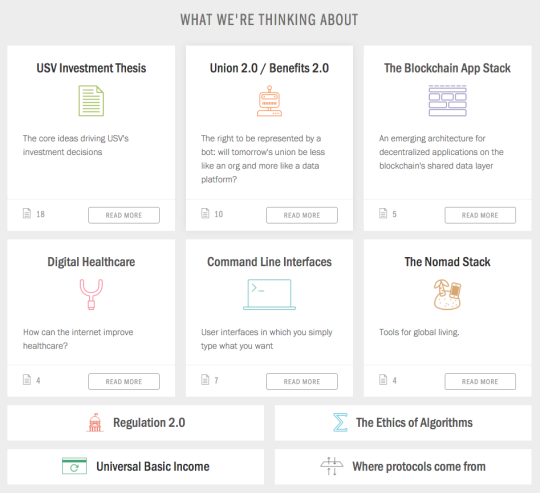
    As one example of what I’m talking about, take Union Square Ventures in New York. They call themselves a “thesis-driven venture capital firm”, which means they come up with a framework and core set of ideas, and then use those to drive their investment decisions.

    You would think that these frameworks and ideas would be pretty sensitive. I mean, they are the core drivers of their business. But their entire website is actually set up around sharing and collaborating – with the public – on these ideas. Here’s a screenshot:

    image

    Each topic is something they are “thinking about” and something they want to make an investment in (or already have). Fascinating.

    Many of you, I’m sure, would argue that there are risks to doing this. But there are also benefits, some of which are driven by collective intelligence. By sharing their ideas and hypotheses with the public, it helps to evolve their thinking. After all, their investment thesis is not a static thing. It grows over time.

    But in addition to this, it also makes it abundantly clear to their customers (entrepreneurs) what they believe in and what they look for. And I am sure this helps them with deal flow. More and more customers aren’t just “buying” a product, they are also “buying” a philosophical underpinning and belief system.

    Can you imagine a real estate firm doing something like this? I can. But it’s not happening yet, as far as I know.

  • True Condos Podcast: Transparency in the Real Estate Industry

    A few weeks ago I was invited by Toronto realtor Andrew la Fleur to participate in his True Condos podcast series. I had actually never met Andrew before in person, but I knew of him because of Twitter, his blog, and because he was an early user of my past startup, Dirt.

    I was initially a bit apprehensive about being on a realtor podcast, because I thought it might end up as some sort of cheesy marketing piece. But I’ve come to learn that Andrew is not that kind of guy. He’s also interviewed some really great people in his podcast series (here’s the full list), so I feel honored to have been invited. 

    I’ve embedded the podcast below, but if for whatever reason you can’t see it, click here to be redirected to Andrew’s site. We talk for about 30 minutes, with a big focus on openness and transparency in the real estate industry. Thanks again for the invite Andrew. It was great to meet you in person.

    http://www.podbean.com/media/player/audio/postId/5289048?url=http%3A%2F%2Ftruecondos.podbean.com%2Fe%2Fbrandon%2F

  • Will real estate developers open up, too?

    A few months ago I read a book by venture capitalist Ben Horowitz called “The Hard Thing About Hard Things.“ It was a great read and I recommend it to anyone who currently or plans to one day manage and lead people. But on a side to that, one of the things I found really interesting is the shift he talks about in the venture capitalist business.

    Over the span of a decade, venture capitalists went from being ivory tower professionals to incredibly open and transparent. And they did that primarily through blogging. Just yesterday, I saw somebody tweet out that the key to becoming a venture capitalist in 1994 was to get an MBA. Today, it’s to start a blog.

    The reason I find that interesting is because I predict that the same transformation is going to happen in the real estate development business. Today, most developers are pretty opaque. The people and personalities behind the projects are still generally concealed (save for a few developers) and my sense is that there’s still very much a fear of exposing and sharing too much.

    But the lesson to be learned from the VC business is that blogs have become one of, if not their most important customer acquisition tool. I read somewhere that entrepreneurs—which are the customers of VCs—are most heavily influenced by blogs over any other medium. That is how they decide who they will allow to invest in their business.

    Which is why I think it’s only a matter of time before the same sort of dynamic plays out in the real estate business. In fact, one of the most common questions I get from readers of ATC is about the reputation of developers and builders. Customers—before they decide who they will allow to build their future home—not surprisingly want to know something about the developer.

    So if you’re a developer looking to sell more homes or lease more space,   I suggest giving blogging a try. It’s hard work, but I think you’ll be surprised at how effective a tool it can be.

  • As a general rule, the most successful man in life is the one who has the best information.

    Benjamin Disraeli