Daily insights for city builders, delivered every morning at 6 AM ET. I’m Brandon Donnelly — a Toronto-based real estate developer and founder of Globizen. I’ve been writing here since 2013.

Tag: oma

  • 3 thoughts from Rem Koolhaas

    Earlier this year, architect Rem Koolhaas of OMA spoke with Mohsen Mostafavi (dean of the Harvard Graduate School of Design) to close out the 2016 AIA convention

    I still remember my first architectural theory class where the professor told us all that Koolhaas was the most important living architect of our time. And today, if you think about all of the stars that have grown out from his firm – such as Bjarke Ingels and Joshua Prince-Ramus – it is certainly a defensible argument.

    Koolhaas is generally very critical of globalization and the market economy when it comes to creating good architecture. His view is that “pure profit motives” are leading to cities that are basically not designed.

    This is a fairly common belief within architectural circles, which is why many celebrated names would rather work on a museum over a residential condo project. The latter is too motivated by profit. It’s not architecturally interesting.

    I, on the other hand, have always believed in working within the confines of the market to try and promote great architecture and city building. I’m not saying that the market is perfect, but profitability is a constraint that every industry deals with. Architecture is no exception.

    That said, there are other things that I agree with Koolhaas on. Below are 3 verbatim highlights taken from a Fast Company article summarizing his talk with Mostafavi: 

    Communication needs an overhaul.

    “Architecture has a serious problem today in that people who are not alike don’t communicate. I’m actually more interested in communicating with people I disagree with than people I agree with.”

    "To have a certain virtuosity of interpretation of every phenomenon is crucial. We’re working in a world where so many different cultures are operating at the same time, each with their own value system. If you want to be relevant, you need to be open to an enormous multiplicity of values, interpretations, and readings. The old-fashioned Western ‘this is’ ‘that is’ is no longer tenable. We need to be intellectual and rigorous, but at the same time relativist.”

    Architecture’s greatest value in the future might not even be architecture.

    “Architecture and the language of architecture—platform, blueprint, structure—became almost the preferred language for indicating a lot of phenomenon that we’re facing from Silicon Valley. They took over our metaphors, and it made me think that regardless of our speed, which is too slow for Silicon Valley, we can perhaps think of the modern world maybe not always in the form of buildings but in the form of knowledge or organization and structure and society that we can offer and provide.”

    Preservation is a path forward.

    "We’ve tried to discover domains and areas in architecture which are not a simple vulgar multiplication of uninspired global projects. Recently, we have looked at preservation. The beautiful thing about preservation is you begin with something that already exists and therefore is already local. By definition, a preservation project is an homage to earlier cultures and mentalities to which you can add a new dimension, a new function, a new beauty or appeal. Almost every impulse signals that globalization needs rethinking or adjustment.”

  • Architecture as a tool of capital

    I just stumbled upon an interesting Architectural Review article from last year called: Architecture is now a tool of capital, complicit in a purpose antithetical to its social mission. The author is Reinier de Graaf, who is an architect and partner at the firm OMA.

    The focus of the article is on inequality; capitalism vs. socialism; Thomas Piketty’s book, Capital in the Twenty-First Century (which is now on my reading list); and on how Modernism lost its social mission and got repurposed as a tool that just serves capitalist interests. It went from an ideology to simply an architectural style.

    Here is an excerpt:

    “Once discovered as a form of capital, there is no choice for buildings but to operate according to the logic of capital. In that sense there may ultimately be no such thing as Modern or Postmodern architecture, but simply architecture before and after its annexation by capital.”

    Given that I am initially trained as an architect, but that I work as a real estate developer, this article hits home for me. But unlike the author, I am not as fussed by this intertwining of capital and architecture. In fact, I have always believed that the more architecture can understand its economic milieu, the more likely it can affect positive change.

    Of course, there’s the question of whether that economic milieu is even the right one in the first place. I’ll echo this blog post (on the limits of capitalism), by saying that I consider myself a capitalist, but not an absolute capitalist. Capitalism isn’t perfect.

    I like Reinier’s description of income vs. wealth (borrowed from Piketty):

    He identifies two basic economic categories: income and wealth. He then proceeds to define social (in)equality as a function of the relation between the two over time, concluding that as soon as the return on wealth exceeds the return on labour, social inequality inevitably increases. Those who acquire wealth through work fall ever further behind those who accumulate wealth simply by owning it.

    What are your thoughts?

  • De Rotterdam…

    image

    “Manhattanism is the one urbanistic ideology that has fed, from its conception, on the splendors and miseries of the metropolitan condition – hyper-density – without once losing faith in it as the basis for a desirable modern culture. Manhattan’s architecture is a paradigm for the exploitation of congestion.” 

    Rem Koolhaas, Delirious New York, 1978

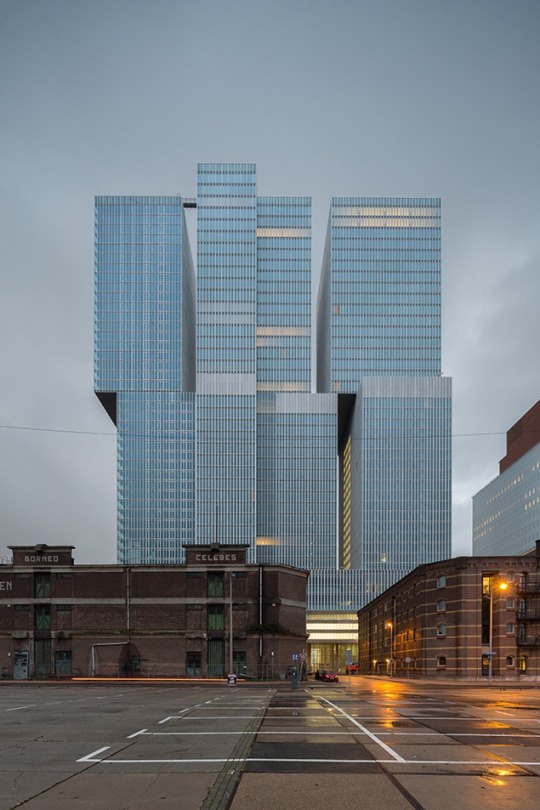
    Image: De Rotterdam by photographer Ossip Van Duivenbode via The Architectural Review

  • Day 1 in Quebec City

    I just checked into the Chateau Laurier Quebec after a busy day touring the city. I don’t have a ton of time to write this post before dinner (though I have a few post ideas brewing). I did however want to share some of the day’s events and some of my photos.

    After I landed I went straight to Île d’Orléans. I had never been there before so I’m glad I got the opportunity. It’s about twice the size of Manhattan and it has a population that hovers somewhere between 7,000 and 10,000 people depending on the season.

    The first stop was a “sugar shack”, which is apparently a big deal in Quebec and in the springtime. The place was packed. Here I had a traditional Quebec lunch (which was great) and I learned that all of the Canadian stereotypes are actually true. We really do put maple syrup on everything.

    After lunch I then asked if we could stop at a few of the local wineries. I love wine and I love wine culture.

    imageimageimage

    I picked up one bottle of “wine” from Cassis Monna & Filles. It’s actually made from black currants though, which I was told was illegal to grow in North America for a long time. It’s far more popular in Europe.

    The winery is run by a father and his two daughters. And I thought they did a great job with their brand story and their overall identity.

    After leaving the island, I then went to the Montmorency Falls. I had no idea Quebec had falls, but they do. And the vertical drop is bigger than that of Niagara Falls.

    image

    Finally, I finished the afternoon with a quick tour of downtown and the OMA designed expansion to the fine arts museums. It has one aggressive cantilever.

    Here’s a video of the project. Click here if you can’t see it below. 

    [vimeo 111133943 w=500 h=281]

    If you’re interested, you can also follow my social posts on the Porter Escapes website by clicking here.

  • The future of the architecture profession

    image

    Yesterday I had a really interesting conversation with somebody about the future of the architecture profession. We spoke about how Joshua Prince-Ramus of REX believes that architects have marginalized themselves as a result of shying away from liability. We spoke about how architecture schools need to teach more about about business and making money. And we spoke about why I decided to never practice architecture and instead become a developer.

    At the end of it all, he came to more or less the same conclusion that I did in this post. He felt that as more and more trained architects choose to become developers, that maybe the future will be firms that vertically integrate both architecture and real estate development. For those of you not in the building industry, this is fairly uncommon practice today. Typically, developers retain the services of an architect to design their buildings and do not handle this in-house.

    But there are firms that do. DDG out of New York and San Francisco is one example. Although there’s a subtlety worth mentioning. According to their website, they say that they often act as the “design architect” for their projects. This means that there would still need to be an “architect of record”, whose name would appear on the building permit and who would ultimately end up shouldering the liability for the design.

    You see, a bifurcation has happened even within the architecture profession itself. You have “design architects” who may or may not be licensed, but do a lot of the fun design work upfront for a project. And you have production oriented firms that actually produce the technical drawings needed for construction. The fees are generally higher in the latter case (unless maybe you’re a starchitect), but the work is less creative.

    The emergence of these two streams of architecture is precisely what Joshua Prince-Ramus is talking about when he says that architects have marginalized themselves by shying away from liability. He believes that architects are reducing themselves to designers and stylists, from master builders. So his argument is that architects need to reinsert themselves into more of the building process.

    What I’ve been suggesting is that architects should become owners. They should insert themselves into the development process. And the reason I feel this way is because I worry about the tendency for production and construction to just be farmed out to the lowest bidder. Design and development, on the other hand, are high value creation items.

    Truthfully though, I don’t really know which option is better for the profession in terms of relevance. I know which one I’m most interested in, but that could just be a personal preference. What do you think?

    Image: The Red List

  • A new model for the architecture profession

    Last week I provided a few suggestions for how architects might be able to transition over to real estate development. And I ended by saying that I loved architecture school, but that it could use a few more business and entrepreneurship classes. Today, I’d liked to expand on that idea.

    When I was doing my Master of Architecture at Penn, I spent a lot of time thinking about hybrid models for the architecture profession. I was trying to figure out a way to reconcile my love of design with my desire to be more of a building entrepreneur.

    I was interested in what Jonathan Segal was doing down in San Diego with his “architect as developer” approach. And I was really taken by a lecture that Joshua Prince-Ramus (formerly of OMA, now REX) gave where he talked about how architects have marginalized themselves (away from being the master builder) by shying away from liability.

    Out of all the models, conflating architecture and development seems to me like a real possibility. I believe that good developers understand good design and that good architects understand what’s good for the market. So why not merge the two?

    We know that the architecture profession is facing significant challenges; fewer and fewer architecture school grads are getting licensed and actually become a bona fide architect. Some think this calls for licensure reform, but I’m also interested in revisiting the model in its entirety.

    Imagine if every architecture school taught students how to design a building and then go out and actually get it leased up and built. Is this too much to ask of one discipline?

    I can see firms naturally splitting up roles between those who prefer the design side and those who prefer the selling and business side, but is there any reason why the same firm couldn’t be handling both?

  • The essence of the stock market is speculation

    Dutch architecture firm OMA (Office for Metropolitan Architecture) has a subtle way of being incredibly subversive in their architecture.

    The recently completed 1.9 million square foot Shenzhen Stock Exchange (SZSE) building is presently making the rounds online and I personally find it incredibly striking. It has the same timelessness about it that makes me love Mies’ Toronto Dominion Centre.

    But it wasn’t until I read the description on OMA’s website that I decided to blog about it. Here’s the first paragraph:

    “For millennia, the solid building stands on a solid base; it is an image that has survived modernity. Typically, the base anchors a structure and connects it emphatically to the ground. The essence of the stock market is speculation: it is based on capital, not gravity.

    All of these factors suggest an architectural invention: our project is a building with a floating base. As if it is lifted by the same speculative euphoria that drives the market, the former base has crept up the tower to become a raised podium.”

    It’s a powerful, yet potentially controversial, symbol, as one could argue that efficient markets should, at least in theory, operate not on ramped speculation but upon fundamental values. However, if markets are an expectations game, perhaps you could simply argue that the building symbolizes a perceived bright future.

    Either way, very interesting.