Daily insights for city builders, delivered every morning at 6 AM ET. I’m Brandon Donnelly — a Toronto-based real estate developer and founder of Globizen. I’ve been writing here since 2013.

Tag: olympic games

  • Nobody drives at the Olympics anymore

    One of the commitments that Paris made for this summer’s Olympics was ensure that every single competition venue was served and accessible by public transport. In fact, if you look on their website, it clearly says “no venues in the Paris region are accessible by motorized vehicles.”

    For those who attended, this seems to have worked out quite well. So much so that Los Angeles just made a similar commitment for the 2028 Olympic Games (excerpt from the New York Times):

    L.A. mayor Karen Bass said Saturday the city is working on expanding its public transportation system to hold a “no-car Games” in four years, which means spectators will have to take public transportation to all Olympic venues. To accomplish this, she added that L.A. will need more than 3,000 buses and plans to borrow them from around the U.S.

    Of course, the built environment of Los Angeles is slightly different than that of Paris’. One was built around the car, and the other was not. And I think the success of Paris 2024 shows how a robust public transport system is uniquely equipped to absorb significant demand shocks when needed.

    Here’s an excerpt from Le Monde talking about transit during the games:

    Not only was the audacious gamble of organizing the first Olympic Games completely accessible by low-carbon public transport, on bicycle and on foot successful. Not only was transportation to the many competition venues scattered around Paris and its surrounding region fluid. But the transit network and its agents also proved their ability to ensure, thanks to planned initiatives and adapted resources, fast, reliable and even pleasant travel. What’s more, the Paris Olympics offered the pleasing spectacle of a large city mostly freed, for a time, from the clutches and nuisances of automobile traffic.

    But regardless of built form, both of these examples represent one of the positive externalities associated with hosting the games. They force cities toward massive positive change, and that’s always a good thing.

  • Utah needs to secure 24,000 hotel rooms to host the Winter Olympics

    Sometime before the Paris 2024 Olympics this summer, the International Olympic Committee (IOC) is expected to announce who will host the 2030 and 2034 Winter Games. Right now, the two frontrunners are thought to be the French Alps and Salt Lake City/Park City — I think respectively.

    Obviously these are two fantastic winter locations. But one of the things that the local committees need to do before they can secure the games is show the IOC that they have enough hotel rooms on hand. More specifically, they need 24,000 rooms reserved for 33 nights. This covers 17 nights during the games, 14 nights before, and 2 nights after.

    Most of these rooms, about 10,000 or so, will go to journalists.

    I didn’t fully appreciate — or I just didn’t think about it — that this was something that needed to be done 6-10 years out. Because right now there is a human running around try to lock up these rooms in advance of the decision this summer.

    According to the Salt Lake Tribune, they’re already at 85% of the requisite 24,000 rooms. Though some of these rooms have yet to be built and some of them reach into neighboring Wyoming, which apparently isn’t an atypical distance when it comes to meeting this accommodation requirement.

    For obvious reasons, I’m rooting for Utah here. I really want them to get the Winter Games.

  • Swimming in the Seine

    There is an ongoing debate about the value of cities hosting the Olympic Games. And that’s because this is usually how it works: You, the host, spend a lot of money (Tokyo 2021 was over $25 billion), it feels really good during the games while the world is watching you on TV, and then everyone leaves and you have a big bill to pay.

    As I understand it, this has generally been the case for almost all of the games. One rare exception is Los Angeles in 1984, which supposedly managed to make over $230 million from hosting. In pretty much every other case, the rough value was, at least in theory, things like exposure, ego, and hopefully a bunch of assets that will remain useful to other people once the games are done.

    But as I have argued a few times before, perhaps the most important hard-to-quantify benefit is this: Hosting the Olympics creates an immutable city-building deadline. Because, what could be worse than not being ready when your global guests show up?

    A perfect example of this is what Paris is now trying to do with the Seine ahead of the 2024 Olympics. The goal is to clean up the Seine so that it’s actually safe enough for the athletes to compete in it. That would obviously be really cool for the games, but it would also be a wonderful legacy for Paris.

    Would Paris still be doing this if it weren’t hosting the games? Perhaps. Paris has a habit of doing some obviously good things. But I bet it wouldn’t be moving nearly as quickly.

  • Construction starting at One Delisle

    Two quick project announcements today.

    One, the sales gallery for One Delisle has now officially closed in preparation for demolition and construction (above is a photo from moving day). None of us expected it to close so quickly after only having launched sales in May, but of course this is a good problem to have. We are now just waiting on our demolition permits to arrive, which we expect will happen sometime between the next few days and several weeks. The official groundbreaking ceremony will happen early in the new year once we have a clean/flat site to work with. Shoring and excavation works after that.

    Two, we just announced a partnership with Technogym for Junction House. Our team was all in the office one day and I asked a question about who makes the best performing and most design-forward gym equipment. Technogym was immediately mentioned and so we reached out. They’ll now be equipping the entire fitness center at Junction House and the plan is to make it a longer-term relationship. If you aren’t familiar with Technogym, you can check them out here. They were the official supplier for the recent Olympic Games in Tokyo, as well as 7 other Olympics, which I suppose is something.

  • Cost of the Olympic Games, 1960-2021

    There are many reasons why one might want to host the Olympics. Brand building is certainly one. Making some kind of profit is another. But the direct economic benefits aren’t always clear. Embedded above are two recent charts from the WSJ outlining 1) the cost of the Olympic Games over the years (the exact numbers are likely debatable) and 2) some of the overruns that host cities have seen. Montreal stands out as an unfortunate outlier with cost overruns exceeding 700%. And Tokyo stands out as being the most expensive games ever. As I understand it, the economics are challenging in the best of times. So one can only imagine what kind of dent the Tokyo Olympics might leave behind.

  • Should the Olympic Games be held in the same place every 4 years?

    I have argued before that hosting major events, such as the Olympics, can serve as a catalyst for completing meaningful public projects. But there is also an argument to be made that it’s not entirely worth it. The economic legacy is weak. The ROI simply isn’t there.

    Recently Harvard Business Review interviewed a gentleman named Chris Dempsey. Dempsey was a former Bain & Company consultant and the cofounder of the No Boston Olympics organization. He played a big part in Boston withdrawing their bid to host the 2024 Summer Games. Los Angeles ending up taking its place.

    His rationale is as follows.

    The International Olympic Committee was founded on June 23, 1894 by a Frenchman by the name of Pierre de Coubertin. At the time of its creation, the World’s Fair had already pioneered the rotational model of traveling to different cities.

    The most famous of these exhibitions was arguably “The Great Exhibition” held in London in 1851. Indeed, the plate-glass Crystal Palace structure which actually hosted the event was later seen as an important turning point in the history of architecture. It was designed by Joseph Paxton, who was an English gardener and architect.

    Of course, the world was a different place at the end of the 19th century.

    The events weren’t being broadcasted around the world in HD. We didn’t have social media. And transportation costs were high (economist Edward Glaeser reminds us of this in the talk I posted yesterday). So rather than ask people to spend weeks traveling the world by boat, it was decided that the show should travel to them. It should rotate places.

    This made sense then, but does it make sense now? I would love to hear your thoughts on this in the comment section below.

  • The Olympics are dead. Or are they?

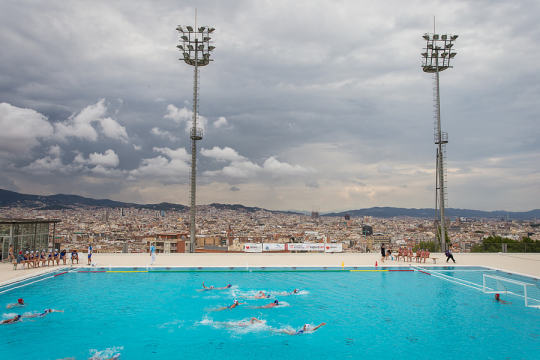
    Olympic Pool – Barcelona, Spain by Tom Weightman on 500px.com

    https://500px.com/embed.js

    Early this morning Professor Robert Wright – who is a regular reader and commenter on this blog – sent me an article from The Guardian called, ‘The Olympics are dead’: Does anyone want to be a host city any more? And that got me thinking.

    With Toronto having just hosted the Pan Am Games (the Parapan Am Games are still going on), there’s a lot of talk and debate happening in this city right now about whether or not we should make a go at hosting the 2024 Summer Games. The deadline for cities to express their interest is September 15th, 2015.

    The supporters (of which I would include myself) say it’s a great opportunity for civic (re)branding and urban renewal. It creates real deadlines to get things done. But the naysayers argue it’s a fiscal disaster waiting to happen. See 1976 Summer Olympics in Montreal.

    But in my view there are ways to host the Olympics and there are ways not to host the Olympics. Montreal (1976) is an example of what not to do. And Los Angeles (1984) and Barcelona (1992) are some of the best examples of what to do.

    The key is to think of the Olympics not as the end, but more as the beginning. In Olympic talk, they refer to this as legacy. Here’s what Los Angeles managed to accomplish as a result of the 1984 Summer Games (via Gizmodo):

    In 1979, the L.A. organizing committee had made a deal. If the games saw any profits, LA84 would give 60 percent back to the U.S. Olympic Committee and keep 40 percent for Southern California. At the end of the games, the total expenditures came in at a respectable $546 million, but even more impressive was the profit: A surplus of $232.5 million, meaning $93 million would stay in the region. This was huge. The only other games at the time which could claim to be financially successful at all were the other L.A. Olympics: The ones held in the city in 1932.

    The profits were used to create an endowment called the LA84 Foundation, which funds youth sporting events, resources, and facilities throughout the area. With smart management, the endowment has grown over the years, and over $214 million has helped an estimated three million children and 1,100 organizations in Southern California. Recently, the LA84 Foundation helped raise money to pay coaches and buy equipment at LAUSD high schools after budget cuts decimated their programs.

    The rest of the above article is definitely worth a read. It’s a great example of fiscal prudence.

    So what I am suggesting is not that we run blindly into hosting the Summer Games. But that we instead open our minds to the opportunities. Let’s great creative. If we could catalyze further city building, turn a profit, and leave meaningful legacies for this region (like what LA did), then why wouldn’t we want to have a go at it?