
Daily insights for city builders, delivered every morning at 6 AM ET. I’m Brandon Donnelly — a Toronto-based real estate developer and founder of Globizen. I’ve been writing here since 2013.

Tag: new yorker

  • Knowing how (automated medicine)

    I should read The New Yorker more often. I’m going to subscribe right now (done). The articles are fantastic. In the April 3, 2017 issue, Siddartha Mukherjee wrote a piece talking about automated medicine. It’s called A.I. Versus M.D.

    Here is an excerpt:

    His prognosis for the future of automated medicine is based on a simple principle: “Take any old classification problem where you have a lot of data, and it’s going to be solved by deep learning. There’s going to be thousands of applications of deep learning.” He wants to use learning algorithms to read X-rays, CT scans, and MRIs of every variety—and that’s just what he considers the near-term prospects. In the future, he said, “learning algorithms will make pathological diagnoses.” They might read Pap smears, listen to heart sounds, or predict relapses in psychiatric patients.

    This is a world where you could snap a photo of your unsightly rash, submit it, and then have a machine provide a diagnosis. This is a world where early detection and prevention would become common place. Already, today, there are instances where learning-based algorithms (distinct from rule-based) have proven to be more accurate than raw humans.

    I don’t know how you all feel about this, but I actually feel a sense of comfort thinking about this as the future of medicine. There’s piece of mind that comes with large amounts of data and the discipline of algorithms. At the same time, this is not necessarily about replacing humans. It is also about augmenting human ability.

    If it leads to better health outcomes, then why wouldn’t we?
  • 70 years of LA

    The New Yorker recently published an interesting split-screen video tour of the same streets in downtown LA in the 1940s and today. 

    They have done a great job pairing up the same views and also panning in such a way that the middle divider seems to magically transport you 70 years.

    Here it is:

    [youtube https://www.youtube.com/watch?v=WIHfmisMLOY?rel=0&w=560&h=315]

    If you can’t see the video above, click here.

    In some cases (okay, many cases), I couldn’t help but feel like 1940s LA was far more urban and engaging. What did you think?

  • Uber, commuting, car ownership, and the future of urban mobility

    Earlier this week I wrote a “Tech Tuesday” post talking about Uber’s new Smart Routes functionality, which it is currently testing out in San Francisco. At the end of the post I ended by saying that it’s not just the taxi industry that should be thinking about Uber, it’s also public transit authorities. 

    And that’s because many people in cities rely on multi-modal forms of transportation (I know I do) and in my mind it is clear that Uber is trending away from just “Everyone’s Private Driver” to a service that is starting to look and feel a lot like urban mass transit.

    Then today my good friend Evgeny sent me a post called, “Public Transit Should Be Uber’s New Best Friend.” And it’s one of the best pieces I’ve read on Uber and its impact on urban mobility. I highly recommend you give it a read, particularly if you’re in the city building arena.

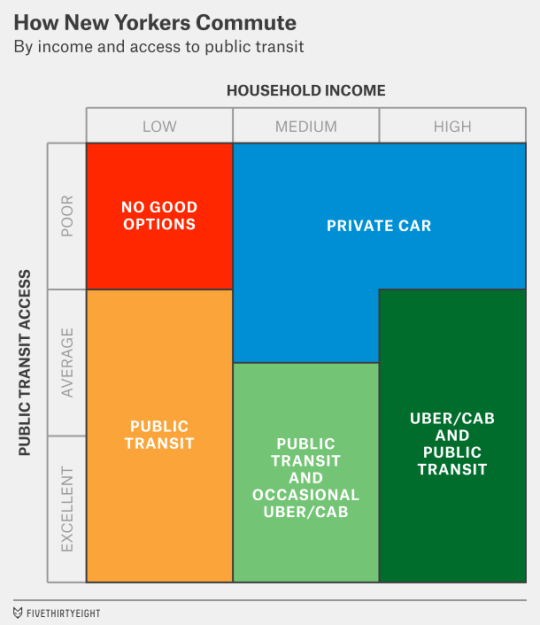
    The article does a deep dive into how New Yorkers commute. Here’s how they broke it down.

    image

    It then talks about what it will take for a company like Uber to make a meaningful dent in car ownership (which is one of the company’s goals) and how the truly big opportunity for Uber is to go more mass market and tap into the public transit market – either by interfacing with or by building its own version of it.

    Here’s their concluding paragraph:

    But there’s a much wider potential audience if Uber can also reach middle-class customers who want to save money. Perhaps in the distant (or even the not-so-distant) future, Uber can build its own version of “public” transit, making rides so cheap that they cost less than the $4 or $5 that Americans now pay, on average, to make a trip in their personal cars. In the meantime, it might have more success among “car-cutting” customers who can use Uber along with public transit. That might mean Uber’s growth is concentrated more in cities like New York, San Francisco and Chicago — and in Europe and Asia — that already have reasonably strong public transit networks.

    It’s definitely worth a full read. Thanks again for sending this over Evgeny.

  • Gentrification and corporate shuttle buses

    A couple of months ago I had coffee with an urban planner who had recently relocated from the Bay Area back to Toronto. One of the interesting things that came up during our conversation – that I hadn’t really given a lot of thought to before – was how corporate shuttle buses (from the likes of Apple, Google, Facebook and so on) could be impacting cities.

    On the surface, they seem fairly benign. Most of the big tech companies are located outside of San Francisco, but young smart people today like living in cities. So let’s run shuttles buses that take people back and forth. Employees get to live the life they want and employers get broader access to human capital. It seems like a win-win.

    But in reality, some argue that these shuttles buses reinforce a powerful trend already plaguing the region: The alienation of non-tech people. George Packer of the New Yorker called the buses “a vivid emblem of the tech boom’s stratifying effect in the Bay Area.”

    What I wonder though is to what extent these buses are not just an emblem, but an actual driver of stratification and other negative outcomes. The first concern that comes to my mind is the possibility for this to lead to infrastructure disinvestment. Already there seems to be a philosophical divide around transit (see BART strike).

    Wired just published an interesting set of maps that try and map “Silicon Valley’s gentrification problem through corporate shuttle routes.” They’re worth checking out. It’s also interesting to see how they collected the data; it was a fairly messy process.