

Daily insights for city builders, delivered every morning at 6 AM ET. I’m Brandon Donnelly — a Toronto-based real estate developer and founder of Globizen. I’ve been writing here since 2013.

Tag: new york

  • Mies

    image

    If you’re into architecture, specifically epic modernism, then I would encourage you to pick up this new monograph on Mies van der Rohe–simply called Mies. It was written by the late Detlef Mertins, who was the Chair of the Department of Architecture at the University of Pennsylvania from 2002 to 2007, but is originally from Toronto.

    Detlef was one of the most brilliant, but also nicest, people I’ve ever met and unquestionably the leading scholar on all things Mies. He passed away in the midst of working on this publication, but it was completed by his partner Keller Easterling–another powerful architecture mind–and a few other contributors.

    For those of you unfamiliar with the work of Mies, here’s a brief description from the book publisher:

    Ludwig Mies van der Rohe is one of the twentieth century’s most influential architects. His most well-known projects include the Barcelona Pavilion in Spain (1929); the Seagram Building in New York (1954-56); the Farnsworth House (1945-50), 860 and 880 Lakeshore Drive (1945-51) and the IIT Campus (1939-58), all in and around Chicago, and the New National Gallery in Berlin (1962-68). These are only a few of Mies’s pavilions, houses, skyscrapers and campuses, which all epitomized a radically new structural and spatial clarity. 

    For readers in Toronto, Mies’s biggest contribution is the Toronto Dominion Centre, which is a beautiful example of the International Style. The complex was designated under the Ontario Heritage Act in 2003. But in addition to it being great architecture, its construction in the late 60s really coincided with Toronto’s rise as a modern metropolis. Here’s a photo of the first tower from blogTO.
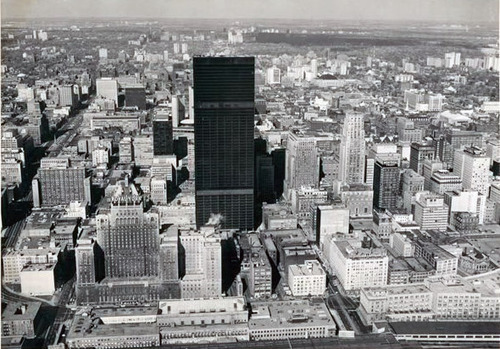
    image

    The TD Centre introduced not only a new architectural language into Toronto’s urban fabric, it also introduced a new and bolder way of how we thought of ourselves as a city. Remember this was a moment in time where Toronto was just about to overtake Montreal as the most populous city in Canada.

    We were reimagining our city with Mies.

  • Can the creation of urban destinations transform or hinder a city’s development?

    I was recently asked by a Canadian architecture website called sixty7 Architecture Road to respond to the following: Can the creation of urban destinations transform or hinder a city’s development? It was for a regular Q+A series they do on their website. Here is my response (I was specifically asked about Dundas Square):

    The best line I’ve ever heard about public spaces and urban destinations was from Bruce Kuwabara of KPMB Architects. He said that the outside of buildings need to be thought of as the inside walls of the public realm. And I think that’s a really great way of framing this discussion. We often think of buildings inwardly and as self contained objects, but by virtue of their existence we’re creating and framing many other spaces.

    With that in mind, I absolutely believe that beautiful and well designed urban destinations–whether public or private–can transform a city and its development patterns. A perfect, but perhaps overused, example of this is the High Line in New York. Not only has it become a destination (“Have you been to the High Line yet?”), it has become an unbelievable city building catalyst. All of a sudden development is happening in, on and around the High Line, where as before developers would have tried to completely ignore it. And so today, the High Line, as an urban destination, is almost being continually reinvented by new development.

    To talk specifically about Toronto, I think that downtown needed a “public” space like Dundas Square. The design could have been less unidirectional (towards the Eaton Centre) and the building to the north is repulsive, but it provided a forum along Toronto’s main street in the heart of downtown. I also believe that good urban destinations give areas a sense of identity, which is why I’m somewhat bothered by the loss of the square at Yonge & Eglinton. Sure it was bad, but we could have made it better. It is the heart of midtown in my mind.

    So not only do urban destinations have the ability to transform, I would argue that they are essential to any great global city. Whether it’s the High Line in New York, the Spanish Steps in Rome, the old Love Park in Philadelphia, or Trafalgar Square in London, these spaces are integral to those city’s brands and identities. What do ours say about Toronto?

    For the full Q+A, click here.

  • 50% of apartments in New York are under a form of rent control

    A friend of mine who lives in New York recently sent me this interesting article: “The Perverse Effects of Rent Regulation.” And he sent it to me, because he wanted me to take note of this stat:

    There are, effectively, two rental markets in Manhattan. Roughly half the apartments are under rent regulation, public housing or some other government program. That leaves everyone else to compete for the half with rents determined by the market.

    50% is a big number. I would never have guessed that the New York rental market would be split in such a way. But it is split because it’s fairly clear what would happen if it weren’t: 

    “Poor people would be priced out of Manhattan,” he says. “Period.”

    This, as the article argues, could threaten the diversity that has made New York the economic and cultural hub that it is today. But at the same time, there are a number of important questions: Is 50% the right split? And are the control mechanisms in place the right kind of mechanisms? Should rent controls be attached to people as opposed to apartments, which is how it’s typically done today?

    Diversity is hugely important and there will always be a portion of any city’s population that cannot afford market rents. But intuitively, and I could be wrong, 50% seems high. It seems high because these types of rent regulations achieve the exact opposite for the balance of the market that has to pay market rents: their apartments become more expensive.

    I’ve been having a lot of discussions lately about affordable housing and rent control always comes up. I think that in a lot of cities there needs to be some sort of intervention in the market to keep them from becoming homogenous playgrounds for the rich. But I also believe that many policies–which may sound great in theory–can have unintended market consequences. These need to be seriously looked at.

  • Best predictor of a city’s growth is its average January temperature

    With the cold winter that we’ve had in Toronto this year I’m going to be honest and say that I’ve, on occasion, wondered why I haven’t moved somewhere warmer. There aren’t any great mountains nearby, so it’s not like I’m putting up with this cold in order to feed my love of snowboarding.

    Then yesterday, I was reading The Urbanophile blog and I was reminded of a fascinating finding from Edward Glaeser’s book, Triumph of the City: climate matters when it comes to cities and prosperity.

    In fact (from New York Magazine):

    The single variable that best predicts a U.S. city’s growth over the past century is its average January temperature. Hence the decline of many northern and midwestern cities and the boom in the South and the Sun Belt, where the Phoenix, Atlanta, Houston, and Dallas metropolitan areas have each gained a million people since 2000. For every five degrees that a city’s January temperatures top the national average, Glaeser writes, its real-estate prices will beat the national mean by 3 percent, thanks to the increased demand.

    But not all cold places are bleeding people. New York isn’t. And neither is Toronto. The Toronto area accepts roughly 100,000 new people every year. We have more cranes up in the air than any other city in North America. But it’s cold as all hell here. So what gives?

    As the New York Magazine article (cited above) points out, New York essentially offers enough benefits to offset its cold winters. There are enough amenities and economic opportunities to make people put up with the bad. And we’re not just talking about weather.

    A lot global cities–New York, London and so on–are crowded, expensive and somewhat impractical places to live. But they continue to attract and retain people in droves, which is a nice tie in to yesterday’s post about urban renewal and the importance of lifestyle.

    People will put up with a lot if your city is an otherwise awesome place to live.

  • Civic leaders, here’s why people need to love your city

    I was planning to write about something else today, but then I saw Fred Wilson’s post on revitalizing urban cores and I had to switch topics, because I think he makes a great point about turning around declining cities:

    I’ve been asked by civic leaders from places like Newark, Cleveland, Buffalo, and a number of other upstate NYC cities that have suffered a similar fate how they can do the same thing. They all talk about tax incentives, connecting with local research universities, and providing startup capital. And I tell them that they are focusing on the wrong thing.

    You have to lead with lifestyle. If you can’t make your city a place where the young mobile talent leaving college or grad school wants to go to start their career, meet someone, and build a life, all that other stuff doesn’t matter.

    It’s exactly the same point I made in my post entrepreneurship as economic development strategy. You can throw as much money as you’d like at startups, but if young people don’t want to live in your city then you have a serious problem.

    Fred goes on to talk about Tony Hsieh’s (founder of Zappos) initiatives in downtown Las Vegas:

    When Tony moved Zappos from the suburbs to the former City Hall in downtown Vegas a few years ago, he decided to invest $350mm in a massive urban revitalization project. He set aside $200mm to purchase land at bargain prices and the other $150mm to invest in three areas, arts and culture, small businesses (restaurants, cafes, bars, markets, boutiques, etc), and tech startups. $50mm is going into each area.

    It’s an example of leading with lifestyle, urbanism and city building, rather than purely economics. And I think it’s the way to go. But to be clear, I’m not suggesting that the focus should be on large capital projects, such as stadiums and infrastructure. I’m not convinced those are the most effective catalysts. There’s no silver bullet here.

    Instead, I think the answer is in building, from the ground up, a real sense of community and place. People need to love your city. That’s easier said than done though.

  • 80% of New York’s 150 million taxi trips could be shared

    I’ve been a big fan of MIT’s Senseable City Lab since I was a grad student at Penn. Their work sits at the intersection of cities and technology, and so I’ve always found it incredibly fascinating.

    Recently, the lab examined data from all of New York’s 13,586 registered cabs and looked for ways that technology and mobile tech could potentially optimize the way the system works today. In particular, they were interested in examining instances where people were heading to the same place at the same time, and were within no more than a 3 minute walk of each at the start of the trip.

    What they found was that, of the 150 million taxi rides taken in New York City during 2011, almost 80% of them could have been shared.

    That is, 80% of the time, there was an overlap in both time and route. That’s an hugely interesting stat because it starts to show just how much waste and inefficiency there currently is in the system. Think about all the trips and carbon emissions that could be potentially eliminated through optimization.

    Here’s a video they produced on the project. Click here if you can’t see it below.

    [youtube https://www.youtube.com/watch?v=Gyq_Zr96uzs?rel=0]

    It’s a great example of how technology is and will continue to creep into every segment of the economy. It’s exactly what I was talking about in my post, “Disrupting everything.”

  • New urban planning buzzword: Lean Urbanism

    The term “lean” is well known in technology and startup circles. Thanks to people like Eric Ries and Steve Blank, it’s become all about starting up lean and not investing a lot of time and money before you’ve really tested your business assumptions in the marketplace.

    But keeping it lean isn’t unique to just tech companies. Its origins are actually in manufacturing—mostly from Toyota’s celebrated production system. Lately though, it has been starting to make its way into cities with a new buzzword called “Lean Urbanism.”

    Championed by New Urbanist Andres Duany—who is actually in the midst of writing a book on the topic—the methodology seems to be gaining awareness in cities spanning from Detroit to San Diego. Here’s an article that a friend of mine (currently working in San Diego) sent me yesterday on the topic.

    At first, the article gave me the impression that the movement was all about building as-of-right. That is, build what’s allowed and stop asking for special discretionary permissions, which is often how real estate development works.

    But then I started to do a bit more research.

    And it turns out that Lean Urbanism is about something much deeper. It’s about empowering incremental urban growth:

    “Lean Urbanism…focuses on revitalizing cities by finding ways for people to participate in community-building — specifically, by enabling everyday people to get things done.”

    What Lean Urbanism hopes to do is create tools and techniques that will help local communities avoid and workaround overly onerous regulations. It’s about removing the barriers to entry—whether that be a business permit or a building permit—so that more people can participate in shaping their own community.

    What I like about it is that it’s building upon the renewal cycle that has traditionally always powered cities. It hopes to empower the proverbial artist that moves into a neighborhood like New York’s Soho and magically makes it cool—then spurring an onslaught of investment.

    And so while the buzzword might be new, it’s a renewal cycle we’ve seen before. But, if it works, maybe not with so much frequency.

  • New York City on Market Street

    On my walk to the subway this morning I was confronted by a transformed Market Street in Toronto’s St. Lawrence Market area. New York City had taken over.

    There were NYC yellow cabs, NYPD cars, FDNY trucks and lots of film people milling about in Canada Goose jackets. Toronto, once again, stands in for New York.

    image

    But while I think it’s great that we’re (presumably) creating a bunch of local jobs, there’s also a part of me that hates to see this. I hate it because I want the Toronto brand to be strong enough so that movies actually take place here, instead of just being filmed here.

    I mean, who wants to be the stand-in? It’s much better to be the actor.

  • I <3 Toronto

    Yesterday I came across an article in the New York Times called “Toronto’s Ethnic Buffet.” It basically talks about how amazing and how diverse our city is, and so I wanted to share it with the Architect This City community this morning.

    It’s easy to take your own city for granted sometimes. You know about all the problems and all the things that you’d like to see happen. And so it can be easy to fixate on them. I just took a look back at my recent blog posts and I’ve certainly been doing my fair share of that.

    So today I’d—instead—like to say: Thanks for being awesome Toronto. You are one hell of a city.

  • Gentrification, animated

    A friend of mine sent me a link this afternoon to an art project called “Vacated”. The artist (Justin Blinder) reverse engineered Google Street View images to create a series of animated GIFs intended to demonstrate New York’s “changing urban landscape during the Bloomberg administration.”

    In his description of the project, Blinder ends by saying that “it’s up to the viewer to decide whether this change represents widespread gentrification.” Given the recent discussion we’ve had (here on Architect This City) about gentrification, I thought this post might be a good addendum.

    One of the big takeaways from our discussion, I think, was idea that there’s good gentrification and bad gentrification. Gentrification, after all, is really just another word for investment. And so generally I would consider this to be a good thing for communities.

    But there are instances when investment comes in and ruins what made the community worth investing in, in the first place. Perhaps the investment brought about the destruction of heritage buildings or the loss of the fine grain urban character that initially made it a great place to be.

    In these cases, I would say that this is bad gentrification. Sure there has been investment, but now the community has lost what made it cool. And as Jane Jacobs rightly pointed out: “When a place gets boring, even the rich people leave.”