Daily insights for city builders, delivered every morning at 6 AM ET. I’m Brandon Donnelly — a Toronto-based real estate developer and founder of Globizen. I’ve been writing here since 2013.
Right now, I’m sitting on the sun deck at my friend’s cottage and looking out at the Georgian Bay. So this is going to be a short post. The New York Times just published a stunning photo series of hidden rooftop pools and gardens in New York. All of the photos were taken from a helicopter. If you’re as fascinated by cities as I am, I think you’ll really like them.
In keeping with the recent theme about cities, their brands, and the messages they send, I thought I would revisit an old essay (2008) written by Paul Graham (of Y-Combinator) called “Cities and Ambition.” In it, he talks about the various messages that cities send us, such as:
You should make more money (New York)
You should be better looking (Miami?)
You should be smarter (Cambridge)
You should be more powerful (Silicon Valley)
But the most interesting part of his argument is the belief that we are largely products of our environment. No matter how strong or formidable our personalities might be, the message a city sends us is hugely important. In fact, it might be impossible to escape it. Here’s how Paul puts it:
How much does it matter what message a city sends? Empirically, the answer seems to be: a lot. You might think that if you had enough strength of mind to do great things, you’d be able to transcend your environment. Where you live should make at most a couple percent difference.
But if you look at the historical evidence, it seems to matter more than that. Most people who did great things were clumped together in a few places where that sort of thing was done at the time.
You can see how powerful cities are from something I wrote about earlier: the case of the Milanese Leonardo. Practically every fifteenth century Italian painter you’ve heard of was from Florence, even though Milan was just as big. People in Florence weren’t genetically different, so you have to assume there was someone born in Milan with as much natural ability as Leonardo. What happened to him?
If even someone with the same natural ability as Leonardo couldn’t beat the force of environment, do you suppose you can?
I don’t. I’m fairly stubborn, but I wouldn’t try to fight this force. I’d rather use it. So I’ve thought a lot about where to live.
To some, this thought may depress you. I mean, if you happen to live in a city or place with the “wrong” message, you might feel as if you’re missing out. I know that thought certainly crossed my mind when I read his essay. But different messages resonate with different people, and so maybe the message your city is telling you is exactly the one you need to accomplish great things.
In Toronto, I’d say that the message is similar to that of New York: You should make more money. Oh, and also that you should buy more condos 😉
Yesterday a colleague at the office sent around this Globe and Mail article talking about a Vancouver family of 4 (plus one cat) who live in a 1,000 square foot loft near downtown that they purchased in 2003 for $269,900. There weren’t really any photos of the place, but the article makes it sound like they have 3 beds crammed into one room. (I wonder how the parents ever manage to have sex. There are better ways to lay out 1,000 sf.)
In any event, the point of the article is that there’s a growing number of families who are clinging to the downtown lifestyle that they’ve grown accustomed to and are refusing to follow the path of a conventional suburban house – regardless of how tight their current quarters might be. It’s happening in Toronto (here’s an article from the Toronto Star and here’s a post I wrote) and it’s happening in New York:
A recent New York Times article on a similar trend noted that the number of white professionals with one or more children living in one-bedroom condo units in that city had jumped by almost a third between 2000 to 2006. Prof. Andrew Beveridge, from Queens College of the City University of New York, said the pattern was showing up in other expensive American cities. In Toronto, the 2011 National Household Survey showed there are about 72,000 families living in 71,500 units in buildings with five or more storeys – undoubtedly many of them the new, tiny condos proliferating there.
To some this might sound crazy. I mean, why would a dual income family–such as the one in Vancouver–subject themselves to a smaller space when they could easily afford a bigger place somewhere else? Isn’t that the dream – to have a big house?
The answer is that these families are considering–in addition to the direct costs of a bigger place–both the indirect costs of living further away from the core (such as longer commute times) and the inevitable lifestyle changes that would happen should they move out from their downtown neighborhoods. The urban lifestyle is different.
But what I find interesting about this phenomenon is that if this trend continues (and I think it will), we’re going to have a new generation of people in North America who grew up in apartments, condos, and lofts, and don’t have the same biases around single family houses and suburban living. To them, an apartment will be a perfectly normal place to raise a family.
One of the reasons I’m so fascinated by cities is that it’s becoming increasingly more important to get them right. From about 1831 to 1925, London was the largest city in the world. Its population went from somewhere around 1.5 to 2 million people to nearly 7.5 million. London surpassed Beijing as the largest city and was then surpassed by New York.
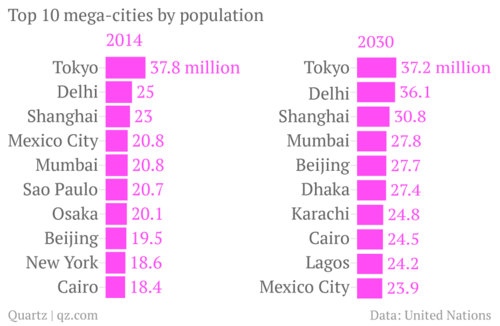
Today our largest cities are significantly bigger. Tokyo has almost 40 million people and London doesn’t even make the top 10. But there’s also a broader shift taking place. According to a new report by the United Nations, most of the world’s largest cities will be in Africa and Asia by 2030. Here’s a chart from Quartz:
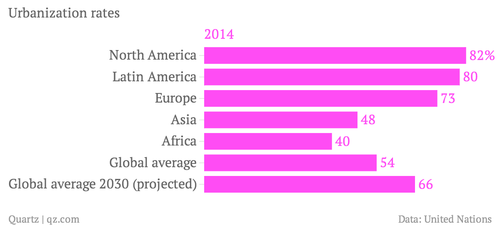
And the reason for this shift is because Asia and Africa are newly urbanizing, whereas the rest of the world has already urbanized. In North America, over 80% of people already live in cities.
But even though Asia and Africa are following a trend that has already taken place in the rest of the world, it doesn’t mean we should assume we know what we’re doing. Having spent time in cities like Dhaka, I can attest to the many challenges that these mega-cities are facing and will continue to face as people flood in from the rural areas looking for economic opportunities.
So while it’s important that we talk about strategies for reviving cities like Detroit – which has a population somewhere around 700,000 – 800,000 people – we should also keep in mind that we have some significant challenges ahead of us in terms of creating a sustainable urban planning agenda for the world.
Last night my father and I were walking to dinner and he commented to me that he thinks my generation will be a lot healthier than his–at least on average–given how much more my generation walks. I responded by reaffirming to him how little I drive these days and how much I enjoy that.
Then today, I was watching this short clip of the The High Road with celebrity chef Mario Batali, where he interviews venture capitalist Fred Wilson. During their tour around New York City, Mario asks Fred what he thinks the future of transportation will be. Fred responds by saying that nobody will drive anymore. He then went on to say that the technology for driverless cars is already ready, but that we as a society just aren’t ready for it, yet.
Finally, on my way home from wakeboarding today, I stumbled upon this Guardian Cities article talking about Helsinki’s ambitious plan to make owning a car pointless. By 2025, the goal is have a “point-to-point mobility on-demand system” that will integrate all forms of mobility into one booking and payment platform. Think everything from public transit to carpools to taxis.
As I read on, I then discovered that Helsinki is already offering on-demand public minibuses that allow people to specify their own routes on their smartphone. The system then aggregates all of the requests and establishes the most efficient route based on the immediate demand. Coincidentally enough, it’s quite similar to a use case I wrote about for driverless cars.
All of this got me thinking that one day we’ll probably look back at that time when people used to drive their own vehicles around as some antiquated and hilarious moment from the past.
I was reading the New York Times this morning and I stumbled upon an interesting article about Shubert Alley. I wasn’t aware of Shubert Alley, but I’m sure many of you probably are. It’s a 300-foot long pedestrian-only alley in the theater district of New York. It connects 44th Street and 45th Street and runs west of Broadway.
And apparently it’s a big deal in the theater world – or at least according to Richard Hornby in 1991: “In New York, the desirability of a theatre is inversely proportional to its distance from Shubert Alley.”
But what you may not be aware of is how the alley–which today serves as a public gathering space–was actually created. In 1913 when the Shubert and Booth theaters were built, the fire code dictated that theaters had to have separate fire exits on the sides of their buildings that connected directly to a main street.
Most of the time this led to blank sidewalls, but in this instance, the Shuberts and their architect Henry Beaumont Herts, decided to run an alley all the way through the block to serve as their emergency exit.
But what seemingly started as a pragmatic response to a code requirement, ended up creating what some people would consider the heart of the theater district. Sometimes constraints can be a good thing for design.
I’m reading a great book right now called Tech and the City. I’m only 31% of the way through it (according to my Kindle app), but already it’s been an interesting read. It’s about the making and rise of New York City as a technology and startup hub – which, is fairly recent phenomenon. There aren’t too many cases where New York plays second or third city, but tech is one of those instances. Silicon Valley dominates.
The book talks about the deliberate efforts that were made, by the Bloomberg administration as well by many others, to diversify New York’s economy away from financial services and towards technology, startups, and entrepreneurship. It gives you all the backstory about the rise of Silicon Alley in the 90s, its subsequent crash in the dot com era, and all the players involved. And yes the reference to Sex and the City is both on purpose and explicit throughout the book.
But at a time where cities all around the world are trying to replicate the success of Silicon Valley, the takeaways from this book are perhaps universally applicable. It certainly got me wondering if, here in Toronto, we’re doing enough to prepare our city to dominate in the 21st century.
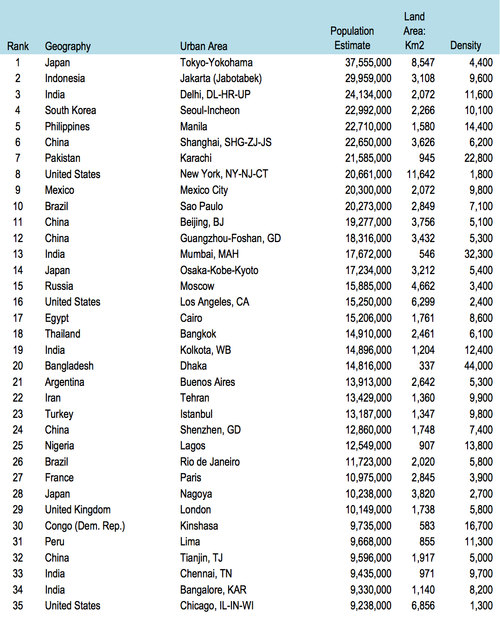
Without a question, we are living in an urban era. More people now live in cities than anywhere else on the planet and I’ve repeatedly argued that cities are our most important economic engine. As a result of these demographic and economic shifts, we’re seeing megacities at a scale the world has never seen before. Below is a list of the top 35 largest urban areas in the world.
The top urban area is Tokyo-Yokohama, with a population of roughly 37.5 million people. That’s almost the same as the state of California and is more than the entire population of Canada, which sits at just over 35 million people. London, which, during the 2nd half of the 19th century, would have been the largest urban area in the world is now the 29th largest.
But at the same time, London arguably remains the most important global city–a title that can only really be rivalled by New York. Which raises an important distinction. One that Aaron Renn clearly identifies in this recent article for New Geography: Just because a city is a megacity, doesn’t mean it is or will ever be a global city. In fact, Renn argues that many of the world’s largest megacities will never “turn the corner” and become leaders of the global economy.
For that to happen, he believes that the city needs to belong to a country on the rise:
Moscow was the capital of the Soviet Empire. New York and Los Angeles came of age when America was the rising, and ultimately dominant, economic colossus. It’s the same for Paris and London, two borderline megacities, which rose as imperial capitals.
But how much of this is driven by the country and how much of it can be driven by the city itself, upwards? Could it be the city that ultimately empowers the country to rise? I ask these questions because Renn frames his argument as if “national hyper growth” is the only prerequisite that will allow the struggling and underdeveloped megacities to pull themselves up and into the developed world.
But the problem is that there’s no clear path to prosperous maturity for these megacities. They are so huge, and their problems so immense that they are difficult to even conceptualize, much less do something about. The amount of needed infrastructure provision alone – water, sanitation, drainage, transport, telecom, electricity, parks, schools, etc. – is staggering. And that doesn’t even touch arguably more difficult problems like corruption and good governance. Absent national hyper growth – a la Japan or Korea – of a level that creates a plausible claim to being the world’s rising economic power, or the proceeds of empire, it seems unlikely any of these cities will ever succeed. By contrast, smaller cities have a much more addressable problem space.
Now, I don’t disagree that the problems in these cities seem almost insurmountable. I’ve been to places like Dhaka, Bangladesh. I’ve witnessed first hand the challenges facing megacities in the developing world.
But to assume that these cities are lost causes without the nation itself lifting it up, seems almost self defeating and overly pessimistic. It also strikes me as a bit of a chicken and egg scenario. Because if cities are our economic engine, then “national hyper growth” seems difficult without also getting our cities right.
What comes first?
Yes, there are and will be reforms that need to happen at the federal level but, at the same time, I think there’s a lot that can and should happen from the ground up. Perhaps that’s part of the reason Singapore has been so successful. As a city-state, its reforms were both top down and bottom up.
I want to believe that with the right reforms, policies, and leadership, any country can create a framework in which its cities are able to thrive. And that it’s not just the result of imperial rule or some other circumstance. From good and transparent governance to developed financial markets, there are many things that cities need to truly prosper. But when you get it right, the results can be remarkable.
I have a friend in town visiting me from New York this weekend. And since today was such a beautiful day in Toronto, we decided to spend the afternoon on the Toronto Islands–Ward’s Island to be exact. The islands are such an incredible amenity in the city. I try and go as often as I can during the summer. It’s my Central Park.
But in addition to parks and beaches, many people also live on the islands. There are 262 residential properties across the archipelago. Below is what a residential street looks like. There are no cars allowed. It’s a gorgeous place.
But if you want a house on the Toronto Islands you have to get on a waiting list. There only 500 spots and it’ll probably take you about 30 years before you get to a meaningful position on that list. But even then, you’re only buying the house. The land itself is on lease.
But if we didn’t regulate, the islands would be a very different place. 262 homes is not a lot of housing. In fact, it’s less than most of the new condo buildings going up downtown. So it’ll probably always be a heavily regulated market.
Yesterday I had a really interesting conversation with somebody about the future of the architecture profession. We spoke about how Joshua Prince-Ramus of REX believes that architects have marginalized themselves as a result of shying away from liability. We spoke about how architecture schools need to teach more about about business and making money. And we spoke about why I decided to never practice architecture and instead become a developer.
At the end of it all, he came to more or less the same conclusion that I did in this post. He felt that as more and more trained architects choose to become developers, that maybe the future will be firms that vertically integrate both architecture and real estate development. For those of you not in the building industry, this is fairly uncommon practice today. Typically, developers retain the services of an architect to design their buildings and do not handle this in-house.
But there are firms that do. DDG out of New York and San Francisco is one example. Although there’s a subtlety worth mentioning. According to their website, they say that they often act as the “design architect” for their projects. This means that there would still need to be an “architect of record”, whose name would appear on the building permit and who would ultimately end up shouldering the liability for the design.
You see, a bifurcation has happened even within the architecture profession itself. You have “design architects” who may or may not be licensed, but do a lot of the fun design work upfront for a project. And you have production oriented firms that actually produce the technical drawings needed for construction. The fees are generally higher in the latter case (unless maybe you’re a starchitect), but the work is less creative.
The emergence of these two streams of architecture is precisely what Joshua Prince-Ramus is talking about when he says that architects have marginalized themselves by shying away from liability. He believes that architects are reducing themselves to designers and stylists, from master builders. So his argument is that architects need to reinsert themselves into more of the building process.
What I’ve been suggesting is that architects should become owners. They should insert themselves into the development process. And the reason I feel this way is because I worry about the tendency for production and construction to just be farmed out to the lowest bidder. Design and development, on the other hand, are high value creation items.
Truthfully though, I don’t really know which option is better for the profession in terms of relevance. I know which one I’m most interested in, but that could just be a personal preference. What do you think?