
This is a great collection of third places or “community living rooms” in New York City. Simply speaking, a third place is any space where people hang out that isn’t their home and isn’t their place of work. Hence the third moniker. The most typical example is arguably the humble coffee shop. But what is clear from this thread list, is that a third place can take on many different permutations — everything from a bathhouse to an art library with the world’s largest collection of artist’s sketchbooks. What is also clear is that these are the kinds of spaces that really define a city. They create a sense of place, they give us community, and they help us with our sense of self — because they allow us to think things like, “I am the kind of person who hangs out and enjoys independent bookstores in the East Village.”
Tag: new york city
-
Manhattan is still looking at a congestion charge for south of 60th Street
We talk a lot about congestion charges and road pricing on this blog. Here’s a list of some of those posts. I found 46 that were tagged with “road pricing.”
I continue to believe that it’s the only way that big cities can effectively solve the problem of traffic congestion. It’s not being caused by the bicycle lanes that were just added to your street. It’s not the new COVID street patios. And it’s not the new apartment that was just built with too many parking spots.
The problem is mispricing.
If you want free roads, then you don’t get free-flowing traffic. That’s how this equation works, which is why I have always thought it a good idea to dynamically price roads based on demand, and then to direct those funds toward more efficient forms of mobility — such as transit.
Despite all this, it’s not a very popular approach in this part of the world. Toronto looked at road pricing back in 2016, but we got nervous and backed away from it. New York City has also been looking at a congestion charge for Manhattan south of 60th Street for at least 4-5 years. But this one appears to still be on the table.
According to this recent CityLab article, New York’s congestion prices could look something like this (note that this chart includes other pre-existing tolls):

But with some exceptions (I think this is an interesting approach):
Primary residents of the Manhattan central business district, which is south of 60th Street, and New York State residents with adjusted gross income of less than $60,000 would be eligible for a state tax credit equal to the amount of the new tolls, paid during the taxable year.
In total, this current pricing scheme is expected to generate an additional $1 billion in annual revenue for the city’s transportation authority. The MTA also plans to bond against this revenue and raise an additional $15 billion for new transit projects.
This sounds like a reasonable approach to me.
-
Paris vs. New York bike lanes
It’s one thing to have bike lanes. And it’s another thing to have really generous bike lanes. The above video by Streetfilms does a good job of comparing Paris to New York City, and showing just how far Paris has come in terms of cycling infrastructure. Some of you might remember that in the fall of last year, Paris announced plans to become a “100% cycling city.” This was a follow-on to their plan vélo 2015-2020, which saw a doubling of the city’s bike lanes. The current plan, which covers 2021-2026, includes 130 km of new bike lanes and 52 km of pandemic lanes that have been (or will be) made permanent. But again, it’s one thing to have a lot of bike lanes. And it’s another thing to have a lot of wide bike lanes that look like the ones in this video.
-
The Germania Bank Building at 190 Bowery
I recently mentioned that it would be nice to be able to buy a five-storey building in Soho (New York) for $70,000. Yes, that was in 1968 dollars. But even in today’s dollars, we’re talking less than $600,000. I would gladly buy a cast-iron five-storey building in Soho for that price today if it were somehow possible.
In response to this post, a reader sent me this (thank you), which is another great example of an artist buying an old buying in New York for what is clearly an absurdly low price. The artist is photographer Jay Maisel, and the building is The Germania Bank Building at 190 Bowery.
Jay bought the six-storey building in 1966 for $102,000. He then used it as his residence, a studio, and as a place to collect a hell of a lot of things. Though at one point he also rented out some of the other floors to artists like Roy Lichtenstein.
It is alleged that most people thought the building was abandoned. But this was obviously not the case. Jay sold the building to RFR Holdings in 2014 for $55 million. And in 2019, streetwear brand Supreme opened up in the bottom.
Today, I understand that Web3 things are also happening in the building. And who knows, it might be the case that we’ll be reading about some of them, in a similar kind of way, fifty years from now.
-
1970s New York, through the lens of a taxi driver
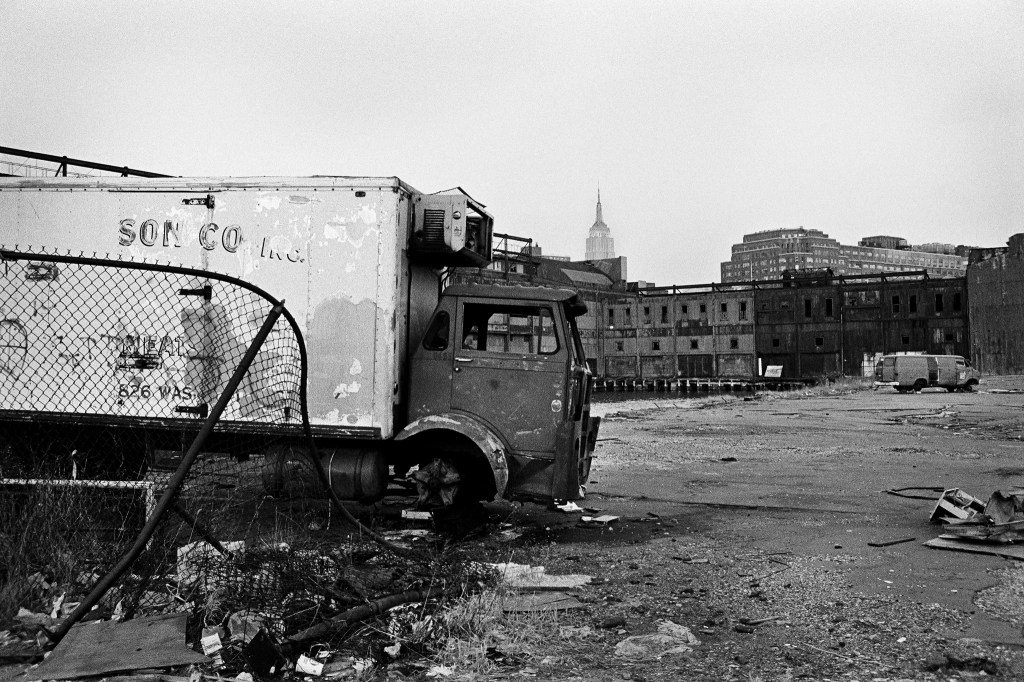
Even if you never experienced it yourself, we have all heard the lore of 1970s New York City. It was a raw, dangerous, and unpolished city that was simultaneously teetering on the edge of bankruptcy and providing fertile ground for artists and many other forms of expression (some suspect and some not).
Jane Jacobs is famous for saying that “new ideas often require old buildings.” And the New York of this era was exactly that kind of city. Artist Donald Judd (a favorite of mine) bought his five-storey cast-iron building in Soho (on Spring Street) around this time (1968). He paid just under $70,000.
So it is perhaps easy to romanticize this more accessible (and equitable?) version of New York. But there were many other things going on the city at this time beyond minimalist art in Soho loft buildings.
This photo essay by Joseph Rodriguez does a great job at telling some of those other stories in a decidedly humanistic way. Joseph was a New York cab driver from 1977 to 1985. And his final years, he had taken up photography and had started documenting the people and the city through his windows.
His incredible photos are also available in this book called, TAXI: Journey Through My Windows 1977-1987.
Photo: Joseph Rodriguez
-
Toronto is the densest urban area in North America
Some of you are probably shocked by this headline. But it is true. Here’s the chart to prove it:

Toronto is number one. Los Angeles is number two. And New York sits just behind Winnipeg and Calgary. Huh?
The reason this is likely surprising to you is that when most people think of urban density they think of the urban core. And you are correct in thinking that the urban core of New York City is denser than the urban core of Winnipeg.
The difference here is that we are talking about “urban area” (or “population centre” in Canada). This is the continuously built up area around each major city. Think of it as the lit up area that you might see on a nighttime aerial photo.
Urban areas don’t care about municipal or other jurisdictional boundaries. And they don’t factor rural areas. Urban areas are a measure of continuous urbanization.
So even if you have the densest downtown on the planet, if you have a sprawling low-density urban area surrounding it, you can still end up with a relatively low overall population density. And this is precisely what is happening here with New York.
This is also why there’s only so much that you can glean from a blended average like this. Because you can have very different urban forms and very different mobility splits (think New York City vs. Winnipeg), and still end up with somewhat comparable averages.
Chart: New Geography
-
Mid-year consumer trends update
The New Consumer has just published its 2022 mid-year update. Some of you might remember that I wrote about their inaugural consumer trends report at the end of last year.
It’s interesting, but not surprising, to see a lot of things returning to their means. Spending on home furnishings, for example, is coming down, whereas luggage and bag sales are up. Home fitness has also come way down as people return to gyms. It’s time to leave home.


At the same time, it has become a lot more expensive to leave home, assuming you need to drive. Motor fuel increased 49% year-over-year as of May 2022. It’s the CPI category with the biggest change. But even with this, transit ridership has yet to fully rebound. NYC is sitting at around 60%.


To download a free copy of the full presentation, click here.
-
Why traffic fatalities are lower in Canada than in the US

We’ve talked about this before. If you live in New York City, you’re probably about a third as likely to die from a transportation-related accident as compared to the average American. And if you live in Paris, you’re probably about a third as likely to die from a transportation-related accident as compared to the average New Yorker.
These stats might feel a bit intuitive to you. Both New York and Paris are big and dense metros with high public transit ridership. And that usually translates into less car accidents. As for the divide between these two cities, Paris is in Europe. It’s old. Most of its streets were built before the car had been invented. And all of these things are generally good for pedestrians. Makes sense.
But David Zipper asked a good question today: So what’s going on with Canada? Canada is not in Europe (though some might argue that it sits culturally somewhere between the US and Europe). It’s not that old. And it generally has a car-oriented landscape just like the US. So why is it that in 2020, Americans were 2.5x more likely than Canadians to die in a car crash? The trend lines are also diverging between these two countries. Between 2010 to 2020, US road deaths increased 19% on a per capita basis, whereas Canada’s rate declined by about the same rate, according to David.
Ultimately, we are probably going to need Malcolm Gladwell to write a book about this so that we can really figure out what’s going on. But in the interim, David does propose a few possible explanations ranging from Canadians buying slightly smaller vehicles to Canadians being slightly more law-abiding than Americans and so less likely to run people over. But one of the most persuasive explanations for me is that maybe our urban landscapes aren’t actually the same.
More than a third of Canadians live in our three biggest cities: Toronto, Montreal, and Vancouver. And this number would be even higher if you looked at the full urban catchment areas of each. Either way, this is a significantly higher concentration than in the US, where about 13% of Americans live in the metro areas of New York City, Los Angeles, and Chicago.
Part of this difference is because the US has almost 9x more people and has many more big cities to choose from. But it doesn’t change the fact that, despite our reputed love for things like forests and beavers, Canadians are actually quite urban. And as we have discovered, that’s a good thing for pedestrians.
Photo by Jamshed Khedri on Unsplash
-
We love you


I was in New York today for meetings. Our office is next to the 9/11 memorial pools and so I walked over with a colleague during lunch. It was my first time visiting the completed memorials and it was hard not to feel things as I stood there watching the water fall into the mysterious squares in the middle of each pool. But even more impactful were the flowers that people have inserted into the various names, and the messages that they have left for their loved ones.
-
Turns out big cities are pretty safe
Conventional wisdom suggests that cities are pretty dangerous. There’s crime, the chance of getting killed, and there are lots of cars, some of which have a tendency to fly off the road and do bad things on occasion. And in some ways, this is true. Here is a chart from Bloomberg showing homicides per 100k people:

What this tells us is that if you live in a large metropolitan area in the US, you have a higher chance of being killed by someone else than if you were to live in a rural non-metro area. However, based on this data, one of the safest places you could actually live is in New York City. This might surprise some of you.
On top of this, if you layer on the chance of dying from a transportation-related accident, the absolute safest place you could live in America is in fact New York City:

This is because New Yorkers are only about a third as likely to die from a transportation-related accident as compared to the average American. Oddly enough, when you have a city where the vast majority of residents don’t drive their own car around, people seem to die a lot less from traffic accidents.
But how does this compare to other cities around the world? Let’s take Paris, which is another big and important global city. According to Bloomberg, the risk that Parisians face from possible killing and transportation accidents is about one-third that of New Yorkers. So it’s even safer over there.
Turns out that some big cities aren’t as dangerous as people might think. For the full Bloomberg article, click here.


